Showing posts with label 10 Year Treasury. Show all posts

Sunday, October 29, 2017

Don"t Fight the Fed

Alexander Hamilton, George Washington’s Treasury Secretary, in his first “Report on the Public Credit” in 1790,


put forth the concepts of “assumption” and “redemption.”


He argued that the federal government should assume the Revolutionary War debt


and pay those debts at “face value” in full to the bearers of such debt on demand.


In order to redeem the $75 million of bonds, Hamilton promoted the creation of a “sinking fund”


that would pay off five percent of the bonds annually.


Revenue to pay off the principle and interest should come from tariffs on imported goods and an excise tax on whiskey.


Bondholders would be due 4% annual interest payments.


Today, the total value of US Treasury Bills, Notes, and Bonds is above $20 trillion


and rising. US Treasuries are the global standard of debt, as is the US Dollar the standard for currency.


A bond investor today would enthusiastically buy 4% US Treasuries, if he could buy them at “par value” or $1000 per bond.


Today’s10 Year Treasury Note Yield is 2.309%.


In today’s bond market, a 4% bond is worth $1150, according to the Hewlett-Packard 12C calculator, a $150 “premium.”


However, if a bond investor believes that market interest rates will rise over time, the price of that 4% bond should


fall until the market rate, now 2.309% matched or rose above the bond’s “coupon rate” of 4%.


The decision to buy, sell or hold US Treasuries takes into account the “interest rate risk” just described.


US Treasuries today carry the lowest “default risk” among global government bonds, so investors need only


consider interest rate risk. Bond prices determine not only what a bond investor will receive twice per year


in interest payments, but also what a borrower pays monthly to finance a home purchase or start a business.


That is where the rubber meets the road for the Fed’s influence on economic expansion or contraction.


The driver of the vehicle to which those wheels are attached is the Federal Open Market Committee (FOMC).


It directs the market operations of the Federal Reserve System (The Fed).  


Fed action affects the price, and thus the yield, of US Treasuries by buying and selling in the open market.


When the Fed buys, it decreases the supply, increases prices, and lowers the yield. Selling increases supply, decreases prices, and raises the yield.


The Fed also sets theFed Funds Rate, the interest rate at which banks may lend money to each other


on an overnight basis.The rate at which banks can borrow also influences the rate at which they will lend to their customers


via home mortgage and business loans. The higher the Fed Funds Rate, the higher the interest rates on loans.


Most often, the effective Federal Funds Rate is lower than the yield on US Treasuries,but not always.


If the Fed wants to slow the economy, it will raise the Fed Funds Rate and make it more expensive for banks to borrow.


Paul Volker’s Fed, in June of 1981, raised the Fed Funds Rate to a peak of 20% in order to squelch the rampant inflation of the 1970’s. He succeeded. His Fed’s action was accompanied by the 1980-82 recession and its 10+% unemployment rate.


If the Fed wants to encourage lending by banks, it can lower the Fed Funds rate.


If banks can borrow at a lower rate, their loans to homebuyers become more profitable, and they will tend to lend more,


but not always. During the 1990-91 recession, which followed theSavings and Loan Crisis of the late 1980’s


and the invasion of Kuwait by Iraq, Alan Greenspan’s Fed dropped the Fed Funds Rate from 9.75% in December of 1988 to 3.0% in September of 1992. Greenspan stated his frustration with the stubborn 7+% unemployment rate and banks’ unwillingness to lend by saying, “You can’t push on a string.”


Paul Volker’s Fed proved that rising interest rates will eventually slow the economy and stem inflation,


but his successors—Alan Greenspan, Ben Bernanke and Janet Yellen—did not meet with equivalent success by lowering rates to stimulate the economy and reduce unemployment.


It turns out that bankers will not lend unless they see a potential for profit.


Loans to poor credit risks can end up as losses on the balance sheet and unemployment for loan officers.


Bankers want to make money, but they also want to keep their jobs.


Confronted with what would later be known as “The Great Recession,” Ben Bernanke’s Fed dropped


the Fed Funds rate from 5.25% in June of 2006 to 0.25% in December of 2008.


Even though banks were able to borrow at an effective 0% interest rate, unemployment continued to rise.


The unemployment rate was 10.0% in October of 2009 and did not drop below 9% until October of 2011.


The Organization for Economic Co-operation and Development considers full employment to be an unemployment rate of between 4% and 6.4%.


For Ben Bernanke, author of Essays on The Great Depression, the worst economic event in US history was not the inflation of the 1970’s, but the deflation of the 1930’s. When, in 2008, a zero-percent Fed Funds rate had little effect on the unemployment rate,


Bernanke’s Fed began buying bank debt, mortgage-backed securities, and treasury notes.


The intent of this “quantitative easing” was to flood the banks with liquidity in order to bring down long-term interest rates.


By the end of his second term, the Federal Reserve had transferred $4.5 trillion to the US Treasury from bank balance sheets. When Bernanke’s second term as Fed Chair ended in 2014, unemployment was still at an unacceptable rate 6.7%.


Janet Yellen, the first female Chair of the Federal Reserve, defended quantitative easing,


but vowed to revert to traditional monetary policywhen economic growth and unemployment returned an acceptable l


evel. Her Fed targets a 2% growth rate forGross Domestic Product (GDP) and is now close to achieving that goal.


The US economy expanded at an annualized rate of 3.1% in the second fiscal quarter of 2017.


Yellen’s Fed has increased the Fed Funds rate four times and projects continued gradual rate increases.


On Tuesday, September 27th,Ms. Yellen told the National Association for Business Economics, “It would be imprudent to keep monetary policy on hold until inflation is back to 2 percent.”


But she also admitted that the Fed’s understanding of inflation is “imperfect” and that the apparent lack of inflation in the current full-employment economy is “a mystery.”


She said, “We recognize that something more persistent may be responsible for the current undershooting.”


Thursday, August 17, 2017

European Junk: "The Good-Looking Ones Are Always Bad News"

Authored by Kevin Muir via The Macro Tourist blog,


Yesterday, a few different readers emailed to ask my opinion about the European Junk Bond versus US Treasury yield chart that Tiho Brkan from The Atlas Investor Blog recently published.


http://www.thefringenews.com/wp-content/uploads/2017/08/themacrotourist.comEuroJunkAug1617-7a30d4031df9bbf6623d7f91720fc6d5b81d376a.png


Well, I have to give Tiho credit, his chart certainly stirred up a lot of primal urgings from investors eager to short European junk bonds. Although I am a huge Kodiak Grizzly of a bond bear, I think there are better ways to express this view than shorting European junk. Let me tell you why.


I couldn’t replicate Tiho’s chart exactly as I don’t pay for the Bank of America / Merrill Lynch bond indexes, but I found a Barclays/Bloomberg index that is close enough. So here is my version.


http://www.thefringenews.com/wp-content/uploads/2017/08/themacrotourist.comTwoChartsAug1617-1b536be501eeec0bd924ddb4e5e3086d66485794.png


I also couldn’t determine Tiho’s term for the US Treasury yield in his chart, but it sure looks like the 10 year yield, so I am going with that.


So when comparing these two series, let’s start with the obvious. The current on-the-run US 10 year treasury note has a modified duration of a little less than 9 years. This compares to the European Junk bond index that comes in at under 4 years.


The sensitivity to changes in interest rates will therefore be much higher in the US treasury notes. Comparing these two assets with such different term lengths is a little misleading.


But you might say, “I don’t care - look at past yield levels for European junk! I can afford to have less duration because the credit part will skate me onside.”


And yes, if credit spreads blow out, then shorting junk is much better than sovereigns.


What do I mean by that? When an investor buys junk bonds, they are typically rewarded with an extra yield to compensate for the increased risk. The amount of this extra yield is called the option-adjust-spread, and we can chart it.


http://www.thefringenews.com/wp-content/uploads/2017/08/themacrotourist.comOASAug1617-91923a83660e3ebb14cc28649440f0706cbff81d.png


Currently, European junk bonds only offer 2.67% over the equivalent sovereign yield. Wait! How can that be? The US year yield is 2.22% and the two series have recently converged, so that doesn’t seem to make any sense. But you have to remember that 4 year German bunds are yielding negative 42 basis points, so that means European junk bonds are trading at roughly 2.25% (267 bps more than sovereigns).


As you can see from the OAS chart, these junk bonds have often yielded considerably more than sovereigns. During the Great Financial Crisis they spiked to 20% more, and even during the 2011 European credit crisis, they got as high as 10% over.


So yeah, I understand the attraction to shorting European junk. It’s easy to look dreamily at this chart and imagine spreads doubling to 5% without batting an eye.


But there are a couple of problems with this trade.


There are no easily traded derivatives on European junk bonds. So unless your friendly neighborhood GS salesperson lets you buy CDS protection on this index, it is kind of a non-starter. Yeah, you might find some ETF and leverage it up a bit, but with a 4 year duration, your returns are going to be mediocre, even if you nail the timing perfectly.


Yet even if I worked in a big fixed income shop and could execute this trade seamlessly, I don’t think I would bother with junk, and would instead focus on the sovereigns.


Getting all hot and bothered about the juiciness of European junk is doing nothing more than repeating the US mistake made by all the hedge funds over the past few years. Remember Carl Icahn’s “Danger Ahead” video? It has now been two years since good ‘ole Uncle Carl blessed you with his advice to put on all the same hedges that worked so fabulously in 2008. Go ahead and watch the video again. See how he recommends shorting credit? And no wonder. This trade worked so well in 2008, it is tough to not look at the tight spreads and think they offer a great asymmetrical risk reward profile (to use the buzzwords from all the hedge fund gurus). And I don’t mean to pick on Carl, practically all these mavens have been positioned the same way. Everyone hedges for the last crisis - even legendary hedge fund managers.


For the last two years, these hedges in the US markets have been a disaster, and I suspect they are about to experience the same sort of pain in Europe.


Don’t mistake my lack of bearishness for European junk bonds as a belief they offer good value. Nope. Not a chance. I wouldn’t buy an asset that offers so little upside, but with the potential for so much downside, in a million years.


Yet I do think shorting sovereigns is a much better trade than betting against European junk. What is going to cause European OAS spreads to blow out? Economic weakness. And what will be the result of more economic weakness? Yup - you got it - more quantitative easing. The ECB is already running out of sovereigns to buy, so what will happen the next time? They will venture even further out the risk curve.


I believe European junk bond yields are headed higher, but only on the back of higher sovereign yields. So if the only way junk bonds are going down is if sovereigns go down, why even bother contemplating shorting junk?


Why not just short the actual security that will cause the other security to decline?


I guess I could sum it up by explaining that I am negative on European bonds, but neutral on option-adjusted-credit spreads.


Governments are going to keep spending and printing until we finally get the nominal growth they so desperately desire (note how I specified nominal growth - they will find it more difficult to generate real growth). If you accept this argument, then it makes way more sense to short sovereigns than junk.


I have argued that the European cycle is mirroring the US experience since the Great Financial Crisis, only a few years behind. If that is the case, then there will be plenty of time to short European junk bonds in the coming years.


In the meantime, I am focusing on shorting the government bonds that are the true bubble. It is funny how so many look at junk and salivate over the possibility of shorting a security yielding 2.25%, yet quietly ignore government bonds yielding negative real rates of return with Central Banks intent on creating the very inflation that bond investors fear the most.


I will leave you with these wise words from the Urban Camel:


http://www.thefringenews.com/wp-content/uploads/2017/08/themacrotourist.comUrbanCamelAug1617-835700afdea36a921b7eced0df018db12fc63310.png


Remember, those good looking trades that everyone wants to put on are usually trouble. Instead, look for the more reliable, underappreciated one that is often staring right at you.

Tuesday, February 28, 2017

Debunking The Big Lie

Authored by Keith Weiner via Acting-Man.com,


Debunking a Lie


Don Watkins of the Ayn Rand Institute wrote an article, The Myth of Banking Deregulation, to debunk a lie. The lie is that bank regulation is good. That it helped stabilize the economy in the 1930’s. And that deregulation at the end of the century destabilized the economy and caused the crisis of 2008.
As of early 2015, Dodd-Frank had imposed altogether 27,670 new restrictions, more than all other laws passed under Obama combined (that is really saying something, considering the regulatory frenzy let loose by his administration. Note: the law may have “only” 2,300 pages, but more than 10 different regulatory agencies have been producing administrative laws for six years in a row to put it into practice – and they are not finished yet. Don’t you feel safer already?


If deregulation is the problem, then re-regulation is the solution. So, in the wake of the crisis, Congress enacted a 2,300-page monstrosity of regulation known as Dodd-Frank.


Watkins does a good job describing government regulation of finance, in particular addressing the savings and loan industry. He gives an example where people commonly assume that Congress reduced regulation, the Graham-Leach-Bliley Act of 1999.


The headline is that this law reduced regulation, and allowed banks to be in the securities business. However, the truth is that it mixed in a dollop of increased regulation.


The economic cost of Dodd-Frank (one guess as to who is going to end up paying for this…). Note: this is not cumulative – the cumulative tally so far is a cost of $36 billion (about $310 per household!); it has so far taken 74.8 million paperwork man hours to create this monster. You will be happy to learn that the law not only makes us perfectly safe, but introduces racial and gender quotas as well. The number of final rules exceeds those generated by Sarbanes-Oxley by a factor of 30 – so far.


Imagined Stability


I commend him for tackling regulation and the moral hazard of deposit insurance, and calling for real deregulation. However, I must criticize his article. He says:


“By far the most important factor in postwar stability was not New Deal financial regulations, however, but the strength of the overall economy from the late 1940s into the 1960s, a period when interest rates were relatively stable, recessions were mild, and growth and employment were high.”


Here is a graph of the interest rate on the benchmark 10-year Treasury bond from 1946 through 1969.


10 year treasury note yield, 1946 to 1969 – stability looks different – click to enlarge.


Even during the initial smooth period through 1953, the rate of interest climbed 27 percent. By this point, the instability had only just begun. If “into the 1960’s” refers to the last plateau in 1965 before the rate destabilizes further, then the rate was about 4.2%.


This is about double what it had been just 15 years earlier. And at the end of the 1960’s, the interest rate had hit 7.7%, or about 3.5 times where it started.


Watkins gives us a hint that he means that the interest rate destabilized after President Nixon severed the last link to gold in 1971. He says, “…[the] U.S. government cut its remaining ties to gold in 1971. The volatile inflation and interest rates that followed…”


So let’s look at the interest rate for the full period of rising rates, up to the peak hit in 1981.


10 year treasury note yield, 1946 – 1981 (it seems fair to assume that the market already anticipated the coming gold exchange standard default in the 50s and 60s – deficit spending and money and credit supply expansion had rendered it untenable) – click to enlarge.


We can see that it does indeed get worse after Nixon’s ill-conceived act. However, it is just a continuation of the same trend that had been underway since 1946. It’s a combination of rising interest rates with rising interest rate volatility. Both phenomena inflict damage on the economy.


The “Good Monetary Policy” Myth


Watkins claims, “Part of the credit for this [interest rate] stability goes to monetary policy.” He thus contributes — I assume unintentionally — to the myth of monetary central planning.


Myth: central planners were successful for decades, delivering a strong and stable economy. They can do it again. So if our present planners are not getting it right, then we just have to hire the right people.


If our civilization is to have a future, then this myth must come down! In recent decades, most people believed that Fed Chairmen Greenspan and Bernanke administered a strong and stable economy. They called it “the great moderation”. Of course, this view ended with a crash in 2008, along with the markets.


Watkins reinforces the myth in his subsequent discussion of regulation and the savings and loan crisis. He says that New Deal regulation, “collapsed under the pressure of bad monetary policy from the Federal Reserve…” The very phrase “bad monetary policy” implies that there is such a thing as good monetary policy.


There is no such thing as good monetary policy. There is no such thing as effective monetary policy, or monetary policy that does no harm. There are only the times when most people see no overt symptoms, when they don’t realize the damage being done.


And there are times of pain, when reality takes hold again. Since monetary policy can have lags of decades, most people do not know how to ascribe the blame properly.


It is actually not necessary to visit hermits atop tall mountains to find this out… the belief in a scientific monetary policy is no different than any other belief in the efficacy of central planning. It is tantamount to believing in a literal impossibility.


Cartoon by Bob Rich


The Quality of Economic Growth


One economic indicator that may make the postwar economy appear strong is Gross Domestic Product. GDP quadrupled from 1946 to 1969. Unfortunately, GDP is not a measure of the quality of economic activity.


A fever is not a measure of the quality your health, but merely the quantity of calories your sick body is burning. Similarly, GDP is not a measure of the quality of the economy, only the quantity of dollars turned over.


GDP should be understood to be a measure combining destruction plus production. Government waste is added to private activity. And of course, not all private activity is productive.


GDP does not distinguish between the squandering of precious capital during false booms and the genuine productive enterprise. It also includes many other wasteful activities, such as regulatory compliance. A rapidly-rising GDP does not necessarily mean the economy is healthy or stable. In fact, it was not in the postwar period.


What is known as gross domestic product isn’t really “gross” at all, since it ignores the bulk of the production structure.  It does however contain activities that don’t generate any wealth, and partly even destroy it. We have discussed a number of the  problems of GDP in past missives (see e.g. “The Mirage of Economic Growth”, which inter alia looks at Oskar Morgenstern’s objections to the measure).


Cartoon by Bob Rich


One subtle but deadly problem was described by economist Robert Triffin in 1959. Rational domestic fiscal policy was in conflict with international demand for the US dollar, used as their monetary reserve asset.


The US was obliged — and happy to oblige — to run greater and greater budget deficits. Triffin knew that a crisis was inevitable. It came under the Nixon administration.


The Self-Immolating Gold Standard Myth


I want to pick on a phrase that feeds — again I assume inadvertently — into the anti free market, anti gold standard myth. Watkins uses the passive voice to say that the classical gold standard “had fallen apart during World War I…”.


Most people today, if you press them, will tell you that that a free market contains the seeds of its own destruction. “Falling apart” is precisely what they fear will happen when a free market is unregulated, uncontrolled, and not centrally planned. That’s why they want regulators and central planners.


It needs to be said again and again. No. The classical gold standard did not fall apart!


It was killed by government. In 1913, the Federal Reserve was created. That altered the gold standard the way drinking a bottle of wine alters consciousness. If a drunken worker drives a bulldozer through a house, no one says that “the building had fallen apart.”


Ludwig von Mises noted: “[T]he gold standard is not a game, but a social institution. Its working does not depend on the preparedness of any people to observe some arbitrary rules. It is controlled by the operation of inexorable economic law.” and furthermore: “What the expansionists call the defects of the gold standard are indeed its very eminence and usefulness. It checks large-scale inflationary ventures on the part of governments. The gold standard did not fail. The governments were eager to destroy it, because they were committed to the fallacies that credit expansion is an appropriate means of lowering the rate of interest and of “improving” the balance of trade.”


Photo via mises.org


In addition to the Fed in the U.S., the governments of Britain and Germany and other belligerent powers suspended the gold convertibility of their currencies in 1914. Many people blithely say that the gold standard fell apart. I say, again, it did not.


After the war, the victorious countries claimed they were returning to the gold standard, but instead they created a pseudo gold standard. As everyone knows now, it didn’t work. At least one economist, Heinrich Rittershausen, knew in advance. He warned that this dysfunctional monetary system would cause great unemployment.


Rigorous Economic Logic and a Rational Assessment of History


We, the advocates of liberty, will only succeed if we are rigorous. We must know the facts we present in our writings, and our theories must take these facts in account. Otherwise, we may get a hosanna from the choir, but we will not persuade the mainstream. False facts will not win people who have studied the field.


Objectivism is the philosophy which reveres facts and integrates facts into theories which explain reality. The fact is that since at least 1913, we have not had capitalism (and there was not a free market in banking in 1912, or even in 1812). Instead, since 1913, we have had a central bank.


The Fed has been taking for itself more and more power over the decades. Our central bank administers the interest rate. Interest, being the price of money, affects every other price and every economic decision in the economy. Distorting interest can have terrible consequences, which can come decades later.


More importantly than deregulating — and that is very important — we need to end central planning. The collapse of the Soviet Union proved that even corn production cannot be centrally planned. Corn is a simple product. You put seeds in fertile ground, wait for sun and rain to do their thing, and then harvest it. Yet the Soviets starved.


We are smart enough to know that we can’t centrally plan corn. However, we think we can centrally plan the most complex of man’s products: credit. We must talk about this in plain language. The gold standard of a freer era did not just collapse, without cause.


Power-lusting, war-mongering governments killed it to do away with the discipline it imposed. Then, free from this constraint, they marched men off to worldwide wars twice in 30 years (no, I am not saying that the US had the same moral stature as the European belligerents).


Towards the of the second world war, the US forced the allied powers to agree to a new monetary order at Bretton Woods. The architect of this vicious scheme was Harry Dexter White, a communist and tool of the Soviet Union. Ever since then, the worldwide monetary system has been dominated by the Fed.


And the US has been abusing what Valéry Giscard d’Estaing, the French Minister of Finance in the 1960’s, called the “exorbitant privilege”. The Fed’s central planning could not possibly have delivered stability, as any rational theory tells us. The Fed’s central planning did not in fact deliver stability, as any rational reading of history shows us.

Thursday, January 26, 2017

What If Hillary Had Won?

Via ConvergEx"s Nicholas Colas,


Counterfactual analysis is a useful way to consider the world we actually inhabit.  To that end, today we ask “What if Hillary Clinton had won the Presidency on November 8th?”


Where would financial markets be trading today, and how does that differ from the reality we see on the screen?  The S&P 500 is up 6.6% since Election Day (11/8/16).  Our best guess is that US stocks would have rallied 2% after a Clinton win as the uncertainty of the election lifted, so the differential of 4-5% is the actual “Trump rally”. The real differences come when you look at interest rates.  The 10 year yield on Election Day was 1.86%.  Now, it is 2.47%.  Had Secretary Clinton won, it might not have even risen to 2.0% given that it was rarely over that level in pre-election 2016.  


The key lesson from this exercise in “What if...”: US stocks don’t seem to fully reflect the power of the “Reflation trade” priced into Treasuries. The push-pull of that dynamic (better earnings vs. higher rates) should drive volatility higher in the weeks to come.


What if the South had won the US Civil War?  That is the subject of an essay by Sir Winston Churchill, published in 1931 as part of a collection titled “If It Had Happened Otherwise”.  By his estimation, the British Empire would have ended up acting as a go-between for a fractured “Un-United States” and eventually all three would have merged into an “English Speaking Association”.  The power of that alliance would have prevented World War I by driving a wedge between the combatants of continental Europe and the world today would be very, very different. For Churchill fans, here is a good description of how he got the idea while on a trip to the US in 1929.


Counterfactual history – imagining alternative outcomes to important events – is part analysis and part fantasy.  At its best, it can illuminate how watershed moments shift the sands in the hourglass.  Some events are clear demarcation lines in world history, and the talented historian (Churchill being first among equals in that camp) can do much with this contrivance to illuminate just why they mattered in the first place.


Today we will use counterfactual history in its smallest form and simply ask “Where would capital market prices be today if Secretary Hillary Clinton had won the 2016 US President election?”  One of our senior options traders asked me that question this morning, and I thought it was a neat way to parse out just how much (and where) the “Trump rally” has changed investor perceptions.  It has been 78 days Americans went to the polls, and since then financial asset prices have changed in the following ways:


  • The Dow Jones Industrial Average is up 8.6%, from 18,333 (close on 11/8/17) to now.

  • The S&P 500 is 6.6% higher, closing at 2140 on Election Day.

  • The 10 Year Treasury yield has moved from 1.86% to 2.47%, and the price return on +20 year US sovereign debt is negative 9.8% since the US election.

  • The CBOE VIX Index is substantially lower, closing today at 11.1 after ending the day on November 8th at 18.7.

  • The best performing S&P Large Cap sector YTD is Materials, up 5.7%. The best performing sector over the last 3 months (the round number that comfortably brackets pre- and post-election action) are the Financials, up 18.2%.  Materials and Industrials are roughly tied for second, up 11.3/11.6%.

  • US mid caps and small caps have comfortably outperformed domestic large caps, with 3 month returns of 10.5% and 13.1% respectively versus 5.6%.

  • Correlations between asset classes and sectors have declined dramatically and remained lower this month.

  • The US dollar has strengthened modestly against the euro since Election Day ($1.10 to $1.07), remained constant against the British pound ($1.25) and strengthened notably against the Japanese yen (103 to 114).

  • Earnings expectations from Wall Street analysts have not fundamentally shifted since the Election, with bottom-up estimates for the S&P 500 at $133/share.

So how would things be different if Secretary Clinton had won?  A few thoughts:


The S&P 500 would likely have rallied, but not as much as it has. The logic here is simple: the election was sufficiently contentious that US equities were likely to bounce higher once a winner was announced and the loser conceded.  That closing VIX on Election Day at 18, high for post-Financial Crisis US equity markets, tells you that.


Moreover, a Clinton win would have preserved the gridlock-prone status quo that had existed in Washington for the last 6 years, during which time US equities generally did quite well.  Average S&P 500 returns during that time were 12.8%.


Our best guess is that US stocks might be 2 percent higher if Hillary Clinton had prevailed on Election Day.  No real science there – just a quick poll among some of the senior people on our desk.  There wasn’t much of a range in their responses; everyone said 2 percent.


Everyone I asked also agreed that long term yields would be lower. The US 10 Year Treasury yield rarely broke 2% during 2016 until the Election was over, and since Secretary Clinton was the odds-on favorite for the entire campaign season it is reasonable to think it would not have done so after her win.


The fact that yields now trade between 2.3-2.5% is therefore purely a function of expectations for higher inflation and/or greater debt issuance due to President Trump’s proposed policies of lower taxes and increased infrastructure spending.  Loosely known as the Trump “Reflation trade”, this is one area where a Clinton victory would have generated a very different outcome.  Even if you believe a Democratic victory would have sparked a relief rally equivalent to the one we actually got, I doubt you would have pegged the 10 year to yield 2.5% in January 2017.


Sector correlations and performance would likely have been quite different as well. Materials and Industrials wouldn’t be leadership groups; most likely Technology (which has underperformed over the last 3 months by 100 basis points) would have been the workhorse sector as it has been for much of the last 6 years.  And forget Financials…  Those would have been held back by a flatter yield curve.


As we have noted in prior briefings, correlations have fallen since Election Day as well.  Average sector correlations now run 50-60%, versus the 70-90% of the last 6 years.  Chalk that up to the direct and indirect effects of a Trump win, with markets discounting a new set of winners in a Trump administration versus a more status quo environment under a President Hillary Clinton.


The upshot to this mini-counterfactual is the dichotomy between equity and bond market performance. 


Fixed income markets are essentially in a new world; US stocks, by comparison, are in only a slightly better position. 


The “Trump rally” has only been worth 4-5% when compared to our “What if” Clinton scenario. 


Realistically, it should either be more (if bond markets are right about a breakout in inflation/corporate pricing power) or less (with higher rates pressuring equity valuations in the absence of greater earnings power).


And so we come to the conclusion that equity markets will show more volatility in the weeks to come since this philosophical tug of war has only just begun.

Monday, January 2, 2017

A Biased 2017 Forecast, Part 1

Submitted by Jim Quinn via The Burning Platform blog,


“The idea that the future is unpredictable is undermined every day by the ease with which the past is explained.” – Daniel Kahneman, Thinking, Fast and Slow


A couple weeks ago I was lucky enough to see a live one hour interview with Michael Lewis at the Annenberg Center about his new book The Undoing Project. Everyone attending the lecture received a complimentary copy of the book. Being a huge fan of Lewis after reading Liar’s Poker, Boomerang, The Big Short, Flash Boys, and Moneyball, I was interested to hear about his new project. This was a completely new direction from his financial crisis books. I wasn’t sure whether it would keep my interest, but the story of Daniel Kahneman and Amos Tversky and their research into the psychology of judgement and decision making, creating a cognitive basis for common human errors that arise from heuristics and biases, was an eye opener.


In psychology, heuristics are simple, efficient rules which people often use to form judgments and make decisions. They are mental shortcuts that usually involve focusing on one aspect of a complex problem and ignoring others. These rules work well under most circumstances, but they can lead to systematic deviations from logic, probability or rational choice theory. The resulting errors are called “cognitive biases” and many different types have been documented.


Heuristics usually govern automatic, intuitive judgments but can also be used as deliberate mental strategies when working from limited information. Kahneman and Tversky created the heuristics and biases research program, which studies how people make real-world judgments and the conditions under which those judgments are unreliable. Their research challenged the idea that human beings are rational actors, but provided a theory of information processing to explain how people make estimates or choices. Kahneman won a Nobel Prize in economics for his work in behavioral economics.


To put their research into terms the common person can understand, human decision making is extremely flawed due to our biases, feelings, irrational thought processes and beliefs in falsehoods. It’s over-confidence in our decision making ability that causes us the most problems. For the average person this can result in financial hardship, frustration or a premature death.


When high level government officials, bankers or corporate executives make flawed decisions due to their biases, it can mean war, financial disasters, depressions, or disastrous legislation like Obamacare. Hubris, egotism and faulty reasoning, as noted by Mark Twain one hundred and fifty years ago, can kill you and in some cases lead to war and unthinkable levels of death and destruction.


“It’s not what you don’t know that kills you, it’s what you know for sure that ain’t true.”  – Mark Twain


In the seven weeks since the election of Donald Trump as our next president, I’ve witnessed the largest case of hindsight bias in world history. Hindsight bias, also known as the knew-it-all-along effect or creeping determinism, is the inclination, after an event has occurred, to see the event as having been predictable, despite there having been little or no objective basis for predicting it.


On November 7 the “expert” pollsters like Nate Silver; every corporate mainstream media network, newspaper, and website; along with elitist economists, professors, Hollywood movie stars, Wall Street bankers, and billionaire oligarchs; were 100% sure Hillary Clinton was going to be elected president. Only the deplorables thought otherwise – and they spoke loudly. Putin had nothing to do with the result.


These very same “experts” and “deep thinkers” now act as if Trump’s election was foreseeable, predictable and the likely outcome. They bloviate about how and why he won as if they knew it was going to happen. When 99% of all establishment “experts” were sure Trump was going to be crushed in a Clinton landslide, why should anyone listen to a word they say?


The same people who didn’t see even the faintest possibility of a Trump victory now expect the ignorant masses to believe their analysis of what will happen next. I would like to attribute their obtuseness to cognitive biases, but I believe it is more insidious. The Deep State propaganda machine is hard at work spreading falsehoods.


“A reliable way to make people believe in falsehoods is frequent repetition, because familiarity is not easily distinguished from truth. Authoritarian institutions and marketers have always known this fact.” – Daniel Kahneman, Thinking, Fast and Slow


The onslaught of 2017 predictions from a myriad of Wall Street “experts” talking their book, highly educated economists demonstrating their lack of prescience, mainstream media pundits peddling propaganda and cheerleaders cheering for their home teams, has already begun. I haven’t written an annual forecast article in a few years because I was tired of being wrong. Since I have no newsletters or books to sell, no investments to peddle, and no agenda to push, an annual forecast will just be my best guess at what will happen in 2017.


The two biases most likely to color my analysis are confirmation bias (The tendency to focus on information in a way that confirms my preconceptions) and pessimism bias (The tendency to overestimate the likelihood of negative things happening). My family and friends think I’m a pessimist. I think I’m a realist. I try to use data to back-up my conclusions, but as George Dvorsky points out, our brains often lead us astray.


“The human brain is capable of 1016 processes per second, which makes it far more powerful than any computer currently in existence. But that doesn’t mean our brains don’t have major limitations. The lowly calculator can do math thousands of times better than we can, and our memories are often less than useless — plus, we’re subject to cognitive biases, those annoying glitches in our thinking that cause us to make questionable decisions and reach erroneous conclusions.” – George Dvorsky


My predictions will be framed by my belief we are midway through a Fourth Turning era of crisis. The three catalysts framing this Fourth Turning are debt, civic decay, and global disorder. No amount of normalcy bias, optimism bias, over-confidence, or desire for the status quo, will take precedence over the uncontrollable mechanisms propelling this Fourth Turning.


We are in the midst of a once in a lifetime crisis and there is only one thing more frightening than not knowing what is coming next, and that is living in a world run by “experts” who think they know exactly what is going to happen next. These are the same “experts” who didn’t see the 2005 housing bubble, the 2008 financial collapse, the EU implosion, Brexit, or the Trump presidency.


“It’s frightening to think that you might not know something, but more frightening to think that, by and large, the world is run by people who have faith that they know exactly what is going on.” –  Amos Tversky


I try to understand the world around me every day, but the hyper-complexity, noise, Deep State propaganda, and volume of data points is overwhelming to our easily distracted brains. I have constructed a story in my mind of how things will develop over the next five to ten years based upon the generational theory put forth by Strauss & Howe in their book The Fourth Turning. It is not a story with a happy ending.


I don’t have high confidence that I understand how it will play out and what specific events will propel history in the making. I can admit my deficiencies, while people in power with the ability to blow up the world overestimate their understanding of the world and ignore the role of chance in events.


“We are prone to overestimate how much we understand about the world and to underestimate the role of chance in events.” – Daniel Kahneman, Thinking, Fast and Slow


Knowing what I don’t know about the unknowns, I’ll try and use what I do know to make some prognostications about 2017:


Debt Forecast


It is fascinating to me no one seems all that worried about the systematically dangerous levels of global debt supporting essentially bankrupt governments, banks and consumers. Global debt stood at $142 trillion at the end of 2007, just prior to a worldwide financial meltdown, caused by too much bad debt in the financial system.


To “fix” this problem, central bankers around the globe ramped up their electronic printing presses to hyper-drive and created another $57 trillion of debt by mid-2014. They haven’t taken their foot off the gas since. Today, global debt most certainly exceeds $225 trillion and has surpassed 300% of global GDP. Rogoff and Reinhart made a pretty strong case that when debt to GDP exceeds 90%, disaster will follow.


Global debt issuance reached a record $6.6 trillion in 2016, with corporations accounting for $3.6 trillion – most of which was used to buy back their stock at all-time highs. What could possibly go wrong? The level of normalcy bias amongst financial “experts”, the intelligentsia, and the common man is breathtaking to behold. We are in the midst of the mother of all bubbles, never witnessed in the history of mankind, and we pretend everything is normal, with no consequences for our reckless disregard for honesty, rational thinking, or simple math.


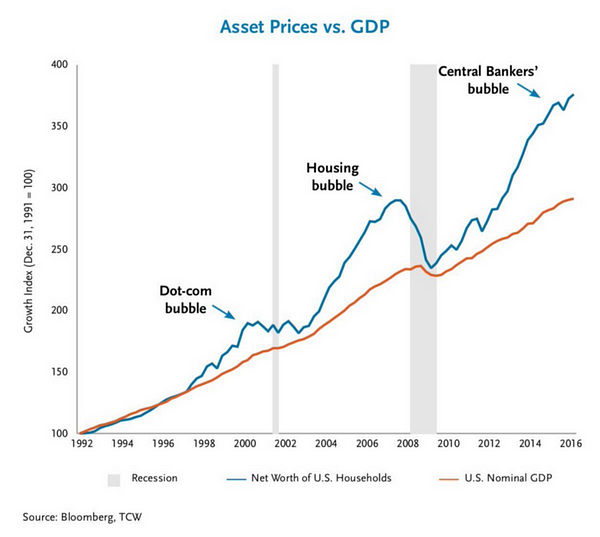
The 2000 dot.com bubble and the 2008 housing bubble were one dimensional. This mother of all bubbles required the global coordination and unprecedented irresponsible intervention of the US Federal Reserve, the European Central Bank (ECB), the Bank of Japan (BOJ), the Bank of England (BOE) and the Swiss National Bank (SNB) to lead the world to the brink of monetary disaster. The highly educated theorists running these central banks have created tens of trillions in unpayable debt while suppressing interest rates to zero or below at the behest of their Deep State masters.


The result is simultaneous bubbles in stocks, bonds and real estate. The pin destined to pop all the bubbles is slightly higher interest rates. The 1% increase in the 10 Year Treasury is already causing havoc in the housing market, the bond market and is hammering pension funds. With the hundreds of trillions in globally interconnected derivatives primed to detonate, 2017 could be an explosive year.


Here are a few things I think could happen in 2017 on the economic front:


  • The national debt stands at $19.9 trillion and will reach $20 trillion before Obama departs. With spending on automatic pilot and tax revenue in decline, the national debt will reach $21 trillion in 2017. With most of the debt financed short-term, the increase in rates will ratchet the interest on the debt from $433 billion to over $550 billion.

  • With the CPI increasing by over 3% in the first few months of the year, the Fed will continue to raise rates, and the 10 Year Treasury will breach the 3% level.

  • Home prices have surpassed the 2006 peak, even though existing home sales are still 20% below 2006 levels and housing starts are 50% below 2006 levels. The entire “recovery” has been engineered by the Fed and Wall Street at the high end of the market. With mortgage rates up 1% already, the further increase will result in existing home sales and housing starts falling by 20% in 2017 and home prices falling by 5% to 10%.


  • The short-term OPEC agreement will allow oil prices to move back to $60 per barrel, further eating into consumer discretionary spending. Desperate fracking companies needing cash flow to service their debt will ramp up. Bankrupt or near bankrupt countries like Venezuela, Mexico, and Iran will also increase production. With a slowing global economy and surging supply, prices will collapse again into the $40s in the second half of the year.

  • Holiday sales for the bricks and mortar retailers will be reported in January as lukewarm at best. By February, the store closing announcements will reach into the hundreds. Sears will finally declare bankruptcy and shutter at least 50% of their stores. Mall developers will begin to declare bankruptcy as vacancies and rising interest rates create a perfect storm.

  • Consumer debt will reach the previous high of $1 trillion, as subprime student loan and auto debt continues to accumulate at an astounding pace. The spigot for student loans is likely to be tightened under Trump, with over 25% of the loans effectively in default. Auto sales (if you can call six year financing and 40% leases, sales) peaked in 2016. Millions of auto buyers are underwater on their loans, subprime auto loans are going into default quicker than you can say Cadillac Escalade, and higher interest rates will price out more potential suckers.

  • The faux jobs recovery is running out of steam. With non-existent wage growth, surging costs for rent, health care, energy, and credit cards tapped out, American families will hunker down and reduce spending further. With consumer spending accounting for 68% of GDP, this will lead to an official recession by the middle of 2017.

  • All the recent surveys showing consumer confidence soaring and optimism for 2017 are based on nothing but hope. The promises of a Trump administration will not come to fruition until 2018 at the earliest. He will meet resistance from Democrats across the board and resistance amongst his own party. His grand plans for massive tax cuts and spending increases will run into the reality of $1 trillion annual deficits. As reality sets in, and recession arrives, the unwarranted optimism will fade rapidly. Tax cuts will be tempered by reduced spending plans.

  • The USD hitting fourteen year highs against the basket of worldwide currencies does not bode well for bringing manufacturing jobs back to make America great again. The reason for the strong dollar is because we are the best looking horse in the glue factory. With Europe and Japan promoting negative interest rates and the Fed slowly raising rates, the dollar will continue to rise. This will hurt our manufacturing businesses, increase our $500 billion annual trade deficit further, and depress the profits of our global corporations.

  • With rising inflation, rising interest rates, stagnant wages, falling corporate profits, stock valuations at all-time highs, and corporations no longer able to finance stock buy backs at no cost, the stock market will finally hit the wall after a seven year bull market. This last surge of euphoria, based on nothing but Trumpmania sweeping Wall Street, will constitute the final blow-off. The market is currently valued to provide nominal returns of less than 1% over the next twelve years and is likely to experience an abrupt sell-off of 50% in the near future. I believe the near future will be 2017. I think the powers that be will be testing Trump’s mettle in his first year to see if he’ll play ball and do their bidding.


“The illusion that we understand the past fosters overconfidence in our ability to predict the future.”  – Daniel Kahneman, Thinking, Fast and Slow


In Part Two of this article I will ponder how much further our civic decay and global disorder will advance in 2017. Over-confidence, hubris and arrogance of our leaders will be the driving factors.

Wednesday, November 9, 2016

10-Year Treasury Yield Tops 2.00% For First Time Since January

Yeah, like no matter what the Donald does, it ain"t gonna turn the economy around on a dime and the Fed ain"t gonna raise rates because it Still Stinks Out There.
I"m still an owner of ling duration high quality bonds.
Once we"re jolted back to reality, it"s gonna hurt bad.
Don"t forget, whom ever won, half the country was going to adjudge it an illegitimate government.
The special snowflakes were devastated whom I spoke with this morning.  About 30 different folks all having coffee.  We know one another as a small area.
They were devastated.
The Hdgers might be happy, but there"s the other half who are in catatonic shock.