Showing posts with label AfD party. Show all posts

Saturday, September 30, 2017

Exposing The Slimy Business Of 'Russia-Gate' (What The Mainstream Media Doesn't Want You To Know)

Authored by Robert Parry via ConsortiumNews.com,


As the U.S. government doles out tens of millions of dollars to "combat Russian propaganda", one result is a slew of new "studies" by "scholars" and "researchers" auditioning for the loot...


The “Field of Dreams” slogan for America’s NGOs should be: “If you pay for it, we will come.”


And right now, tens of millions of dollars are flowing to non-governmental organizations if they will buttress the thesis of Russian “meddling” in the U.S. democratic process no matter how sloppy the “research” or how absurd the “findings.”
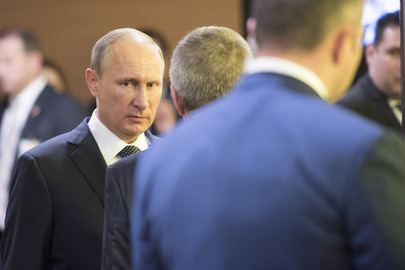

Russian President Vladimir Putin, following his address to the UN General Assembly on Sept. 28, 2015. (UN Photo)


And, if you think the pillars of the U.S. mainstream media – The Washington Post, The New York Times, CNN and others – will apply some quality controls, you haven’t been paying attention for the past year or so. The MSM is just as unethical as the NGOs are.


So, we are now in a phase of Russia-gate in which NGO “scholars” produce deeply biased reports and their nonsense is treated as front-page news and items for serious discussion across the MSM.


Yet, there’s even an implicit confession about how pathetic some of this “scholarship” is in the hazy phrasing that gets applied to the “findings,” although the weasel words will slip past most unsuspecting Americans and will be dropped for more definitive language when the narrative is summarized in the next day’s newspaper or in a cable-news “crawl.”


For example, a Times front-page story on Thursday reported that “a network of Twitter accounts suspected of links to Russia seized on both sides of the [NFL players kneeling during the National Anthem] issue with hashtags, such as #boycottnfl, #standforouranthem and #takeaknee.”


The story, which fits neatly into the current U.S. propaganda meme that the Russian government somehow is undermining American democracy by stirring up dissent inside the U.S., quickly spread to other news outlets and became the latest “proof” of a Russian “war” against America.


However, before we empty the nuclear silos and exterminate life on the planet, we might take a second to look at the Times phrasing: “a network of Twitter accounts suspected of links to Russia.”


The vague wording doesn’t even say the Russian government was involved but rather presents an unsupported claim that some Twitter accounts are “suspected” of being part of some “network” and that this “network” may have some ill-defined connection – or “links” – to “Russia,” a country of 144 million people.


‘Six Degrees from Kevin Bacon’


It’s like the old game of “six degrees of separation” from Kevin Bacon. Yes, perhaps we are all “linked” to Kevin Bacon somehow but that doesn’t prove that we know Kevin Bacon or are part of a Kevin Bacon “network” that is executing a grand conspiracy to sow discontent by taking opposite sides of issues and then tweeting.

The New York Times building in Manhattan. (Photo credit: Robert Parry)


Yet that is the underlying absurdity of the Times article by Daisuke Wakabayashi and Scott Shane. Still, as silly as the article may be that doesn’t mean it’s not dangerous. The Times’ high-profile treatment of these gauzy allegations represents a grave danger to the world by fueling a growing hysteria inside the United States about being “at war” with nuclear-armed Russia. At some point, someone might begin to take this alarmist rhetoric seriously.


Yes, I understand that lots of people hate President Trump and see Russia-gate as the golden ticket to his impeachment. But that doesn’t justify making serious allegations with next to no proof, especially when the outcome could be thermonuclear war.


However, with all those millions of dollars sloshing around the NGO world and Western academia – all looking for some “study” to fund that makes Russia look bad – you are sure to get plenty of takers. And, we should now expect that new “findings” like these will fill in for the so-far evidence-free suspicions about Russia and Trump colluding to steal the presidency from Hillary Clinton.


If you read more deeply into the Times story, you get a taste of where Russia-gate is headed next and a clue as to who is behind it:


“Since last month, researchers at the Alliance for Securing Democracy, a bipartisan initiative of the German Marshall Fund, a public policy research group in Washington, have been publicly tracking 600 Twitter accounts — human users and suspected bots alike — they have linked to Russian influence operations. Those were the accounts pushing the opposing messages on the N.F.L. and the national anthem.


“Of 80 news stories promoted last week by those accounts, more than 25 percent ‘had a primary theme of anti-Americanism,’ the researchers found. About 15 percent were critical of Hillary Clinton, falsely accusing her of funding left-wing antifa — short for anti-fascist — protesters, tying her to the lethal terrorist attack in Benghazi, Libya, in 2012 and discussing her daughter Chelsea’s use of Twitter. Eleven percent focused on wiretapping in the federal investigation into Paul Manafort, President Trump’s former campaign chairman, with most of them treated the news as a vindication for President Trump’s earlier wiretapping claims.”


The Neocons, Again!


So, let’s stop and unpack this Times’ reporting.


First, this Alliance for Securing Democracy is not some neutral truth-seeking organization but a neoconservative-dominated outfit that includes on its advisory board such neocon luminaries as Mike Chertoff, Bill Kristol and former Freedom House president David Kramer along with other anti-Russia hardliners such as former deputy CIA director Michael Morell and former House Intelligence Committee Chairman Mike Rogers.


Neoconservative pundit William Kristol. (Photo credit: Gage Skidmore)


How many of these guys, do you think, were assuring us that Iraq was hiding WMDs back in 2003?


This group clearly has an ax to grind, a record of deception, and plenty of patrons in the Military-Industrial Complex who stand to make billions of dollars from the New Cold War.


The neocons also have been targeting Russia for regime change for years because they see Russian President Vladimir Putin as the chief obstacle to their goal of helping Israel achieve its desire for “regime change” in Syria and a chance to bomb-bomb-bomb Iran. Russia-gate has served the neocons well as a very convenient way to pull Democrats, liberals and even progressives into the neocon agenda because Russia-gate is sold as a powerful weapon for the anti-Trump Resistance.


The Times article also might have mentioned that Twitter has 974 million accounts. So, this alarm over 600 accounts is a bit disproportionate for a front-page story in the Times, don’t you think?


And, there’s the definitional problem of what constitutes “anti-Americanism” in a news article. And what does it mean to be “linked to Russian influence operations”? Does that include Americans who may not march in lockstep to the one-sided State Department narratives on the crises in Ukraine and Syria? Any deviation from Official Washington’s groupthink makes you a “Moscow stooge.”


And, is it a crime to be “critical” of Hillary Clinton or to note that the U.S. mainstream media was dismissive of Trump’s claims about being wiretapped only for us to find out later that the FBI apparently was wiretapping his campaign manager?


However, such questions aren’t going to be asked amid what has become a massive Russia-gate groupthink, dominating not just Official Washington, but across much of America’s political landscape and throughout the European Union.


Why the Bias?


Beyond the obvious political motivations for this bias, we also have had the introduction of vast sums of money pouring in from the U.S. government, NATO and European institutions to support the business of “combatting Russian propaganda.”
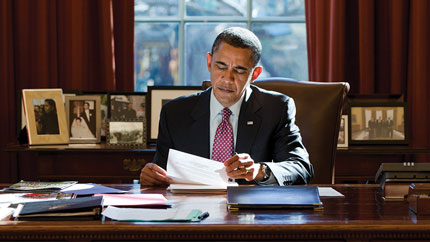

President Obama in the Oval Office.


For example, last December, President Obama signed into law a $160 million funding mechanism entitled the “Combating Foreign Propaganda and Disinformation Act.” But that amounts to only a drop in the bucket considering already existing Western propaganda projects targeting Russia.


So, a scramble is on to develop seemingly academic models to “prove” what Western authorities want proven: that Russia is at fault for pretty much every bad thing that happens in the world, particularly the alienation of many working-class people from the Washington-Brussels elites.


The truth cannot be that establishment policies have led to massive income inequality and left the working class struggling to survive and thus are to blame for ugly political manifestations – from Trump to Brexit to the surprising support for Germany’s far-right AfD party. No, it must be Russia! Russia! Russia! And there’s a lot of money on the bed to prove that point.


There’s also the fact that the major Western news media is deeply invested in bashing Russia as well as in the related contempt for Trump and his followers. Those twin prejudices have annihilated all professional standards that would normally be applied to news judgments regarding these flawed “studies.”


On Thursday, The Washington Post ran its own banner-headlined story drawn from the same loose accusations made by that neocon-led Alliance for Securing Democracy, but instead the Post sourced the claims to Sen. James Lankford, R-Oklahoma. The headline read: “Russian trolls are stoking NFL controversy, senator says.”


The “evidence” cited by Lankford’s office was one “Twitter account calling itself Boston Antifa that gives its geolocation as Vladivostok, Russia,” the Post reported.


By Thursday, Twitter had suspended the Boston Antifa account, so I couldn’t send it a question, but earlier this month, Dan Glaun, a reporter for Masslive.com, reported that the people behind Boston Antifa were “a pair of anti-leftist pranksters from Oregon who started Boston Antifa as a parody of actual anti-fascist groups.”


In an email to me on Thursday, Glaun cited an interview that the Boston Antifa pranksters had done with right-wing radio talk show host Gavin McInnes last April.


And, by the way, there are apps that let you manipulate your geolocation data on Twitter. Or, you can choose to believe that the highly professional Russian intelligence agencies didn’t notice that they were telegraphing their location as Vladivostok.


Mindless Russia Bashing


Another example of this mindless Russia bashing appeared just below the Post’s story on Lankford’s remarks. The Post sidebar cited a “study” from researchers at Oxford University’s Project on Computational Propaganda asserting that “junk news” on Twitter “flowed more heavily in a dozen [U.S.] battleground states than in the nation overall in the days immediately before and after the 2016 presidential election, suggesting that a coordinated effort targeted the most pivotal voters.” Cue the spooky Boris and Natasha music!


Boris and Natasha, the evil spies from the Rocky and Bullwinkle shows.


Of course, any Americans living in “battleground states” could tell you that they are inundated with all kinds of election-related “junk,” including negative TV advertising, nasty radio messages, alarmist emails and annoying robo-calls at dinner time. That’s why they’re called “battleground states,” Sherlock.


But what’s particularly offensive about this “study” is that it implies that the powers-that-be must do more to eliminate what these “experts” deem “propaganda” and “junk news.” If you read deeper into the story, you discover that the researchers applied a very subjective definition of what constitutes “junk news,” i.e., information that the researchers don’t like even if it is truthful and newsworthy.


The Post article by Craig Timberg, who apparently is using Russia-gate to work himself off the business pages and onto the national staff, states that “The researchers defined junk news as ‘propaganda and ideologically extreme, hyperpartisan, or conspiratorial political news and information.’


“The researchers also categorized reports from Russia and ones from WikiLeaks – which published embarrassing posts about Democrat Hillary Clinton based on a hack of her campaign chairman’s emails – as ‘polarizing political content’ for the purpose of the analysis.”


So, this “study” lumped together “junk news” with accurate and newsworthy information, i.e., WikiLeaks’ disclosure of genuine emails that contained such valid news as the contents of Clinton’s speeches to Wall Street banks (which she was trying to hide from voters) as well as evidence of the unethical tactics used by the Democratic National Committee to sabotage Sen. Bernie Sanders’s campaign.


Also dumped into the researchers’ bin of vile “disinformation” were “reports from Russia,” as if everything that comes out of Russia is, ipso facto, “junk news.”


And, what, pray tell, is “conspiratorial political news”? I would argue that the past year of evidence-lite allegations about “Russian meddling” in the U.S. election accompanied by unsupported suspicions about “collusion” with the Trump campaign would constitute “conspiratorial political news.” Indeed, I would say that this Oxford “research” constitutes “conspiratorial political news” and that Timberg’s article qualifies as “junk news.”


Predictable Outcome


Given the built-in ideological bias of this “research,” it probably won’t surprise you that the report’s author, Philip N. Howard, concludes that “junk news originates from three main sources that the Oxford group has been tracking: Russian operatives, Trump supporters and activists part of the alt-right,” according to the Post.


The Washington Post building in downtown Washington, D.C. (Photo credit: Washington Post)


I suppose that since part of the “methodology” was to define “reports from Russia” as “junk news,” the appearance of “Russian operatives” shouldn’t be much of a surprise, but the whole process reeks of political bias.


Further skewing the results, the report separated out information from “professional news organizations [and] political parties” from “some ‘junk news’ source,” according to the Post. In other words, the “researchers” believe that “professional news organizations” are inherently reliable and that outside-the-mainstream news is “junk” – despite the MSM’s long record of getting major stories wrong.


The real “junk” is this sort of academic or NGO research that starts with a conclusion and packs a “study” in such a way as to guarantee the preordained conclusion. Or as the old saying goes, “garbage in, garbage out.”


Yet, it’s also clear that if you generate “research” that feeds the hungry beast of Russia-gate, you will find eager patrons doling out dollars and a very receptive audience in the mainstream media.


In a place like Washington, there are scores if not hundreds of reports generated every day and only a tiny fraction get the attention of the Times, Post, CNN, etc., let alone result in published articles. But “studies” that reinforce today’s anti-Russia narrative are sure winners.


So, if you’re setting up a new NGO or you’re an obscure academic angling for a lucrative government grant as well as some flattering coverage in the MSM, the smart play is to join the new gold rush in decrying “Russian propaganda.”

Sunday, September 24, 2017

In Major Disappointment, Merkel Wins German Election Despite Worst Result Since 1949; AfD Surges To Enter Parliament

The German polls have officially closed, and the first exit polls numbers come in, confirming the expected fourth victory for Angela Merkel"s CDU/CSU, however getting a unexpectedly low 32.5% of the vote, which according to Europe Elects was the worst result for Merkel"s CDU/CSU (EPP) since 1949. Merkel"s main challenger, the SPD, got 20%, also its worst result since Nazi era 1945; furthermore, the SPD has said it plans to enter the opposition, collapsing the current CDU/CSU-SPD "grand coalition." 


In other words, just like in the recent Franch elections, the German establishment was just trounced:


  • Worst result for Merkel"s CDU/CSU since 1949

  • Worst result for SPD Since 1945

Meanwhile, there was an unexpected surge for the newcomers: the dramatic (late) surge for the nationalist AfD party, which got a higher than expected 13.5% of the vote, has made it not only the third most popular German party but also the first far-right German party to enter the Bundestag in 60 years.


The first exit poll breakdown from ARD is as follows.


  • CDU/CSU - 32.5%

  • SPD - 20%

  • AfD - 13.5%

  • FDP - 10.5%

  • Greens - 9.5%

  • Left party - 9%


An exit poll from ZDF has a similar breakdown:


  • CDU/CSU-EPP: 33.5%

  • SPD-S&D: 21%

  • AfD-ENF: 13%

  • FDP-ALDE: 10%

  • LINKE-LEFT: 9%

  • GRÜNE-G/EFA: 9%

Even more troubling for the German establishment is that the far-right AfD was the second strongest party in former Eastern Germany:


According to the Exit Poll, the likely coalition options include CDU/CSU-SPD or CDU/CSU-FDP-GREENS. The various possibilites are shown below.


However, according to SPD"s Schwesig, the leadership is united on entering opposition, meaning a grand coalition is unlikely and the CDU may have to settle for a government with the FDP and the Greens, a so-called "Jamaica Coalition." 


* * *


Contrary to earlier reports of muted participation, Europe Elects predicted today"s turnout could be as high as 80 per cent, potentially the highest turnout of the past two decades.


Furthermore, as Europe Elects adds, today could mark the highest turnout in a key German state since 1988.  In Sachsen-Anhalt, as of  4pm, turnout today is around 56 per cent - quite a bit higher than in 2013, 2009, 2005 and 2002. Turnout is not quite as high as 1988 yet, when turnout was around 62 per cent at the same time.


Turnout is particularly significant in this election, as fewer CDU and SDP voters heading out to their booths means a larger vote share for the AfD.

Wednesday, September 20, 2017

AfD In 3rd Place In German Election Polls: Unhappy Political Marriages Loom

Authored by Mike Shedlock via MishTalk.com,


German federal elections are Sunday, September 24. The most likely outcome of the election is another “Grand Coalition” but it will be a much-weakened coalition.  And If that coalition forms again, the rightwing AfD party is poised to become the largest opposition party.


Rightwing Turning Point


The Wall Street Journal reports Nationalist AfD Party Moves Into Third Place in German Election Polls


A last-minute surge in the polls has put a far-right party that wants to dial down German remembrance of the Holocaust within striking distance of becoming the country’s biggest opposition force.


The four-year-old Alternative for Germany, or AfD, has moved into third place and double digits in recent polls. If those numbers hold up until the Sept. 24 election and German Chancellor Angela Merkel repeats her current governing coalition with the center-left Social Democrats, the AfD would become the biggest opposition party in parliament.


No matter how exactly the results shake out, Sunday’s election seems assured to represent a turning point in postwar German history. Ms. Merkel’s center-right Christian Democrats are set to finish first, and she is expected to remain chancellor. But the AfD, polls show, is very likely to become the first far-right party in more than half a century to win seats in parliament.


“If the AfD in fact gets into the Bundestag, Nazis will be speaking in the Reichstag [building] for the first time in more than 70 years,” Foreign Minister Sigmar Gabriel recently told German magazine, Der Spiegel.


Political scientists say while the AfD isn’t a neo-Nazi party, it includes a right-wing-radical wing that appears to be strengthening. And without question, the anti-immigrant party breaks taboos in a country that has resisted right-wing populism for decades in the shadow of the Nazi era.


In parliament, AfD lawmakers would receive state financing to hire new staff and to set up offices in their districts, increasing the party’s nationwide reach. They would hold key seats on legislative committees, make nationally televised speeches, and be able to send official inquiries to the government, which ministries are required to answer.


Polls suggest the AfD draws voters from across the political spectrum who are unhappy with mainstream politics, particularly on immigration. A strong showing by the AfD could complicate things for Ms. Merkel by preventing her from being able to form a governing coalition with just one of two smaller parties, the pro-business Free Democrats or the environmentalist Greens. Instead, she may well need to form an unwieldy three-way coalition including them both—despite their ideological differences—and her conservative bloc. Repeating her current “grand coalition” with the Social Democrats would require her to overcome misgivings in both parties.


Eurointelligence View


For many international observers Germany is the exception: In times of Donald Trump, Brexit and Emmanuel Macron, Germans seem to live on another continent of social peace and political harmony. There is nothing of the desire for renewal witnessed during the French elections, or the desire to distinguish themselves shown by the Brexit vote. There is no major populist insurgency. Controversial subjects of our times like terrorism, refugees, immigration, military engagement, or nationalism, are avoided, observes Jean-Dominique Giuliani, president of the Robert Schuman Foundation.


But this peace is superficial, notes Philippe Rocard in Le Monde. There are about 20-30% frustrated voters in Germany, angry about Angela Merkel and her motto “Wir schaffen das” (we can make it) in immigration policy, or her handouts to bailout countries during the eurozone crisis. The three parties that capture the rising protest are the AFD, Die Linke and even the FDP with its radicalised discourse against Greece.


The rise of the AfD, which looks like it could become the third strongest party only four years after its foundation, would be a turning point in postwar German history, notes the WSJ. Never since the 1950s has a far-right party cleared the 5% hurdle. According to the recent polls, the AfD could get as many as 89 out of 703 seats. With its xenophobic and nationalistic rhetoric, the party breaks taboos in a country that has resisted right-wing populism for decades. To be fair, these numbers are still small compared to Austria where the Freedom party is polling 25%, or France where Marine Le Pen received 34% in the presidential run-off. But for Germany it is a major shift.


Unhappy Marriages


CDU (36) + FDP (22) would have a total percentage of about 58%. But many in SPD would prefer the SPD to be in opposition. Should that develop, SPD would be the largest opposition party.


If SDP chooses opposition, Merkel could form a majority government via an alliance of CDU (36), the Greens (7), and FDP (9). Currently, that alliance would have a bare majority with 52% of the vote.


Regardless of what happens, Merkel will be in a much-weakened position compared to now.


And other than a miracle CDU/FDP finish that achieves more than 50%, it may take quite some time after the election for the next government to form.

Wednesday, August 2, 2017

Poll Finds More Germans Fear Climate Change Than Terrorism

For a time back in 2015, there were widespread concerns that the spike in terrorist attacks in Germany in the aftermath of Angela Merkel"s open door policy which admitted 1 million refugees in Germany from the middle east would lead to a popular wave of unrest, perhaps culminating with the unseating of Angela Merkel as Chancellor. It now appears that the Germans had more pressing concerns on their mind like... global warming.


According to a new poll ahead of the German national election in September, Germans are more concerned about the future state of the environment than they are about more headline-grabbing topics like terrorism or the refugee crisis. The survey released on Tuesday conducted by research group Kantar Emnid Institute on behalf of publishing group Funke Mediengruppe found that 71% of respondents said they were personally more concerned about climate change. This worry ranked higher than the possibility of new wars, listed by 65% of survey participants, and also above terror attacks, listed by 63%.


Crime was noted as a worry by 62% of the 1,000 participants surveyed, who were able to list more than one fear.


But the most surprising finding is that less than half of those polled, or 45%, said they were anxious about the immigration of refugees into the country, while the lowest concern was unemployment 33% .


Ironically, as the Local.de points out, while climate change was the biggest concern named by Germans, the topic doesn"t seem to be winning any more support for the environment-conscious Green party, which is currently polling at around 8% .


"Environment and climate protection have already greatly mattered to people in Germany for years," Torsten Schneider-Haase, head of political research at Kantar Emnid, explained to the publishing group. "The fight against climate change has been understood as a cross-party effort, and not only associated with the Green party." Plus, he noted that Chancellor Angela Merkel stood out recently as a convincing advocate for battling climate change after she criticized US President Donald Trump for announcing that his country would withdraw from the international Paris climate agreement.


That, or the poll had "sampling" issues similar to the polls that gave Hillary Clinton a 95% probability of winning.


In fact, one can"t help but wonder if the entire poll was nothing more than an informercial for Merkel"s CDU, with comments such as the following:


The fact that most of those polled did show concern for security issues like wars, crime and terrorist attacks could have an implication for how people ultimately vote in September, Schneider-Haase added.


"Security topics play a big role. This pertains to external, internal and social security," said Schneider-Haase.


"The classic topics of social equity will not win anyone more votes right now."


Why worry about mundane things that impact everyone on a tangible daily basis when there are icebergs to be rescued?


According to the institute, support for the Union parties is currently polling at 38 percent, while the SPD is at 24 percent.


In some vestige of credibility, the survey at least found differences among respondents according to their political party preferences: supporters of the anti-immigrant AfD party were much more likely to be worried about an influx of refugees at 90 percent, and were also more concerned than the general population about crime (84 percent) as well as terror attacks (72 percent). On the other end of the political spectrum, supporters of Die Linke (The Left Party) were most concerned about old-age poverty (71 percent), new wars (69 percent) and climate change (58 percent).

Thursday, February 2, 2017

Angela Merkel Faces Challenge For Chancellorship

Submitted by Soren Kern via The Gatestone Institute,


  • The policy positions of Schulz and Merkel on key issues are virtually identical: Both candidates are committed to strengthening the EU, maintaining open-door immigration policies, pursuing multiculturalism and quashing dissent from the so-called far right.

  • Regardless of who wins, Germany is unlikely to undergo many course corrections during the next four years.

  • Schulz has already called for tax increases on the wealthy and for fighting the AfD party. He has also threatened financial consequences for European countries that refuse to take in more migrants.

  • "The chancellor"s office is worried." – Der Spiegel.

Martin Schulz, the former president of the European Parliament, has been chosen to challenge Chancellor Angela Merkel in Germany"s general election on September 24.


The policy positions of Schulz and Merkel on key issues are virtually identical: Both candidates are committed to strengthening the European Union, maintaining open-door immigration policies, pursuing multiculturalism and quashing dissent from the so-called far right.


Time for a changing of the guard? Pictured: Then European Parliament President Martin Schulz meets with German Chancellor Angela Merkel in Brussels, January 30, 2012. (Image source: European Parliament)


Polls show Merkel, who heads the center-right Christian Democratic Union (CDU), slightly ahead of Schulz, the new leader of the center-left Social Democratic Party (SPD). Regardless of who wins, Germany is unlikely to undergo many course corrections during the next four years.


Schulz, who became a Member of the European Parliament in 1994, and has spent most of his political career in Brussels, unofficially took over the reins of the SPD on January 29, 2017, after the unpopular Sigmar Gabriel said he was stepping down. The move will become official at a party congress on March 19. SPD leaders said that as an "outsider," Schulz has a better chance of unseating Merkel, who has been in office since November 2005, and is running for a fourth term.


The SPD has been the junior partner in a Merkel-run "grand coalition" (Große Koalition) government since December 2013. SPD leaders say that if the party wins at least 30% of the national vote, Schulz will become the next chancellor.


In an interview with Der Spiegel, Schulz, 61, said he was the best candidate to replace Merkel, who is 62. "I have worked with Angela Merkel longer than almost anyone outside her party," he said. "I have studied her, gotten to know her." Schulz has eight months to persuade Germans to vote for him.


The latest INSA poll shows the CDU (together with its Bavarian sister party, the CSU) with 32.5% of the vote, the SPD with 26%, and the anti-establishment party Alternative for Germany (AfD) in third place with 13%.


If the CDU/CSU or the SPD fail to win a majority, they may join forces to form another grand coalition. Either party may also seek to form a coalition government with other smaller parties, particularly the Greens, but all have ruled out entering into a coalition with the eurosceptic AfD.


The AfD, which is set to enter the Parliament (Bundestag) for the first time, is uniquely placed to attract voters who are angry about Merkel"s decision to allow into Germany more than one million mostly Muslim migrants from Africa, Asia and the Middle East. The party, which polled as high as 15.5% in December 2016, has struggled to gain more traction due to internal power struggles and accusations of anti-Semitism.


Schulz — a high school dropout whom The Economist magazine described as "pugnacious" and "impulsive" — is campaigning on a platform to unite an increasingly divided German polity. "Germany needs a new start and that cannot happen with the CDU," he said. "We have come to the end of what we can achieve with divided conservatives."


The SPD will not unveil its election platform until a party congress in May. But Schulz has already called for tax increases on the wealthy and for fighting the AfD. He has also threatened financial consequences for European countries that refuse to take in more migrants.


When a television presenter confronted Schulz about his lack of governing experience, he compared himself to Barack Obama: "I share the fate with Barack Obama. He also had no government experience when he became President of the United States."


If elected, Schulz, an ardent Europhile who is committed to European federalism, is sure to work to strengthen the European Union. "I know what"s going on in Europe," he said. "I know the strengths and also weaknesses of the European Union." He added:


"European politics is German domestic politics and German domestic politics has a powerful effect in Europe. Whoever wants to play those against each other is committing a sin against the future of our children and generations to come."


Schulz has argued that the EU must be preserved at any cost:


"We are at a historical juncture: A growing number of people are declaring what has been achieved over the past decades in Europe to be wrong. They want to return to the nation-state. Sometimes there is even a blood and soil rhetoric that for me is starkly reminiscent of the interwar years of the past century, whose demons we are still all too familiar with. We brought these demons under control through European structures, but if we destroy those structures, the demons will return. We cannot allow this to happen."


He has opposed the idea of holding national referendums on quitting the EU:


"Referendums have always posed a threat when it comes to EU policy, because EU policy is complicated. They"re an opportunity for those from all political camps who like to oversimplify things."


Schulz has also said that the British decision to leave the European Union would facilitate the creation of a European Army:


"In the fields of security and defense policy, although the EU loses a key member state, paradoxically such a separation could give the necessary impulse for a closer integration of the remaining member states."


Playing the anti-Americanism card, Schulz has expressed his disdain for U.S. President Donald J. Trump, calling him "an obviously irresponsible man sitting in a position that requires the utmost sense of responsibility." He added: "Trump is not just a problem for the EU, but for the whole world."


Schulz described Trump"s order to build a wall along the U.S. border with Mexico as "a taboo breach that is intolerable." He also criticized Trump"s temporary travel ban for citizens of seven countries deemed to be terrorist safe havens:


"I"m sure when European politicians travel to Washington they will explain to the U.S. government that international law and human rights also apply for Donald Trump."


Schulz has reserved his worst vitriol for the anti-immigration AfD, whose leaders he has described as "rat catchers" (Rattenfänger) who are "trying to profit from the plight of refugees." He has also called them "shameful and repulsive."


Merkel, who up until recently vowed to continue her open-door migration policy, has now promised to consider an annual cap on the number of migrants allowed into Germany. In a rare moment of contrition, she said: "If I could, I would turn back the time by many, many years. If I knew what change in policy people wanted, I would be ready to consider it and to talk about it."


In an interview with Welt am Sonntag, Finance Minister Wolfgang Schaeuble admitted that the Merkel government made mistakes with its open-door migration policy. "We have tried to improve what got away from us in 2015," he said. "We politicians are human; we also make mistakes. But one can at least learn from them."


Some in the German media are skeptical about Schulz. Frankfurter Allgemeine Zeitung wrote:


"As a chancellor candidate, Schulz has announced an election campaign for social justice and the EU. He will not allow "bashing" of the EU. Can Schulz score points? Like any other German politician, he stands for "Brussels" as a cipher for a detached and bureaucratic European elite. The alienation between elites and large parts of the population is not only in America. In Germany as well, voters increasingly are turning away from established politics."


By contrast, Der Spiegel published a sensational cover story entitled, "Saint Martin" which portrayed Schulz as a supernatural figure — similar to its adulation of Barack Obama eight years ago. The magazine added: "The chancellor"s office is worried."