Showing posts with label onion. Show all posts

Tuesday, October 17, 2017

Why Fall May Be The Best Time To Plant Your Onions

Why Fall May Be The Best Time To Plant Your Onions

Image source: Pixabay.com


Onions may well have been among the first edible foods grown in domestic gardens, as the history of the domestic onion goes back thousands of years – seeds have been found in ancient Egyptian tombs — and they are still one of the most common vegetables found in modern kitchens.


Most people who grow their own onions plant them during spring, but did you know it is possible to get a head start on your harvest by planting in the fall, as well? There are several advantages of planting in the fall. First, it is a time when there a fewer garden chores that need done. Also, onions that have been planted this time of year are often more productive and reliable than their spring counterparts. They are less vulnerable to common pests that enjoy munching on them.


Like their garlic cousins, onions can be very hardy and cold tolerant. You simply have to keep a few things in mind if you choose to plant them during autumn.


Planting Your Onions


Fall onions tend to do well if planted between early September to late October (provided the ground is not frozen). It often works well to plant them following the harvest of a summer crop such as potatoes, as you already have ground that has been dug.


While it is possible to grow onions from seed, it is much more common (and easier!) for backyard gardeners to grow them from sets or immature bulbs. Over winter, these sets have the opportunity to establish a healthy root system before their green shoots emerge in the spring.


Looking For Onions For Your Garden? Get Them From A Family-Owned Company You Can Trust!


Choose a relatively weed-free area that gets full sun and that has firm, well-draining soil. To avoid possible disease, do not plant onions where you have grown other onions, carrots, beetroot or garlic during the previous season.


Sets of onions should be planted about one-inch deep, allowing the tip of the bulblet to slightly poke above ground level. If the tips are on the long side, you can trim them down to the shoulder of the bulb first. Space your onions 3-4 inches apart.


Caring for Onions

Why Fall May Be The Best Time To Plant Your Onions

Image source: Pixabay.com


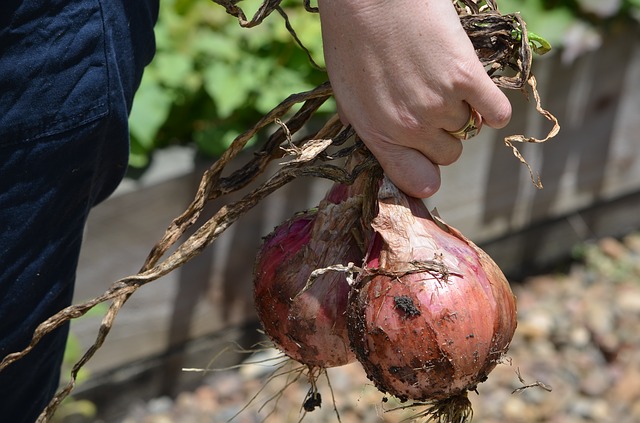
One of the nice things about planting onions during the fall is that they don’t really require a great deal of care. Your sets will only grow for a few weeks before the colder temperatures send them into a kind of semi-hibernation mode.


Still, you need to ensure that the area in which they are planted has few weeds and that they do not get waterlogged.


Sets of onions may be watered once after they’ve been planted, and after that normal fall rain should be enough to give them the water that they need. If you live in an area that gets excessive fall rain, you may not find it worth it to plant during autumn.


Varieties to Plant


Planting onions during fall is not something that can be done with every variety. Many types simply will not survive freezing temperatures, so you have to choose carefully. For gardeners in zone 6 or colder, you should cover your plants with straw or mulch and use plastic sheeting or tunnels to help them survive the winter.


Among the best varieties of onions to plant during fall are:


  1. Senshyu yellow – this cold hardy onion produces a semi-flat, average-sized bulb with yellow skin.

  2. Radar – this type of onion has light-brown skin and boasts a mild to medium flavor. This type of onion also stores better than many other varieties of onion when harvested during June.

  3. Electric – a red-skinned onion that has red and white flesh. This variety has a medium to strong flavor and can be stored for up to four weeks.

  4. Valencia – these onions have a golden to brown skin and a mild, somewhat sweet flavor. They tend to do well in almost any region.

  5. Talon F1 – these form hard, uniformly shaped bulbs with golden brown skin and white flesh.

  6. Red baron – a very pretty variety that has deep red skin. The flesh is mostly white, but has red to purple inner rings.

  7. Evergreen hardy bunching onion – one of the most cold-tolerant varieties! Can be overwintered in even northern regions such as Vermont. Grows in dense, green clumps.

  8. Bandit leeks – produces nice blue-green flags and a thick white base with very little bulbing.

Your Spring Harvest


Overwintered onions are generally producing bulbs by May and reach their full size by June. Harvest your onions before or shortly after you see a scape appear.


These onions will not last in storage as long as other onions, so it is best to use them fresh — in the same way you would use scallions.


Do you have any fall-planting tips for onions? Share your tips in the section below:

Thursday, September 14, 2017

How To Get Your Onions To Store ALL WINTER Long

How To Get Your Onions To Store ALL WINTER Long

Image source: Pixabay.com


When it comes to growing vegetables, it doesn’t get much easier than onions. Just plant them in the garden, give them a little water, and these distinctive, dependable vegetables are ready to harvest almost before you know it.


Once harvested, onions can last weeks and even months if they’re properly cured and stored, and you can grab one for the kitchen whenever you need it. Here’s how to harvest, cure and store onions.


Harvesting Onions


Onions are ready to harvest when the tops begin to flop over and turn yellow. This means the plant has finished growing and the leaves no longer need to provide energy to the bulb. It isn’t necessary to wait until the tops are completely dry.


Don’t harvest the onions right away, though, unless rain is predicted. Instead, stop watering and give them a week or 10 days to finish maturing. If weather turns damp and rainy, then go ahead and harvest.


The best time to harvest onions is during the morning when weather is dry and sunlight is less intense. Loosen the soil around the plants carefully with a spade or garden fork, and then pull the onions gently from the ground. Lay the onions on top of the soil for a day or two to dry. If the weather is hot, cover them lightly with straw to prevent sunburn. If the soil is wet, put the onions in a protected spot like a patio or garage. Handle the onions with care to avoid cuts and bruises. You even can hang the onions over a fence if you live in a dry climate.


Curing Onions


If you want to store onions, curing is a critical step that allows the onions to form a papery, protective covering. If you plan to use onions soon, don’t bother curing them, as there’s no need. Keep in mind that mild, sweet onions don’t store as long as sharp, pungent onions. If you grow both types, then use the sweet onions first and save the pungent onions for storage. Some popular onions that store well include Copra, Southport Red Globe, Redwing, White Sweet Spanish and Downing Yellow Globe.


Looking For Non-GMO Seeds? Get Them From A Company You Can Trust!


How To Get Your Onions To Store ALL WINTER Long

Image source: Wikimedia


To cure the onions, place them in a clean, dry, shady, well-ventilated spot with stems still attached. If you’re short on space and need to cure the onions outdoors, spread the onions in a single layer and cover them with a light sheet to prevent sunburn, and then anchor the rocks in place with rocks. Never cover them with plastic, as lack of air circulation can cause the onions to rot.


Allow the onions to cure for two or three weeks, until the papery skin is tight and crispy and the roots are dry. Turn them every few days so they cure evenly. Set any soft onions aside for immediate use.


Storing Onions


Brush the onions gently with your fingers to remove remaining dirt, and then trim the tops to about an inch with scissors before you store the onions. You can also trim the roots.


Sort through the onions again. If any are bruised, store them in the refrigerator and use them soon. Like apples, one bad onion can ruin the entire batch. Also, do not store onions near potatoes.


Place onions in a wooden crate or a nylon or mesh bag – that is, a dark area — and store them in a cool, dry place where temperatures are kept between 35 and 40 degrees Fahrenheit, but never freezing.


Check the onions every few weeks and remove any that are turning soft.


What your onion storage tips? Share them in the section below:


Bust Inflation With A Low-Cost, High-Production Garden. Read More Here.

Friday, July 14, 2017

Visualizing The Dark Side Of The Web

The term Dark Web is evocative. It conjures up images of hitmen, illegal drugs, and pedophilia. One imagines a place where the dark side of human nature flourishes away from the eyes – and laws – of society at large.


Today’s infographic, from Cartwright King Solicitors, cuts through the mystique and provides an entertaining and practical overview of the Deep Web and the Dark Web.


Courtesy of: Visual Capitalist


LAYERS (PART 1)


Much like the ocean, the internet is divided into defined layers.


The internet most people are familiar with is called the Surface Web. Websites in this layer tend to be indexed by search engines and can be easily accessed using standard browsers. Believe it or not, this familiar part of the web only comprises less than 10% of the total data on the internet.


The next layer down, we encounter the largest portion on the internet – the Deep Web. Basically, this is the layer of the internet that is quasi-accessible and not indexed by search engines. It contains medical records, government documents, and other, mostly innocuous information that is password protected, encrypted, or simply not hyperlinked. To reach beyond this layer of the internet, users need to use Tor or a similar technology.


LAYERS (PART 2)


Tor, which stands for “The Onion Router”, is how the majority of people anonymously access the Dark Web. Tor directs internet traffic through complex layers of relays to conceal a user’s location and identity (hence the onion analogy).


In 2004, Tor was released as an open source software. This allowed the Dark Web to grow as people could anonymously access websites.


Since anonymity is sacrosanct in the deep reaches of the Internet, transactions are typically conducted using cryptocurrencies like Bitcoin or Ethereum. People making purchases in Dark Web markets are (understandably) concerned with privacy, so they often use a series of methods to transfer funds. Below is a common transaction flow on the Dark Web.


Tumblers are used as an extra step to ensure privacy. A conventional equivalent would be moving funds through banks located in countries with strict bank-secrecy laws (e.g. Cayman Islands, Panama).


WHAT’S GOING ON DOWN THERE?


The concept of the Dark Web isn’t vastly different from the Surface Web. There are message boards (e.g. 8chan, nntpchan), places you can buy things (e.g. Alphabay, Hansa), and blogs (e.g. OnionNews, Deep Web Radio). The rules, or rather a lack thereof, is what makes the Dark Web unique.


Anything that is illegal to sell (or discuss) on the Surface Web is available in the Dark Web. Personal information, drugs, weapons, malware, DDoS attacks, hacking services, fake accounts for social media, and contract killing services are all available for sale.


The Dark Web is full of criminal activity, but it’s also place where dissidents and whistle-blowers can anonymously share information. In countries with restrictive internet surveillance, the Dark Web may be the only place to safely voice criticisms against government and other powerful entities.


MEASURING IN THE DARK


Many .onion sites are only up temporarily, so determining the true size of the Dark Web is nearly impossible. That said, Intelliagg and Darksum recently attempted to map out the Tor-based Dark Web by using a script to crawl reachable sites. They found 29,532 websites; however, 54% of them disappeared during the course of their research. Another recent study found that 87% of Dark Web sites don’t link to any other sites.


It is more accurate to view the darkweb as a set of largely isolated dark silos.


– Graph Theoretic Properties of the Dark-web


Recent changes to Tor, such as 50-character hidden service URLs, have made the Dark Web an even more untraceable place, so we may never fully know what lies beneath the surface of the internet. Based on the parts we have seen, perhaps that’s for the best.