Showing posts with label tools. Show all posts

Thursday, August 31, 2017

7 Incredible Tools The Native Americans Crafted From Tree Bark

7 Survival Items The Native Americans Made From Tree Bark


Most of us see little use for bark. We peel it before we build with it, we trim it off before smoking fish or game, and we generally don’t see much value in it as firewood or a dependable heat source.


Native people, though, had a much different viewpoint. They used bark from many trees as a resource for numerous solutions, but there’s a trick to working with this material.


Paper birch is the bark of choice for bark crafters, and the Ojibway took barkcraft to a new level thanks to the fact that birch grew everywhere they lived. Other tribes had to make-do with stiffer and less pliable resources, although slippery elm, willow and aspen offered workable solutions.


Harvesting Bark


Be careful with living, green trees. If you remove too much bark, you will potentially kill the tree. In fact, if you cut the bark from a tree around its circumference, it will be dead in weeks, if not months. Native peoples would sometime “girdle” a tree. This involved removing bark around the full circumference of the tree; this was a designed action and they knew that the following year the tree would be dead. Often, a large fire was started at the base and stone axes were used to cut into the weakened and charred wood until repeated fires and chopping felled the tree.


Discover The Secrets Of The Word’s Top Survivalists!


Even a dead birch tree will provide a strong and pliable source of bark. If you come across a dead-fall birch, harvest the bark to your heart’s content. If you’re desperate and only have access to live trees, limit your cuts and stripping to half of the tree if you can. That will at least give it a fighting chance for recovery.


You may be wondering: Why is bark so important to a tree? The inner bark or “xylem” is essentially the circulatory system for any tree. Water and nutrients are delivered to the tree from the roots to its leaves by this circulation. That’s why a “girdled” tree will soon die. When its only source of water and nutrients is cut off, the tree has no options for survival.


Pre-Treating Bark


There are a few steps to making any bark more workable. Some tree bark, like the slippery elm, requires a bit of scraping of the outer bark to make the piece more pliable. Birch is naturally flexible, but it will be curved when first harvested. Native Americans flattened the birch bark on the ground with the curved side down and weighted it with stones. The moisture in the ground and the weight of the stones eventually flattened the bark.


Another key step is to soak the bark in hot water before working with it. This also adds some flexibility, and it helps to keep the bark from splitting when it’s folded or shaped.


Many bark creations were sewn at the seams with cordage or strips of leather to re-enforce items like baskets and bowls. If the object needed to hold water, the seams were sealed with pine pitch.


Let’s take a look at items the Native Americans made from bark:


1. Cup


One of the easiest and most common uses for bark was for a ladle or drinking cup.  A circle of birch bark was cut and a triangular fold was made from the center to the edge. This fold was then overlapped to form a cone. The creased bark was held in place with a stick with a split in it, and the fact that the bark was not cut made it water tight to either scoop water from a spring, or to simply drink it as a cup.


2. Bowl


This same approach was used with a wider circle of birch bark or slippery elm to make bowls supported by rocks around the side, or a hat that would shade you from the sun or protect you from the rain.


Story continues below video


3. Pot


The bowl concept also can allow you to cook with a bark cooking pot. Hot stones were picked from a fire with two sticks much like chop sticks, and the stones were swirled in the water until the water actually started to boil.


But be careful with hot rocks. A rock from a river may appear nice and smooth, but many of them contain moisture in their cracks and crevices and can explode and shatter in the fire. Igneous rocks like granite or basalt are the best because they are less likely to be porous and allow water to seep in.


4. Sunglasses


“Sunglasses” are another option, with a piece of bark cut about six inches wide and two inches in height. You may doubt the need for sunglasses, but in winter, snow-blindness is a serious problem, as sunlight reflects off forests and fields of snow. These sunglasses, though, did not contain any glass or plastic. A couple of sticks were used to support the bark strip over the ears like a regular pair of sunglasses, and two crosses in the shape of a plus sign (+) were cut into the bark at eye level.


Ultra-Compact Water Filter Fits In Your POCKET !


A semi-circular cut was made to fit over the bridge of the nose. The size of the crosses was usually a half-inch long both up and across, and the slit was about an eighth of an inch wide. You look at the world through the slit, which allows less light and protects your eyes. This was actually an Eskimo invention.


5. Backpack


A backpack is also easy to make with a long piece of bark about three feet in length and a foot and a half wide. The bark was folded over, and the seams on either side were sown together with cordage or long strips of leather. Holes were poked first and the cordage or leather simply woven through. Straps from cordage or leather were attached and reinforced with more lacing. and everything from personal items to harvested plants, fruits and vegetables could be carried with ease.


6. Candle lantern


A curved piece of birch bark, wrapped and held in place at the base around a circle of sawn wood creates a wind block and reflector for a candle lantern in a fixed camp. Be careful using this indoors. Birch bark is highly flammable, which makes it great tinder, but not something you want to burst into flames in a cabin.


7. Torch


A simple torch is easy to improvise, with strips of birch bark held in place by a slit in a long branch. Additional strips of bark can be added as the birch burns; it actually gives off a good amount of light for a long time.


Final thoughts


All Native American tribes crafted canoes from birch, but that’s something that’s a bit beyond my expertise, although I’ve had success making small-scale toy canoes from birch bark, and my kids and grandkids still play with them. Maybe someday I’ll see if I can scale it up and actually make a birch bark canoe, but I’ll definitely be testing it in very shallow water.


What advice would you add on making tools and utensils from bark? Share your tips in the section below:


Every Year, Gardeners Make This Stupid Mistake — But You Don’t Have To. Read More Here.

Thursday, April 27, 2017

15 Irreplaceable Tools That Helped The Pioneers Survive

15 Irreplaceable Tools That Helped The Pioneers Survive

Artist: Walt Curlee


Americans today have it made compared to the pioneers. When something breaks, we can just drive down to our local home hardware store and pick up what we need. We even can order online and wait for the item(s) to arrive on our doorstep!


It certainly wasn’t that easy for the pioneers. Whether they had just arrived in the New World, were traveling West in hopes of grabbing some land, or were settled on their farm, there were few “mercantiles”  or general stores to be had.


How did they manage to survive? Good old ingenuity for one, a few working skills, and a few tools made all the difference.


Let’s examine 15 of their most useful tools.


Building and Construction Tools


No matter where they ended up, the pioneers had to build their own shelter. While some homes were made from sod, many more were made from wood. This made saws and axes both valuable and common. Of course, if you could afford to pay the mill to cut your logs, you were fortunate, but most people simply cut their own logs to make cabins to live in and barns for their livestock. Hatchets and axes did any work that saws couldn’t.


Hammers were vital. Hammers can split logs (with a wedge, which was another important tool), work metal, break rocks, and, of course, hammer nails. These ancient but super-flexible tools came in several types and sizes, depending on your need.


“The Big Book Of Off The Grid Secrets” — Every Homesteader Needs A Copy!


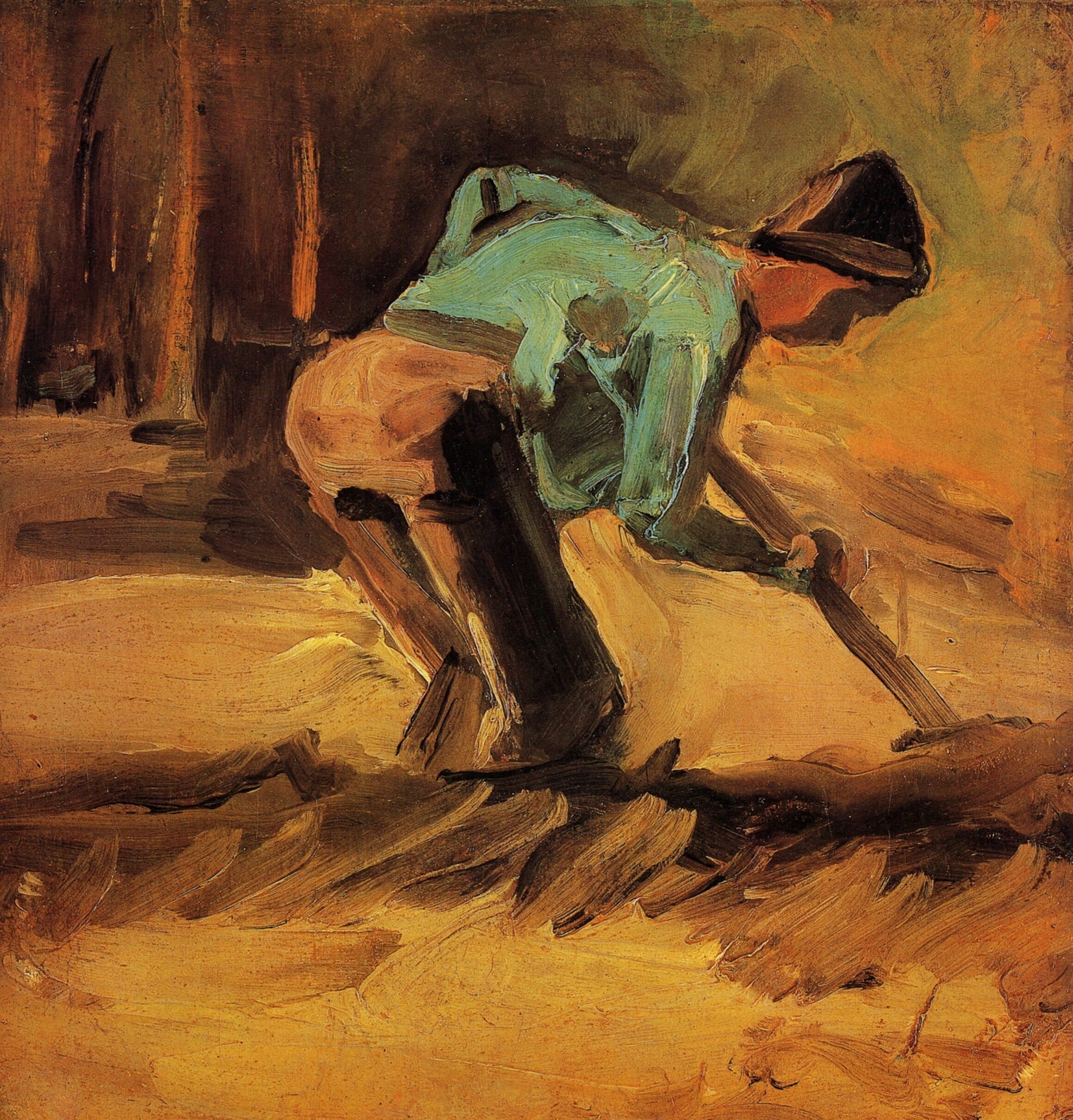
van goghShovels, or spades as they once were called, were another fundamental tool. Holes needed to be dug to support log cabins, turf was often used as roofing material, and a spade would be necessary to cut out those blocks.


Many of the early settlers had root cellars that would preserve food as the temperature was more stable. Even a small root cellar required a whole lot of digging! Pioneers also used shovels for the same things we do today — planting vegetable gardens, cleaning out stalls, and planting trees.


Farming and Planting Tools


Every pioneer would need to do at least some planting in order to survive, even if they only wanted to grow food for themselves and their livestock to survive through the winter.


Therefore, almost every farmer relied on his plow. Whether drawn by hand or pulled by an animal, a featured, pioneers, survival, tools, was an absolute necessity. John Deere invented the first steel plow blade in 1837, but long before that, people used wood or sharp rocks for plow blades.


Hoes were another invaluable tool for farmers. Crops involve much more than just seeds and water; weeds need to be removed. With a sharp hoe, a person can go at a slow walking pace and remove weeds.


Scythes were great for those who could not afford the mechanical horse drawn crop reapers. These slightly curved blades enabled a person to cut crops or clear tall grass and weeds from a standing position.


A tool that many people today are unaware of, which enabled grains to be removed from the husk, is the flail. It’s a simple tool, but quite effective. A flail consists of one larger stick that the person would hold, connected by a chain or hooks to a shorter stick. Harvested grain crops, such as wheat, were placed in a pile, and then the person would beat (thresh) the grain with the small stick, until the husk surrounding the grain fell off.


Household Tools


15 Irreplaceable Tools That Helped The Pioneers Survive

Artist: Hanne Lore Koehler


People of today have it made in the simple process of day-to-day cooking and cleaning.


Washboards were, for many years, exactly as the name implies — nothing more than pieces of rounded wood strips, nailed to a frame. It sounds very primitive, but it must have been in improvement over beating your clothing with sticks or rubbing them over rocks in the river!


Spinning wheels changed the wool from sheep or cotton balls into fibers that could be used to make clothing and blankets. Spinning wheels were used in Europe since at least the year 1250, so it was a common tool that almost every woman knew how to operate.


Once you had the wheat threshed, you needed to grind it into flour. This was done with a little device that some of us today think of as a meat grinder. Pioneer women used this same type of hand-powdered device to grind their grains to make flour.


Get Backup Electrical Power In A Convenient, Portable Briefcase!


Let’s not forget the lowly needle. While many of the needles used by the pioneer women are pretty much the same as the ones we use today, they had a much larger variety that was needed. In addition to the regular clothing that needed to be made or repaired, they had to sew their own blankets, in addition to sew horse blankets and leatherwork. Most saddles would be made by professionals, but the repairs to straps or bridles could be done if one had a large needle.


While most pioneers were very resourceful and independent, they cherished nearby neighbors who could be counted on in a pinch. Common tasks were often shared by neighbors or nearby family members, knowing that when the need arose, they also would benefit from this shared labor. It was not uncommon to see neighbors get together to help build a house for newlyweds or to help out with household chores when a family was sick or having difficulties.


Hunting Tools and Weapons


One of the most useful tools that every pioneer owned was a shotgun. A shotgun was used for protection and as their main source of killing animals for meat. Some of these hardy mountain men also kept pistols as a backup, but the shotgun or rifle was the weapon of choice.


A hunting knife also was an essential tool, and most pioneers had several of them. A good hunting knife was priceless, as it could handle almost every chore or need. It could be used to kill in close quarters, to skin and gut the animal, and to hack off a few branches for wood if necessary. Knives are one of the most versitle tools around, which would explain why  many pioneers, like the indigenous people, had special places to store them so they wouldn’t be misplaced.


Hatchets also were sometimes used in self defense. Many pioneers kept both a hunting knife and a small hatchet on their person at all times.


What tools would you add to our list? Share your thoughts in the section below:

Wednesday, March 8, 2017

5 Gadgets Tested In Real Survival Situations: “What To Carry, And What To Pass Over”

a-bag


Do you have everything you need?


If you had to put back a handful of items from your bug out bag to make room other essentials, which would you choose to carry no matter what, and which would you put back as extra weight?


When compact and lightweight travel matters the most, you might consider a more serious class of multi-tools. With the prepper market exploding, and millions of people wondering what will happen if the economy crashes, or another Great Depression falls upon the troubled land of America, some serious thought has gone into what to carry, and what to pass over.


When the time comes to count on yourself, and little else, you want some well-thought out items that can cover all your needs – both those you considered in advance, as well as all the situations you didn’t see coming.


So, what should you carry? That’s up to you.


But these items speak for themselves. In this YouTube, the people at Zip HD purport to test each clever utility tool, addressing the gimmicks inherent in many similar items. If this video is persuasive at all, these are the next generation, evolved from a mere novelty categorization. Most of these items are made of rugged and reliable materials, an a variety of functions could be used over-and-over – improving upon past devices that would become too flimsy or tangled to put back into their proper place, or to count upon when they are needed most.


More and more, the multi-tool 13-in-1-style functions could actually be useful if needed in a true survival situation, and these preppers detail to pros-and-cons of items you might consider for your bug out bag.


You can find the products via the Zip HD page.


No two preppers will agree on the merits and drawbacks of everything you may need, or simply find useful. Simply acquiring everything, and as many items as possible, may not be beneficial either, and could quickly drain your wallet. Find items that can actually serve your needs, and that would match the surrounding environment you will be dealing with.


Of course, tools alone can’t guarantee how you’ll make it out of a dire situation.


Survival is about a mindset, a well-thought out and instinctively grounded individual who calculates ahead, minimizes risk, meshes with the environment and uses resources wisely.


You’ll need to improvise, make do and get by. It’s worth putting some thought into, because you never know what’s ahead.


A Step-By-Step Guide To Survive Any Disaster


Don’t Be Without These Prepping Essentials: “Survival Fuel You Must Have”


The Six Laws of Survival: Strategies For Beating the Worst Case Scenario


A Green Beret’s Guide to EMP: Practical Steps to Prepare for a “Lights Out” Scenario