 Jeff Sessions hypocritically granted a monopoly on the sale of THC to a company whose drug fentanyl kills tens of thousands a year, while promising to arrest people for a plant.
Showing posts with label opioid. Show all posts
Showing posts with label opioid. Show all posts
Sunday, January 7, 2018
Sessions Wages War on Natural Weed, As He Grants Maker of Fentanyl a Monopoly on Synthetic THC
Jeff Sessions hypocritically granted a monopoly on the sale of THC to a company whose drug fentanyl kills tens of thousands a year, while promising to arrest people for a plant.

Sunday, December 24, 2017
American Life-Expectancy Falls For Second Straight Year As Drug Overdoses Soar
The twin scourges of opioid addiction and worsening wealth inequality are literally draining the lifeblood from the American public. Case in point: The Centers for Disease Control confirmed earlier today that the average life expectancy at birth declined in 2016 for the second consecutive year - the first multiyear decline since 1963, when a flu epidemic led to a rash of deaths as hundreds of thousands of elderly Americans succumbed to the virus.
The increase has been fueled by a 21% rise in drug overdose deaths, according to the Washington Post.
Let that sink in for a second: In 1963, penicillin was a relatively recent innovation. We live in an age of unprecedented medicinal efficacy. Despite this, Americans are sicker than ever before.
And as if that weren’t enough, they’re also spending more on health-care than ever before. Data from the NHE shows the US spent a staggering $3.3 trillion on healthcare in 2016, equivalent to roughly 18% of GDP.

“I think we should take it very seriously,” said Bob Anderson, chief of the Mortality Statistics Branch at the National Center for Health Statistics, told the Washington Post. “If you look at the other developed countries in the world, they’re not seeing this kind of thing. Life expectancy is going up."
As we’ve highlighted time and time again, more than 42,000 Americans died of opioid overdoses alone in 2016 - a 28% increase over 2015. When deaths from drugs such as cocaine, methamphetamine and benzodiazepines are included, the overall increase was 21%.

A multiyear decline in life expectancy is more commonly associated with AIDS epidemics in southern and eastern Africa or wars in Syria and Afghanistan, said Majid Ezzati, a professor of public health at Imperial College London who has studied life expectancy.
“The story does come down to young people,” he said. “It’s the overdose story, to a large extent."
Last year - when the CDC data showed the first annualized drop in life expectancy since the early 1990s - public health observers declared that this could be the beginning of a seriously troubling trend that could have far reaching repercussions for the US economy. Experts, including Nobel Prize winner Angus Deaton, examined the impact of so-called “diseases of despair” - drug overdoses, suicides and alcoholism - as well as small increases in deaths from heart disease, strokes and diabetes as the Baby Boom generation ages into retirement.
Furthermore, the 2016 data shows that just three major causes of death are responsible: unintentional injuries, Alzheimer’s disease and suicides, with the bulk of the difference attributable to the 63,632 people who died of overdoses. That total was an increase of more than 11,000 over the 52,404 who died of the same cause in 2015. This trend was largely driven by deaths from fentanyl and other synthetic opioids, which more than doubled from the previous year. Heroin and prescription opioid overdose deaths also rose, but more modestly.
At the same time, a long decline in deaths from heart disease continued a six-year trend of leveling out, Anderson said. The small decrease last year in the rate of the nation’s leading cause of death no longer canceled the drug epidemic’s impact on life expectancy, Anderson said.
“The key factor is the increase in drug overdose deaths,” he said.
Overall, life expectancy dropped by a tenth of a year, from 78.7 to 78.6. It fell two-tenths of a year for men, who have much higher overdose death rates, from 76.3 to 76.1 years. Women’s life expectancy held steady at 81.1 years.

While drug mortality has been increasing among all age groups since 1999, it’s highest among those ages 25 to 54. Their fatal overdose rate for all drugs was roughly 35 cases per 100,000 individuals in 2016, compared with 12 deaths per 100,000 for people under 24 and six deaths per 100,000 among seniors 65 and older.
Examining this data through the lens of gender reveals another startling detail: The bulk of this increase is driven by a spike in overdose deaths among men.
As WaPo points out, men of all ages (26 deaths per 100,000) are twice as likely to die of a drug overdose as women (13 per 100,000). At the state level, West Virginia stands alone as the epicenter of overdose mortality, with 52 deaths per 100,000 residents in 2016. The next two states, New Hampshire and Ohio, each saw 39 deaths per 100,000 last year.
“This is no longer an opioid crisis,” said Patrick Kennedy, a former Rhode Island congressman who was a member of President Trump’s Commission on Combating Drug Addiction and the Opioid Crisis. “This is a moral crisis . . . we know how to answer this problem, but we can’t get around our own prejudices."
During the campaign, President Trump promised to do everything in his power to combat the opioid epidemic. But so far, his actions have fallen far short of the recommendations from a committee that he created in March to study options to suppress the crisis. Most notably, Trump ignored a recommendation from the committee to declare the opioid crisis a national emergency - a designation that would’ve allowed the hardest-hit states to access federal disaster-relief funds. Instead Trump declared it a national health crisis, leaving states empty-handed.
Another factor that shows just how damaging opioids have been to the American public: last year, rates of heart disease, cancer, chronic lower respiratory diseases, strokes, diabetes, influenza and pneumonia, and kidney disease fell, as did the nation’s overall death rate. But this wasn’t enough to offset the impact of opioids.
Increasing incidences of Alzheimer’s disease have also contributed to this trend.
“As people avoid [cancer and heart disease], they’re going to survive long enough to die of Alzheimer’s,” he said.
And while only limited provisional data is available for 2017, things don’t look any better.
“My guess is that when all of the data are in that the [2017] trend line will be at least as steep as for 2016, if not steeper,” Anderson said.
And in case you wondered what all this has to do with me... apart from it"s "your" life expectancy, well this is what happened to the only thing that really matters to everyone... The Dow... the last time that US life expectancy dropped for two straight years...


Thursday, November 30, 2017
Kellyanne Conway Will Be White House Opioid Czar
President Trump is finally acquiescing to his opioid commission’s recommendation that he swiftly appoint an “opioid czar” to coordinate the federal government’s response to the rapidly worsening opioid epidemic.
And his pick is: Former campaign manager and West Wing strategist Kellyanne Conway, according to Buzzfeed. The pick is significant: Thanks to her frequent television appearances both now and during the campaign, Conway is one of the administration’s most visible figures. Tom Marino, Trump"s previous nominee for the position, withdrew after it was revealed he pushed for a bill that made it harder for law enforcement to crack down on opioid drug manufacturers.
As many are already aware, drug-overdose deaths have skyrocketed in recent years, driven primarily by opioids, particularly powerful synthetic opioid drugs that have tainted the US heroin supply and have led to an unprecedented number of accidental overdoses. Last year alone, it’s estimated that 64,000 Americans died from drug overdoses.
Attorney General Jeff Sessions announced that Conway would be coordinating the opioid response effort from the White House. Of course, the position of director of the Office of National Drug Control Policy, another agency that would presumably be heavily involved in the administration"s response, remains vacant since Marino withdrew his name from consideration.

The opioid crisis played heavily in Trump’s campaign rhetoric and after taking office he appointed a commission led by New Jersey Gov. Chris Christie to compile a report on effective strategies for combating the crisis. The committee issued more than 50 recommendations, most of which have yet to be implemented, and many likely never will be. Last month, Trump declared the opioid abuse epidemic a national public health crisis, but declined to declare it a national emergency, which would’ve allowed states to receive federal disaster relief funding.
"It is a positive sign, she is a high profile figure in the administration, showing the administration takes this seriously," opioid policy expert Andrew Kolodny of Brandeis University told BuzzFeed News.
But Kolodny noted the administration still hasn"t named a head for its Office of National Drug Control Policy (ONDCP), or released a strategy to combat the crisis (one is promised in February), or requested any money from Congress to fill the depleted national public health emergency fund — now down to $66,000 — to pay for its health emergency declaration.
Trump has asked her "to coordinate and lead the effort from the White House," Sessions said at a news conference in remarks that went beyond prepared ones from the event. Sessions also announced $12 million in grants to state and local police departments, and the opening of a new Drug Enforcement Agency field office in Louisville to combat illicit opioid use in Appalachia. He also ordered each US attorney"s office to name an opioid coordinator.
"I know that this crisis is daunting — the death rates are stunning — and it can be discouraging," Sessions said. "But we will turn the tide."
When Christie’s commission was working, Conway sat in on many of the panel"s meetings and has been heavily involved with crafting the administration"s response to the crisis. Sessions touted Conway"s communication skills at the news conference, perhaps signaling an administration push for public service announcements aimed at changing public attitudes towards opioid addiction.
"Stemming overdose deaths will take a broad interagency approach led by someone with a singular focus and extensive knowledge of the drivers of - and solutions to the epidemic," former ONDCP official Regina LaBelle told BuzzFeed. "Therefore, a Senate confirmed Director of National Drug Control Policy should lead this effort."
Calls for Trump to appoint an opioid czar have intensified in recent days. Earlier this week, Axios published a list of reasons why Trump should appoint someone to coordinate the federal government"s response to the epidemic. Axios made the case for appointing a White House drug policy coordinator, the path Trump eventually chose.
"There"s only so much money and human capacity to go around. A centralized authority figure could help make sure agencies aren"t duplicating each other"s work, and set priorities those agencies might not arrive at on their own, but which would contribute more to the broader, inter-agency effort."
However, apparently not everybody agrees on the need to appoint an opioid czar. At a congressional hearing in Baltimore on Tuesday, Christie, who headed a presidential report panel on the opioid crisis, had called the clamor for a US opioids czar "overblown." The steps needed to counter the overdose crisis are well understood, he said, starting with limiting over-prescriptions of painkillers, cutting fentanyl exports from China, and providing the overdose remedy naloxone to communities, and don"t need a czar to kick start.


Saturday, October 28, 2017
OxyContin Nation: Meet The Billionaire Family Who Helped Spark America"s Opiod Crisis
Unbeknownst to many, the Sackler Family, with assets of $13 billion, the nation’s 19th wealthiest family is one the top players in philanthropy. You can find the Sackler Gallery in the Smithsonian museum in Washington, D.C. or visit the Sackler wing at the Metropolitan Museum of Art in New York City. The Sackler’s even have a museum at Harvard, Guggenheim, and dozen of universities around the country. If it’s art— the Sackler family has it.
Participating in the art game takes money and a lot of it. So, where does the Sackler money come from?

According to Forbes, the “Sacklers continue to reap hundreds of millions of dollars in profits from the businesses in 2016– some $700 million last year, by Forbes’ calculations - from an estimated $3 billion in Purdue Pharma revenues plus at least $1.5 billion in sales from their foreign companies”.
Forbes outlines a brief history lesson of how the Sackler family got started in the world of medicine-
The family fortune began in 1952 when three doctors — Arthur (d. 1987), Mortimer (d. 2010) and Raymond Sackler — purchased Purdue, then a small and struggling New York drug manufacturer. The company spent decades selling products like earwax remover and laxatives before moving into pain medications by the late 1980s. To create OxyContin, Purdue married oxycodone, a generic painkiller, with a time-release mechanism to combat abuse by spreading the drug’s effects over a half-day.
The FDA approved the medication in 1995 and it soon took off. By 2003 OxyContin sales hit $1.6 billion as the drug helped drive a huge nationwide spike in opioid prescribing. At its peak in 2012, doctors wrote more than 282 million prescriptions for opioid painkillers, including OxyContin, Vicodin and Percocet — nearly enough for every American to have a bottle.
Now opioid prescriptions are declining amid increased scrutiny over drug addiction, down 12% since 2012 according to data from healthcare information firm IMS Health. OxyContin (which is also beginning to face competition from authorized generics while fighting to protect its patents over tamper-proof, extended-release oxycodone) saw prescriptions fall 17%.
It wasn’t until the 1980’s, as explained by Forbes, the Sackler family through their family-owned drug company called Purdue Pharma created OxyContin. Then in 1995, the FDA approved the medication and sales exploded. Sales hit $1.6 billion in 2003, as a nationwide spike in opioids was seen. By the peak in 2012, doctors wrote more than 282 million prescription for opioid painkillers, such as OxyContin, Vicodin and Percocet. Good times for the Sacklers from 1996- 2012, as the family drug business exploded.

According to The New Yorker, Oxycontin ” has reportedly generated some thirty-five billion dollars in revenue for Purdue” since 1995. OxyContin’s sole active ingredient is oxycodone, a chemical cousin of heroin, which makes it highly addictive.
The New Yorker further says Purdue used marketing techniques to deceive the American public of the drug’s true addictive characteristics.
Purdue launched OxyContin with a marketing campaign that attempted to counter this attitude and change the prescribing habits of doctors. The company funded research and paid doctors to make the case that concerns about opioid addiction were overblown, and that OxyContin could safely treat an ever-wider range of maladies. Sales representatives marketed OxyContin as a product “to start with and to stay with.” Millions of patients found the drug to be a vital salve for excruciating pain. But many others grew so hooked on it that, between doses, they experienced debilitating withdrawal.
Oddly enough, around the time OxyContin was approved, prescription opioid deaths across the United States surged. Fast forward to more relevant times, where heroin and fentanyl deaths are exploding.

Diving into the opioid crisis onto the streets of Baltimore. It’s very common to see local citizens shooting up heroin on city streets. In this video, I asked a man how did this addiction start? Guess what he said?... It all started with legal painkillers, such as OxyContin.
As a few parasitical elites make billions flooding America’s streets with opioids. We the every day American citizen have to deal with the consequences, as President Trump outlined in yesterday’s opioid crisis speech:
- In 2016, more than two million Americans had an addiction to prescription or illicit opioids.
- Since 2000, over 300,000 Americans have died from overdoses involving opioids.
- Drug overdoses are now the leading cause of injury death in the United States, outnumbering both traffic crashes and gun-related deaths.
- In 2015, there were 52,404 drug overdose deaths — 33,091 of those deaths, almost two-thirds, involved the use of opioids.
- The situation has only gotten worse, with drug overdose deaths in 2016 expected to exceed 64,000.
- This represents a rate of 175 deaths a day.
Bottomline: It’s time for the American people to learn the truth about the opioid crisis and the very few elites who have profited. The question You should ask: why did our government allow this to happen?


Tuesday, October 17, 2017
Ex-DEA Agent Blasts Congress And Drug Industry For Creating The Opioid Crisis
Authored by Mac Slavo via SHTFplan.com,
Whistleblower Joe Rannazzisi is telling all when it comes to placing blame for the nation’s opioid crisis. He says drug distributors pumped opioids into communities in the United States knowing that people were dying and that the US government is helping.

Joe Rannazzisi is a tough and blunt former DEA (Drug Enforcement Administration) deputy assistant administrator with a law degree, a pharmacy degree, and a growing rage at the unrelenting death toll from opioids. Congress has often been complicit in atrocities, especially when a politician profits off of the removal of the rights of others. So it should not come as a surprise that Rannazzisi is blaming Congress and the drug industry for the opioid epidemic gripping the nation.
Rannazzisi ran the DEA’s Office of Diversion Control, the division that regulates and investigates the pharmaceutical industry. Now in a joint investigation by 60 Minutes and The Washington Post, Rannazzisi tells the inside story of how, he says, the opioid crisis was allowed to spread. Its quick spread was also aided by Congress, lobbyists, and a drug distribution industry that shipped, almost unchecked, hundreds of millions of pills to rogue pharmacies and pain clinics providing the rocket fuel for a crisis that, over the last two decades, has claimed 200,000 lives.
The DEA responded to the explosive report that the government is helping keep Americans addicted to opioids so that pharmaceutical companies can continue to boast big profits. The DEA says it has taken actions against far fewer opioid distributors under a new law. A Justice Department memo shows 65 doctors, pharmacies, and drug companies received suspension orders in 2011. Only six of them have gotten them this year.
“During the past seven years, we have removed approximately 900 registrations annually, preventing reckless doctors and rogue businesses from making an already troubling problem worse,” the DEA said in a written statement.
“Increasingly, our investigators initiated more than 10,000 cases and averaged more than 2,000 arrests per year.”
But Rannazzisi says this is an industry that is out of control and the DEA isn’t making a dent in this crisis.
“What they [big pharma] wanna do, is do what they wanna do, and not worry about what the law is. And if they don’t follow the law in drug supply, people die. That’s just it. People die.”
The harsh reality is that the burgeoning issue of the opioid epidemic is lining the pockets of the pharmaceutical industry and the politicians who help fuel it, so there’s no real rush to stem the bleeding of this crisis.
“This is an industry that allowed millions and millions of drugs to go into bad pharmacies and doctors’ offices, that distributed them out to people who had no legitimate need for those drugs,” Rannazzisi said.
Most of his anger is reserved for the distributors of opioid drugs. Some of them are actually multibillion-dollar, Fortune 500 companies. They are the middlemen that ship the pain pills from manufacturers, like Purdue Pharma and Johnson & Johnson to drug stores all over the country. Rannazzisi accuses the distributors of fueling the opioid epidemic by turning a blind eye to pain pills being diverted to illicit use.
“This is an industry that allowed millions and millions of drugs to go into bad pharmacies and doctors’ offices, that distributed them out to people who had no legitimate need for those drugs,” Rannazzisi said.
“The three largest distributors are Cardinal Health, McKesson, and AmerisourceBergen. They control probably 85 or 90 percent of the drugs going downstream,” he added when prompted.
Rannazzisi said it’s a “fact” that the big pharmaceutical companies knew they were pumping drugs into people unnecessarily for profits and that people were dying.
In the late 1990s, opioids like oxycodone and hydrocodone became a routine medical treatment for chronic pain. Drug companies assured doctors and congressional investigators that the pain medications were effective and safe. With many doctors convinced the drugs posed few risks, prescriptions skyrocketed and so did addiction.
Big pharma had a plan. It was solely a business plan. Their plan was to sell a lotta pills and make a lot of money. And they did both of those very well.
Saturday, October 14, 2017
"Enough To Kill 5 Million People": Authorities Make One Of Biggest Fentanyl Busts In History
The Acting United States Attorney for the District of Nebraska announced earlier this morning that a joint force involving both the Drug Enforcement Administration and Nebraska State Patrol made one of the largest fentanyl busts in the history of the country. According to authorities, 27 year old Edgar Navarro-Aguirre of California was arrested at an Amtrak station in Omaha carrying 15 kilos (33 pounds) of the deadly opioid. Here is more from a local NBC affiliate:
Navarro-Aguirre was traveling on the Amtrak train and waiting at the station when a Drug Enforcement Administration agent was doing a routine surveillance there and noticed a suspicious person with a bag.
"We have officers that are trained to pick out people that are different than the normal traveling public," Nebraska State Patrol Lt. Jason Scott said.
According to an affidavit, Navarro-Aguirre said it was his friend"s bag, and he denied that anything illegal was inside.
Inside Navarro-Aguirre"s luggage was 15 vacuum-sealed bundles of what forensic chemists determined was pure or nearly pure fentanyl.
"This fentanyl seizure is the largest ever in Nebraska and one of the largest in the nation," a news released from the U.S. Attorney"s Office said.

For those who may not be familiar with this deadly epidemic, fentanyl is a synthetic opioid that is 40-50 times more potent than herion and has resulted in a wave of overdoses across the country, and particularly in the midwest. Experts say it only takes a small amount, about 3 milligrams, for the drug to be fatal.
"This is playing Russian Roulette knowing every cylinder has a bullet in it," DEA Associate Special Agent in Charge Matt Barden said.
With that in mind, the amount seized by authorities in its pure form would be enough to kill approximately 4.9 million people, or nearly the entire populations of Iowa and Nebraska.
"I think it was literally one mishap away from something extremely tragic for Nebraska," Lt. Scott said, "dropping a suitcase or it being cut open, this is in a public venue, this was not in a private room."
As the New York Times pointed out last month, fentanyl is estimated to have killed over 20,000 people in the U.S. in 2016, a 5x increase over just a couple of years.
Drug overdoses killed roughly 64,000 people in the United States last year, according to the first governmental account of nationwide drug deaths to cover all of 2016. It’s a staggering rise of more than 22 percent over the 52,404 drug deaths recorded the previous year — and even higher than The New York Times’s estimate in June, which was based on earlier preliminary data.
Drug overdoses are expected to remain the leading cause of death for Americans under 50, as synthetic opioids — primarily fentanyl and its analogues — continue to push the death count higher. Drug deaths involving fentanyl more than doubled from 2015 to 2016, accompanied by an upturn in deaths involving cocaine and methamphetamine. Together they add up to an epidemic of drug overdoses that is killing people at a faster rate than the H.I.V. epidemic at its peak.
The explosion in fentanyl deaths and the persistence of widespread opioid addiction have swamped local and state resources. Communities say their budgets are being strained by the additional needs — for increased police and medical care, for widespread naloxone distribution and for a stronger foster care system that can handle the swelling number of neglected or orphaned children.

Navarro-Aguirre is facing a charge of possession with intent to distribute 400 grams or more of a mixture or substance containing fentanyl. The penalty carries a minimum of 10 years with a maximum of life in prison. The 27-year-old will appear in federal court Friday afternoon.
Monday, October 2, 2017
Visualizing America's Disappearing Workforce
In his September 2017 paper entitled "Where Have All the Workers Gone? An Inquiry into the Decline of the U.S. Labor Force Participation Rate", Alan B. Krueger of Princeton University explores the dramatic fall in labor force participation in the U.S. from 1997 to 2017.
As Statista"s Martin Armstrong shows in the infographic below, over the last twenty years, the rate has fallen the most for the under 20"s, with the share of 16 to 17 year olds in work dropping by 18.4 and 16.2 percentage points for men and women, respectively.
You will find more statistics at Statista
As Krueger reports, last year, Italy was the only OECD country which had a lower participation rate of prime age men than the United States. One of the reasons posited by the research is the opioid crisis currently ravaging the country. Labor force participation rates have fallen more in areas where more opioid pain medication is prescribed. According to the Centers for Disease Control and Prevention, the amount of opioids prescribed in 2015 was three times higher than it was in 1999.
As noted in the paper, while the direction of causality is not clear, a 2017 report by David Mericle entitled "The Opioid Epidemic and the U.S. Economy" states that “the opioid epidemic is intertwined with the story of declining prime-age participation, especially for men, and this reinforces our doubts about a rebound in the participation rate.”
But as we pointed out previously, after spending months, or maybe even years, running very complicated regressions that your simple mind could never possibly understand, Krueger would like for you to believe that it"s the growing opioid epidemic that is forcing men to sit on their couches all day rather than look for work. Here"s a summary of his findings from the Brookings Institute:
The increase in opioid prescriptions from 1999 to 2015 could account for about 20 percent of the observed decline in men’s labor force participation (LFP) during that same period.
In “Where have all the workers gone? An inquiry into the decline of the U.S. labor force participation rate” (PDF), Princeton University’s Alan Krueger examines the labor force implications of the opioid epidemic on a local and national level.
Among other findings, the research suggests that:
- Regional variation in opioid prescription rates across the U.S. is due in large part to differences in medical practices, rather than varying health conditions. Pain medication is more widely used in counties where health care professionals prescribe greater quantities of opioid medication, with a 10 percent increase in opioid prescriptions per capita is associated with a 2 percent increase in the share of individuals who report taking a pain medication on any given day. When accounting for individuals’ disability status, self-reported health, and demographic characteristics, the effect is cut roughly in half, but remains statistically significant.
- Over the last 15 years, LFP fell more in counties where more opioids were prescribed. Krueger reaches this conclusion by linking 2015 county-level opioid prescription rates to individual level labor force data in 1999-2001 and 2014-16. For more on the relationship between prescription rates and labor force participation rate on the county-level.
Krueger also provided this very helpful map proving that opioid abuse is highly correlated to unemployment. Of course, it couldn"t possibly be the case that opioid abuse is the result of high unemployment and the associated depression that goes along with it...no, the opioid abuse definitely came first.

So, what is Krueger"s solution to help reverse the seemingly perpetual decline in labor force participation rates? If you guessed "Obamacare" then you"re absolutely right...and unfortunately, no, that is not a joke...here is the excerpt from page 38 of Krueger"s paper:
Third, addressing the decades-long slide in labor force participation by prime age men should be a national priority. This group expresses low levels of SWB and reports finding relatively little meaning in their daily activities. Because nearly half of this group reported being in poor health, it may be possible for expanded health insurance coverage and preventative care under the Affordable Care Act to positively affect the health of prime age men going forward.
And while we would never presume to be smart enough to question the very thorough, impartial research of a Princeton economist, we do wonder whether it"s in any way relevant that labor force participation rates seemingly started to decline in 1965...

...at exactly the same time that welfare spending started to surge?

It"s probably just a coincidence.
Tuesday, September 12, 2017
Inside The Opioid Crisis: What The Mainstream Media Won't Let You See
America’s opioid crisis is accelerating and could kill nearly ‘half a million people’ over the next decade.

The epidemic is now killing 100 people every day, fueling a public-health crisis draining the resources of the economy. Overdoes and deaths have been on the rise for decades, but in most recent times American’s prime working age males (25-54) have been ravaged by the crisis. This is a cause for concern…
Princeton professor and former Obama White House economist Alan Krueger is out with a Bookings paper titled: Where Have All the Workers Gone? An Inquiry Into The Decline Of The U.S. Labor Force Participation Rate. In the report, Krueger gives it his best to correlate the “mushrooming opioid crisis in the U.S. since the early 2000’s” in connection between the use of “pain medication and opioid prescription rates” with the declining labor force of prime age males.
According to the author’s calculations…. 47% of men age 25-54 take pain medication.

In a classic ‘bait and switch’ marketing tactic, the Federal Reserve’s transitory narrative is running out of time. To be safe, Fed officials have started countering their narrative of ‘rainbows and unicorns’ with talk of an existential threat called the opioid crisis.
“We are seeing, as I mentioned, an increase in death rates — which is extremely unusual,” Yellen said last week. That trend is “partly reflecting opioid use, and it is obviously a very serious and heartbreaking problem.”
On a per annum basis, opioid deaths are forecasted to increase 21% from 2015 33,091 to 2027 40,000. The forecast in deaths indicate the crisis is only accelerating. Should we say the blowoff top phase has started?

There are much larger trends at play and the opioid crisis is just a symptom of extreme wealth inequality in the United States.

In terms of wealth inequality, the American middle class has not earned their fair share of wages & salaries as % GDP in decades. The trend exemplifies the cry of the bottom 90% of Americans who have turned to opioids to escape the physical and or figurative pain of not being able to achieve the American Dream.

In Baltimore, a city with a population 621k and of that 63% are African American. JPM reports nearly 129k Africans Americans in the inner city have a net worth of zero. Yes, JPM said it correctly… ZERO.

Many in Baltimore’s inner city have escaped the physical and mental pain with the use of opioids. With-in these areas of limited opportunity and a city that is outright shrinking— the area has an abundance of methadone clinics. Last month, we exposed America’s largest methadone clinic residing on the east side of Baltimore, where the homicide rate is doubled of Chicago’s.
Diving further down the rabbit hole. I’m going to share with you raw footage of inside the opioid crisis destroying America from with-in. As always, the mainstream media is not allowed to share this with you, because it destroys the narrative that everything is awesome.
In the first interview, Alastair Williamson interviews Anthony ‘Tonyluck’, a prime age male at the end of the bracket (53) and former heroin addict in Baltimore’s east side. Anthony’s interview consists of socio-economic topics coming straight from the source that is not censored like mainstream media. At the end of the interview, he makes a great point of how the we can conquer countries through war, but we can’t win the war on our city streets.
About 120 feet to the left of Anthony’s interview, we spotted a prime age male who actually collapsed from opioid use during the interview. After the interview was over, I was able to film a snapshot of one reason why America’s productivity is being drained. FYI, the location is just blocks away from America’s largest methadone clinic.
Down the street, I stumbled across ‘Cashland’, a prime working age male, who is a current heroin user. He talks about his history of addiction and how methadone clinics keep you in a perpetual state of addiction. Half way through the interview he says “the system is setup for us to fail”. Throughout the interview, ‘Cashland’ is shooting up heroin. You’re hearing it right from the source of what is happening in the opioid crisis. At the end of interview, ‘Cashland’ passes out from the opioid injection.
Conclusion
The opioid crisis is a lot worse than we thought. Government and the Federal Reserve are powerless with the next leg up in the crisis underway. No matter how you see it, America is in structural decline. Officials are now diverting blame to the opioid crisis rather than their failed policies. In reality, the opioid crisis is just a a symptom of a dying empire where wealth inequality is wide through failed Central Bank monetary policies. After decades of finacialization in America, the side effects are finally showing its ugly head. Heed the warning….
Sunday, September 10, 2017
Here Are The California Counties Where Annual Opioid Scripts Outnumber People
The California Department of Public Health just dropped some staggering statistics about the level of opioid abuse in America"s progressive paradise of the left coast. As the Sacramento Bee points out, there are a remarkable number of counties in California where annual prescriptions for pain killers actually exceed the population.
Trinity County is the state’s fourth-smallest, and ended last year with an estimated population of 13,628 people.
Its residents also filled prescriptions for oxycodone, hydrocodone and other opioids 18,439 times, the highest per capita rate in California.
Besides Trinity, other counties with more prescriptions than people include Lake, Shasta, Tuolumne and Del Norte counties. In the Sacramento region, El Dorado, Placer and Sacramento counties had prescription rates above the statewide average, with Yolo County slightly below the state average.
A county’s prescription total represents all opioids dispensed via prescriptions filled at a pharmacy and tracked by the state. Statewide, 15 percent of Californians were prescribed opioids in 2016, ranging from 7.3 percent of residents in tiny Alpine County to almost 27 percent in Lake County.
As might be expected, the scripts per capita are highest in California"s more rural northern counties.

So who is participating most in this deadly epidemic? Well, according the Centers for Disease Control and Prevention, the biggest abusers of opioids are high-school educated, unemployed, white people living in small towns...
“The following characteristics were associated with higher amounts of opioids prescribed: a larger percentage of non-Hispanic whites; higher rates of uninsured and Medicaid enrollment; lower educational attainment; higher rates of unemployment; (small-town) status; more dentists and physicians per capita; a higher prevalence of diagnosed diabetes, arthritis, and disability; and higher suicide rates,” concluded the authors of a Centers for Disease Control and Prevention study released in July.
“What you’re seeing in California is what you’re seeing in many parts of the country, including Oregon,” Korthuis said. “There are still a lot of rural counties around the U.S. that are awash in prescription opioids.”
...oh, and grandma and grandpa are getting high on the reg as well.
In California, residents aged 15 to 29 got 1.7 million prescriptions in 2016, representing 7.2 percent of the state total. That’s down from the 1.9 million prescriptions in 2015, which represented about 7.8 percent of the state total. The age range that featured the largest prescription rate increase were 70- to74-year-olds, whose prescriptions grew from almost 1,354 per 1,000 people in 2015 to 1,394 per 1,000 people in 2016.

Of course, growth in opioid addiction is hardly just a California phenomenon. According to the CDC"s Annual Surveillance Report of Drug-Related Risks and Outcomes, addiction-related deaths are far more prevalent in the rural "rust-belt" states of the Midwest.

Meanwhile, the epidemic is growing far more severe every year with overdose deaths up 167% across the country since 1999.
The rate of drug overdose deaths increased from 6.1 per 100,000 population in 1999 to 16.3 in 2015; for unintenttional drug overdose deaths, the rate increased from 4.0 per 100,000 in 1999 to 13.8 in 2015; for drug overdose deaths involving any opioid, the rate increased from 2.9 per 100,000 in 1999 to 10.4 in 2015 (p<0.05); for unintenttional drug overdose deaths involving any opioid, the rate increased from 2.1 per 100,000 in 1999 to 9.3 per 100,000 in 2015 (p<0.05). For all four categories of drug overdose deaths, increases in rates were largest from 2013 to 2015, with the rate increasing on average by 9% per year for overall drug overdose deaths (p<0.05), 11% per year for unintenttional drug overdose deaths (p<0.05), 15% per year for drug overdose deaths involving any opioid (p<0.05), and 16% for unintenttional drug overdose deaths involving any opioid (p<0.05).

But don"t worry too much because, as Princeton Economist Alan Krueger told us yesterday, there is a simple solution to the opioid epidemic in the U.S...apparently it can all be solved with just a little more Obamacare.
Saturday, September 9, 2017
Princeton Economist: Nearly Half Of Working Age Men Not In The Labor Force Take Opioids Daily
Esteemed Princeton professor and former Obama White House economist Alan Krueger is back with yet another prediction about why Americans, particularly men between the ages of 25-54, suddenly no longer have any interest in working. In his report, entitled "Where Have All The Workers Gone? An Inquiry Into The Decline Of The U.S. Labor Force Participation Rate," Krueger ponders the data below which reveal that the labor force participation rate among men, aged 25-54, started dropping around 1965 and has been steadily declining ever since.

Of course, it couldn"t possibly have anything to do with stagnant real wages or soaring entitlements that have provided massive, and increasing, disincentives to work over the past several decades.
No, after spending months, or maybe even years, running very complicated regressions that your simple mind could never possibly understand, Krueger would like for you to know that it"s the growing opioid epidemic that is forcing men to sit on their couches all day rather than look for work. Here"s a summary of his findings from the Brookings Institute:
The increase in opioid prescriptions from 1999 to 2015 could account for about 20 percent of the observed decline in men’s labor force participation (LFP) during that same period.
In “Where have all the workers gone? An inquiry into the decline of the U.S. labor force participation rate” (PDF), Princeton University’s Alan Krueger examines the labor force implications of the opioid epidemic on a local and national level.
Among other findings, the research suggests that:
- Regional variation in opioid prescription rates across the U.S. is due in large part to differences in medical practices, rather than varying health conditions. Pain medication is more widely used in counties where health care professionals prescribe greater quantities of opioid medication, with a 10 percent increase in opioid prescriptions per capita is associated with a 2 percent increase in the share of individuals who report taking a pain medication on any given day. When accounting for individuals’ disability status, self-reported health, and demographic characteristics, the effect is cut roughly in half, but remains statistically significant.
- Over the last 15 years, LFP fell more in counties where more opioids were prescribed. Krueger reaches this conclusion by linking 2015 county-level opioid prescription rates to individual level labor force data in 1999-2001 and 2014-16. For more on the relationship between prescription rates and labor force participation rate on the county-level.
Krueger also provided this very helpful map proving that opioid abuse is highly correlated to unemployment. Of course, it couldn"t possibly be the case that opioid abuse is the result of high unemployment and the associated depression that goes along with it...no, the opioid abuse definitely came first.
So, what is Krueger"s solution to help reverse the seemingly perpetual decline in labor force participation rates? If you guessed "Obamacare" then you"re absolutely right...and unfortunately, no, that is not a joke...here is the excerpt from page 38 of Krueger"s paper:
Third, addressing the decades-long slide in labor force participation by prime age men should be a national priority. This group expresses low levels of SWB and reports finding relatively little meaning in their daily activities. Because nearly half of this group reported being in poor health, it may be possible for expanded health insurance coverage and preventative care under the Affordable Care Act to positively affect the health of prime age men going forward.
And while we would never presume to be smart enough to question the very thorough, impartial research of a Princeton economist, we do wonder whether it"s in any way relevant that labor force participation rates seemingly started to decline in 1965...
...at exactly the same time that welfare spending started to surge?
It"s probably just a coincidence.
Thursday, August 31, 2017
Opioid Epidemic of Fraud

Collusion between Big Pharma and the federal government is to blame for the current opioid epidemic in the U.S., says a team of Harvard researchers.
The authors of “The Opioid Epidemic: Fixing a Broken Pharmaceutical Market” cite estimates from the American Society of Addiction of Medicine that over 2.5 million Americans now have an opioid use disorder.
The study outlines how Big Pharma’s fraudulent marketing practices combined with the federal government’s enabling of patent schemes have fueled an epidemic that costs society $80 billion/year.
Not surprisingly, the perpetrators of this medical, social and economic disaster are never held accountable:
But no one ever goes to jail; no one in top management is ever held to account. The persons in “personhood” conveniently disappear when corporations get in trouble. And the fines? Mere pocket change compared to the revenues already made from the drugs involved
Read ‘The Opioid Epidemic: Fixing a Broken Pharmaceutical Market’
Create your own review
Average rating:
0 reviews
0 reviews
Wednesday, August 16, 2017
Inside The Opioid Crisis That You're Not Allowed To See
Earlier this month, U.S. Attorney General Jeff Sessions unveiled a plan to go after doctors and pharmacies suspected of healthcare fraud by oversubscribing opioids. America’s opioid epidemic killed 33,000 people in 2015 making it the worst drug crisis in our history. Last week, President Donald Trump declared the opioid crisis a national emergency allowing the executive branch to direct funds towards treatment facilities and supplying police officers with naloxone.
As a socio-economist on the front lines of the opioid crisis in Baltimore, Maryland, I am about to take you through an opioid experience like you’ve never seen before. We’re going to travel into the inner city of Baltimore and interview current and former addicts of opioids and heroin. Some of these individuals used heroin 15-minutes before the cameras started rolling.
These individuals have never been given the chance to tell their story until now. Baltimore’s mainstream news is not allowed to share this because it breaks the narrative that everything is awesome. It turns out that Baltimore could have the largest methadone clinic in the United States called Turning Point Clinic. Each of the interviewees are current and past patients of the clinic and speak very negatively about it. A similar description of Baltimore is heard from each of the interviewees of a hellacious city with decades of deindustrialization, drug abuse, and violent crime.
In the first video, three women who are current or past addicts of opioids tell the story of clinics, doctors, and pharmacies flooding the street of Baltimore with opioids. Gina mainly speaks about the Turning Point Clinic - how a preacher who operates the facility went from “nothing to now wearing $1000 gators, flying private jets, and driving Bentleys”. As described by one of the women, it looks like ‘zombie-land’ outside of the clinic.
In the second video, Gina speaks about her addiction to opioids and how she overcame the troubles through a strong-will. The next women to speak is Wanda, who is currently in pain management at Turning Point Clinic and speaks about how the opioid crisis is destroying America’s youth. I then ask the question about record number of homicides in Baltimore, and Wanda says opioids are a big part of that.
In the third video, ‘John Doe’ shot up on heroin 15-minutes before giving us the interview. He is an active patient at the Turning Point Clinic and describes it to be the largest methadone clinic in the United States with 6k-10k patients per day. The illegal activity and the corruption around this clinic is highlighted in the video via ‘John Doe’ statements, along with truth bombs that will not disappointment.
Conclusion
We now have an understanding that opioids are big business in the hood. You’re not allowed to know about this, because only a select few in our society are allowed to prosper from it. It’s unfortunate that drug trade is the most prevalent type of good flowing around low income areas across the United States. We wouldn’t expect nothing else after 50-years of deindustrialization and the bottom 90% of Americans left to rot.
America’s inner cities have to change or the collapse of an empire is on the horizon. Doesn’t help when 96 million Americans are out of the workforce.
Wednesday, August 9, 2017
The Opioid Crisis Is Even Worse Than We Thought
America’s opioid epidemic is now killing more than 100 people every day, fueling a public-health crisis that’s straining state and local resources – even forcing at least one Pennsylvania coroner to increase his freezer capacity to make room for all of the bodies.
And according to one recently published study, the epidemic may be killing more Americans than previously believed. The study, published in the American Journal of Preventative Medicine, suggests that certain states may have underestimated the rate of opioid- and heroin-related deaths, skewing national death totals by more than 20%. In 2014, the most recent year covered by the study, the rate of opioid-related deaths was, in reality, 24% higher than the official count.
Meanwhile, data from the CDC released Tuesday show that drug overdose deaths peaked in the third quarter of last year, with 19.7 for every 100,000 people, compared with 16.7 in the same period the year before.

Trump signed an executive order in March creating a national opioid commission to recommend strategies for combating the crisis. The commission, which is being led by New Jersey Gov. Chris Christie, has already urged Trump to declare a national emergency to deal with the opioid crisis. A final list of recommendations is expected by Oct. 1.
"We will fight this deadly epidemic and the United States will win," Trump said during a press briefing on Tuesday called to address the opioid epidemic. "We will win. We have no alternative."
Discrepancies arise when death certificates don’t specify the class of drug, or the specific drug, responsible for a given death. In certain states, the corrected opioid-related death rates were significantly higher than what had previously been reported. In Pennsylvania, which had the highest discrepancy, the real rate was more than double the official rate, with deaths per 100,000 rising to 17.8 from 8.5. Indiana, Alabama, Louisiana and Kentucky were also guilty of “substantially” underreporting death rates.

According to government data, Pennsylvania had the 32nd highest reported opioid mortality rate and the 20th highest reported heroin mortality rate in the country. But the study found that nearly half of opioid and heroin-related deaths weren’t counted. When the data were corrected, Pennsylvania’s ranking rose to the fourth-highest opioid mortality rate, and seventh-highest heroin mortality rate.
The corrected data also yielded more “coherent” geographic patterns by eliminated discrepancies caused by quirks in how fatality data are collected in each state.
“Specifically, the corrected death rates demonstrate that opioid involved mortality was concentrated in the Mountain States, Rust Belt, and Industrial North—extending to New England—and much of the South, whereas heroin deaths were particularly high in the Northeast and Rust Belt, but less so in the South or Mountain States. The results were less apparent when using reported rates, because high mortality in states such as Pennsylvania and Indiana were concealed by a frequent lack of specificity about drug involvement on death certificates.”
The study, which analyzed data on drug-related deaths collected between 2008 and 2014, found that heroin-related deaths increased more rapidly in most states, except for Montana, North Dakota, South Dakota and Nebraska. Nationwide, the increase in heroin-involved mortality was underestimated by around 18%, while the change in opioid-related fatalities was negligible.

Drug-overdose deaths in 2015 killed 52,000 Americans, more than gun homicides or car accidents. Preliminary data suggest that number grew to nearly 60,000 in 2016. In one Ohio county, deaths from drug overdoses – the bulk of which were caused by powerful synthetic opioids like fentanyl – surpassed deaths from homicides, suicides and car crashes combined.
And 2017 is expected to be even worse.
Read the full study below:
2017.08.08ajpmopiates by zerohedge on Scribd
Tuesday, July 18, 2017
"It's Raining Needles" Locals Frustrated As Opioid Addicts Litter Ground With Syringes
Drug-overdose deaths rose 19% in 2016 to 52,000, making drugs the leading killer of American adults under 50. And all evidence suggests these totals have continued to climb in 2017, propelled by the worsening opioid epidemic or the fact that more dangerous opioid analogues like fentanyl and carfentanil are findng their way into the drug supply.

Indeed, the US has a higher rate of drug related deaths than any other developed country in the world. As we’ve reported previously, the epidemic is straining public resources like hospitals, local police departments, and child services which in many states have seen a surge in cases where the parents are addicted to opioids. To that list, we can now add local public health department in areas hit hard by the epidemic, which are struggling to clean up a flood of used and possibly infected needles discarded by addicts.
“They hide in weeds along hiking trails and in playground grass. They wash into rivers and float downstream to land on beaches. They pepper baseball dugouts, sidewalks and streets. Syringes left by drug users amid the heroin crisis are turning up everywhere.
In Portland, Maine, officials have collected more than 700 needles so far this year, putting them on track to handily exceed the nearly 900 gathered in all of 2016. In March alone, San Francisco collected more than 13,000 syringes, compared with only about 2,900 the same month in 2016.”
People, often children, risk getting stuck by discarded needles, raising the prospect they could contract blood-borne diseases such as hepatitis or HIV or be exposed to remnants of heroin or other drugs. It"s unclear whether anyone has gotten sick, but the reports of children finding the needles can be sickening in their own right. One 6-year-old girl in California mistook a discarded syringe for a thermometer and put it in her mouth; she was unharmed, according to NBC Boston.
“‘I just want more awareness that this is happening,’ said Nancy Holmes, whose 11-year-old daughter stepped on a needle in Santa Cruz, California, while swimming. ‘You would hear stories about finding needles at the beach or being poked at the beach. But you think that it wouldn"t happen to you. Sure enough.’
They are a growing problem in New Hampshire and Massachusetts — two states that have seen many overdose deaths in recent years.
‘We would certainly characterize this as a health hazard,’ said Tim Soucy, health director in Manchester, New Hampshire"s largest city, which collected 570 needles in 2016, the first year it began tracking the problem. It has found 247 needles so far this year.”
Needles turn up in places like parks, baseball diamonds, trails and beaches, places where drug users can gather and attract little attention. They toss the needles out of carelessness, or the fear of being prosecuted for possessing them. One child was poked by a needle left on the grounds of a Utah elementary school. Another youngster stepped on one while playing on a beach in New Hampshire. Even if these children did"t get sick, they still had to endure a battery of tests to make sure they didn"t catch anything. The girl who put a syringe in her mouth was not poked but had to be tested for hepatitis B and C, her mother said.

Some community advocates have started helping out, organizing patrols to dispose of illegally discarded needles.
"Rocky Morrison leads a cleanup effort along the Merrimack River, which winds through the old milling city of Lowell, and has recovered hundreds of needles in abandoned homeless camps that dot the banks, as well as in piles of debris that collect in floating booms he recently started setting.
He has a collection of several hundred needles in a fishbowl, a prop he uses to illustrate that the problem is real and that towns must do more to combat it.
"We started seeing it last year here and there. But now, it"s just raining needles everywhere we go," said Morrison, a burly, tattooed construction worker whose Clean River Project has six boats working parts of the 117-mile (188-kilometer) river."
Still, children continue to find, and sometimes accidentally stick themselves with, the discarded needles – it’s another way in which the worsening public-health crisis that is the opioid epidemic disproportionately impacts the young. Some parents in Santa Cruz, Calif. even talk about the first time children find a needle as a rite of passage.
Among the oldest tracking programs is in Santa Cruz, California, where the community group Take Back Santa Cruz has reported finding more than 14,500 needles in the county over the past 4 1/2 years. It says it has gotten reports of 12 people getting stuck, half of them children.
"It"s become pretty commonplace to find them. We call it a rite of passage for a child to find their first needle," said Gabrielle Korte, a member of the group"s needle team. "It"s very depressing. It"s infuriating. It"s just gross."
Along the Merrimack, nearly three dozen riverfront towns are debating how to stem the flow of needles. Two regional planning commissions are drafting a request for proposals for a cleanup plan. They hope to have it ready by the end of July.
"We are all trying to get a grip on the problem," said Haverhill Mayor James Fiorentini. "The stuff comes from somewhere. If we can work together to stop it at the source, I am all for it."
While the crisis’s epicenter is in Ohio and the Rust - opioid-related deaths in Ohio jumped from 296 in 2003 to 2,590 in 2015 - Northeastern states like Massachusetts, New Jersey and even Vermont and New Hampshire have been especially hard hit.
In Ohio, resources have been spread so thin that one city council member has proposed a controversial solution: When people who dial 911 seeking help for someone who"s overdosing on opioids, they may start hearing something new from dispatchers: “No.” Dan Picard, a city councilman in Middletown, Ohio, population 50,000, floated the idea.
Picard and others have described his proposal as a cry of frustration.
“It’s not a proposal to solve the drug problem,” Picard said this week. “My proposal is in regard to the financial survivability of our city. If we’re spending $2 million this year and $4 million next year and $6 million after that, we’re in trouble. We’re going to have to start laying off. We"re going to have to raise taxes,” he told the Washington Post.
But as death tolls rise, and local morgues run out of room for more bodies, Picard"s proposal begs the question: What, exactly is our plan for dealing with this crisis?
Monday, July 3, 2017
The Real Cause Of The Opioid Epidemic: Scarcity Of Jobs And Positive Social Roles
Authored by Charles Hugh Smith via OfTwoMinds blog,
The employment rate for males ages 25-54 has been stairstepping down for 30 years, but it literally fell off a cliff in 2009.
We all know there is a scourge of addiction and premature death plaguing the nation, a scourge that is killing thousands and ruining millions of lives: the deaths resulting from the opioid epidemic (largely the result of "legal" synthetic narcotics) are mounting at an alarming rate:

We also know that the proximate cause of this epidemic is Big Pharma, which promised non-addictive painkillers that lasted for 12 hours but delivered addictive painkillers that did not last 12 hours.
The unsavory truth was reported by the Los Angeles Times last May (2016) in a scathing investigative series: "You Want a Description of Hell?" Oxycontin"s 12-hour problem.
There are plenty of other participants who share responsibility for the public health and law-enforcement disaster: physicians who all too readily passed out prescriptions for powerful synthetic opioids like aspirin; the government agencies that approved the synthetic heroin as "safe" (heh) and paid for their distribution via Medicaid, the Veterans Administration, etc., and the patients who all too willingly accepted the false promises of synthetic opioids.
But what"s missing from the public conversation is the underlying cause of the epidemic: a structural scarcity of paid work and positive social roles for vast swaths of America"s workforce.
We all know what paid work means: jobs. Positive social roles include jobs--supporting oneself and one"s family provides purpose, meaning, identity and a source of pride, all atrributes of positive social roles--but the concept extends beyond work to any role in which the participant feels needed and that offers dignity: this includes volunteer, guardian, mentor, coach, etc., many of which are unpaid.
A significant essay in the March/April issue of Foreign Affairs describes The Dignity Deficit: Reclaiming Americans" Sense of Purpose (subscription or registration required)
At its core, to be treated with dignity means being considered worthy of respect. Certain situations bring out a clear, conscious sense of our own dignity: when we receive praise or promotions at work, when we see our children succeed, when we see a volunteer effort pay off and change our neighborhood for the better. We feel a sense of dignity when our own lives produce value for ourselves and others. Put simply, to feel dignified, one must be needed by others.
Giving people welfare, cheap prescriptions for opioids and Universal Basic Income (UBI) does not make them feel needed--it makes them feel superfluous and worthless.
The recent decline in male employment in the peak earning years (ages 25-54) is striking: the employment rate for males ages 25-54 has been stairstepping down for 30 years, but it literally fell off a cliff in 2009. Is it coincidental that the opioid epidemic took off around 2010? I don"t think so.

How do you support a consumer economy with stagnant incomes for the bottom 90%, rising basic expenses and crashing employment for males ages 25-54? Answer: you don"t. The males working in two-income families in the top 10% of the work force are doing just fine. It"s the bottom 50% of households that earn a fraction of the top 10% that reflect the decline of paid work for males below the top 20% or so:

The labor force participation rate (percentage of the civilian populace that is in the labor force, i.e. either working or actively seeking employment) has been crashing since 2000.

The participation rate of males has been in structural decine for decades. The entire 30-year boom in employment from 1970 to 2000 bypassed much of the male labor force.

Faced with a scarcity of jobs and social roles that provide the dignity of being needed and productive, people slip into the toxic depths of the opioid epidemic. As I keep saying here, We Need A "Third" Economy, a community economy that provides an abundance of both paid work and positive social roles. I outline such a system in my book A Radically Beneficial World.
Sunday, July 2, 2017
Big Pharma Losing Grip as Study Shows Nearly 100% Cannabis Users Give Up Rx Pain Meds

A landmark study helps explain why Big Pharma is so afraid of the medical benefits of cannabis. The pharmaceutical and alcohol industries, both powerful influences in Washington, have long lobbied against cannabis legalization in order to protect their profits.
The recent study is lending credibility to the idea that medical cannabis can be used as a natural alternative to prescription pain medications, with nearly 100 percent of respondents saying they believe cannabis is helping them decrease their use of prescription opioids to treat the pain.
The study, which was conducted by HelloMD, one of the largest medical cannabis communities in the nation, and University of California Berkley, surveyed nearly 3,000 patients who use both opioid and non-opioid based pain medication.
Advertisment
The results of the study concluded that 97 percent of respondents “strongly agreed/agreed” that they could decrease use of their opioid medications when using cannabis. While 92 percent of respondents said that they “strongly agreed/agreed” that they prefer cannabis to treat their medical condition.
The study also found that 81 percent of respondents said they “strongly agreed/ agreed” that using cannabis alone was more effective than taking cannabis with opioids.
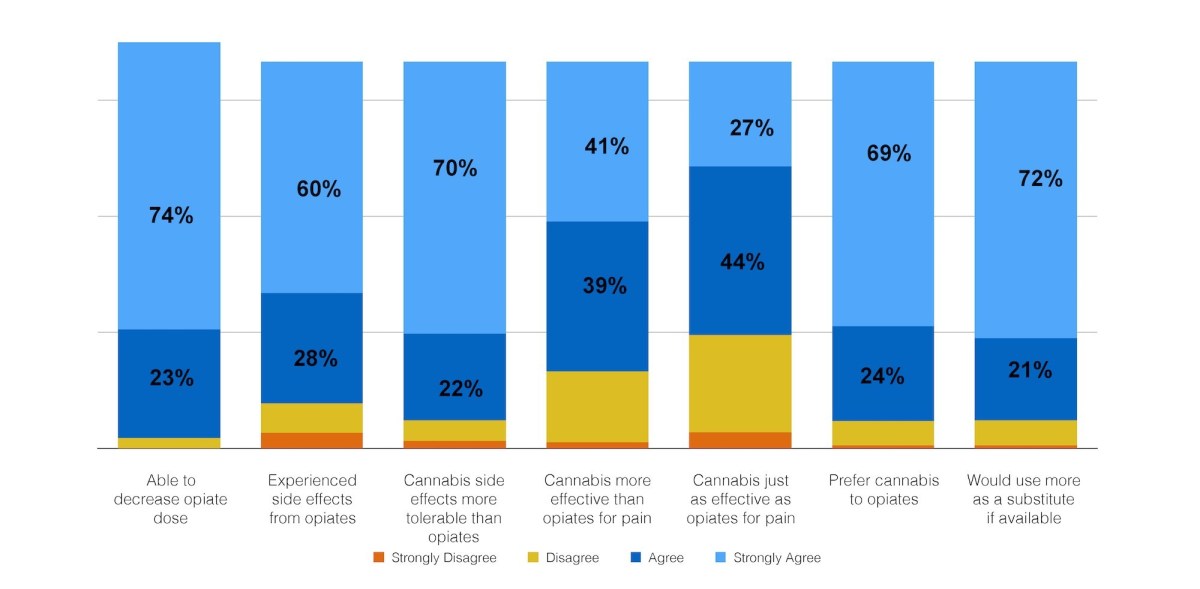 Use of cannabis as a substitute/in conjunction with opioid-based pain medication (PRNewsfoto/HelloMD)
While cannabis is only legalized for medicinal use in 26 states and the District of Columbia, 93 percent of respondents said they “strongly agreed/agreed” that they would use cannabis as a substitute for their current prescription medication if it was available.
Dr. Perry Solomon, Chief Medical Officer of HelloMD, referenced a recent publication from the National Academy of Sciences, Engineering & Medicine on “The Health Effect of Cannabis and Cannabinoids,” and noted that this study serves as a way to support the theory that cannabis is the opposite of a gateway drug.
READ MORE: Mainstream Media Up in Arms About Malia Smoking Pot -- Silent on Her Dad Blowing Up Children
“The latest publication from the National Academy of Sciences clearly refuted the ‘gateway drug’ theory that using marijuana can lead to opioid addiction, instead finding evidence of cannabis having multiple curative benefits,” Dr. Solomon said. “Our study further substantiates this. Hopefully this will awaken the public, medical professionals and legislatures to the fact that cannabis is a safe, non-addictive product, available to help fight the opioid epidemic.”
Amanda Reiman, a professor at UC Berkley who helped lead the study, said the treatment of pain has become a “politicized business” in the United States that has resulted in “the rapidly rising rate of opioid related overdoses and dependence.”
“Cannabis has been used throughout the world for thousands of years to treat pain and other physical and mental health conditions,” Reiman said. “Patients have been telling us for decades that this practice is producing better outcomes than the use of opioid based medications. It’s past time for the medical profession to get over their reefer madness and start working with the medical cannabis movement and industry to slow down the destruction being caused by the over prescribing and overuse of opioids.”

As The Free Thought Project has reported, despite the fact that cannabis has been proven to help with a number of things from killing cancer cells to treating rare and fatal conditions, it is still classified among the deadliest drugs that are supposed to have no medicinal value in the United States.
While studies such as the latest one from HelloMD and UC Berkley serve as a reminder that for many patients, cannabis is the ideal alternative to opioid medications, there is still a clear reason why cannabis has yet to be legalized in the U.S. If medical cannabis was legalized in all 50 states, it would take at least $4.5 billion away from the stranglehold that has been established by big pharma.
Subscribe to:
Posts (Atom)