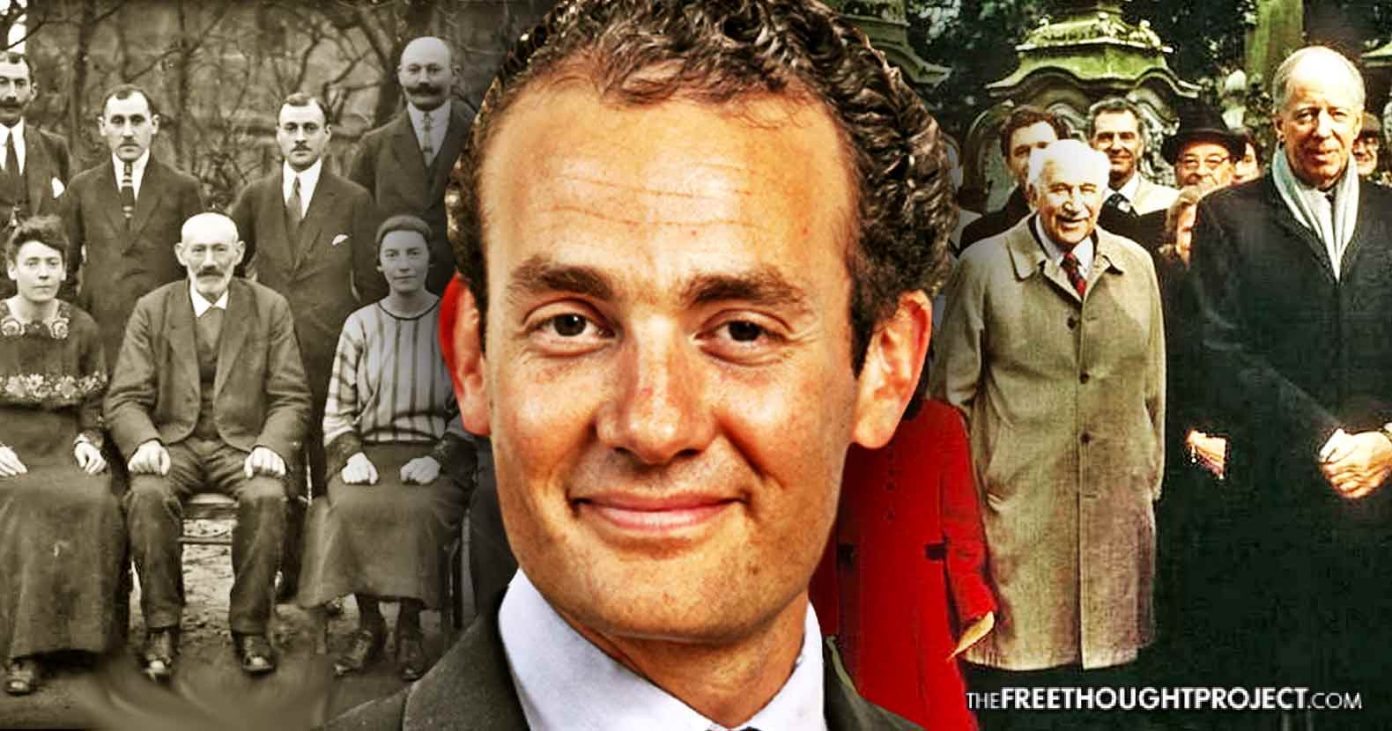
The Rothschild-linked Bronfman sisters donated millions to the cult whose leaders, Allison Mack and Keith Raniere, have been charged with child sex trafficking.
The Rothschild banking empire will ensure that its control continues to stay within the family for a seventh generation as David de Rothschild, 75, is set to hand the role of chairman over to his son, Alexandre de Rothschild, 37, in June.
The banking dynasty has been passed between generations for the last 200 years. It was started by Mayer Amschel Rothschild as a French railway company, and five of his sons went on to establish banking businesses across Europe. Financial Times reported that the investment bank is currently pushing to “diversify from its core French and British advisory business to help it ride out less buoyant periods in Europe’s mergers and acquisitions market.”
The new chairman joined the bank in 2008, and he has helped to set up and oversee the private equity business. As the group increases its investments in small U.S. operations, the Times noted that the overhaul of the corporate structure that occurred during the elder de Rothschild’s term allowed the family to “tighten control over the group by buying out minority shareholders.”
The Rothschild family has also shown its influence in “U.S. operations” by working closely with political figures such as failed presidential candidate, Hillary Clinton. WikiLeaks revealed that Lynn Forester de Rothschild was working with the Clinton campaign to formulate economic policy as early as January 2015.
“I think this blog overstates what Warren was doing, but we need to craft the economic message for Hillary so that Warren’s common inaccurate conclusions are addressed. Xoxo Lynn,” Lady Rothschild wrote in an email to top Clinton aide, Cheryl Mills.
Emmanuel Macron, the current French president, is also a former employee of Rothschild. He earned the nickname of “Mozart of Finance” at the company after he played a crucial role in advising Nestlé to invest $12 billion in the acquisition of a Pfizer unit in 2012.
The Rothschild family currently has 58 percent of voting rights and owns 49 percent of the company, and the Times noted that while revenue from its global advisory business fell 8 percent, private wealth and asset management and merchant banking divisions grew by more than 30 percent each and overall revenue rose by 6 percent in 2017.
As The Free Thought Project reported in August 2017, Lord Jacob Rothschild, founder and chairman of RIT Capital Partners, sent ominous signals internationally when he began selling U.S. assets because he viewed them as risky and unstable.
“We do not believe this is an appropriate time to add to risk. Share prices have in many cases risen to unprecedented levels at a time when economic growth is by no means assured,” Rothschild wrote in his company’s semi-annual report.
Rothschild also said he believes “The period of monetary accommodation may well be coming to an end,” and that quantitative easing programs employed by central banks, such as the Federal Reserve Bank in the U.S. will eventually “come to an end.”
The Rothschilds consider themselves to be the “custodians of the Economist magazine’s legacy.” The magazine published an article in 1988 that claimed a centralized “world currency” could be expected by the year 2018—a methodical movement that has played out in many ways over the years.
The Financial Times reported that while Rothschild was affected by a financial crisis in 2016, its share increased by more than 15 percent in 2017. It remains to be seen how Alexandre de Rothschild’s leadership will impact the banking empire.
As the Free Thought Project previously reported, the Rothschild family has been moving its chess pieces around the world for centuries.
The head of the Rothschild banking empire, and staunch supporter of Israel, Lord Jacob Rothschild, recently revealed the critical role of his family in the securing the Balfour Declaration, which “helped pave the way for the creation of Israel.”
The Balfour Declaration, written in 1917, was an official document from the British Foreign Minister, Lord Balfour, addressed to Lord Rothschild, a leader of the Zionist movement in Britain at the time – and Lord Jacob Rothschild’s uncle.
During the television interview with Rothschild, he revealed new details about the extremely pivotal role his cousin Dorothea de Rothschild played. Rothschild described Dorothea, who was in her teens at the time, as “devoted to Israel,” and said: ‘What she did was crucially important.’”
Rothschild went on to say that Dorothy acted as a conduit between Zionist leader Chaim Weizmann and the British political establishment. Dorothy “told Weizmann how to integrate, how to insert himself into British establishment life, which he learned very quickly,” according to Rothschild.
Rothschild explained that the manner in which the declaration was procured was extraordinary.
“It was the most incredible piece of opportunism,” he reasoned.
“[Weizmann] gets to Balfour,” Rothschild described, “and unbelievably, he persuades Lord Balfour, and Lloyd George, the prime minister, and most of the ministers, that this idea of a national home for Jews should be allowed to take place. I mean it’s so, so unlikely.”
This extremely revealing interview with Lord Rothschild was conducted by former Israeli ambassador Daniel Taub as part of the Balfour 100 project, commemorating the 100-year anniversary of the Balfour Declaration. The interviewed took place at Waddesdon Manor in Buckinghamshire, a manor bequeathed to the nation by the Rothschild family in 1957, where the Declaration is stored.
According to Ambassador Taub, the Balfour Declaration “changed the course of history for the Middle East.”
Rothschild said his family at the time was divided on the idea of Israel, noting that some members “didn’t think it was a good thing that this national home be established there.”
Dorothea’s letters are also stored at Waddesdon, and describe her subsequent dealings with a variety of Zionist leaders, as well as her advice on the organization of the Zionist Conference, according to the Times.
Rothschild said that the Declaration went through five separate drafts before finally being formally issued on November 2, 1917.
In her book, Against Our Better Judgment: The Hidden History of How the U.S. Was Used to Create Israel, Alison Weir exposed the fact that numerous drafts of the declaration were presented to Zionists in the United States prior to the document being finalized.
Weir’s book notes that one of the primary inducements offered to British leaders to issue the Balfour Declaration was the Zionist claim that they would bring the U.S. into world war I on Britain’s side if the British would promise to enable the Zionist colonization of Palestine.
Balfour Declaration Text:
Foreign Office
November 2nd, 1917
Dear Lord Rothschild,
I have much pleasure in conveying to you. on behalf of His Majesty’s Government, the following declaration of sympathy with Jewish Zionist aspirations which has been submitted to, and approved by, the Cabinet.
His Majesty’s Government view with favour the establishment in Palestine of a national home for the Jewish people, and will use their best endeavors to facilitate the achievement of this object, it being clearly understood that nothing shall be done which may prejudice the civil and religious rights of existing non-Jewish communities in Palestine or the rights and political status enjoyed by Jews in any other country.
I should be grateful if you would bring this declaration to the knowledge of the Zionist Federation.
Yours,
Arthur James Balfour
The deeply intertwined relationship between modern Zionism and the Rothschild banking empire cannot be overstated. Without the Rothschild family’s vast influence and direct assistance, Israel very well may have never been created.
The Rothschild banking empire will ensure that its control continues to stay within the family for a seventh generation as David de Rothschild, 75, is set to hand the role of chairman over to his son, Alexandre de Rothschild, 37, in June.
The banking dynasty has been passed between generations for the last 200 years. It was started by Mayer Amschel Rothschild as a French railway company, and five of his sons went on to establish banking businesses across Europe. Financial Timesreported that the investment bank is currently pushing to “diversify from its core French and British advisory business to help it ride out less buoyant periods in Europe’s mergers and acquisitions market.”
The new chairman joined the bank in 2008, and he has helped to set up and oversee the private equity business. As the group increases its investments in small U.S. operations, the Times noted that the overhaul of the corporate structure that occurred during the elder de Rothschild’s term allowed the family to “tighten control over the group by buying out minority shareholders.”
The Rothschild family has also shown its influence in “U.S. operations” by working closely with political figures such as failed presidential candidate, Hillary Clinton. WikiLeaks revealed that Lynn Forester de Rothschild was working with the Clinton campaign to formulate economic policy as early as January 2015.
“I think this blog overstates what Warren was doing, but we need to craft the economic message for Hillary so that Warren’s common inaccurate conclusions are addressed. Xoxo Lynn,” Lady Rothschild wrote in an email to top Clinton aide, Cheryl Mills.
Emmanuel Macron, the current French president, is also a former employee of Rothschild. He earned the nickname of “Mozart of Finance” at the company after he played a crucial role in advising Nestlé to invest $12 billion in the acquisition of a Pfizer unit in 2012.
The Rothschild family currently has 58 percent of voting rights and owns 49 percent of the company, and the Times noted that while revenue from its global advisory business fell 8 percent, private wealth and asset management and merchant banking divisions grew by more than 30 percent each and overall revenue rose by 6 percent in 2017.
As The Free Thought Projectreported in August 2017, Lord Jacob Rothschild, founder and chairman of RIT Capital Partners, sent ominous signals internationally when he began selling U.S. assets because he viewed them as risky and unstable.
“We do not believe this is an appropriate time to add to risk. Share prices have in many cases risen to unprecedented levels at a time when economic growth is by no means assured,” Rothschild wrote in his company’s semi-annual report.
Rothschild also said he believes “The period of monetary accommodation may well be coming to an end,” and that quantitative easing programs employed by central banks, such as the Federal Reserve Bank in the U.S. will eventually “come to an end.”
Rothschild & Co. is ensuring that the business will stay in the family for a seventh generation as the current chairman prepares to hand his seat down to his son.
NWO FORBIDDEN HISTORY: TIMELINE OF THE NEW WORLD ORDER1763-1816
The Currency Act of 1764 is a British action that imposes a monetary policy on its American colonies. The Act extends the provisions of the Currency Act of 1751 and forbids the American colonies from issuing debt-free paper currency as legal tender.
When the First Continental Congress meets in 1774, it objects to The Currency Act as “subversive of American rights” and calls for its repeal.
It is a little known fact of the American Revolution, that the right of the colonial governments to issue their own debt-free currency, and spend it into circulation (as opposed to a private Central Bank printing and lending its debt-currency into circulation), was one of the main causes of the coming American Revolution.
During the 64 year reign of Queen Victoria (1837-1901) Great Britain will experience a transformation from a Constitutional Monarchy to a totally Rothschild owned “democracy”. Three assassination attempts against Victoria during the turbulent 1840’s, further attempts on her in 1872 and 1882, and the many other attempts and murders of European Kings in the coming years, combine to send a clear and intimidating message to the British Monarchy: The Rothschild Family, not the “Royal Family”, rules the British Empire.
The Rothschilds view the American US Civil War as a chance to “divide and conquer” America. If the South can break away from the Union, two rival nations can be played off against each other in a European style game of “balance-of-power.”
Lincoln needs money to fund the war. He is extorted by the New York bankers, who want the government to sell high interest bonds to them, which they can then resell to the banking syndicate in London. Lincoln writes:
“I have the Confederacy before me and the bankers behind me, and for America, I fear the bankers most.”
Lincoln thwarts the bankers by issuing interest-free currency directly from the Treasury. (Greenbacks)
Republican President McKinley is a staunch advocate of “hard money” (Gold Standard) and limited constitutional government. McKinley is re-elected in 1900. Less than one year later, a foreign-born Red terrorist named Leon Czolgosz shoots McKinley in Buffalo, NY. Czolgosz is a follower of the Jewish Red Emma Goldman, who openly praises Czolgosz’s evil deed!
McKinley recovers briefly, and then turns for the worse, finally dying on September 14. His death launches the Globalist puppet Teddy Roosevelt into office, completing TR’s amazing ascent from obscurity to the White House in just two years! The convenient murder of McKinley marks the beginning of “The Progressive Era” in which the Federal government will expand its power and foreign involvement.
After many years of strategic political preparation, the Globalist-Zionist New World Order now has 7 major goals its wants to achieve in coming decade:
1. Establish a US Central Bank conceived at Jekyll Island.
2. Impose an income tax on America so that State debt to the Central Bank can be collateralized with human labor.
3. Trigger the long planned Triple Entente-Triple Alliance World War to destroy Germany and reshape Europe.
4. Entangle the mighty USA in the coming European war and the emerging World Government movement.
5. Finish off Czarist Russia once and for all and convert the Eurasian giant into a Communist nation.
6. Establish a World Political Body under the pretext of “world peace” after the war is over.
7. Carry out Zionist Herzl’s 1897 plan to take Palestine away from the Ottoman Turks & Arabs.
The popular Republican President William Howard Taft will never involve America in such treasonous schemes. So the Globalists recruit a weak professor from Princeton named Woodrow Wilson. Wilson is rocketed to Governor of New Jersey, and then to Democrat nominee for President in 1912. In order to steal Republican votes from Taft, the NWO recruits ex-President Teddy Roosevelt to ran as the Progressive Party candidate (also known as Bull-Moose Party).
Pledging a “return to normalcy”, Warren Harding (R-OH) is elected President in 1920. An opponent of entry into the League of Nations, his victory over James Cox (D-OH) and his VP running mate Franklin D Roosevelt (TR’s cousin), is the largest Presidential Election landslide in America’s history (60%-34%)!
Harding inherits a Wilsonian economic Depression. He quickly moves to slash income taxes, and will cut government spending by 50%. With the private economy now freed from the parasitic dead weight of big government, an historic economic boom soon follows.
Harding’s support for free markets, limited government, low taxes, neutral foreign policy, and his refusal to grant diplomatic recognition to the murderous Soviet Union, are all positions that anger the Globalists. An intense newspaper smear campaign regarding “scandals” in Harding’s administration is then unleashed against the highly popular President.
A prominent Congressman who dares to accuse the Fed is the Chairman of the House Banking Committee: Louis McFadden (R-PA). In a June 10 speech, McFadden puts the blame directly on the international bankers for fomenting the Russian Revolution, crashing the US economy, and robbing the American people. McFadden pulls no punches:
“(The Fed) was deceitfully and disloyally foisted upon this country by the bankers who came here from Europe and repaid us for our hospitality by undermining our American institutions. Those bankers took money out of this country to finance Japan in a war against Russia. They financed Trotsky’s passage from New York to Russia so that he might assist in the destruction of the Russian Empire. …What king ever robbed his subjects to such an extent as the Federal Reserve has robbed us?”
In what is a sure signal to oligarchs across the globe, Lord Jacob Rothschild, founder and chairman of RIT Capital Partners, has substantially minimized his exposure to what he views as a risky and unstable U.S. capital market. In the half-yearly financial report for RIT Capital Partners, Rothschild explained the company’s aggressive moves to significantly reduce exposure to U.S. assets.
“We do not believe this is an appropriate time to add to risk. Share prices have in many cases risen to unprecedented levels at a time when economic growth is by no means assured,” Rothschild said in his semi-annual report.
Additionally, Rothschild stated that he believes quantitative easing (QE) programs employed by central banks, such as the Federal Reserve Bank in the U.S. will “come to an end.”
Rothschild was quoted in the report as saying, “The period of monetary accommodation may well be coming to an end.”
Signaling a potential disaster in the making in the United States financial markets, Rothschild reduced the investments RIT Capital Partners has in the U.S. dollar by nearly fifty percent. On December 31, 2016, RIT Capital Partners reported a 62 percent net value asset investment in U.S. dollars. In the latest report released by RIT Capital Partners on June 30, 2017, the company has a 37 percent net value asset investment in U.S. dollars.
Over that same period of time, Rothschild increased RIT’s investment in the Sterling, Euro, and the Japanese Yen.
Just last year, the bond manager of what was once the world’s largest bond fund had a dire prediction about how “all of this” will all end. And by “all of this,” he means the propping up of financial markets by central banks.
Gross: Global yields lowest in 500 years of recorded history. $10 trillion of neg. rate bonds. This is a supernova that will explode one day
— Janus Henderson U.S. (@JHIAdvisorsUS) June 9, 2016
When the U.S. stock market is trading at all-time highs, but Lord Rothschild is divesting RIT from those same markets, the central bank manipulation of market valuations becomes apparent.
Additionally, it’s worth noting that Rothschild’s RIT investment portfolio has returned roughly 2,000% since its formation – so he obviously understands how to position his assets to get big returns on investments, thus these recent moves should be a red flag to every American.
In explaining his recent investment moves, Rothschild, the RIT chairman stated:
We have a particular interest in investments which will benefit from the impact of new technologies, and Far Eastern markets, influenced by the growing demand from Asian consumers.
The report also noted that RIT had invested in Social Capital, a tech investment firm based in Silicon Valley, and that Francesco Goedhuis, Chief Executive of J. Rothschild Capital Management, will serve on the company’s advisory board. Social Capital provides seed funding for companies in the education, finance, and health care business sectors.
Rothschild also mentioned the advent of a fourth industrial revolution in the RIT Capital Partners report, noting, “As the ‘Fourth Industrial Revolution’ develops, it becomes increasingly important for your Company to be able to assess investment opportunities in the innovation driven changes which are affecting almost every business sector.”
The fourth industrial revolution will be driven by new technologies that work to integrate the digital, biological, and physical worlds. Rothschild indicated in the report that the fourth industrial revolution was a driving factor in his investment in Social Capital.
To date, at least in stock market terms, the policy has been successful with markets near their highs, while volatility on the whole has remained low. Nearly all classes of investment have been boosted by the rising monetary tide. Meanwhile, growth remains anaemic, with weak demand and deflation in many parts of the developed world.
Many of the risks which I underlined in my 2015 statement remain; indeed the geo-political situation has deteriorated with the UK having voted to leave the European Union, the presidential election in the US in November is likely to be unusually fraught, while the situation in China remains opaque and the slowing down of economic growth will surely lead to problems. Conflict in the Middle East continues and is unlikely to be resolved for many years. We have already felt the consequences of this in France, Germany and the USA in terrorist attacks.
With global yields at their lowest in recorded history, and with $10 trillion of neg. rate bonds, there is likely only one way that this ends – with a massive global financial collapse, the likes of which would make the Great Depression look like the “good old days.” Make no mistake that when Lord Rothschild begins to move his assets out of the U.S., it is surely a sign of ominous things on the horizon.
Jay Syrmopoulos is a geopolitical analyst, freethinker, and ardent opponent of authoritarianism. He is currently a graduate student at the University of Denver pursuing a masters in Global Affairs and holds a BA in International Relations. Jay’s writing has been featured on both mainstream and independent media – and has been viewed tens of millions of times. You can follow him on Twitter @SirMetropolis and on Facebook at SirMetropolis. This article first appeared at The Free Thought Project.
The Economist magazine published an article almost thirty years ago, discussing the prospect of a world currency that should be expected around the year 2018. The 1988 article foreshadows a methodical movement towards a centralized world currency that we have, in many ways, seen play out over the past few decades.
One must also keep in mind that the controlling interest of The Economist is held by the powerful Rothschild family, who regard themselves as the “custodians of The Economist magazine’s legacy.” In essence, the magazine operates as a quasi-propaganda arm for the Rothschild banking empire and related businesses and, is in many ways, meant to prime the pump of public opinion for the globalist agenda to be implemented.
The excerpt below appeared in the print magazine on January 9, 1988, in Vol. 306, pp 9-10.
Ready for the Phoenix
THIRTY years from now, Americans, Japanese, Europeans, and people in many other rich countries, and some relatively poor ones will probably be paying for their shopping with the same currency. Prices will be quoted not in dollars, yen or D-marks but in, let’s say, the phoenix. The phoenix will be favoured by companies and shoppers because it will be more convenient than today’s national currencies, which by then will seem a quaint cause of much disruption to economic life in the last twentieth century. – At the beginning of 1988 this appears an outlandish prediction. Proposals for eventual monetary union proliferated five and ten years ago, but they hardly envisaged the setbacks of 1987. The governments of the big economies tried to move an inch or two towards a more managed system of exchange rates – a logical preliminary, it might seem, to radical monetary reform. For lack of co-operation in their underlying economic policies they bungled it horribly, and provoked the rise in interest rates that brought on the stock market crash of October. These events have chastened exchange-rate reformers. The market crash taught them that the pretence of policy co-operation can be worse than nothing, and that until real co-operation is feasible (i.e., until governments surrender some economic sovereignty) further attempts to peg currencies will flounder.
…
The New World Economy
The biggest change in the world economy since the early 1970’s is that flows of money have replaced trade in goods as the force that drives exchange rates. as a result of the relentless integration of the world’s financial markets, differences in national economic policies can disturb interest rates (or expectations of future interest rates) only slightly, yet still call forth huge transfers of financial assets from one country to another. These transfers swamp the flow of trade revenues in their effect on the demand and supply for different currencies, and hence in their effect on exchange rates. As telecommunications technology continues to advance, these transactions will be cheaper and faster still. With unco-ordinated economic policies, currencies can get only more volatile.
With the enactment of the privately owned central bank, the Bank of England provided the model for the financial enslavement of governments, and their citizens. Well before the conflict for establishing a National Bank in America or the eventual surrender to the money changers with the betrayal in instituting the Federal Reserve, the history of the Bank of England needs to be studied. Relying on British historians may seem to invoke a cultural bias; however, the range and wealth of information on this topic comes from an earlier age. Further research will expand this understanding and many of the sources cited can fulfill this objective.
For purposes of a mainstream account, the official site of the Bank of England provides a flowery version about the background and purported success of the scheme proposed by “William Paterson, envisaged a loan of £1,200,000 to the Government, in return for which the subscribers would be incorporated as the “Governor and Company of the Bank of England”. Although the new bank would have risked its entire capital by lending it to the Government, the subscription proved popular and the money was raised in a few weeks. The Royal Charter was sealed on 27 July 1694, and the Bank started its role as the Government’s banker and debt-manager, which it continues today.”
“The bank hath benefit of interest on all moneys which it creates out of nothing.”
“The goldsmiths evolved to become the original private bankers of the time. Since goldsmiths already had as part of their trade private stores of gold and stout vaults to store them in, entrepreneurs could entrust their own gold to them for safe keeping, for a fee, and receive a paper receipt for the deposit. The goldsmiths could then lend monies against these deposits for an additional fee. Mr. Hartley Winters declares that “some ingenious goldsmith conceived the epock-making notion of giving notes…and so founded modern banking.” Merchants would deposit “their money with the goldsmiths and received from them receipts” that “…were payable on demand, and were transferred from one holder to another in payment of debts.” These receipts or notes from the goldsmith bankers, often in the form of a letter, are some of the earliest surviving cheques in England. Given the economic realities of the time, although deposits provided the funds for their business, most of the clients of these goldsmith bankers were usually borrowers rather than depositors.”
From such humble origins, the foundation was laid to invent a central bank that would create money out of thin air and loan it at interest to the government, who lost it sovereignty for making this Faustian bargain.
The Charter of the Bank of England (1694) with the Great Seal of William and Mary. The first usury central bank to be incorporated in England.
The Bank of England account, published by Cassell, Petter & Galpin cites a rocky start and opposition from the goldsmiths.
“In 1696 (very soon after its birth) the Bank experienced a crisis. There was a want of money in England. The clipped silver had been called in, and the new money was not ready. Even rich people were living on credit, and issued promissory notes. The stock of the Bank of England had gone rapidly down from 110 to 83. The goldsmiths, who detested the corporation that had broken in on their system of private banking, now tried to destroy the new company. They plotted, and on the same day they crowded to Grocers’ Hall, where the Bank was located from 1694 to 1734, and insisted on immediate payment—one goldsmith alone demanding £30,000. The directors paid all their honest creditors, but refused to cash the goldsmiths’ notes, and left them their remedy in Westminster Hall. The goldsmiths triumphed in scurrilous pasquinades entitled, “The Last Will and Testament,” “The Epitaph,” “The Inquest on the Bank of England.”
It did not take long for the Jewish bankers to set their sights on Paterson’s bank and financers for the English regime. Brother Nathanael Kapner adds his audacious viewpoints.
“The new King William III soon got England involved in costly wars against Catholic France which put England deep into debt. Here was the Jewish bankers’ chance to collect. So King William, under orders from the Elders of Zion in Amsterdam, persuaded the British Treasury to borrow 1.25 million pounds of sterling from the Jewish bankers who had helped him to the throne.
Since the state’s debts had risen dramatically, the government had no choice but to accept. But there were conditions attached: The names of the lenders were to be kept secret and that they be granted a Charter to establish a Central Bank of England. Parliament accepted and the Jewish bankers sunk their tentacles into Great Britain.”
“A very famous story relates to the Bank of England and the infamous Rothschilds, that all powerful banking family. This story was re-told recently in a BBC documentary about the creation of money and the Bank of England.
It revolves around the Battle of Waterloo in which Nathan Rothschild used his inside knowledge of the outcome and his faster horses and couriers to play the market by getting the result of the battle before anyone else knew the outcome.
He quickly sold his English bonds and gave all the traders who looked to him for guidance the impression that the French had won at Waterloo.
The other traders all rushed to sell their bonds before the market crashed thinking that they were now worthless and a massive fire-sale occurred as brokers clamered to get rid of their stock. This massive sell off quickly drove the price of the bonds down to 5% of their original worth.
Once the bottom had dropped out the market Nathan Rothschild then re-bought as many bonds back as he could at hugely discounted prices and in doing so he multiplied his wealth twenty times in 3 days of trading.
At the same time as becoming immensely wealthy he also became the single largest debtor to the English government which ultimately gave him control over the bank of England.”
“As you can see by the 250-year chart of Bank of England stock, the shares showed no real trend during the 1700s, rose in price during the Napoleonic Wars as England left the gold standard and suffered inflation, declined in price from around 1818 to 1845 during the deflation that followed, rose in price for the rest of the 1800s as the Bank gradually increased its dividend, plunged until 1920 as inflation occurred without any compensating rise in the dividend, then gradually rose in price until the Bank was nationalized in 1945. The behavior of the Bank of England’s stock encapsulates the general behavior of the British stock market over that 250-year period.”
Now for most of its history the privately held Bank of England was extremely profitable to its owners. The method for charging interest on the creation of money has been the prime vehicle for driving both public and private debt throughout modern times.
“The Bank of England let the cat out of the bag. In a paper called “Money Creation in the Modern Economy“, co-authored by three economists from the Bank’s Monetary Analysis Directorate, they stated outright that most common assumptions of how banking works are simply wrong, and that the kind of populist, heterodox positions more ordinarily associated with groups such as Occupy Wall Street are correct. In doing so, they have effectively thrown the entire theoretical basis for austerity out of the window.”
The entire monitory financial system is based upon charging usury on the creation of national currencies. No larger debtor exists than governments. The perfection of the Rothschild fraud is founded upon charging compound interest on the very medium of exchange that serves as legal tender.
The Bank of England set the stage for the centralization of all banking under the umbrella of banksters control. In order to discover all the secrets of manipulating the financial system, one must comprehend, the first and primary lesson; that central banks do not function as beneficiaries to their host nation, much less the ordinary “little people”.
Keeping this deplorable rip-off system extorting their pound of flesh is the principal objective of the financial elites. Interest on government bonds must be paid. More debt needs to be incurred. And the framework for human impoverishment lies at the feet of central banking.
The head of the Rothschild banking empire, and staunch supporter of Israel, Lord Jacob Rothschild, recently revealed the critical role of his family in the securing the Balfour Declaration, which “helped pave the way for the creation of Israel.”
The Balfour Declaration, written in 1917, was an official document from the British Foreign Minister, Lord Balfour, addressed to Lord Rothschild, a leader of the Zionist movement in Britain at the time – and Lord Jacob Rothschild’s uncle.
During the television interview with Rothschild, he revealed new details about the extremely pivotal role his cousin Dorothea de Rothschild played. Rothschild described Dorothea, who was in her teens at the time, as “devoted to Israel,” and said: ‘What she did was crucially important.’”
Rothschild went on to say that Dorothy acted as a conduit between Zionist leader Chaim Weizmann and the British political establishment. Dorothy “told Weizmann how to integrate, how to insert himself into British establishment life, which he learned very quickly,” according to Rothschild.
Rothschild explained that the manner in which the declaration was procured was extraordinary.
“It was the most incredible piece of opportunism,” he reasoned.
“[Weizmann] gets to Balfour,” Rothschild described, “and unbelievably, he persuades Lord Balfour, and Lloyd George, the prime minister, and most of the ministers, that this idea of a national home for Jews should be allowed to take place. I mean it’s so, so unlikely.”
This extremely revealing interview with Lord Rothschild was conducted by former Israeli ambassador Daniel Taub as part of the Balfour 100 project, commemorating the 100-year anniversary of the Balfour Declaration. The interviewed took place at Waddesdon Manor in Buckinghamshire, a manor bequeathed to the nation by the Rothschild family in 1957, where the Declaration is stored.
READ MORE:Rothschild Makes Dismal Admission — His Financial World Order Now "Threatened"
According to Ambassador Taub, the Balfour Declaration “changed the course of history for the Middle East.”
Rothschild said his family at the time was divided on the idea of Israel, noting that some members “didn’t think it was a good thing that this national home be established there.”
Dorothea’s letters are also stored at Waddesdon, and describe her subsequent dealings with a variety of Zionist leaders, as well as her advice on the organization of the Zionist Conference, according to the Times.
Rothschild said that the Declaration went through five separate drafts before finally being formally issued on November 2, 1917.
In her book, Against Our Better Judgment: The Hidden History of How the U.S. Was Used to Create Israel, Alison Weir exposed the fact that numerous drafts of the declaration were presented to Zionists in the United States prior to the document being finalized.
Weir’s book notes that one of the primary inducements offered to British leaders to issue the Balfour Declaration was the Zionist claim that they would bring the U.S. into world war I on Britain’s side if the British would promise to enable the Zionist colonization of Palestine.
Balfour Declaration Text: Foreign Office November 2nd, 1917 Dear Lord Rothschild,
I have much pleasure in conveying to you. on behalf of His Majesty’s Government, the following declaration of sympathy with Jewish Zionist aspirations which has been submitted to, and approved by, the Cabinet.
His Majesty’s Government view with favour the establishment in Palestine of a national home for the Jewish people, and will use their best endeavors to facilitate the achievement of this object, it being clearly understood that nothing shall be done which may prejudice the civil and religious rights of existing non-Jewish communities in Palestine or the rights and political status enjoyed by Jews in any other country.
READ MORE:5 Things the Establishment Slipped By You While Focusing Solely on Orlando Shooting
I should be grateful if you would bring this declaration to the knowledge of the Zionist Federation. Yours,
Arthur James Balfour
The deeply intertwined relationship between modern Zionism and the Rothschild banking empire cannot be overstated. Without the Rothschild family’s vast influence and direct assistance, Israel very well may have never been created.
(ZH) After 9 gigabytes of Macron-linked documents and emails were released on an anonymous pastebin website on Friday afternoon in what Macron’s campaign said was a “massive and coordinated” hacking attack, France – fearing a similar response to what happened with Hillary Clinton after 35,000 John Podesta emails were released one month before the US presidential election – cracked down on the distribution of the files, warning on Saturday it would be a “criminal offense” to republish the data, and warning the French media not to publish content from any of the hacked emails “to prevent the outcome of the vote being influenced.”
Quoted by Reuters, the French election commission said in a statement that “on the eve of the most important election for our institutions, the commission calls on everyone present on internet sites and social networks, primarily the media, but also all citizens, to show responsibility and not to pass on this content, so as not to distort the sincerity of the ballot.” Following a rushed meeting on Saturday morning, the commission which supervises the electoral process, said that the data been “fraudulently obtained and could be mixed with false information.” It is unclear, however, how it hopes to enforce any punitive claims, especially when much of the initial document distribution appears to have taken place offshore.
Domestically, in a similar reaction to the US media’s response to the Podesta emails, French TV news channels chose not to mention the hack, although the left-leading Liberation prominently featured the news on its website. Liberation author Cedric Mathiot wrote that the leak, and its timing, “wants to create chaos” adding that the information was distributed in an “unethical method.”
READ MORE:Rothschild Bank Now Under Criminal Investigation After Baron David De Rothschild Indictment
On Friday night, as news of what has been hashtagged as @MacronLeaks on twitter spread, Florian Philippot, deputy leader of the National Front, tweeted “Will Macronleaks teach us something that investigative journalism has deliberately kept silent?” In a tweeted response, Macron spokesman Sylvain Fort called Philippot’s tweet “vile”.
In another parallel to the Clinton leaks, Macron’s En Marche! party said the leaked documents dealt with “the normal operations of a campaign and included some information on campaign accounts.” It said the hackers had mixed false documents with authentic ones to “sow doubt and disinformation.”
But in the biggest parallel to the Clinton hacking, few have touched upon the actual contents of the documents, which some say confirm prior allegations of illicit financial dealings and offshore accounts, and instead merely sought to attack the messenger. Indeed, as journalist Kim Zetter noted overnight, “Telling journos to not report on hacked emails misses point that nearly all important leaks occur because someone broke law or a contract” and then followed up with the following rhetorical question, flipping the situation by 180 degrees: “If GRU, intending to assault dem., hacks Trump & publishes emails showing his direct connection to Russia, should journos report on those.”
Telling journos to not report on hacked emails misses point that nearly all important leaks occur because someone broke law or a contract
If GRU, intending to assault dem., hacks Trump & publishes emails showing his direct connection to Russia, should journos report on those? https://t.co/cJJcjXkgBa
As reported on Friday evening, WikiLeaks tweeted that the leak contained “many tens of thousands” of emails, photos and attachments dated up to April 24, but it noted that it had come “too late” to affect the election results. In a follow up tweet, the controversial whistleblowing organization posted a tweet sharing the location of all #MacronLeaks archives which are “now available as uncensorable magnet links http://archive.is/aULcm”
Since there has been no suggestion WikiLeaks is responsible for this hack, speculation about the source of the hack has grown, with Russia once again emerging as the “usual suspect.”
READ MORE:"Expect Full Mobilization" -- Anonymous Already Pursuing Justice for Nice Attack
Cited by Reuters, Vitali Kremez, director of research with New York-based cyber intelligence firm Flashpoint, said his review indicates that APT 28, a group tied to the GRU, the Russian military intelligence directorate, was behind the leak. He cited similarities with U.S. election hacks that have been previously attributed to that group. Kremez also said that APT28 last month registered decoy internet addresses to mimic the name of En Marche, which it likely used send tainted emails to hack into the campaign’s computers. Those domains include onedrive-en-marche.fr and mail-en-marche.fr.
“If indeed driven by Moscow, this leak appears to be a significant escalation over the previous Russian operations aimed at the U.S. presidential election, expanding the approach and scope of effort from simple espionage efforts towards more direct attempts to sway the outcome,” Kremez said.
We expect the Kremlin to deny all allegations shortly.
Ben Nimmo, a UK-based security researcher with the Digital Forensic Research Lab of the Atlantic Council think tank, said initial analysis indicated that a group of U.S. far-right online activists were behind early efforts to spread the documents via social media. They were later picked up and promoted by core social media supporters of Le Pen in France, Nimmo said.
The leaks emerged on 4chan, a discussion forum popular with far right activists in the United States. An anonymous poster provided links to the documents on Pastebin, saying, “This was passed on to me today so now I am giving it to you, the people.”
The hashtag #MacronLeaks was then spread by Jack Posobiec, a pro-Trump activist whose Twitter profile identifies him as Washington D.C. bureau chief of the far-right activist site Rebel TV, according to Nimmo and other analysts tracking the election. Contacted by Reuters, Posobiec said he had simply reposted what he saw on 4chan.
“You have a hashtag drive that started with the alt-right in the United States that has been picked up by some of Le Pen’s most dedicated and aggressive followers online,” Nimmo told Reuters.
Sunday’s election, whose result is expected in just over 24 hours, is seen as “the most important in France for decades, with two diametrically opposed views of Europe and the country’s place in the world at stake.” Tune in then to find out if Wikileaks is correct, and the #MacronLeaks is nothing more than a tempest in a teapot, unable to chisel away at Macron’s lead over Le Pen which the latest polls calculate to be as much as 25 points.
READ MORE:BREAKING: President-Elect Trump Calls for Jailing People for Protected Free Speech
RIT Capital Partners fund issued its 2016 year-end report in late February. While the company was pleased to report a net profit of 12.1 percent and total shareholder returns hold at 14.2 percent, the company, and its chairman Lord Jacob Rothschild, seem preoccupied with risks associated with political and economic instability.
Rothschild announced that while the funds’ assets are at an all-time high, the announcement comes, “Against a background of daunting uncertainty and political turmoil.” Going further, he stated a more ominous warning. “At this time of upheaval and uncertainty, our investment portfolio will continue to be well diversified,” he wrote comforting his shareholders their fund’s portfolio would be as protected as possible from any coming downturns in the market.
However comforting the report may be for individual investors, Rothschild’s final comments loom large over the mostly positive economic report. He wrote, “There could well be a period ahead of us when the avoidance of risk is as high a priority as the pursuit of gain.” The investment banker’s chosen word of “period” seems to indicate a coming downturn in profitability, even though for the past five years the fund has realized a profit of more than 1 billion euros.
According to the report, Rothschild and his very powerful family have a vested interest in preserving their assets. “RIT Capital Partners plc is an investment company listed on the London Stock Exchange. Its net assets have grown from £280 million on listing in 1988 to over £2.7 billion today. RIT is chaired by Lord Rothschild, whose family interests retain a significant holding,” the issue reveals.
If the fund, whose value is at an all-time high, suddenly declines, falling with it will be a large portion of wealth the Rothschild family enjoys. Although, any such declines would hardly come as a surprise to the Rothschild family who reportedly controls much of the world’s wealth and has a hand in nearly all of the world’s banking institutions, including the Federal Reserve, as some have stated.
The chairman’s statement continues with what some might say is an ominous and uncertain view of the future. “Since the last World War, we have enjoyed some 70 years of patiently crafted international cooperation, which is now threatened,” an apparent reference to Brexit and the UK’s referendum to withdraw from the European Union.
“Against this deeply worrying geo-political situation,” he wrote seeming to highlight the potential of WWIII if the Syrian conflict continues, “one can point to a number of positive investment factors.” Echoing many statements made by the current U.S. president, Lord Rothschild stated he was hopeful corporations would receive a break in government imposed revenue. He said, “in the US, the proposed tax reduction for companies and individuals,” was a favorable policy change for his fund’s portfolio.
Echoing President Trump’s call for deregulation, Rothschild also was reportedly pleased with the “reforms of an over-regulated system.” Likewise, in step with Trump’s call to exponentially increase spending on America’s failing transportation infrastructure, Lord Rothschild is pleased. However, Trump’s call for, “increases in fiscal and infrastructure expenditure…come at a time late in the business cycle, when the labour market is close to full employment,” means there’s no forecast of immediate returns on infrastructure spending forecasted in the future.
The banking and financial baron also seemed to lament that “wage increases up by some 4% over the last few months” a factor which affects the bottom line for every company. He also stated across the fund’s portfolio will also be affected by rising interest rates. “Valuations are at the high end of their historical range, inflation is returning and in these circumstances, it is likely that interest rates in the US will rise meaningfully,” he said. And coming from the man whose familial connections and financial partners control the Federal Reserve, he should know.
RIT Capital Partners fund issued its 2016 year-end report in late February. While the company was pleased to report a net profit of 12.1 percent and total shareholder returns hold at 14.2 percent, the company, and its chairman Lord Jacob Rothschild, seem preoccupied with risks associated with political and economic instability.
Rothschild announced that while the funds’ assets are at an all-time high, the announcement comes, “Against a background of daunting uncertainty and political turmoil.” Going further, he stated a more ominous warning. “At this time of upheaval and uncertainty, our investment portfolio will continue to be well diversified,” he wrote comforting his shareholders their fund’s portfolio would be as protected as possible from any coming downturns in the market.
However comforting the report may be for individual investors, Rothschild’s final comments loom large over the mostly positive economic report. He wrote, “There could well be a period ahead of us when the avoidance of risk is as high a priority as the pursuit of gain.” The investment banker’s chosen word of “period” seems to indicate a coming downturn in profitability, even though for the past five years the fund has realized a profit of more than 1 billion Euros.
According to the report, Rothschild and his very powerful family have a vested interest in preserving their assets. “RIT Capital Partners plc is an investment company listed on the London Stock Exchange. Its net assets have grown from £280 million on listing in 1988 to over £2.7 billion today. RIT is chaired by Lord Rothschild, whose family interests retain a significant holding,” the issue reveals. If the fund, whose value is at an
READ MORE:Now that Trump"s In Office, Media Suddenly Concerned with US Military Killing Civilians
If the fund, whose value is at an all-time high, suddenly declines, falling with it will be a large portion of wealth the Rothschild family enjoys. Although, any such declines would hardly come as a surprise to the Rothschild family who reportedly controls much of the world’s wealth and has a hand in nearly all of the world’s banking institutions, including the Federal Reserve, as some have stated.
The chairman’s statement continues with what some might say is an ominous and uncertain view of the future. “Since the last World War, we have enjoyed some 70 years of patiently crafted international cooperation, which is now threatened,” an apparent reference to Brexit and the UK’s referendum to withdraw from the European Union.
“Against this deeply worrying geo-political situation,” he wrote seeming to highlight the potential of WWIII if the Syrian conflict continues, “one can point to a number of positive investment factors.” Echoing many statements made by the current U.S. president, Lord Rothschild stated he was hopeful corporations would receive a break in government imposed revenue. He said, “in the US, the proposed tax reduction for companies and individuals,” was a favorable policy change for his fund’s portfolio.
Resounding President Trump’s call for deregulation, Rothschild also was reportedly pleased with the “reforms of an over-regulated system.” Likewise, in step with Trump’s call to exponentially increase spending on America’s failing transportation infrastructure, Lord Rothschild is pleased. However, Trump’s call for, “increases in fiscal and infrastructure expenditure…come at a time late in the business cycle, when the labour market is close to full employment,” meaning there’s no forecast of immediate returns on infrastructure spending forecasted in the future.
READ MORE:Trump Orders Media Blackout At EPA: Bans Use Of Social Media, Bars New Contracts
The banking and financial baron also seemed to lament that “wage increases up by some 4% over the last few months” a factor which affects the bottom line for every company. He also stated across the fund’s portfolio will also be affected by rising interest rates. “Valuations are at the high end of their historical range, inflation is returning and in these circumstances, it is likely that interest rates in the US will rise meaningfully,” he said. And coming from the man whose familial connections and financial partners control the Federal Reserve, he should know.
Charitable institutions (like The Clinton Foundation), as Judge Jeanine Pirro has stated publicly, often serve as a slush fund for those whose name the institution bears. Pirro called the Clintons’ foundation nothing more than a “money laundering operation used as a slush fund.” Now, it seems, Senator John McCain (R-AZ) and his institution are coming under fire for contributions it has been receiving from the Rothschild family, a controversial global mining company, and the Royal Family of Saudi Arabia.
Accusations of financial impropriety first arose back in 2008, when The Guardian first ran the story. McCain was traveling through the UK, and made a stop at London’s Spencer House, where Judicial Watch, noted Washington watchdog organization, objected to the fundraiser luncheon hosted by the Rothschilds. “The question is whether or not the Rothschilds paid for the event, the venue, the catering, or any other related costs,” asked Judicial Watch’s president Tom Fitton. McCain wasn’t successful in defeating President Obama in the election. Yet while his campaign for president is a thing of the past, McCain’s ties to the Rothschilds and others is present day subject matter. Wikileaks has made certain the issue will not go away.
The organization committed to governmental transparency revealed just how close of a relationship McCain has with the Rothschilds. “Close Hillary Clinton friend Lynn Forester de Rothschild (Economist publisher) is a trustee of the Saudi-funded John McCain Institute,” Wikileaks’ tweet reads. And guess what. They’re right again. A quick check of the McCain Institute’s Board of Trustees finds a photo of Ms. Rothschild, as well as her bio.
Since June 2002, Lady de Rothschild has been the Chief Executive of E.L. Rothschild LLC,a private investment company with investments in media, asset management, information technology, agriculture and real estate worldwide. Holdings include The Economist Group (UK), Bronfman/E.L.Rothschild, real estate and financial instruments. Lady de Rothschild has been a director of The Estee Lauder Companies since December 2000 and The Economist Newspaper Limited (member of the Audit Committee) since October 2002 .
Close Hillary Clinton friend Lynn Forester de Rothschild (Economist publisher) is a trustee of the Saudi funded John McCain Institute.
Also worth noting is the list of donors who’ve given $100,000 or more to the senator from Arizona’s institute hosted by Arizona State University. A quick glance reveals at least one branch of the Rothschild family is on the list. “The Eranda Rothschild Foundation – Sir Evelyn and Lynn Forester de Rothschild,” is listed on the institute’s website as a significant donor. Also listed as a donor is the highly controversial Phoenix-based mining company Freeport-McMoRan, whose gold and copper mining operations in West Papua, Indonesia are said to have brought poverty and genocide to the indigenous population.
READ MORE:Standing Rock Vets Do what US Govt Never Had the Courage to Do -- Apologize to Native Americans
“Indigenous tribes such as the Kamoro and the Amungme claim their communities have been racked with poverty, disease, oppression and environmental degradation since the mine began operations in 1973,” writes The Guardian. Since the discovery of gold, and the alleged fraudulent handover of control to the Indonesian government in 1969, the country’s Muslim transmigration plan has resettled militant Muslims who have been systematically killing the Christian Kamoro and Amungme. The resulting genocide has been going on for nearly five decades with very little international attention given to the extermination taking place, often referred to as the “silent genocide”.
Last, but certainly not least, in the list of controversial donors to The McCain Institute, is the Royal Embassy of Saudi Arabia. Yes. That’s right. The country with one of the worst human rights abuse records on the planet is a major donor to senator’s institute. According to Amnesty International, the country where it’s a crime to play a guitar in public, is one of the worst countries to live it one wishes to engage in life, liberty and the pursuit of happiness.
The authorities severely curtailed the rights to freedom of expression, association and assembly, detaining and imprisoning critics, human rights defenders and minority rights activists on vaguely worded charges. Torture and other ill-treatment of detainees remained common, particularly during interrogation, and courts continued to accept torture-tainted “confessions” to convict defendants in unfair trials. Women faced discrimination in both law and practice and were inadequately protected against sexual and other violence. The authorities continued to arrest, detain and deport irregular migrants. Courts imposed many death sentences, including for non-violent crimes and against juvenile offenders; scores of executions were carried out. Coalition forces led by Saudi Arabia committed serious violations of international law, including war crimes, in Yemen.
An unconfirmed document, found on IMGUR, reportedly shows the foundation, in 2014, received $1,000,000 from the Saudis and $300,000 from The Eranda Rothschild foundation. And while receiving funds, from organizations one might not agree with politically, is not a crime, keeping those funds may speak volumes about where Sen. McCain’s allegiances ultimately belong.
READ MORE:Megabank Caught Laundering for Terrorists & Drug Cartels and the Feds are Keeping it Secret
One only has to think back to 2001, when the World Trade Center was destroyed, allegedly by Saudi terrorist hijackers, to remember when the New York mayor chose to give back funds he received and considered to be insulting. Rudi Giuliani gave back a check for 10 million dollars to the Saudi Royal Family, a gesture which drew bipartisan praise.
Likewise, the Rothschild family reportedly controls half of the world’s banks. The elitist banking family who has made its fortunes creating paper currency, and lending money at high interest rates, crippling the U.S. economy is seen by many as an enemy of the people. Former U.S. Congressman Ron Paul once said they help control the Federal Reserve, and hand-select all appointments to government committee positions. But it’s still anyone’s guess if the Rothschilds’ man in Washington is John McCain. At any rate, he doesn’t seem to have a litmus test as to from whom he will receive money.
When a bank is found guilty of doing business in countries where they’re not supposed to be, and when the same bank is found guilty of helping drug cartels launder money, shouldn’t the public have a right to know about the banks’ efforts at correcting such actions? That’s the question being raised with respect to HSBC’s 1.92 billion dollar settlement with the U.S. and oral arguments are taking place in federal court this week on whether or not the compliance report should stay sealed.
The bank lost in court in 2012 when it was discovered they had business dealings in, “Cuba, Iran, Libya, Sudan and Burma, racking up violations of the Bank Secrecy Act, the International Emergency Economic Powers Act and the Trading With the Enemy Act,” according to CNS. The bank’s executives, who knew full well what the bank was doing, were given deferred prosecution agreements, so long as the bank, going forward, would reform its business practices and comply with the law.
“HSBC admitted to violating U.S. sanctions laws and failing to stop Mexican and Colombian cartels from laundering hundreds of millions of dollars in drug proceeds through the bank,” but now is fighting to keep the contents of the compliance report a secret. And the bank is getting help from what should be considered the most unlikely of sources, the Department of Justice. Yes. That’s right. The same justice department which prosecuted HSBC and won, is now seeking to keep the progress, or lack thereof, in complying with the law, a secret.
READ MORE:Selected not Elected -- Rothschilds Hold $100,000 a Plate Dinner Fundraiser for Guess Who
One lone ranger, a mortgage holder with HSBC, is fighting to make the compliance report public. Hubert Dean Moore believes HSBC’s progress with complying with the law should be a matter of public record and is arguing his case this week in Manhattan, NY. The DOJ’s lawyer, Jenny Ellickson, argued for the government on Wednesday saying Gleeson shouldn’t’ be involved in the proceedings. She argued that releasing the report would make it harder for the federal government to enforce the deferred prosecution agreement adding that doing so would mean that HSBC would be less likely to cooperate going forward. “The importance of the monitor’s confidential sources is critical here,” she said according to the New York Post.
Circuit Judge Gerard Lynch, one of the judges on the panel, expressed skepticism of that argument, saying that sources were most likely to suffer retaliation from HSBC, which received the monitor’s reports anyway. Paul Clement, representing HSBC, said it would not be fair to the bank to have the report released, when the original agreement called for reports to be confidential. David Schulz, who represents Moore pro bono, said it was prosecutors, not Gleeson, who had overreached. When Lynch pressed him to explain what gave Gleeson the power to order the report’s release, Schulz cited his ‘inherent supervisory powers’ over the case.
For the moment the report will remain confidential, as judges continue to hear arguments both for and against releasing the compliance report’s findings. The federal government’s own lawyers are helping to keep it that way, and the bank is more than happy to keep their movements in complying or not complying with the settlement, a continued secret.
READ MORE:"Too Big to Jail" -- US Refuses to Charge HSBC Because it Could Hurt the Financial System
Discovering HSBC engaged in illegal business dealings is almost as shocking as the slap on the wrist settlement it was given. According to one estimate, the 1.92 billion dollar figure amounts to five days worth of business earnings by the bank. Even more surprising may be the fact that not one person has spent any time in jail or prison over dealing directly with drug cartels and rogue governments leading many to question what would happen to an individual caught doing the same things. Are banks who are “too big to fail” also too big to prosecute?
Moore’s attorney, David Schulz said, “The appellants in this case try to argue that this is judicial overreach into a realm that’s exclusively left to prosecutors, and the fact is, just the opposite is true…What is going on here is not judicial overreach. It’s prosecutorial, executive branch overreach.”
Schulz wrote in his legal brief to the court, “Disclosing the report serves the important interest of informing the public about any substantive reforms actually being made by HSBC, and is needed for meaningful analysis of the propriety of the government’s decision to enter into the DPA (Deferred Prosecution Agreement),” with HSBC.
In a nutshell, HSBC was found guilty of some pretty nasty business dealings. The good old boy Wall Street network and its cozy relationship with the federal government likely resulted in a drop in the bucket type of settlement with the government, and deferred prosecution (some might say immunity) was given to its executives. And now, precisely how HSBC has shaped up its dealings is being kept from the American people, by our own Justice Department. And we call this ‘justice’ in the land of the free.
A recent report by Oxfam International highlights the dramatic rise in income equality by noting that the combined wealth of the world’s top 8 individual billionaires is more than the lower half of the world’s population, some 3.6 billion people. The intention of the report was to bring awareness to the unfairness and injustice inherent in our global economic system.
It calls for a fundamental change in the way we manage our economies so that they work for all people, and not just a fortunate few. [Oxfam]
Listed below are the 8 billionaires along with their estimated wealth, which combined equals $426.2 billion.
Bill Gates – $75 b Amancio Ortega – $67 b Warren Buffett – $60.8 b Carlos Slim Helu – $50 b Jeff Bezos – $45.2 b Mark Zuckerberg – $44.6 b Larry Ellison – $43.6 b Michael Bloomberg – $40 b
Oxfam’s assertion is that world economies are mismanaged in favor of the wealthy, which is largely true; however, the report failed to hit the mark on this serious issue by not acknowledging the greatest problem with the world’s economy, which is the global central banking model of privately owned debt-based fiat currencies.
The current banking model is the product of hundreds of years of planned development, structuring, manipulation, force and trickery which began in earnest with Mayer Amschel Rothschild, who first established banking and finance houses in Germany in the 18th century.
The careful cultivation of his wealth with the assistance of his five sons allowed Rothschild to profit immensely during the French Revolution by providing financing and war materials to Austria, which in turn allowed the budding family empire to evolve into a multi-national organization, henceforth becoming a major financier of industry and war.
Around that time, Rothschild sent his five sons to live in the capital cities of various European countries. His goal was to have each of his children establish a banking business in Frankfurt, Naples, Vienna, Paris, and London, and throughout the 1800s, they did. With Mayer Rothschild’s children spread across Europe, the Rothschilds became the first bank to transcend borders. Lending to governments to finance war operations for the past several centuries provided ample opportunity to accumulate bonds and shore up additional wealth in a range of different industries.[Source]
Fast forward to 2016, the Rothschild family is a dynasty of unimaginable wealth which manages to somehow conceal it for the most part, never quite being publicly credited as the richest and most influential family in the world. By dividing up their capital and holdings amongst the many members of the family, including numerous descendants and heirs, occasionally a single member of the family will appear on a list of the world’s top individuals; however, the family as a whole represents the largest fortune ever known.
Traditionally, the Rothschild fortune is invested in closely held corporations. Most family members are employed by these corporations directly or invested in operations that generate family wealth. The remarkable success of the family has largely been due to a strong interest in cooperation, being entrepreneurs and the practice of shrewd business principles. [Source]
Investopedia estimates the family’s total wealth at over $2 trillion in assets and holdings, including some of the world’s oldest living corporations:
…their holdings span a number of diverse industries, including financial services, real estate, mining, energy and even charitable work.There are a few Rothschild-owned financial institutions still operating in Europe, including N M Rothschild & Sons Ltd in the United Kingdom, and Edmond de Rothschild Group in Switzerland. The family also owns more than a dozen wineries in North America, Europe, South America, South Africa and Australia. [Source]
At $2 trillion plus, the family’s reported wealth is closing in on five times as much as the combined wealth of the world’s top 8 individual billionaires, meaning that the Rothschild family alone controls more wealth than perhaps three-fourths or more of the world’s total population.