Showing posts with label Energy returned on energy invested. Show all posts

Sunday, February 19, 2017

There's Not Nearly Enough Growth To Keep Growing

Submitted by Raul Ilargi Meijer via The Automatic Earth blog,


It’s amusing to see how views start to converge, at the same time that it’s tiresome to see how long that takes. It’s a good thing that more and more people ‘discover’ how and why austerity, especially in Europe, is such a losing and damaging strategy. It’s just a shame that this happens only after the horses have left the barn and the cows have come home, been fed, bathed, put on lipstick and gone back out to pasture again. Along the same lines, it’s beneficial that the recognition that for a long time economic growth has not been what ‘we’ think it should be, is spreading.


But we lost so much time that we could have used to adapt to the consequences. The stronger parties in all this, the governments, companies, richer individuals, may be wrong, but they have no reason to correct their wrongs: the system appears to work fine for them. They actually make good money because all corrections, all policies and all efforts to hide the negative effects of the gross ‘mistakes’, honest or not, made in economic and political circles are geared towards making them ‘whole’.


The faith in the absurd notion of trickle down ‘economics’ allows them to siphon off future resources from the lower rungs of society, towards themselves in the present. It will take a while for the lower rungs to figure this out. The St. Louis Fed laid it out so clearly this week that I wrote to Nicole saying ‘We’ve been vindicated by the Fed itself.’ That is, the Automatic Earth has said for many years that the peak of our wealth was sometime in the 1970’s or even late 1960’s.


Intriguing questions: was America at its richest right before or right after Nixon took the country off the gold standard in 1971? And whichever of the two one would argue for, why did he do it smack in the middle of peak wealth? Did he cause the downfall or was it already happening?


As per the St. Louis Fed report: “Real GDP growth fell and leveled off in the mid-1970s, then started falling again in the mid-2000s”. What happened during that 30-year period was that we started printing and borrowing with abandon, making both those activities much easier while we did, until the debt load overwhelmed even our widest fantasies ten years ago. And we’ve never recovered from that, if that was not obvious yet. Nor will we.


As the first graph below shows, there was still growth post-Gold Standard but the rate of growth fell and then “leveled off”, only to fall more after, to a point where Real GDP per Capita is presently 0.5% or so -little more than a margin error-. How one would want to combine that with talk of an economic recovery is hard to see. In fact, such talk should be under serious scrutiny by now.


Still, the numbers remain positive, you say. Yes, that’s true. But there’s a caveat, roughly similar to the one regarding energy and the return on it. Where we used to pump oil and get 100 times the energy in return that we needed to pump it, that ratio (EROEI) is now down to 10:1 or less. Alternative energy sources do little better, if at all. Whereas to run a complex society, let alone one like ours that must become more complex as we go along – or die-, we would need somewhere along the lines of a 20:1 to even 30:1 EROEI rate.


Another place where a similar caveat can be found is the amount of dollars it takes to produce a dollar of real growth. That amount has been increasing, and fast, to the point where it takes over $10 to create $1 or growth in the US and Europe, and China too moves towards such numbers.


Both our energy systems and our financial systems are examples of what happens when what we should perhaps call the rate of ‘productivity’ (rather than growth) falls below a critical mass: it becomes impossible to maintain, even keep alive, a society as complex as ours, which requires an increase in complexity to survive. In other words: a Real GDP per Capita growth rate of 0.5% is not enough to stand still, just like oil EROEI of 5:1 is not; there is growth, but not -nearly- enough to keep growing.


One does not get the impression that the St. Louis Fed economists who wrote the report are aware of this -though the title is suggestive enough-, they seem to lean towards the eternal desire for a recovery, but they did write it nonetheless. Do note the sharp drop that coincides with the 1973 oil crisis. We never ‘recovered’.


Why Does Economic Growth Keep Slowing Down?


The U.S. economy expanded by 1.6% in 2016, as measured by real GDP. Real GDP has averaged 2.1% growth per year since the end of the last recession, which is significantly smaller than the average over the postwar period (about 3% per year). These lower growth rates could in part be explained by a slowdown in productivity growth and a decline in factor utilization. However, demographic factors and attitudes toward the labor market may also have played significant roles.


The figure below shows a measure of long-run trends in economic activity. It displays the average annual growth rate over the preceding 40 quarters (10 years) for the period 1955 through 2016. (Hence, the first observation in the graph is the first quarter of 1965, and the last is the fourth quarter of 2016.)


Long-run growth rates were high until the mid-1970s. Then, they quickly declined and leveled off at around 3% per year for the following three decades. In the second half of the 2000s, around the last recession, growth contracted again sharply and has been declining ever since. The 10-year average growth rate as of the fourth quarter of 2016 was only 1.3% per year. Total output grows because the economy is more productive and capital is accumulated, but also because the population increases over time.


The same dynamics (or lack thereof) are reflected in a recent piece by Chris Hamilton, in which he argues that global growth -as expressed by growth in energy consumption- has largely been non-existent for years, other than in China. Moreover, China has added a stunning amount of debt to achieve that growth, and since its population growth is about to stagnate -and then turn negative-, this was pretty much all she wrote.


Global Growth is All About China…Nothing but China


Since 2000, China has been the nearly singular force for growth in global energy consumption and economic activity. However, this article will make it plain and simple why China is exiting the spotlight and unfortunately, for global economic growth, there is no one else to take center stage. To put things into perspective I’ll show this using four very inter-related variables…(1) total energy consumption, (2) core population (25-54yr/olds) size and growth, (3) GDP (flawed as it is), and (4) debt. First off, the chart below shows total global energy consumption (all fossil fuels, nuclear, hydro, renewable, etc…data from US EIA) from 1980 through 2014, and the change per period. The growth in global energy consumption from ’00-’08 was astounding and an absolute aberration, nearly 50% greater than any previous period.


[..] here is the money chart, pointing out that the growth in energy consumption (by period) has shifted away from “the world” squarely to China. From 2008 through 2014 (most recent data available), 2/3rds or 66% of global energy consumption growth was China. Also very noteworthy is that India nor Africa have taken any more relevance, from a growth perspective, over time. The fate of global economic growth rests solely upon China’s shoulders.


China’s core population is essentially peaking this year and beginning a decades long decline (not unlike the world. The chart below shows total Chinese core population peaking, energy consumption stalling, and debt skyrocketing.


The chart below shows China’s core population (annual change) again against total debt, GDP, and energy consumption. The reliance on debt creation as the core population growth decelerated is really hard not to see. This shrinking base of consumption will destroy the meme that a surging Chinese middle class will drive domestic and global consumption…but I expect this misconception will continue to be peddled for some time.


• China of ’85-’00 grew on population and demographic trends.


• China of ’00-’15 grew despite decelerating population growth but on accelerating debt growth…this growth in China kept global growth alive.


• China of ’15-’30 will not grow, will not drive the global economy and absent Chinese growth…the world economy is set to begin an indefinite period of secular contraction. China ceased accumulating US Treasury debt as of July of 2011 and continues to sell while busy accumulating gold since 2011.


Unfortunately, neither quasi-democracies nor quasi-communist states have any politically acceptable solutions to this problem of structural decelerating growth and eventual outright contraction…but that won’t keep them from meddling to stall the inevitable global restructuring.


I can only hope that these data will convince more people that all the times I’ve said that growth is over, it was true. And perhaps even make them think about what follows from there: that when growth is gone, so is all centralization, including globalization, other than by force. This will change the world a lot, and unfortunately not always in peaceful ways.


What seems to have started (but was in the air long before) with Brexit and Trump, is merely a first indication of what’s to come. People will not accept that important decisions that affect them directly are taken by anonymous ‘actors’ somewhere far away, unless this promises and delivers them very concrete and tangible benefits. In fact, many have lost all faith in the whole idea, and that’s why we have Trump and Brexit in the first place.


This turn inward - protectionism if you will - in the UK, US and many other places, is an inevitable development that follows from declining growth and soaring debt. Entire societies will have to be re-built from the ground up, and people will want to do that themselves, not have it dictated by strangers. At the same time, of course, those who profit most from centralization want that to continue. They can’t, but they will try, and hard.


Equally important, people who wish to try and save existing ‘central institutions’ for less selfish and more peaceful reasons should think twice, because they will fail too. It’s centralization itself that is failing, and the demise of the structures that represent it is but a consequence of that. We will see local structures being built, and only after that possibly -and hopefully- connect to each other. This is a big change, and therefore a big challenge.

Thursday, January 26, 2017

What Is This "Crisis" Of Modernity?

Authored by Alastair Crooke, originally posted at The Automatic Earth blog,


We have an economic crisis – centred on the persistent elusiveness of real growth, rather than just monetised debt masquerading as ‘growth’ – and a political crisis, in which even ‘Davos man’, it seems, according to their own World Economic Forum polls,is anxious; losing his faith in ‘the system’ itself, and casting around for an explanation for what is occurring, or what exactly to do about it. Klaus Schwab, the founder of the WEF at Davos remarked  before this year’s session, “People have become very emotionalized, this silent fear of what the new world will bring, we have populists here and we want to listen …”.


Dmitry Orlov, a Russian who was taken by his parents to the US at an early age, but who has returned regularly to his birthplace, draws on the Russian experience for his book, The Five Stages of Collapse. Orlov suggests that we"re not just entering a transient moment of multiple political discontents, but rather that we are already in the early stages of something rather more profound. From his perspective that fuses his American experience with that of post Cold War Russia, he argues, that the five stages would tend to play out in sequence based on the breaching of particular boundaries of consensual faith and trust that groups of human beings vest in the institutions and systems they depend on for daily life. These boundaries run from the least personal (e.g. trust in banks and governments) to the most personal (faith in your local community, neighbours, and kin). It would be hard to avoid the thought – so evident at Davos – that even the elites now accept that Orlov’s first boundary has been breached.


But what is it? What is the deeper economic root to this malaise? The general thrust of Davos was that it was prosperity spread too unfairly that is at the core of the problem. Of course, causality is seldom unitary, or so simple. And no one answer suffices. In earlier Commentaries, I have suggested that global growth is so maddeningly elusive for the elites because the debt-driven ‘growth’ model (if it deserves the name ‘growth’) simply is not working.  Not only is monetary expansion not working, it is actually aggravating the situation: Printing money simply has diluted down the stock of general purchasing power – through the creation of additional new, ‘empty’ money – with the latter being intermediated (i.e. whisked away) into the financial sector, to pump up asset values.


It is time to put away the Keynesian presumed ‘wealth effect’ of high asset prices. It belonged to an earlier era. In fact, high asset prices do trickle down. It is just that they trickle down into into higher cost of living expenditures (through return on capital dictates) for the majority of the population. A population which has seen no increase in their real incomes since 2005 – but which has witnessed higher rents, higher transport costs, higher education costs, higher medical costs; in short, higher prices for everything that has a capital overhead component. QE is eating into peoples’ discretionary income by inflating asset balloons, and is thus depressing growth – not raising it. And zero, and negative interest rates, may be keeping the huge avalanche overhang of debt on ‘life support’, but it is eviscerating savings income, and will do the same to pensions, unless concluded sharpish.


But beyond the spent force of monetary policy, we have noted that developed economies face separate, but equally formidable ‘headwinds’, of a (non-policy and secular) nature, impeding growth – from aging populations in China and the OECD, the winding down of China’s industrial revolution,  and from technical innovation turning job-destructive, rather than job creative as a whole. Connected with this is shrinking world trade.


But why is the economy failing to generate prosperity as in earlier decades?  Is it mainly down to Greenspan and Bernanke’s monetary excesses?  Certainly, the latter has contributed to our contemporary stagnation, but perhaps if we look a little deeper, we might find an additional explanation. As I noted in a Comment of 6 January 2017, the golden era of US economic expansion was the ‘50s and ‘60s – but that era had begun to unravel somewhat, already, with the economic turbulence of the 70s. However, it was not so much Reagan’s fiscal or monetary policies that rescued a deteriorating situation in that earlier moment, but rather, it was plain old good fortune. The last giant oil fields with greater than 30-to-one, ‘energy-return’ on ‘energy-cost’ of exploitation, came on line in the 1980s: Alaska’s North Slope, Britain and Norway’s North Sea fields, and Siberia. Those events allowed the USA and the West generally to extend their growth another twenty years.


And, as that bounty tapered down around the year 2000, the system wobbled again, “and the viziers of the Fed ramped up their magical operations, led by the Grand Vizier (or “Maestro”) Alan Greenspan.”  Some other key things happened though, at this point: firstly the cost of crude, which had been remarkably stable, in real terms, over many years, suddenly started its inexorable real-terms ascent.  And from 2001, in the wake of the dot.com ‘bust’, government and other debt began to soar in a sharp trajectory upwards (now reaching $20 trillion). Also, around this time the US abandoned the gold standard, and the petro-dollar was born.


Source: Get It. Got It. Good, by Grant Williams


Well, the Hill’s Group, who are seasoned US oil industry engineers, led by B.W. Hill, tell us – following their last two years, or so, of research – that for purely thermodynamic reasons net energy delivered to the globalised industrial world (GIW) per barrel, by the oil industry (the IOCs) is rapidly trending to zero. Note that we are talking energy-cost of exploration, extraction and transport for the energy-return at final destination. We are not speaking of dollar costs, and we are speaking in aggregate. So why should this be important at all; and what has this to do with spiraling debt creation by the western Central Banks from around 2001?


The importance? Though we sometimes forget it, for we now are so habituated to it, is that energy is the economy.  All of modernity, from industrial output and transportation, to how we live, derives from energy – and oil remains a key element to it.  What we (the globalized industrial world) experienced in that golden era until the 70s, was economic growth fueled by an unprecedented 321% increase in net energy/head.  The peak of 18GJ/head in around 1973 was actually of the order of some 40GJ/head for those who actually has access to oil at the time, which is to say, the industrialised fraction of the global population. The Hill’s Group research  can be summarized visually as below (recall that these are costs expressed in energy, rather than dollars):


Source: http://cassandralegacy.blogspot.it/2016/07/some-reflections-on-twilight-...


But as Steve St Angelo in the SRSrocco Reports states, the important thing to understand from these energy return on energy cost ratios or EROI, is that a minimum ratio value for a modern society is 20:1 (i.e. the net energy surplus available for GDP growth should be twenty times its cost of extraction). For citizens of an advanced society to enjoy a prosperous living, the EROI of energy needs to be much higher, closer to the 30:1 ratio. Well, if we look at the chart below, the U.S. oil and gas industry EROI fell below 30:1 some 46 years ago (after 1970):


Source: https://srsroccoreport.com/the-coming-breakdown-of-u-s-global-markets-ex...


“You will notice two important trends in the chart above. When the U.S. EROI ratio was higher than 30:1, prior to 1970, U.S. public debt did not increase all that much.  However, this changed after 1970, as the EROI continued to decline, public debt increased in an exponential fashion”. (St Angelo).


In short, the question begged by the Hill’s Group research is whether the reason for the explosion of government debt since 1970 is that central bankers (unconsciously), were trying to compensate for the lack of GDP stimulus deriving from the earlier net energy surplus.  In effect, they switched from flagging energy-driven growth, to the new debt-driven growth model.


From a peak net surplus of around 40 GJ  (in 1973), by 2012, the IOCs were beginning to consume more energy per barrel, in their own processes (from oil exploration to transport fuel deliveries at the petrol stations), than that which the barrel would deliver net to the globalized industrial world, in aggregate.  We are now down below 4GJ per head, and dropping fast. (The Hill’s Group)


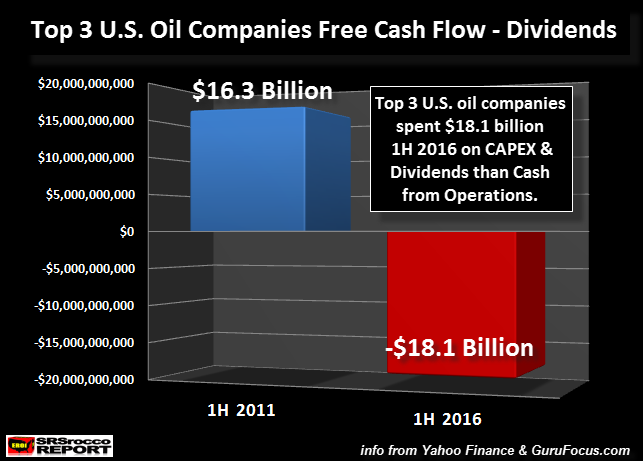
Is this analysis by the Hill’s Group too reductionist in attributing so much of the era of earlier western material prosperity to the big discoveries of ‘cheap’ oil, and the subsequent elusiveness of growth to the decline in net energy per barrel available for GDP growth?  Are we in deep trouble now that the IOCs use more energy in their own processes, than they are able to deliver net to industrialised world? Maybe so. It is a controversial view, but we can see – in plain dollar terms – some tangible evidence fo rthe Hill’s Groups’ assertions:  


Source: https://srsroccoreport.com/wp-content/uploads/2016/08/Top-3-U.S.-Oil-Com...


(The top three U.S. oil companies, ExxonMobil, Chevron andConocoPhillips: Cash from operations less Capex and dividends)


Briefly, what does this all mean? Well, the business model for the big three US IOCs does not look that great: Energy costs of course, are financial costs, too.  In 2016, according to Yahoo Finance, the U.S. Energy Sector paid 86% of their operating income just to service the interest on the debt (i.e. to pay for those extraction costs). We have not run out of oil. This is not what the Hill’s Group is saying. Quite the reverse. What they are saying is the surplus energy (at a ratio of now less than 10:1) that derives from the oil that we have been using (after the energy-costs expended in retrieving it) – is now at a point that it can barely support our energy-driven ‘modernity’.  Implicit in this analysis, is that our era of plenty was a one time, once off, event.


They are also saying that this implies that as modernity enters on a more severe energy ‘diet’, less surplus calories for their dollars – barely enough to keep the growth engine idling – then global demand for oil will decline, and the price will fall (quite the opposite of mainstream analysis which sees demand for oil growing. It is a vicious circle. If Hills are correct, a key balance has tipped. We may soon be spending more energy on getting the energy that is required to keep the cogs and wheels of modernity turning, than that same energy delivers in terms of calorie-equivalence.  There is not much that either Mr Trump or the Europeans can do about this – other than seize the entire Persian Gulf.  Transiting to renewables now, is perhaps too little, too late.


And America and Europe, no longer have the balance sheet ‘room’, for much further fiscal or monetary stimulus; and, in any event, the efficacy of such measures as drivers of ‘real economy’ growth, is open to question. It may mitigate the problem, but not solve it. No, the headwinds of net energy per barrel trending to zero, plus the other ‘secular’ dynamics mentioned above (demography, China slowing and technology turning job-destructive), form a formidable impediment – and therefore a huge political time bomb.


Back to Davos, and the question of ‘what to do’. Jamie Dimon, the CEO of  JPMorgan Chase, warned  that Europe needs to address disagreements spurring the rise of nationalist leaders. Dimon said he hoped European Union leaders would examine what caused the U.K. to vote to leave and then make changes. That hasn’t happened, and if nationalist politicians including France’s Marine Le Pen rise to power in elections across the region, “the euro zone may not survive”. “The bottom line is the region must become more competitive, Dimon said, which in simple economic terms means accept even lower wages. It also means major political overhauls: “I say this out of respect for the European people, but they’re going to have to change,” he said. “They may be forced by politics, they may be forced by new leadership.”


A race to the bottom in pay levels?  Italy should undercut Romanian salaries?  Maybe Chinese pay scales, too? This is politically naïve, and the globalist Establishment has only itself to blame for their conviction that there are no real options – save to divert more of the diminished prosperity towards the middle classes (Christine Lagarde), and to impose further austerity (Dimon). As we have tried to show, the era of prosperity for all, began to waver in the 70s in America, and started its more serious stall from 2001 onwards. The Establishment approach to this faltering of growth has been to kick the can down the road: ‘extend and pretend’ – monetised debt, zero, or negative, interest rates and the unceasing refrain that ‘recovery’ is around the corner.


It is precisely their ‘kicking the can’ of inflated asset values, reaching into every corner of life, hiking the cost of living, that has contributed to making Europe the leveraged, ‘high cost’, uncompetitive environment, that it now is.  There is no practical way for Italians, for example, to compete with ‘low cost’ East Europe, or  Asia, through a devaluation of the internal Italian price level without provoking major political push-back.  This is the price of ‘extend and pretend’.


It has been claimed at Davos that the much derided ‘populists’ provide no real solutions. But, crucially, they do offer, firstly, the hope for ‘regime change’ – and, who knows, enough Europeans may be willing to take a punt on leaving the Euro, and accepting the consequences, whatever they may be. Would they be worse off? No one really knows. But at least the ‘populists’ can claim, secondly, that such a dramatic act would serve to escape from the suffocation of the status quo. ‘Davos man’ and woman disdain this particular appeal of ‘the populists’ at their peril.