Showing posts with label East Europe. Show all posts

Friday, December 8, 2017

What"s The Best Company To Work For Where You Live?

With unemployment in the US purportedly reaching its lowest level in 17 years (that is, according to the Department of Labor"s flawed household survey) employees who once would"ve been too fearful to leave their jobs are now actively looking for opportunities. With that in mind, many have probably wondered what"s the best company to work for where they live?


Well, HowMuch.com gathered data compiled by Forbes into an infographic to try and map out the best and largest employers in every country.


Forbes recently released a ranking of the best companies in the world using a variety of different perks and benefits, like the quality of food served to employees, parental leave policies or whether companies allow their employees to nap while on the job.


HowMuch mapped these companies by paying attention to their market capitalization to get a feel for how large an organization needs to be to afford such high-quality benefits. One company therefore represents each country, color-coded by market cap. Red countries have an employer worth over $100 billion, and dark blue countries boast relatively small employers under $10 billion.


Several trends immediately pop out from our map:


  • Red countries with huge companies predominantly originate in North America and Western Europe.

  • Alphabet is the largest on our list by a landslide with a market cap of $579.5 billion, bigger than the entire GDP of Argentina.

  • The three exceptions proving the rule are a tobacco company in India called ITC with a market cap of $51.6 billion, plus Hong Kong (CNOOC, $54.8 billion) and Taiwan (Han Hai Precision, $54.4 billion). All three of these places experienced long-term and unique economic and political relationships with the West.

  • Africa only contributes a single company to Forbes’ list, namely Remgro from South Africa, a conglomerate made of many subsidiaries from different industries.

  • The Middle East and Eastern Europe also have only a few companies that made the cut.

Here’s a simplified list of the countries with the best employers in the world, ranked in order of their total market cap:


  • 1. United States - Alphabet: Computer Services - $579.5B and 72,053 employees

  • 2. Switzerland - Nestle: Food Processing - $229.5B and 328,000 employees

  • 3. Netherlands - Unilever: Household/Personal Care - $143.9B and 169,000 employees

  • 4. Germany - Daimler: Auto & Truck Manufacturers - $76.1B and 282,488 employees

  • 5. Hong Kong - CNOOC: Oil & Gas Operations - $54.8B and 19,718 employees

  • 6. Taiwan - Hon Hai Precision: Electronics - $54.4B and 1,000,000 employees

  • 7. Canada - Suncor Energy: Oil & Gas Operations – $51.7B and 12,837 employees

  • 8. India - ITC: Tobacco - $51.6B and 25,564 employees

  • 9. Italy - Enel: Electric Utilities - $47.5B and 62,080 employees

  • 10. Australia - CSL: Biotechs - $43.9B and 16,000 employees

Coming in at No. 1 is, of course, Alphabet. It tops the list because of its size and market dominance.


Monday, August 7, 2017

NATO Beefs Up Logistics Infrastructure For Offensive Operations

Authored by Alex Gorka via The Strategic Culture Foundation,


Some very important news is kept out of spotlight and undeservedly so. Bits of information pieced together indicate that very quietly the North Atlantic alliance is gearing up for large-scale combat operations. War preparations are not limited to weapon systems deployments and troop movements that hit headlines. No combat can be waged without logistics.


The US Army official website informs that the US European Command (EUCOM) Logistics Directorate (ECJ4), other EUCOM directorates, NATO allies and partners, and the Joint Logistics Enterprise (JLEnt) are effecting an unprecedented security transformation. They are transitioning from being focused on assurance through engagement to being a warfighting command postured for deterrence and defense. Throughout fiscal year 2017, 28 joint and multinational exercises in 40 European countries, the buildup of four NATO Enhanced Forward Presence (EFP) multinational battlegroups in the Baltics, and overlapping deployments of rotating armored brigade combat teams and combat aviation brigades will test, validate, and offer proof of principle for these infrastructure and organic capability investments.


NATO Exercise Saber Guardian 17, a US Army Europe-led, multinational exercise, took place in Bulgaria, Hungary, and Romania on July 11 - 20, 2017 with 25,000 troops and forces from 24 countries. The event demonstrated the increased scope and complexity of war games. The drills were conducted against the background of this year"s rotational deployment of more than 4,500 troops in the Baltic states of Lithuania, Latvia and Estonia, as well as Poland. 2nd Cavalry Regiment soldiers are already operating as a deterrent force roughly 100 miles from Poland’s border with the Russian military enclave of Kaliningrad.


Citing the lessons learned from the training event, US Army Lieutenant General Ben Hodges, commander of US Army Europe, emphasized in an interview the importance of NATO logistics. According to him, progress is evident but much remained to be done to ease the movement of military equipment and forces across Europe in the event of a real crisis, and Germany could play a crucial role. Hodges noted that Berlin could ensure guaranteed rail access as part of its bid to boost military spending from around 1.2 percent of gross domestic product to the 2 percent NATO target.


The military leader underscored the importance of creating a military free transit zone modeled on the 1996 Schengen agreement to allow free forces movements across the borders of European NATO members.


Meanwhile, construction works are in full swing to enable Poland to host combat-ready stocks at the 33rd Air Base, operated by the Polish Air Force. Powidz, a village with a population of 1,000, is to become a strategically important NATO hub for the Baltics and all of Northern Europe. The plans include the delivery of more than a brigade’s worth of military vehicles, equipment, artillery and personnel. In April, Lt. Gen. Ben Hodges described it as the «center of the center of gravity».


Over the next two years, $70 million will be spent on 77 military infrastructure and improvement projects for both US Army and US Air Force operations. An additional $200 million in NATO funds will be spent for the US Army Corps of Engineers to construct a new storage site and warehouse facility in Powidz. Poland’s increasing importance is the result of a combination of factors, Hodges said, including geography and existing hubs, such as the NATO Enhanced Forward Presence unit in the country’s northeast. «Any contingency we have to deal with, we’ll almost certainly have to come through Poland», he noted.


US European Command Chief Gen. Curtis M. Scaparrotti is planning for an expanded military presence in Europe to eventually include a full US Army division. If that happens, even on a rotational basis, the Army would likely need more facilities for basing forces.


In May, US Army Europe announced that it had established a new tactical headquarters in Poznan, Poland. The goal is to enhance the mission command of US rotational forces and units assigned to US Army Europe conducting operations where no significant military presence had been previously maintained.


So, Poland is in focus of the infrastructure efforts but the plans go much further. The Estonian town of Tapa, which sits at an important railway junction, is located less than 150km (93 miles) from the Russian border. It has recently become the base for a NATO battle group, in accordance with the Enhanced Forward Presence concept approved at the Warsaw summit in 2016. It envisions multi-national battle groups deployed in each of the three Baltic States and another in Poland.


General Sir Nicholas Patrick «Nick» Carter, the head of the British Army as Chief of the General Staffsaid «We would very much like to test the land line of communication from our mounting bases in Germany, forward into the Baltics, and we would absolutely like to test what it would be like bringing in reinforcing capabilities - the signature equipment that are appropriate to show how you would reinforce and to understand what would happen».


In 2016, Poland and the Baltic States reached an agreement to link Poland, Finland and the Baltic States with the unified Trans-European Transport Network (NRA) that will be crucial to the defense of the Baltic States. A continuous rail link named «Rail Baltica» from Tallinn to Warsaw (Poland), via Kaunas (Lithuania) and Riga (Latvia) will lead to significant logistical implications for the NATO.


Thomas Durell Young, a program manager at Naval Postgraduate School, Monterey, California, and a staff consultant at the RAND Corporation, has recently published a book, titled Anatomy of Post-Communist European Defense Institutions. He believes that the «new» members of the alliance - Hungary, Poland, the Czech Republic, the three Baltics States, Bulgaria, Romania, Slovakia, and some of the republics that emerged out of Yugoslavia - need to radically transform their «ineffectual legacy logistics organizations« with the help of «old» members of the alliance. Professor Young emphasizes the importance of reform as a potential war with Russia would «almost certainly» start in Central or Eastern Europe.


The rapid creation of logistics infrastructure and some other factors, such as militarization of the Scandinavian Peninsula, fit into a bigger picture of NATO war preparations in East Europe and the Baltics. These are not steps of defensive nature. The goal is to acquire the ability to move substantial forces to the areas close to Russia’s borders gearing up for offensive operations in an armed conflict.

Sunday, April 16, 2017

Paul Craig Roberts Asks "Is That Armageddon Over The Horizon?"

Authored by Paul Craig Roberts,


The insouciance of the Western world is extraordinary.


It is not only Americans who permit themselves to be brainwashed by CNN, MSNBC, NPR, the New York Times and Washington Post, but also their counterparts in Europe, Canada, Australia, and Japan, who rely on the war propaganda machine that poses as a media.


The Western “leaders,” that is, the puppets on the end of the strings pulled by the powerful private interest groups and the Deep State, are just as insouciant.


Trump and his counterparts in the American Empire must be unaware that they are provoking war with Russia and China, or else they are psychopaths.


A new White House Fool has replaced the old fool. The New Fool has sent his Secretary of State to Russia. For what? To deliver an ultimatum? To make more false accusations? To apologize for the lies?


Consider the audacity of Secretary of State Tillerson. He has spent the week prior to his visit to Moscow supporting incredible lies and false allegations that Assad of Syria used chemical weapons with Russia’s permission, which justified Washington’s unambigious war crime of a military attack on a country with which the US has not declared war. Less than 100 days in office, and Trump is already a war criminal along with the rest of his warmonger government.


The entire world knows this, but no one says it. Instead, Tillerson, who has been heavy with lies and threats has the confidence to go to Moscow to tell the Russians that they have to hand over Assad to the American Uni-Power.


Tillerson’s mission demonstrates the complete, total unreality of the world in which Washington lives. Try to imagine Tillerson’s arrogance. If you had been bad-mouthing and threatening strong, important people, would you feel comfortable going over to their house to have dinner with them? Does Tillerson think that now that Russia has largely freed Syrtia of US-supported ISIS, Russia is going to turn Syria over to Washington?


Is he going to tell Lavrov that he didn’t really mean all those nasty lies he told about Russia, but the zionist neoconservatives made him do it? That he is not really in charge, just a tool of the Anglo-Zionist Empire?


Is Tillerson going to apologize for White House press secretary Sean Spicer’s statement that Assad, Russia’s ally, is more evil than Hitler? 


Maybe Tillerson is going to ask for asylum and get on the winning side.


Stephen Cohen, one of the few remaining Americans knowledgeable about Russia, told the two CNN presstitutes and the warmonger Col. Leighton, one of the “experts” that the presstitutes roll out to pronounce the propaganda against Russia, that Russia was preparing for hot war. It seems to have gone over the heads of the CNN presstitutes and colonel. Whose payroll are they on?


The Russian leaders, who, unlike the Western liars, speak the truth, have said clearly that Russia will never again fight a war on her own territory. The Russians couldn’t put it more clearly. Provoke a war, and we will destroy you on your own territory.


When you watch the president and government in Washington, the European governments, especially the idiots in London, the Canadian and Australian governments, you can only marvel at the total stupidity of “Western leadership.” They are begging for the end of the world.


And the presstitutes are at work driving toward the end of life. Huge numbers of Western peoples are being prepared for their demise, and they are protected from the realization by their insouciance.


Washington is so arrogant and lost in its own hubris, that Washington does not understand that the years of clear as crystal lies about Russia and Russian intentions and deeds have convinced Russia that Washington is preparing the populations of the United States and Washington’s captive peoples in West and East Europe, Canada, Australia, and Japan for a US pre-emptive nuclear strike against Russia. Published US war plans against China have convinced China of the same.


If not for war, what else is the change in US war doctrine for? George W. Bush abandoned the stabilizing role of nuclear weapons by moving them from a retaliatory function to a nuclear first strike. Then he pulled out of the anti-ballistic missile treaty concluded by President Richard Nixon. Now we have US missile sites positioned on Russia’s borders. We tell the Russians the lie that the missiles are to prevent an Iranian nuclear ICBM strike against Europe. This lie is told, and accepted by the puppets in Europe, despite the known, incontestable fact that Iran has neither nukes nor ICBMs. But the Russians do not accept it. They know it is another Washington lie.


When Russia hears these flagrant, blatant, obvious lies, Russia understands that Washington intends a preemptive nuclear attack on Russia.


China has reached the same conclusion.


So, here is the situation. Two countries with nuclear forces expect that the insane fools who rule the West are going to attack them with nuclear weapons. What are Russia and China doing? Are they begging for mercy?


No. They are preparing to destroy the evil West, a collection of liars and war criminals, the like of which the world has never previously experienced.


It is the US, the washed-up joke of a “uni-power” that after 16 years is still unable to defeat a few thousand lightly armed Taliban in Afghanistan, that needs to ask for mercy.


The reckless and irresponsible war talk in the US government and presstitute media and among NATO and Washington’s vassals must stop immediately. Life is in the balance.


Putin has shown amazing patience with Washington’s lies and provocations, but he cannot risk Russia by trusting Washington, whom no one can trust. Not the American people, not the Russian people, not any people.


By jumping on the Deep State’s propaganda wagon the liberal/progressive/left is complicit in the march toward Armageddon.

Thursday, January 26, 2017

What Is This "Crisis" Of Modernity?

Authored by Alastair Crooke, originally posted at The Automatic Earth blog,


We have an economic crisis – centred on the persistent elusiveness of real growth, rather than just monetised debt masquerading as ‘growth’ – and a political crisis, in which even ‘Davos man’, it seems, according to their own World Economic Forum polls,is anxious; losing his faith in ‘the system’ itself, and casting around for an explanation for what is occurring, or what exactly to do about it. Klaus Schwab, the founder of the WEF at Davos remarked  before this year’s session, “People have become very emotionalized, this silent fear of what the new world will bring, we have populists here and we want to listen …”.


Dmitry Orlov, a Russian who was taken by his parents to the US at an early age, but who has returned regularly to his birthplace, draws on the Russian experience for his book, The Five Stages of Collapse. Orlov suggests that we"re not just entering a transient moment of multiple political discontents, but rather that we are already in the early stages of something rather more profound. From his perspective that fuses his American experience with that of post Cold War Russia, he argues, that the five stages would tend to play out in sequence based on the breaching of particular boundaries of consensual faith and trust that groups of human beings vest in the institutions and systems they depend on for daily life. These boundaries run from the least personal (e.g. trust in banks and governments) to the most personal (faith in your local community, neighbours, and kin). It would be hard to avoid the thought – so evident at Davos – that even the elites now accept that Orlov’s first boundary has been breached.


But what is it? What is the deeper economic root to this malaise? The general thrust of Davos was that it was prosperity spread too unfairly that is at the core of the problem. Of course, causality is seldom unitary, or so simple. And no one answer suffices. In earlier Commentaries, I have suggested that global growth is so maddeningly elusive for the elites because the debt-driven ‘growth’ model (if it deserves the name ‘growth’) simply is not working.  Not only is monetary expansion not working, it is actually aggravating the situation: Printing money simply has diluted down the stock of general purchasing power – through the creation of additional new, ‘empty’ money – with the latter being intermediated (i.e. whisked away) into the financial sector, to pump up asset values.


It is time to put away the Keynesian presumed ‘wealth effect’ of high asset prices. It belonged to an earlier era. In fact, high asset prices do trickle down. It is just that they trickle down into into higher cost of living expenditures (through return on capital dictates) for the majority of the population. A population which has seen no increase in their real incomes since 2005 – but which has witnessed higher rents, higher transport costs, higher education costs, higher medical costs; in short, higher prices for everything that has a capital overhead component. QE is eating into peoples’ discretionary income by inflating asset balloons, and is thus depressing growth – not raising it. And zero, and negative interest rates, may be keeping the huge avalanche overhang of debt on ‘life support’, but it is eviscerating savings income, and will do the same to pensions, unless concluded sharpish.


But beyond the spent force of monetary policy, we have noted that developed economies face separate, but equally formidable ‘headwinds’, of a (non-policy and secular) nature, impeding growth – from aging populations in China and the OECD, the winding down of China’s industrial revolution,  and from technical innovation turning job-destructive, rather than job creative as a whole. Connected with this is shrinking world trade.


But why is the economy failing to generate prosperity as in earlier decades?  Is it mainly down to Greenspan and Bernanke’s monetary excesses?  Certainly, the latter has contributed to our contemporary stagnation, but perhaps if we look a little deeper, we might find an additional explanation. As I noted in a Comment of 6 January 2017, the golden era of US economic expansion was the ‘50s and ‘60s – but that era had begun to unravel somewhat, already, with the economic turbulence of the 70s. However, it was not so much Reagan’s fiscal or monetary policies that rescued a deteriorating situation in that earlier moment, but rather, it was plain old good fortune. The last giant oil fields with greater than 30-to-one, ‘energy-return’ on ‘energy-cost’ of exploitation, came on line in the 1980s: Alaska’s North Slope, Britain and Norway’s North Sea fields, and Siberia. Those events allowed the USA and the West generally to extend their growth another twenty years.


And, as that bounty tapered down around the year 2000, the system wobbled again, “and the viziers of the Fed ramped up their magical operations, led by the Grand Vizier (or “Maestro”) Alan Greenspan.”  Some other key things happened though, at this point: firstly the cost of crude, which had been remarkably stable, in real terms, over many years, suddenly started its inexorable real-terms ascent.  And from 2001, in the wake of the dot.com ‘bust’, government and other debt began to soar in a sharp trajectory upwards (now reaching $20 trillion). Also, around this time the US abandoned the gold standard, and the petro-dollar was born.


Source: Get It. Got It. Good, by Grant Williams


Well, the Hill’s Group, who are seasoned US oil industry engineers, led by B.W. Hill, tell us – following their last two years, or so, of research – that for purely thermodynamic reasons net energy delivered to the globalised industrial world (GIW) per barrel, by the oil industry (the IOCs) is rapidly trending to zero. Note that we are talking energy-cost of exploration, extraction and transport for the energy-return at final destination. We are not speaking of dollar costs, and we are speaking in aggregate. So why should this be important at all; and what has this to do with spiraling debt creation by the western Central Banks from around 2001?


The importance? Though we sometimes forget it, for we now are so habituated to it, is that energy is the economy.  All of modernity, from industrial output and transportation, to how we live, derives from energy – and oil remains a key element to it.  What we (the globalized industrial world) experienced in that golden era until the 70s, was economic growth fueled by an unprecedented 321% increase in net energy/head.  The peak of 18GJ/head in around 1973 was actually of the order of some 40GJ/head for those who actually has access to oil at the time, which is to say, the industrialised fraction of the global population. The Hill’s Group research  can be summarized visually as below (recall that these are costs expressed in energy, rather than dollars):


Source: http://cassandralegacy.blogspot.it/2016/07/some-reflections-on-twilight-...


But as Steve St Angelo in the SRSrocco Reports states, the important thing to understand from these energy return on energy cost ratios or EROI, is that a minimum ratio value for a modern society is 20:1 (i.e. the net energy surplus available for GDP growth should be twenty times its cost of extraction). For citizens of an advanced society to enjoy a prosperous living, the EROI of energy needs to be much higher, closer to the 30:1 ratio. Well, if we look at the chart below, the U.S. oil and gas industry EROI fell below 30:1 some 46 years ago (after 1970):


Source: https://srsroccoreport.com/the-coming-breakdown-of-u-s-global-markets-ex...


“You will notice two important trends in the chart above. When the U.S. EROI ratio was higher than 30:1, prior to 1970, U.S. public debt did not increase all that much.  However, this changed after 1970, as the EROI continued to decline, public debt increased in an exponential fashion”. (St Angelo).


In short, the question begged by the Hill’s Group research is whether the reason for the explosion of government debt since 1970 is that central bankers (unconsciously), were trying to compensate for the lack of GDP stimulus deriving from the earlier net energy surplus.  In effect, they switched from flagging energy-driven growth, to the new debt-driven growth model.


From a peak net surplus of around 40 GJ  (in 1973), by 2012, the IOCs were beginning to consume more energy per barrel, in their own processes (from oil exploration to transport fuel deliveries at the petrol stations), than that which the barrel would deliver net to the globalized industrial world, in aggregate.  We are now down below 4GJ per head, and dropping fast. (The Hill’s Group)


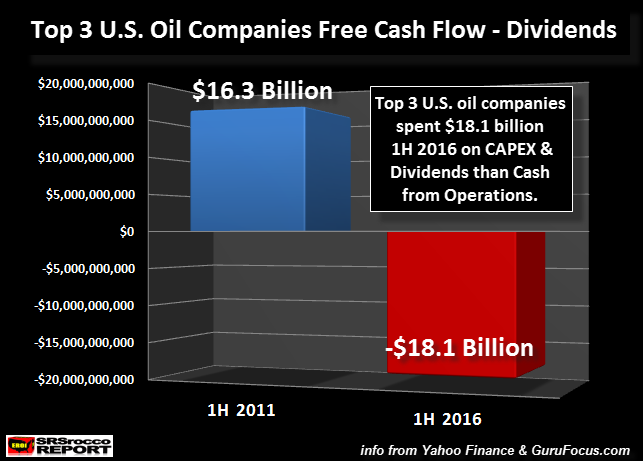
Is this analysis by the Hill’s Group too reductionist in attributing so much of the era of earlier western material prosperity to the big discoveries of ‘cheap’ oil, and the subsequent elusiveness of growth to the decline in net energy per barrel available for GDP growth?  Are we in deep trouble now that the IOCs use more energy in their own processes, than they are able to deliver net to industrialised world? Maybe so. It is a controversial view, but we can see – in plain dollar terms – some tangible evidence fo rthe Hill’s Groups’ assertions:  


Source: https://srsroccoreport.com/wp-content/uploads/2016/08/Top-3-U.S.-Oil-Com...


(The top three U.S. oil companies, ExxonMobil, Chevron andConocoPhillips: Cash from operations less Capex and dividends)


Briefly, what does this all mean? Well, the business model for the big three US IOCs does not look that great: Energy costs of course, are financial costs, too.  In 2016, according to Yahoo Finance, the U.S. Energy Sector paid 86% of their operating income just to service the interest on the debt (i.e. to pay for those extraction costs). We have not run out of oil. This is not what the Hill’s Group is saying. Quite the reverse. What they are saying is the surplus energy (at a ratio of now less than 10:1) that derives from the oil that we have been using (after the energy-costs expended in retrieving it) – is now at a point that it can barely support our energy-driven ‘modernity’.  Implicit in this analysis, is that our era of plenty was a one time, once off, event.


They are also saying that this implies that as modernity enters on a more severe energy ‘diet’, less surplus calories for their dollars – barely enough to keep the growth engine idling – then global demand for oil will decline, and the price will fall (quite the opposite of mainstream analysis which sees demand for oil growing. It is a vicious circle. If Hills are correct, a key balance has tipped. We may soon be spending more energy on getting the energy that is required to keep the cogs and wheels of modernity turning, than that same energy delivers in terms of calorie-equivalence.  There is not much that either Mr Trump or the Europeans can do about this – other than seize the entire Persian Gulf.  Transiting to renewables now, is perhaps too little, too late.


And America and Europe, no longer have the balance sheet ‘room’, for much further fiscal or monetary stimulus; and, in any event, the efficacy of such measures as drivers of ‘real economy’ growth, is open to question. It may mitigate the problem, but not solve it. No, the headwinds of net energy per barrel trending to zero, plus the other ‘secular’ dynamics mentioned above (demography, China slowing and technology turning job-destructive), form a formidable impediment – and therefore a huge political time bomb.


Back to Davos, and the question of ‘what to do’. Jamie Dimon, the CEO of  JPMorgan Chase, warned  that Europe needs to address disagreements spurring the rise of nationalist leaders. Dimon said he hoped European Union leaders would examine what caused the U.K. to vote to leave and then make changes. That hasn’t happened, and if nationalist politicians including France’s Marine Le Pen rise to power in elections across the region, “the euro zone may not survive”. “The bottom line is the region must become more competitive, Dimon said, which in simple economic terms means accept even lower wages. It also means major political overhauls: “I say this out of respect for the European people, but they’re going to have to change,” he said. “They may be forced by politics, they may be forced by new leadership.”


A race to the bottom in pay levels?  Italy should undercut Romanian salaries?  Maybe Chinese pay scales, too? This is politically naïve, and the globalist Establishment has only itself to blame for their conviction that there are no real options – save to divert more of the diminished prosperity towards the middle classes (Christine Lagarde), and to impose further austerity (Dimon). As we have tried to show, the era of prosperity for all, began to waver in the 70s in America, and started its more serious stall from 2001 onwards. The Establishment approach to this faltering of growth has been to kick the can down the road: ‘extend and pretend’ – monetised debt, zero, or negative, interest rates and the unceasing refrain that ‘recovery’ is around the corner.


It is precisely their ‘kicking the can’ of inflated asset values, reaching into every corner of life, hiking the cost of living, that has contributed to making Europe the leveraged, ‘high cost’, uncompetitive environment, that it now is.  There is no practical way for Italians, for example, to compete with ‘low cost’ East Europe, or  Asia, through a devaluation of the internal Italian price level without provoking major political push-back.  This is the price of ‘extend and pretend’.


It has been claimed at Davos that the much derided ‘populists’ provide no real solutions. But, crucially, they do offer, firstly, the hope for ‘regime change’ – and, who knows, enough Europeans may be willing to take a punt on leaving the Euro, and accepting the consequences, whatever they may be. Would they be worse off? No one really knows. But at least the ‘populists’ can claim, secondly, that such a dramatic act would serve to escape from the suffocation of the status quo. ‘Davos man’ and woman disdain this particular appeal of ‘the populists’ at their peril.

Saturday, January 21, 2017

Trump's Declaration Of War: 12 Things He Must Do For America To Be Great Again

President Trump’s brief inaugural speech was a declaration of war against the entirety of the American Ruling Establishment. All of it.


As Paul Craig Roberts details, Trump made it abundantly clear that Americans’ enemies are right here at home: globalists, neoliberal economists, neoconservatives and other unilateralists accustomed to imposing the US on the world and involving us in endless and expensive wars, politicians who serve the Ruling Establishment rather than the American people, indeed, the entire canopy of private interests that have run America into the ground while getting rich in the process.


If truth can be said, President Trump has declared a war far more dangerous to himself than if he had declared war against Russia or China.


The interest groups designated by Trump as The Enemy are well entrenched and accustomed to being in charge. Their powerful networks are still in place. Although there are Republican majorities in the House and Senate, most of those in Congress are answerable to the ruling interest groups that provide their campaign funds and not to the American people or to the President. The military/security complex, offshoring corporations, Wall Street and the banks are not going to roll over for Trump. And neither is the presstitute media, which is owned by the interest groups whose power Trump challenges.


Trump made it clear that he stands for every American, black, brown, and white. Little doubt his declaration of inclusiveness will be ignored by the haters on the left who will continue to call him a racist just as the $50 per hour paid protesters are doing as I write.


Indeed, black leadership, for example, is enculturated into the victimization role from which it would be hard for them to escape. How do you pull together people who all their lives have been taught that whites are racists and that they are the victims of racists?


Can it be done? I was just on a program briefly with Press TV in which we were supposed to provide analysis of Trump’s inaugural speech. The other commentator was a black American in Washington, DC. Trump’s inclusiveness speech made no impression on him, and the show host was only interested in showing the hired protesters as a way of discrediting America. So many people have an economic interest in speaking in behalf of victims that inclusiveness puts them out of jobs and causes.


So along with the globalists, the CIA, the offshoring corporations, the armaments industries, the NATO establishment in Europe, and foreign politicians accustomed to being well paid for supporting Washington’s interventionist foreign policy, Trump will have arrayed against him the leaders of the victimized peoples, the blacks, the hispanics, the feminists, the illegals, the homosexuals and transgendered. This long list, of course, includes the white liberals as well, as they are convinced that flyover America is the habitat of white racists, misogynists, homophobes, and gun nuts. As far as they are concerned, this 84% of geographical US should be quarantined or interred.


In other words, does enough good will remain in the population to enable a President to unite the 16% America haters with the 84% America lovers?


Consider the forces that Trump has against him:


  • Black and hispanic leaders need victimization, because it is what elevates them to power and income. They will turn a jaundiced eye toward Trump’s inclusiveness. Inclusiveness is good for blacks and hispanics, but not for their leaders.

  • The executives and shareholders of global corporations are enriched by the offshored jobs that Trump says he will bring home. If the jobs come home, their profits, performance bonuses, and capital gains will go away. But the economic security of the American population will return.

  • The military/security complex has a 1,000 billion annual budget dependent on “the Russian threat” that Trump says he is going to replace with normalized relations. Trump’s assassination cannot be ruled out.

  • Many Europeans owe their prestige, power, and incomes to the NATO that Trump has called into question.

  • The financial sector’s profits almost entirely flow from putting Americans into debt bondage and from looting their private and public pensions. The financial sector with their agent, the Federal Reserve, can overwhelm Trump with financial crisis. The New York Federal Reserve Bank has a complete trading desk. It can send any market into turmoil. Or support any market, because there is no limit on its ability to create US dollars.

  • The entire political ediface in the US has insulated itself from the will, desires, and needs of the people. Now Trump says the politicians will be accountable to the people. This, of course, would mean a big drop in their security in office and in their income and wealth.

  • There are a large number of groups, funded by we-know-not-who. For example, RootsAction has responded today to Trump’s forceful commitment to stand for all of the people against the Ruling Establishment with a request to “ask Congress to direct the House Judiciary Committee to open an impeachment investigation” and to send money for Trump’s impeachment.

  • Another hate group, human rights first, attacks Trump’s defense of our borders as closing “a refuge of hope for those fleeing persecution.” Think about this for a minute. According to the liberal-progressive-left and the racial interest group organizations, the US is a racist society and President Trump is a racist. Yet, people subject to American racism are fleeing from persecution to America where they will be racially persecuted? It doesn’t make sense. The illegals come here for work. Ask the construction companies. Ask the chicken and animal slaughter houses. Ask the vacation area cleaning services.

This list of those on whom Trump has declared war is long enough, although there are more that can be added.


We should ask ourselves why a 70 year old billionaire with flourishing businesses, a beautiful wife, and intelligent children is willing to give his final years to the extraordinary stress of being President with the stressful agenda of putting the government back in the hands of the American people. There is no doubt that Trump has made himself a target of assassination. The CIA is not going to give up and go away. Why would a person take on the grand restoration of America that Trump has declared when he could instead spend his remaining years enjoying himself immensely?


Whatever the reason, we should be grateful for it, and if he is sincere we must support him. If he is assassinated, we need to take up our weapons, burn Langley to the ground and kill every one of them.


If he succeeds, he deserves the designation: Trump the Great!


Russia, China, Iran, Venezuela, Ecuador, Bolivia, and any other country on the CIA’s hit list should undersand that Trump’s rise is insufficient protection. The CIA is a worldwide organization. Its profitable businesses provide income independent of the US budget. The organization is capable of undertaking operations independently of the President or even of its own Director.


The CIA has had about 70 years to entrench itself. It has not gone away.


But, as Jeremiah Johnson explains (via SHTFPlan.com), it will take a complete sea change to rectify the course this country has been heading in the past eight years.  These are some of the problems that Trump will need to reverse when he becomes President Trump, many of which he promised to either change or end completely:


  1. The (Un)Affordable Health Care Act, now law, termed “Obamacare” that is the most heinous piece of legislation…a law that mandates a requirement for a citizen to have health care coverage as dictated by government requirements.


  2. “Differentially permeable” borders: where foreigners, such as Mexicans and Canadians can come and go as they please, and illegal aliens have free access…but Americans are confined until a full cavity search is conducted.


  3. An economy based not on true GNP, but on consumer spending (almost 80%); convincing one company not to pick up and relocate overseas is an illustration of the concept, and not the implementation…not yet.


  4. A reversal of the true unemployment rate, that hovers between 15 and 20%, depending on what paid “parrot” (such as Labor and Statistics) announces the phony figure.


  5. A reversal of the Entitlement Nation: the EBT and Food Stamp users, the unemployment collectors, the Social Security Disability recipients whose corpulence from overeating is termed a “disability,” the illegal aliens on the dole for all of the above, plus free healthcare, the almost 100 million no longer “in the work force.”


  6. Knocking the knees off lobbyists, NGO’s, and NPO’s who have been holding administrations hostage (the 1st), or acting as if they were a government agency (the 2nd), or with executives profiting immensely while running on slave labor using socially misfortunate people and writing it all off (the 3rd).


  7. Revitalizing a military whose Air Force is forced to scavenge parts from “the Boneyard,” and where levels of service members in terms of numbers and readiness have fallen to their lowest point since before WWII.


  8. Resetting an abysmal foreign policy where (for the past eight years) we have instituted coup d’états, undermined relations that worked throughout the world, placed ourselves in position to start a new Cold War, and turned the Middle East and Eastern Europe completely upside down.


  9. Revitalizing a crumbling infrastructure of roads, bridges, and buildings very dangerously in disrepair…where maintenance charges and fees continue to rise with very little return on taxpayer dollars and nothing changing on our highways, ports, and bridges.


  10. Permitting (yes, permitting) and encouraging American businesses to be able to start up, operate, and produce in the United States without Soviet-style restrictions, regulations, and an army of bureaucratic “flying monkeys” inserting themselves into the business’s “fourth point of contact,” preventing U.S. businesses (especially the small proprietorships and Mom-and-Pop concerns) from either starting, or succeeding.


  11. The Supreme Court: just look at them…and nothing else really needs to be said: Except that a branch of the U.S. government meant to be a “check and balance” does not need to circumvent the Constitution and be the sole arbiter and (in essence) a lawmaker to institute policy for a presidential administration.


  12. Bring about a change in the hearts of the American people.


Perhaps the most important item in that list is the last one.


When Reagan took office, we (and he) faced double-digit unemployment, double digit inflation, and enormous taxation and loss of liberties.  We faced a crumbling infrastructure, a military that was in shambles (Desert One to free the Iranian hostages, conducted with helicopters in a sandstorm as Carter approached the midnight hour to lose the election should never be forgotten).  The Soviets were strong, and we were not…having recently ended the war in Vietnam.  We weren’t doing too well, in the world and in our own minds and hearts.


Then Reagan came, and he turned it around.  He was not perfect, but he made up for his imperfections by surrounding himself with an excellent staff.  He had a heart for the United States, and the fortitude to stand up for it.  His leadership staved off the fall of the U.S., and turned things around for us.  Do you remember that Lake Placid victory of the amateur U.S. hockey team in the semifinals against the professionals of the Soviet hockey team?  Remember the moment…a small thing, perhaps, and many may discount it as being “completely unimportant” or “unrelated to problems we now face.”


But that victory was neither one of those disparaging remarks.  It was something that we all could focus upon, to form some kind of cohesive unity and think of ourselves together as Americans…to take pride in accomplishment in something…for once, after four years of Carter.  There was a sea change made.  Did it last?  Perhaps it didn’t, and yet, if the memory of those years is still alive in even one person with the hopes of a repeat…then maybe others can feel the same.


This is still the best country in the world.  Trump’s campaign slogan was “Make America Great Again.”  Cliché, perhaps, but we must start somewhere.  Last time I checked, the preamble to the Constitution starts out with “We the people.”  Yes, we the people need to do the best we can with what we have, to be vigilant in our undertakings to prevent another eight years akin to the ones we are just emerging from, and to move forward and improve our lives.  Many will say that it doesn’t matter, and that there are forces that are out of our control that will prevent us as a nation from overcoming obstacles.


Such may be for a while, as it was under Obama.  Those times cannot last forever, and eventually the change has to occur.  We have perhaps a bigger job than those 12 items I listed for Trump to accomplish.


Number 12 is not all on him: it’s also on us.


In order for the country to succeed, the people have to return to core values of family, hard work, respect (for self and others), and faith, with one another and in God.  Trump can do a great deal, but in the end, it is we the people who will enable him to turn it around or not.  Change can’t be forced upon you by some jerk with a perfect smile who tells you that change is a movement “we can believe in,” and then assumes the role of a dictator and forces it on you.  Change is something that comes from within, precipitated by a feeling that is in one’s heart.  We have our chance to change it all, and let us wish success for this man who will become the president of the United States in a couple of days.  Let us hope that he has that feeling inside of himself and holds onto it…to unite the United States of America again.