Showing posts with label election meddling. Show all posts

Wednesday, March 21, 2018

Ex-Obama Staffer Admits Facebook Allowed Them To ‘Break Rules’ Because Of Political Bias


Add another log to the bonfire of Facebook controversy! A former staffer of Barack Obama’s admitted that the social media giant, Facebook, allowed the Obama campaign to break the user data rules because Facebook was “on their side.”


Yesterday, Facebook’s stock tanked after it was revealed that the social media giant gave user data to a firm, Global Science Research (GSR), via an app. This data was then given to Cambridge Analytica, a firm that was working for Donald Trump’s 2016 presidential campaign. But it gets even worse. Facebook has been known to censor right-leaning voices and often has been a mouthpiece for the corporate media and leftist policies.


According to Townhall, some have noted a similar mining tool used by the Obama team, but they gathered information through their website (with permission from those who engaged) and the armies of volunteers, which was then matched with voter profiles. Yes, still a bit creepy, especially since the campaign boasted that they probably knew every single one of the 67+ million voters who supported President Obama in 2012.


Many have figured out that various social media platforms and Google itself have an inherent left-wing bias ingrained in the services. Well, one former data officer for the Obama campaign, Carol Davidsen, admitted that Facebook allowed them to break the rules because they were on their side.


First, she tweeted a Time magazine piece showing what the 2012 campaign did to gather information:


In the final weeks before Election Day, a scary statistic emerged from the databases at Barack Obama’s Chicago headquarters: half the campaign’s targeted swing-state voters under age 29 had no listed phone number. They lived in the cellular shadows, effectively immune to traditional get-out-the-vote efforts.


For a campaign dependent on a big youth turnout, this could have been a crisis. But the Obama team had a solution in place: a Facebook application that will transform the way campaigns are conducted in the future. For supporters, the app appeared to be just another way to digitally connect to the campaign. But to the Windy City number crunchers, it was a game changer. “I think this will wind up being the most groundbreaking piece of technology developed for this campaign,” says Teddy Goff, the Obama campaign’s digital director.


That’s because the more than 1 million Obama backers who signed up for the app gave the campaign permission to look at their Facebook friend lists. In an instant, the campaign had a way to see the hidden young voters. Roughly 85% of those without a listed phone number could be found in the uploaded friend lists. What’s more, Facebook offered an ideal way to reach them. “People don’t trust campaigns. They don’t even trust media organizations,” says Goff. “Who do they trust? Their friends.” –Time


Davidsen then detailed on Twitter how representatives from the social media company were surprised how much data they mined, adding that they were “very candid that they allowed us to do things they wouldn’t have allowed someone else to do because they were on our side.”


Davidsen added that she’s 100% sure that Facebook recruits folks to handle the GOP side of things, but what is known with absolute certainty, is that the tech giant was willing to allow one campaign to break the rules because they agreed with their leftist and collectivized agenda.


What we have here is an admission from a Democratic campaign manager that the most powerful social media platform in the first world is currently lending its untold amounts of data to a specific political party’s purposes. This, folks, is what “election meddling” looks like.

Thursday, March 15, 2018

Facebook ‘Hid Webpages’ And Bragged About Ability To Influence Elections


While many leftists in the United States are still screeching about “election meddling” by Russia, they may want to take a long look at Facebook.  The social media giant actually hid webpages and bragged about its ability to influence elections.


According to The Intercept, when Mark Zuckerberg was asked if Facebook had influenced the outcome of the 2016 presidential election, the founder, and CEO dismissed the notion that the site even had such power as “crazy.” It was a disingenuous remark. Facebook’s website had, in fact, an entire section devoted to touting the “success stories” of political campaigns that used the social network to influence electoral outcomes. That page, however, is now gone, even as the 2018 congressional primaries get underway.


On the heels of a public reckoning with Facebook’s unparalleled ability to distribute information, obvious censorship, and global anxiety over election meddling, bragging about the company’s ability to run highly effective influence campaigns (propaganda campaigns) probably doesn’t look very good for Facebook.


The social media giant’s “success stories” page is a monument to the company’s dominance of online advertising. It provided users with examples from almost every imaginable industry of how the use of the social network gave certain players an advantage. “Case studies like these inspire and motivate us,” the page crows. Current examples include CoverGirl (“promoting a beauty brand makeover with video ads on Facebook and Instagram”) and Tropicana (“Facebook video ads elevate fruit juice brand awareness”). Not so controversial…anymore.  Because Facebook hid the part where they influenced elections.


The case studies that Facebook used to list from political campaigns, however, included more interesting claims. Facebook’s work with Florida’s Republican Gov. Rick Scott “used link ads and video ads to boost Hispanic voter turnout in their candidate’s successful bid for a second term, resulting in a 22% increase in Hispanic support and the majority of the Cuban vote.” Facebook’s work with the Scottish National Party, a political party in the U.K., was described as “triggering a landslide.”


The “success stories” drop-down menu that once included an entire section for “Government and Politics” is now gone. Pages for the individual case studies, like the Scott campaign and SNP, are still accessible through their URLs, but otherwise seem to have been deliste


The “success stories” drop-down menu that once included an entire section for “Government and Politics” is now gone. Pages for the individual case studies, like the Scott campaign and SNP, are still accessible through their URLs, but otherwise seem to have been delisted. -The Intercept


Photo Credit: The Intercept


When asked about the deleted section titled “Government and Politics,” which is removed completely from the site, Facebook did not reply.


As many complain that their elections are being meddled with, they miss the big picture.  A former Facebook executive actually admitted that the social media giant is using its power to “program” the behaviors of its users.


Chamath Palihapitiya admitted that social media is “programming” the behaviors of users. “Your behaviors—you don’t realize it but you are being programmed. It was unintentional, but now you gotta decide how much you are willing to give up, how much of your intellectual independence,” he told the students in the crowd. “And don’t think, ‘Oh yeah, not me, I’m fucking genius, I’m at Stanford.’ You’re probably the most likely to f*cking fall for it. ‘Cause you are f*cking check-boxing your whole Goddamn life.” –SHTFPlan


“You can sway a thousand men by appealing to their prejudices quicker than you can convince one man by logic.”

― Robert A. Heinlein, Revolt in 2100/Methuselah’s Children

Tuesday, March 13, 2018

House Inquiry: ‘We Found NO EVIDENCE Trump Campaign Colluded With Russia’


The House Intelligence Committee’s inquiry into Russian election collusion, led by Mike Conaway, said the House agreed with US intelligence agencies that Russia interfered in the U.S.’s 2016 presidential election. However, Conaway also stated that there’s no evidence that Donald Trump or anyone associated with the Trump campaign colluded with Russia to win the election.


Conaway, the Texas Republican who has led the yearlong probe, announced on Monday the House committee had finished interviewing witnesses and planned to share a draft report with Democratic colleagues on Tuesday. “The bottom line: The Russians did commit active measures against our election in ’16, and we think they will do that in the future,” he told reporters. However, he added, “We found no evidence that the Trump campaign or anyone associated with it colluded with the Russians.”


According to The BBC, Conway said Republicans conducting the inquiry did not find proof that any of the “Russian meddling” done by the Kremlin was to sway the election in favor of President Donald Trump. The inquiry is just one of several probes looking into alleged Russian meddling.


Investigations by special counsel Robert Mueller and the Senate Intelligence Committee are ongoing. Mueller is leading a criminal investigation while the congressional inquiries serve to inform the public and make legislative recommendations.


Russian officials have repeatedly denied intervening in the 2016 election and the Democrats on the panel are expected to release their own report. Adam Schiff, the ranking Democrat on the committee, called the investigation “fundamentally incomplete,” mostly because it’s been a year and Schiff still hasn’t found evidence to back his allegations.  “By ending its oversight role in the only authorized investigation in the House, the Majority has placed the interests of protecting the President over protecting the country, and history will judge its actions harshly,” Schiff said.


President Trump, who has denied any wrongdoing, also tweeted about the House Republicans’ conclusion on Monday night.


The responses to this tweet have shown that leftists in the United States are far from satisfied with ending an evidenceless 14-month-long investigation. But even though the inquiry may be drawing to a close, the political warfare is just getting started. Many on the left wonder if the committee did enough in their drawn-out investigation to find evidence of collusion.


That these are the key questions the left is pondering is good news for the Trump administration. The admission that no clear-cut evidence of “collusion” has been unearthed shows the weakness in the statement “We just didn’t look hard enough” and doesn’t carry that venomous of a political sting.


Conaway said the panel had done more than enough to find the evidence that just doesn’t exist.  They have spoken to 73 witnesses and reviewed more than 300,000 pages of documents. He said the worst the panel found was “perhaps some bad judgment, inappropriate meetings, inappropriate judgment at taking meetings,” which appeared to refer to a June 2016 meeting between Trump campaign officials and a Russian lawyer that has come under scrutiny but that was still not evidence of collusion, according to the House Intelligence Committee.

Tuesday, June 6, 2017

WATCH: Putin Hints JFK Was Murdered By The “Deep State” Says It’s Now Targeting Russia

putin


Former FOX News host, Megyn Kelly, debuted with rival NBC for “Sunday Night with Megyn Kelly,” in a much-hyped interview with Russian President Vladimir Putin, who then flabbergasted the United States’ viewing audience by intimating the shadowy Deep State had indeed been responsible for JFK’s murder — and has now turned its sights on Russia.


“There is a theory that Kennedy’s assassination was arranged by the United States intelligence services,” Putin needled the host, as reported by Reuters, blithely referring to the Deep State. “So if this theory is correct, and that can’t be ruled out, then what could be easier in this day and age than using all the technical means at the disposal of the intelligence services and using those means to organize some attacks, and then pointing the finger at Russia.”


Largely contained to analysis and conjecture among right-leaning and independent media organizations, and posited by reputable former members of the U.S. Intelligence Community, that a covert, soft coup intending to oust Trump indeed appears to have been underway since the election cycle.


Corporate outlets with ties to the Democrat establishment — or both that and the CIA, in the case of the Washington Post — amplified America’s perpetual Russophobia once leaks fatal to the campaign Hillary Clinton, the Democratic National Committee, John Podesta, and the Party starred in several massive publishings by Wikileaks.


As if a thunderclap from the blue, mainstream outlets abruptly parroted petulant Democratic officials, who shirked accountability for the contents of the leaks by, instead, preaching the ‘Russia did it!’ gospel in a singular chorus — it, being everything from ‘Russians hacked the election’ to ‘Russians compromised the electrical grid of Vermont,’ to every imaginable hyperbole in between.


Don’t grimace … but, maybe, just maybe, the Russian president is onto something.


First emphasizing there had been no contact between himself and former private citizen, Donald Trump, during the latter’s multiple business trips to Russia, Putin repeatedly rebuffed any suggestion Trump’s campaign or current administration officials had effected secretive communication via back or covert channels.


Putin, like Trump, has maintained the two never met face-to-face, and that any contact between officials in the new administration or former campaign and Russian officials would have been ordinary for business dealings — certainly not deserving of alarm or attention, as has been championed in the corporate press.


Nothing the one-hundred or so American business people present in Russia right now, Putin made a tongue-in-cheek jab at needlessly alarmist reactions to that connection, asking Kelly rhetorically,


“Do you think we’re gathering compromising information on all of them right now or something?” And, to U.S. officials and an implied, broad audience watching his interview from inside the U.S., Putin added, “Have you all lost your senses?”


Asked to discuss still unproven accusations proffered by intelligence officials as steel truth Moscow meddled in the U.S. election through propaganda and by hacking the emails of a cadre of Democrat officials to ensure the installation of Trump, the Russian president again balked.


Unsurprisingly, Putin excoriated the widely-criticized report emanating only in broken unison from the seventeen agencies comprising the Intelligence Community, saying the experts in espionage are lying.


“They have been misled,” Putin asserted of officials harpooning Russia as fully culpable for Clinton’s inglorious loss, “and they aren’t analyzing the information in its entirety. I haven’t seen, even once, any direct proof of Russian interference in the presidential election.”


Although putative digital fingerprints characteristic of Russia have ostensibly been found after several intelligence agencies investigated insinuations of interference, independent experts and analysts vary considerably in characterizing the data as proof of meddling.


“What fingerprints or hoof-prints or horn-prints — what are you talking about?” Putin scoffed.


Although powerful nation-states tend only to admit to influencing others’ elections on a superficial basis — which would indeed abide self-interest and logic — instances of blatant interference could not be deemed rare.


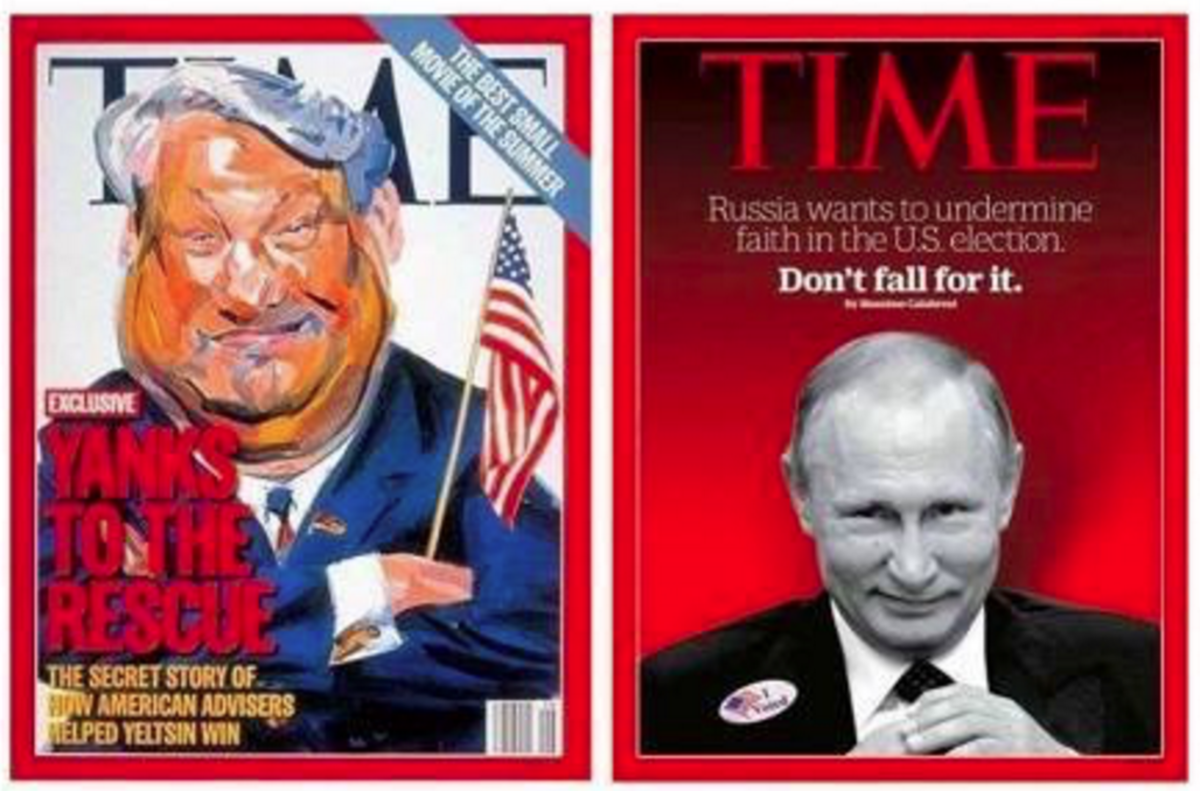
In fact, twenty-one years ago, TIME Magazine featured an exclusive detailing direct actions undertaken to ensure Russian President Boris Yeltsin would win re-election — an effort coordinated covertly by none other than … the United States.


Mudslinging and snarkiness lobbed between Washington and Moscow this time around — while perhaps the most groan-inducing international political theater in years — belies the umbral Deep State squabble otherwise apparent in headlines continually lambasting the Trump administration’s prior business contact list as unassailable evidence of treasonous guilt.


Spanning the gamut in plausibility, innumerable theories swear to shred the official account of President John F. Kennedy’s assassination, but similarities existent in the vilification of JFK’s and the current administration’s by establishment die-hards verily beg to be examined by the American masses and press — both, tragically somnambulating vacuous accusations plucked from the stale landscape of regurgitated modern Red Scare McCarthyism.


Whether or not the Trump presidency will ultimately prove to be the Deep State’s perilous exercise in planned obsolescence remains to be seen, but President Putin’s now joins a mellifluous ensemble of ordinarily disparate voices — including Libertarian icon and former presidential candidate, Dr. Ron Paul — warning the handiwork of a clandestine operation is on display for anyone willing to look.


American Deep State or not, the laughably-unproven Russians Did It meme persists in gracing corporate media headlines as often as the lips of U.S. officials — despite the expiration date on believability having long since passed.


Tuesday, March 21, 2017

As the Media Focuses on Russia, Govt’s Own Data Shows US Interfered in 81 Elections

Ask an average American who makes a habit of following government-mouthpiece corporate media about interference in national elections and you’ll likely elicit a nebulous response concerning Russian hackers and a plan to install Donald Trump in the White House — but you probably won’t hear a single syllable pertaining to United States government’s actual attempts to do the same.


On Monday, FBI Director James Comey confirmed for the first time publicly the bureau is officially investigating hotly contentious allegations of Russian meddling in the U.S. election — but, even if proven true, such geopolitical escapades better characterize the routine behavior of accuser than of accused.


“The F.B.I., as part of our counterintelligence effort, is investigating the Russian government’s efforts to interfere in the 2016 president election,” the director announced, adding the bureau would conduct a probe to discern whether Trump’s associates had contact with Russian officials.


Despite that the U.S. has hypocritically exerted influence over foreign elections in all corners of the globe — in fact, it has arrogantly done so a whopping 81 times between 1946 and 2000, alone — with just one-third of those operations undertaken overtly.


For months, mainstream media parroted murky accusations hurled by politicians — keen to point a finger of blame for the apparently stultifying victory of a former reality television host on someone — that The Russians had somehow surreptitiously undermined the election-centric foundation of American Democracy.


While that has yet to prove true, this new Red Scare constitutes a duplicitous attempt by the pot to call the kettle … an election meddler.


Researcher Dov Levin of Carnegie Mellon University’s Institute for Politics and Strategy — an expert on the topic at hand — discussed the lengthy but incomplete list of times the U.S. government has interfered in other nations’ elections with NPR’s Ari Shapiro.


Asked for examples where this tampering tangibly altered results, Levin stated,


“One example of that was our intervention in Serbia, Yugoslavia in the 2000 election there. Slobodan Milosevic was running for re-election, and we didn’t want him to stay in power there due to his tendency, you know, to disrupts the Balkans and his human rights violations.


“So we intervened in various ways for the opposition candidate, Vojislav Kostunica. And we gave funding to the opposition, and we gave them training and campaigning aide. And according to my estimate, that assistance was crucial in enabling the opposition to win.”


Levin reiterated the more blatant methods with which the U.S. asserts dominance — through the overt coups or all-out regime changes branding the nation a notorious interventionist — are not among the list of the 80-plus attempts to manipulate the electoral outcome.


As for the issue of pot versus kettle, Levin explained that — although Russia and other powerful nations indisputably employ similar tactics — the United States has been quite prodigious in its effort.


“Well, for my dataset, the United States is the most common user of this technique. Russia or the Soviet Union since 1945 has used it half as much. My estimate has been 36 cases between 1946 to 2000. We know also that the Chinese have used this technique and the Venezuelans when the late Hugo Chavez was still in power in Venezuela and other countries.”


As sanctimoniously as U.S. politicians cry foul about The Russians, it would behoove the new McCarthyites to reflect on the nation’s sticky imperialist fingerprints around the globe — like that time in 1996, when the United States undertook an extensive, secret operation to ensure the presidency of Boris Yeltsin.


That is, of course, former President Boris Yeltsin — of the Russian Federation.

Wednesday, December 14, 2016

Media Ignores US Rigging of Russia’s Elections As CIA Struggles to Prove Russian Hacking

Mainstream, corporate media and the U.S. political establishment has once again proved the depth of their hypocrisy in thus far unsubstantiated claims Russia directly interfered with the presidential election — because the United States has done so, itself, with multiple countries.


Including Russia.


Twenty years ago, TIME Magazine exclusively reported on the feats of American political consultants who’d managed — much to the joy of the United States government — to ensure Boris Yeltsin won re-election to the Russian presidency.


election20 years ago, TIME praised America’s propaganda campaign to elect Yeltsin. Today, they have appeared to change their tone.


Titled Rescuing Boris, TIME’s article bore a subtitle eerily similar to accusations flooding headlines two decades later — for altogether different but parallel reasons — “THE SECRET STORY OF HOW FOUR U.S. ADVISERS USED POLLS, FOCUS GROUPS, NEGATIVE ADS AND ALL THE OTHER TECHNIQUES OF AMERICAN CAMPAIGNING TO HELP BORIS YELTSIN WIN.”


While the U.S. decries “fake news” and dismisses the successes of alternative media’s reporting on corruption in the Democrat Party by collectively deeming it “Russian propaganda,” it would seem the entire country has forgotten American exploits in Russia in 1996.


In fact, these American advisors literally meddled in the Russian election that year — and as TIME, itself, points out, changed the course of the country’s politics forever.


“The outcome was by no means inevitable,” TIME’s Michael Kramer penned on July 15, 1996. “Last winter Yeltsin’s approval ratings were in the single digits. There are many reasons for his change in fortune, but a crucial one has remained a secret. For four months, a group of American political consultants clandestinely participated in guiding Yeltsin’s campaign. Here is the inside story of how these advisers helped Yeltsin achieve the victory that will keep reform in Russia alive.”


Because of increasing authoritarianism and corrupt economic policies, the Russian populace had grown weary of Yeltsin and looked to vote in a more traditional communist leader. But the U.S. sought to maintain the course of reform in Russia, because, as Kramer noted in TIME, Yeltsin “is arguably the best hope Russia has for moving toward pluralism and an open economy.”


Thus, Felix Braynin, a close friend to one of Yeltsin’s aides, helped hatch a plan to sway the election in the president’s favor — one that involved specialized polling, negative ad campaigns, propaganda, and other tools typical of an American election.


But the plan had to remain covert — for obvious reasons.


“Secrecy was paramount,” Braynin told TIME, saying he had been told to “find some Americans” to put the plan into action. “Everyone realized that if the Communists knew about this before the election, they would attack Yeltsin as an American tool. We badly needed the team, but having them was a big risk.”


The TIME article continues:


“To ‘find some Americans,’ Braynin worked through Fred Lowell, a San Francisco lawyer with close ties to California’s Republican Party. On Feb. 14, Lowell called Joe Shumate, a G.O.P. expert in political data analysis who had served as deputy chief of staff to California Governor Pete Wilson. Since Wilson’s drive for the 1996 Republican presidential nomination had ended almost before it began, Lowell thought Shumate and George Gorton, Wilson’s longtime top strategist, might be available to help Yeltsin. They were — and they immediately enlisted Richard Dresner, a New York-based consultant who had worked with them on many of Wilson’s campaigns.”


Dresner, it’s imperative and timely to note, had strong ties to the Clintons — a detail of critical import given the Democrats current hysteria over alleged Russian meddling in the U.S. election. TIME reported:


“Dresner had another connection that would prove useful later on. In the late 1970s and early ’80s, he had joined with Dick Morris to help Bill Clinton get elected Governor of Arkansas. As Clinton’s current political guru, Morris became the middleman on those few occasions when the Americans sought the Administration’s help in Yeltsin’s re-election drive. So while Clinton was uninvolved with Yeltsin’s recruitment of the American advisers, the Administration knew of their existence — and although Dresner denies dealing with Morris, three other sources have told Time that on at least two occasions the team’s contacts with Morris were ‘helpful.’”


It would be difficult to find a more appalling example of ‘it’s only wrong when it doesn’t benefit us’ hypocrisy.


In fact, these American advisors — although watched closely by the Russian intelligence community — carried out their clandestine mission to ensure Yeltsin’s re-election without much discretion.


“The Americans carried multiple-entry visas identifying them as working for the ‘Administration of the President of the Russian Federation,’ a bit of obviousness that constantly threatened to undermine all the supposed secrecy surrounding their real work,” Kramer wrote.


Shumate, Braynin, Dresner, and the others understood the breadth of manipulation necessary to sway Russian voters who were dead set against another term under Yeltsin — just before the team got to work, just 6 percent of Russians saw the president in a favorable light, and even fewer trusted his competency as a leader.


“Stalin had higher positives and lower negatives than Yeltsin,” Dresner told TIME. “We actually tested the two in polls and focus groups. More than 60% of the electorate believed Yeltsin was corrupt; more than 65% believed he had wrecked the economy. We were in a deep, deep hole.”


Ultimately, the team of secretive American political insiders waged a successful information and propaganda war on the otherwise oblivious Russian population, whom they convinced Yeltsin wasn’t so bad, after all.


“We were brought in to help win,” Gorton told TIME, “and that’s what we did. The Russians are prideful and say that people like us won’t be necessary in the future because they’ve learned what to do. You hear that everywhere after the hired guns have done their work — and it may be true. All I know is that for every guy who thinks he can go it alone, there will always be another guy who knows he can’t.”


Make no mistake about it — without U.S. interference and meddling, Yeltsin would not have been victorious in Russia’s 1996 election.


Whether or not Russia interfered in the U.S. election twenty years later — about which no unassailable evidence has yet been presented — shouldn’t really be a matter of consternation for the same political establishment so unconcerned with election ‘rigging’ when the manipulation works in its favor.