Showing posts with label Boris Yeltsin. Show all posts

Tuesday, November 28, 2017

The Saker: How I Became A Kremlin Troll

Authored by The Saker,


Today, with the kind permission of Phil Butler, I am posting the full text of my contribution to his book “Putin’s Praetorians: Confessions of the Top Kremlin Trolls“.  There are a couple of reasons for that.  The main one is that I strongly believe that this book deserves a much bigger visibility than it has received (this is also why, exceptionally, I am placing this post in the top “analyses” category and not elsewhere).  Please read my review here to see why I feel so strongly about this book.  Frankly, I am rather shocked by the very little amount of reviews this book as generated.  I don’t even know if somebody besides Russia Insider has bothered writing a review of it or not, but even if somebody has, it is still a crying shame that this most interesting volume has been so far ignored by the alternative media including the one friendly to Russia.  So by posting my own contribution here I want to bring back this book to the “front page”, so to speak, of our community.  Second, I want to ask for your help.  Right now the Kindle version of the book has 15 reviews on Amazon and only 1 review for the printed paper version.  This is not enough.  I am therefore asking you to 1) buy the book (Amazon wants reviews by purchasers) and 2) write a review on Amazon.  Guys – that is something most of you can do to help, so please do so!  We need to show the world that there is what I call “another West” which, far from being russophobic is, in fact, capable of producing real friends and even defenders of Russia.  So, please, do your part, help Phil in his heroic struggle, get the paper version of the book and review it on Amazon!


Thanks a lot for your help, hugs and cheers,


The Saker


*  *  *


How I became a Kremlin troll by The Saker


By birth, experience, and training, I truly had everything needed to hate Putin.  I was born in a family of “White Russians” whose anti-Communism was total and visceral.


My childhood was filled with (mostly true) stories about atrocities and massacres committed by the Bolsheviks during the revolution and subsequent civil war.  Since my father had left me, I had an exiled Russian Orthodox Archbishop as a spiritual father, and through him, I learned of all the genocidal persecutions the Bolsheviks unleashed against the Orthodox Church.


At the age of 16, I had already read the three volumes of the “Gulag Archipelago” and carefully studied the history of WWII.  By 18 I was involved in numerous anti-Soviet activities such as distributing anti-Soviet propaganda in the mailboxes of Soviet diplomats or organizing the illegal importation of banned books into the Soviet Union through the Soviet merchant marine and fishing fleet (mostly at their station in the Canary Islands).  I was also working with an undercover group of Orthodox Christians sending help, mainly in the form of money, to the families of jailed dissidents. And since I was fluent in Russian, my military career took me from a basic training in electronic warfare, to a special unit of linguists for the General Staff of the Swiss military, to becoming a military analyst for the strategic intelligence service of Switzerland.


The Soviet authorities had long listed me, and my entire family, as dangerous anti-Soviet activists and I, therefore, could not travel to Russia until the fall of Communism in 1991 when I immediately caught the first available flight and got to Moscow while the barricades built against the GKChP coup were still standing.   Truly, by this fateful month of August 1991, I was a perfect anti-Soviet activist and an anti-Communist hardliner.  I even took a photo of myself standing next to the collapsed statue of Felix Derzhinsky (the founder of the ChK – the first Soviet Secret police) with my boot pressed on his iron throat.  That day I felt that my victory was total.  It was also short-lived.


Instead of bringing the long-suffering Russian people freedom, peace, and prosperity, the end of Communism in Russia only brought chaos, poverty, violence, and abject exploitation by the worst class of scum the defunct Soviet system had produced.  I was horrified.  Unlike so many other anti-Soviet activists who were also Russophobes, I never conflated my people and the regime which oppressed them.  So, while I rejoiced at the end of one horror, I was also appalled to see that another one had taken its place.  Even worse, it was undeniable that the West played an active role in every and all forms of anti-Russian activities, from the total protection of Russian mobsters, on to the support of the Wahabi insurgents in Chechnya, and ending with the financing of a propaganda machine which tried to turn the Russian people into mindless consumers to the presence of western “advisors” (yeah, right!) in all the key ministries.  The oligarchs were plundering Russia and causing immeasurable suffering, and the entire West, the so-called “free world” not only did nothing to help but helped all the enemies of Russia with every resource it had.  Soon the NATO forces attacked Serbia, a historical ally of Russia, in total violation of the most sacred principles of international law.  East Germany was not only reunified but instantly incorporated into West Germany and NATO pushed as far East as possible.  I could not pretend that all this could be explained by some fear of the Soviet military or by a reaction to the Communist theory of world revolution.  In truth, it became clear to me that the western elites did not hate the Soviet system or ideology, but that they hated Russian people themselves and the culture and civilization which they had created.


By the time the war against the Serbian nation in Croatia, Bosnia and Kosovo broke out, I was in a unique situation: all day long I could read classified UNPROFOR and military reports about what was taking place in that region and, after work, I could read the counter-factual anti-Serbian propaganda the western corporate Ziomedia was spewing out every day.  I was horrified to see that literally everything the media was saying was a total lie.  Then came the false flags, first in Sarajevo, but later also in Kosovo.   My illusions about “Free World” and the “West” were crumbling.  Fast.


Fate brought me to Russia in 1993 when I saw the carnage of meted out by the “democratic” Eltsin regime against thousands of Russians in Moscow (many more than what the official press reported).  I also saw the Red Flags and Stalin portraits around the parliament building.  My disgust by then was total.  And when the Eltsin regime decided to bring Dudaev’s Chechnia to heel triggering yet another needless bloodbath, that disgust turned into despair.  Then came the stolen elections of 1996 and the murder of General Lebed. At that point, I remember thinking “Russia is dead.”


So, when the entourage of Eltsin suddenly appointed an unknown nobody to acting President of Russia, I was rather dubious, to put it mildly.  The new guy was not a drunk or an arrogant oligarch, but he looked rather unimpressive.  He was also ex-KGB which was interesting: on one hand, the KGB had been my lifelong enemy but on the other hand, I knew that the part of the KGB which dealt with foreign intelligence was staffed by the brightest of the brightest and that they had nothing to do with political repression, Gulags and all the rest of the ugly stuff another Directorate of the KGB (the 5th) was tasked with (that department had been abolished in 1989).  Putin came from the First Main Directorate of the KGB, the “PGU KGB.”  Still, my sympathies were more with the (far less political) military intelligence service (GRU) than the very political PGU which, I was quite sure by then, had a thick dossier on my family and me.


Then, two crucial things happened in parallel: both the “Free world” and Putin showed their true faces: the “Free world” as an AngloZionist Empire hell-bent on aggression and oppression, and Vladimir Putin as a real patriot of Russia. In fact, Putin slowly began looking like a hero to me: very gradually, in small incremental steps first, Putin began to turn Russia around, especially in two crucial matters: he was trying to “re-sovereignize” the country (making it truly sovereign and independent again), and he dared the unthinkable: he openly told the Empire that it was not only wrong, it was illegitimate (just read the transcript of Putin’s amazing 2007 “Munich Speech”).


Putin inspired me to make a dramatic choice: will I stick to my lifelong prejudices or will I let reality prove my lifelong prejudices wrong. The first option was far more comfortable to me, and all my friends would approve. The second one was far trickier, and it would cost me the friendship of many people. But what was the better option for Russia? Could it be that it was the right thing for a “White Russian” to join forces with the ex-KGB officer?


I found the answer here in a photo of Alexander Solzhenitsyn and Vladimir Putin:


If that old-generation anti-Communist hardliner who, unlike me, had spent time in the Gulag, could take Putin’s hand, then so could I!


In fact, the answer was obvious all along: while the “White” and the “Red” principles and ideologies were incompatible and mutually exclusive, there is also no doubt that nowadays true patriots of Russia can be found both in the former “Red” and “White” camps. To put it differently, I don’t think that “Whites” and “Reds” will ever agree on the past, but we can, and must, agree on the future. Besides, the Empire does not care whether we are “Red” or “White” – the Empire wants us all either enslaved or dead.


Putin, in the meantime, is still the only world leader with enough guts to openly tell the Empire how ugly, stupid and irresponsible it is (read his 2015 UN Speech).


And when I listen to him I see that he is neither “White” nor “Red.”  He is simply Russian.


So, this is how I became a Kremlin troll and a Putin fanboy.


Monday, August 21, 2017

The Future Of The Third World

Authored by Jayant Bhandari via Acting-Man.com,


Decolonization


The British Empire was the largest in history. At the end of World War II Britain had to start pulling out from its colonies. A major part of the reason was, ironically, the economic prosperity that had come through industrialization, massive improvements in transportation, and the advent of telecommunications, ethnic and religious respect, freedom of speech, and other liberties offered by the empire.


The colors represent the colonies of various nations in 1945, and the colonial borders of that time – click to enlarge.


After the departure of the British — as well as the French, German, Belgians, and other European colonizers — most of the newly “independent” countries suffered rapid decay in their institutions, stagnant economies, massive social strife, and a fall in standards of living. An age of anti-liberalism and tyranny descended on these former colonies. They rightly became known as third-world countries.


An armchair economist would have assumed that the economies of these former colonies, still very backward and at a very low base compared to Europe, would grow at a faster rate. Quite to the contrary, as time went on, their growth rates stayed lower than those of the West.


Socialism and the rise of dictators were typically blamed for this — at least among those on the political Right. This is not incorrect, but it is a merely proximate cause. Clarity might have been reached if people had contemplated the reason why Marxism and socialism grew like weeds in the newly independent countries.


Was There a Paradigm Shift in the 1980s?


According to conventional wisdom, the situation changed after the fall of the socialist ringleader, the USSR, in the late 1980s. Ex-colonized countries started to liberalize their economies and widely accepted democracy, leading to peace, the spread of education and equality, the establishment of liberal, independent institutions. Massive economic growth ensued and was sustained over the past three decades. The “third world” was soon renamed “emerging markets.”


Alas, this is a faulty narrative. Economic growth did pick up in these poor countries, and the rate of growth did markedly exceed that of the West, but the conventional narrative confuses correlation with causality. It tries to fit events to ideological preferences, which assume that we are all the same, that if Europeans could progress, so should everyone else, and that all that matters are correct incentives and appropriate institutions.


The beginning and end of the Soviet communist era in newspaper headlines. The overthrow of Kerensky’s interim government was the start of Bolshevik rule. To be precise, the Bolsheviks took over shortly thereafter, when they disbanded the constituent assembly in in early 1918 and subsequently gradually did the same to all non-Bolshevik Soviets that had been elected. A little more than seven decades later, the last Soviet Bolshevik leader resigned. It is worth noting that by splitting the Russian Federation from the Ukraine and Belorussia, Yeltsin effectively removed Gorbachev from power – the latter was suddenly president of a country that no longer existed and chairman of a party that was declared illegal in Russia. [PT] – click to enlarge.


The claimed liberalization in the “emerging markets” after the collapse of the USSR did not really happen. Progress was always one step forward and two steps back. In some ways, government regulations and repression of businesses in the “emerging markets” have actually gotten much worse. Financed by increased taxes, governments have grown by leaps and bounds — not for the benefit of society but for that of the ruling class — and are now addicted to their own growth.


The ultimate underpinnings of the so-called emerging markets haven’t changed. Their rapid economic progress during the past three decades — a one-off event — happened for reasons completely different from those assumed by most economists. The question is: once the effect of the one-off event has worn off, will emerging markets revert to the stagnation, institutional degradation, and tyranny that they had leaped into soon after the European colonizers left?


The One-Off Event: What Actually Changed in the 1980s


In the “emerging markets” (except for China) synchronized favorable economic changes were an anomaly. They resulted in large part from the new, extremely cheap telephony that came into existence (a result of massive cabling of the planet implemented in the 1980s) and the subsequent advent of the new technology of the internet. The internet enabled instantaneous transfer of technology from the West and as a consequence, unprecedented economic growth in “emerging markets.”


Meanwhile, a real cultural, political, and economic renaissance started in China. It was an event so momentous that it changed the economic structure not just of China, but of the whole world. Because China is seen as a communist dictatorship, it fails to be fully appreciated and respected by intellectuals who are obsessed with the institution of democracy.


But now that the low-hanging fruit from the emergence of the internet and of China (which continues to progress) have been plucked, the “emerging markets” (except, again, for China) are regressing to their normal state: decay in their institutions, stagnant economies, and social strife. They should still be called the “third world.”


There are those who hold China in contempt for copying Western technology, but they don’t understand that if copying were so easy, Africa, the Middle East, Latin America, and South Asia would have done the same. They were, after all, prepared for progress by their colonial history.


European colonizers brought in the rule of law and significantly reduced the tribal warfare that was a matter of daily routine in many of the colonies — in the Americas, Africa, the Middle East, and Asia. Britain and other European nations set up institutional structures that allowed for the accumulation of intellectual and financial capital. Western-style education and democracy were initiated. But this was helpful in a very marginal way.


What is Wrong with the Third World


For those who have not traveled and immersed themselves in formerly colonized countries, it is hard to understand that although there was piping for water and sewage in Roman days, it still isn’t available for a very large segment of the world’s population. The wheel has existed for more than 5,000 years, but a very large number of people continue to carry water in pots on their heads.


Lead piping supplying water to homes already existed in Roman days, 2000 years ago.


The Ljubljana Marshes Wheel, which is more than 5,000 years old


There are easily a billion or more people today, who have no concept of either the pipe or the wheel, even if they went to school. It is not the absence of technology or money that is stopping these people from starting to use some basic forms of technology. It is something else.


Sir Winston Churchill, the war-time Prime Minister of Britain, talking about the future of Palestine said:


“I do not admit… that a great wrong has been done to the Red Indians of America or the black people of Australia. I do not admit that a wrong has been done to these people by the fact that a stronger race, a higher-grade race, a more worldly wise race… has come in and taken their place.”


Cigar-puffing British war-time PM Winston Churchill was as politically incorrect as they come. If he were alive today, he would probably be labeled the newest Hitler by the press and spend 90% of his time apologizing. Perhaps we shouldn’t mention this, but there are many Churchill monuments dotted across Europe and one can be found in Washington DC as well (alert readers will notice that a decidedly non-triggered Washington Post fondly remembered Churchill as an “elder statesman” a mere 10 months ago; rest assured that won’t stop the social justice warrior brigade if they decide to airbrush him out of history). Just to make this clear, your editor is not exactly the biggest fan of the man who traded away half of Europe to Stalin because he felt he could “trust the Soviet communist government” and who was clearly a tad too enamored of war, a characteristic Robert Kaplan described in his strident, amoral pro-war screed Warrior Politics: Why Leadership Demands a Pagan Ethos as follows: “Churchill’s unapologetic warmongering arose not from a preference for war, but from a breast-beating Victorian sense of imperial destiny…” Neither the breast-beating nor the sense of imperial destiny are really our thing, but we tip our hat to the man’s utter lack of political correctness and his associated willingness to offend all and sundry with a nigh Trumpian alacrity and determination. [PT]


On Islam, he said:


“How dreadful are the curses which Mohammedanism lays on its votaries! Besides the fanatical frenzy, which is as dangerous in a man as hydrophobia in a dog, there is this fearful fatalistic apathy. The effects are apparent in many countries. Improvident habits, slovenly systems of agriculture, sluggish methods of commerce, and insecurity of property exist…”


Talking about India he famously said:


“I hate Indians. They are a beastly people with a beastly religion.”


A remark often attributed to Churchill, although this remains unverified, has certainly stood the test of time so far:


“If independence is granted to India, power will go to the hands of rascals, rogues, freebooters; all Indian leaders will be of low caliber and men of straw. They will have sweet tongues and silly hearts. They will fight amongst themselves for power and India will be lost in political squabbles. A day will come when even air and water will be taxed in India.”


Europeans of that time clearly knew that there was something fundamentally different between the West and the rest, and that the colonies would not survive without the pillars and the cement European management provided.


With the rise of political correctness this wisdom was erased from our common understanding – but it is something that may well return to haunt us in the near future, as the third world fails to fulfill expectations, while people who immigrate to Europe, Canada, Australia and the US from there fail to assimilate.


The Missing Underpinnings: Reason And All That Depends On It


Until now, the hope among people in the World Bank, the IMF, and other armchair intellectuals was that once the correct incentives were in place and institutions were organized, these structures imposed from on high would put the third world on a path to perpetual growth. They couldn’t have been more wrong.


The cart has been put in front of the horse. It is institutions that emerge from the underlying culture, not the other way around. And cultural change is a process taking millennia, perhaps even longer. As soon as Europeans quit their colonies, the institutional structures they left started to crumble.


Alas, it takes a Ph.D. from an Ivy League college and a quarter of a million dollar salary at the World Bank or the IMF to not understand what the key issue with development economics and institutional failures is: the missing ingredient in the third world was and is the concept of objective, impartial reason – the basis of laws and institutions that protect individual rights.


This concept of reason took 2,500 years to develop and get infused into the culture, memes, and genes of Europeans — a difficult process that, even in Europe, was never fully completed. European institutions were at their root products of this concept.


A justly famous quote by Thomas Paine (a prolific writer with a side job as a founding father and revolutionary). Paine was deeply suspicious of self-anointed authorities, both of the secular and clerical variety, who in turn regarded him as dangerous. His writings inter alia provoked a so-called “pamphlet war” in Britain (it would be best if all wars were conducted via pamphlets). [PT]


Despite massive efforts by missionaries, religious and secular, and of institutions imposed on poor countries, reason failed to get transmitted. Whatever marginal improvement was achieved over 200 to 300 years of colonization is therefore slowly but surely undone.


Without reason, subsidiary concepts such as equality before the law, compassion and empathy won’t operate. Irrational societies simply cannot maintain institutions representing the rule of law and fairness. The consequence is that they cannot evolve or even maintain institutions the European colonizers left behind.


Any institutions imposed on them — schools, armies, elections, national executives, banking and taxation systems — must mutate to cater to the underlying irrationality and tribalism of the third world.


Western Institutions Have Mutated


Education has become a dogma in “emerging markets”, not a tool; it floats non-assimilated in the minds of people lacking objective reason. Instead of leading to creativity and critical thinking, it is used for propaganda by demagogues.


Without impartial reason, democracy is a mere tribal, geographical concept, steeped in arrogance. All popular and “educated” rhetoric to the contrary, I can think of no country in the non-western world that did well after it adopted “democracy.”


The spread of nationalism (which to a rational mind is about the commonality of values) has created crises by unifying people along tribal lines. The most visible example is provided by events in the Middle East, but the basic problem is the same in every South Asian and African country and in most of South America.


India, the geographical entity I grew up in, was rapidly collectivized under the flag and the national anthem. It has the potential to become the Middle East on steroids, once Hindutava (Hindu nationalism) has become deeply rooted in society.


Assessing the Current Predicament


In Burma, a whiff of democracy does not seem to have inhibited a genocide perpetrated by Buddhists against the Muslim Rohingya. Thailand (which was not colonized in a strictly political sense) has gone silent, but its crisis continues.


Turkey and Malaysia, among the better of these backward societies, have embarked on a path of rapid regression to their medieval pasts. South Africa, which not too long ago was considered a first-world country, got rid of apartheid only to end up with something even worse.


The same happened with Venezuela, which was among the richer countries of the world in the not-too-distant past. It is ready to implode, a fate that may befall Brazil as well one day. Pakistan, Bangladesh, Nepal, and East Timor are widely acknowledged to be in a mess, and are getting worse by the day.


Indonesia took a breather for a few years and is now once again in the thrall of fanaticism. India is the biggest democracy, so its problems are actively ignored by the Western press, but they won’t be for long, as India continues to evolve toward a police state.


Botswana was seen as one of the countries with the fastest and longest-lasting economic growth. What was ignored was the fact that this rather large country has a very small population, which benefited hugely from diamonds and other natural resources. The top political layer of Botswana is still a leftover from the British. The local culture continues to corrode what was left by them, and there are clear signs that Botswana is past its peak.


Part of the central business district in Gaborone, Botswana. Long time readers may recall an article we posted about 2.5 years ago: “Botswana – Getting it Right in Africa”. We are not sure if much has changed since then, but it is worth recalling that Botswana started out as the third-poorest country in Africa when it became independent in 1966 and is today one the richest. The very small population (by African standards) combined with the large income the country obtains from diamond mining no doubt played a role in this, but being rich in natural resources means very little per se. Botswana never fell for Marxism. When the country gained independence, its political leadership adopted democracy and free markets and never looked back. Botswana is a very homogenous society in terms of religious and tribal affiliations, which differentiates the country from most other former colonial territories in Africa. From our personal – admittedly by now a bit dated – experience, we can state that Botswana is the only African country in which one is unlikely to encounter any corruption – not even the lowliest government minion will ask for bribes as far as we could tell (in many African countries, officials begin demanding bribes the moment one wants to cross the border). Considering all that, we are slightly more hopeful about Botswana, but it is not an island. Deteriorating conditions in neighboring countries may well prove contagious at some point. [PT]


Papua New Guinea was another country that was doing reasonably well before the Australians left. It is now rapidly regressing to its tribal, irrational, and extremely violent norms, where for all practical purposes rape is not even considered a crime.


Conclusion: A Vain Hope


The world may recognize most of the above, but it sees these countries’ problems as isolated events that can be corrected by further impositions of Western institutions, under the guidance of the UN or some such international (and therefore “non-colonialist”) organization.


Amusingly, our intellectual climate — a product of political correctness — is such that the third world is nowadays seen as the backbone of humanity’s future economic growth. Unfortunately, so-called emerging markets are probably headed for a chaotic future. The likeliest prospect is that these countries will continue to cater to irrational forces, particularly tribalism, and that they will consequently cease to exist, disintegrating into much smaller entities.


As the tide of economic growth goes out with the final phase of plucking the free gift of internet technology nearing its end, their problems will resurface rapidly – precisely when the last of those who were trained under the colonial system are sent to the “dustbin of history”.

Thursday, July 6, 2017

"Our Leaders Should Shut Up" - Time For The US To Modernize Its Approach To Russia

Authored by James Durso via TheHill.com,


The Cold War was never won or lost; it just ended one day. Who even remembers where they were on December 3, 1989? 


As the Cold War ended, the U.S. forswore a demand for unconditional surrender, thanked God it was over, and thought about how to spend the peace dividend. The message Russia took away was: We didn’t lose.


And so, after the chaos of the Yeltsin years and “shock therapy,” Vladimir Putin ascended to the Russian presidency. Buoyed by high oil prices and the network of siloviki, he resumed the task of every Russian ruler since Peter the Great: securing the periphery.


Putin’s secure periphery won’t necessarily involve physical occupation of neighboring states. Russia’s goals can also be achieved by political subversion and using information warfare as a political warfare tool to create unsettled conflicts. As to what the Russians want to secure, it’s no secret – just look at a map.


The East European Plain covers the Baltics, Belarus, Ukraine, Moldova, Romania, and European Russia and is the traditional invasion route to Russia used by the Golden Horde, the Swedish Empire, the  Grande Armée, and the Third Reich. Russia is practically landlocked, has no ready access to the oceans, and its population centers, agricultural belt, transportation system, and industrial assets are concentrated West of the Urals – on the East European Plain.


Russia’s fear of invasion from the West probably originated in the 1200s and is captured in the lamentation, “for our sins, unknown tribes [Mongols] came” in The Chronicle of Novgorod. Russia will act to extend its borders, but the use of political warfare means it can stay below NATO’s Article 5 threshold and, when accused of hacking and stealing emails or whatnot, can direct the court’s attention to Exhibit A: Edward Snowden.


Whatever Putin’s motivation – patriotism, paranoia and insecurity, or all the money he allegedly has – his message about protecting Christianity and Russia’s unique culture against a homogenized, relativistic Europe resonates with many more Europeans than Communism ever did. Russia’s project is also aided and abetted by Germany’s feckless welcome of over one million Middle Eastern immigrants, many of whom will never be economically productive and thus be unlikely to assimilate.


So yes, Russia is challenging the U.S., but hyping Russia as a greater threat than the Islamic State, per Sen John McCain (R-Ariz.), is, as they say in Washington, “unhelpful.” It is, however, clever marketing to prepare the taxpayers for Cold War 2.0.


Much of America’s political class and commentariat doesn’t want to admit that the end of the Cold War, watershed that it was, didn’t mean an end to power politics on the continent. Is Russia unpredictable? No, but its tactics are, as we saw in Ukraine and Syria. In the annals of statecraft, that’s hardly cheating. Even worse, at least for some in Washington, Putin might actually believe what he’s saying.


What should we do? 


One is prioritize. As Charles de Gaulle asked, are we ready to trade New York for Paris? We probably weren’t then and we sure aren’t now as nothing less than an attack on the U.S. is worth a nuclear exchange. If Russia’s focus is on information operations (IO) and unconventional warfare, we should help the Eastern European states that already have experience with Russian cyber operations. Military maneuvers with allies are always useful, but political warfare is moving to the non-kinetic sphere of weaponized social media. IO adds another layer states must work through before they result to kinetic measures and, if combined with unconventional warfare instead of conventional forces on a tripwire footing, can limit the body count if things heat up.


Secondly, we should swear off “regime change.” A policy of regime change is an excellent way to rally the troops. Unfortunately, the troops it rallies are the opposition’s. Remember, the first rule of regime change is you don’t talk about regime change.


No doubt some senior Russian officials and businessmen are unsatisfied with Putin, but they’re not so unsatisfied that they will cooperate with the U.S., EU or NATO in unhorsing him, especially given our chronic inability to keep a secret. Despite all that “mafia state” chatter, Russia’s leadership will, if they need to, close ranks and clean house to protect themselves and Russia. I’m sure we’ll get along just great with President Sergei Shoigu.


Finally, our leaders should shut up. Calling Russia a “regional power,” as President Obama did, or saying Putin can be a “best friend,” as President Trump did, is counterproductive. We’ll get better results with Russia if we are firm, respectful, unambiguous, and consistent in defending our interests.

Saturday, December 17, 2016

Princeton & NYU Professor Warns Of Dangers From Liberal Media's "False Narratives Of A New Cold War"

Submitted by Mike Krieger via Liberty Blitzkrieg blog,


We’re shut out now. There hasn’t been an op-ed in The New York Times or Washington Post editorial pages arguing that the United States is at least equally to blame for this new Cold War crisis. They simply will not accept those articles…So this is the problem. In a democracy we fight through discourse. If you can’t get to the mainstream media  and make the argument, then there’s no way of slowing the drift toward catastrophe.


– Stephen F. Cohen, Professor Emeritus of Russian studies at Princeton University and New York University


Stephen Cohen just recorded an incredibly trenchant interview regarding the extreme dangers of the recent explosion in Russia hysteria with Brian Lehrer on WNYC.


This is what the sage-like Cohen said three years ago...


The degradation of mainstream American press coverage of Russia, a country still vital to US national security, has been under way for many years. If the recent tsunami of shamefully unprofessional and politically inflammatory articles in leading newspapers and magazines—particularly about the Sochi Olympics, Ukraine and, unfailingly, President Vladimir Putin—is an indication, this media malpractice is now pervasive and the new norm.


Even in the venerable New York Times and Washington Post, news reports, editorials and commentaries no longer adhere rigorously to traditional journalistic standards, often failing to provide essential facts and context; to make a clear distinction between reporting and analysis; to require at least two different political or “expert” views on major developments; or to publish opposing opinions on their op-ed pages. As a result, American media on Russia today are less objective, less balanced, more conformist and scarcely less ideological than when they covered Soviet Russia during the Cold War.


And sure enough, what has come to pass.


As the following paragraphs published in Politico earlier today show... While the article itself was embarrassingly biased toward standard U.S. government talking points, some valuable history can be found amongst all the noise. Such as the following:


Related was Hillary Clinton’s enthusiasm for NATO’s further expansion into Eastern Europe. That process was based on the well-founded idea that Eastern Europe needed—indeed, was asking for—protection from Russia aggression. But Russia’s military establishment treated it as a slow-rolling invasion of their sphere of influence.


This reaction, too, had its roots under Bill Clinton. An expanded NATO would help ensure democracy, prosperity and stability across Europe, he believed. Moscow took a sharply different view. After one 1994 summit at which Yeltsin gave Bill Clinton his blessing to the addition of new NATO members—including Poland and Hungary, both former Soviet satellites—a communist newspaper fumed about “the capitulation of Russian policy before NATO and the U.S.” One of Yeltsin’s main political opponents said he had allowed “his friend Bill [to] kick him in the rear.” He compared the agreement to the treatment of Germany at Versailles after World War I—a recurring theme among Russian officials since the Cold War’s end.


Some of Bill Clinton’s top advisers correctly predicted that NATO expansion would produce a backlash in Moscow, and would create a handy narrative for would-be nationalists to posture against the West. Clinton’s secretary of defense, William Perry, told POLITICO this summer that he considered resigning over the issue out of concern for its effect on U.S.-Russia relations. But Clinton pressed ahead, kicking off a process that added a dozen new members over the next 20 years, from the Baltic countries of Latvia, Lithuania and Estonia through Eastern Europe (the Czech Republic and Romania) and into the former Yugoslavia—all places where Russia had once enjoyed uncontested influence.


As Obama kept the NATO train rolling, his secretary of state was fully on board. “There can be no question that NATO will continue to keep its doors open to new members,” Clinton said in February 2010.


Now without further ado, here’s perhaps the most important interview you’ll hear all month. Listen and share with everyone you know.

Wednesday, December 14, 2016

Media Ignores US Rigging of Russia’s Elections As CIA Struggles to Prove Russian Hacking

Mainstream, corporate media and the U.S. political establishment has once again proved the depth of their hypocrisy in thus far unsubstantiated claims Russia directly interfered with the presidential election — because the United States has done so, itself, with multiple countries.


Including Russia.


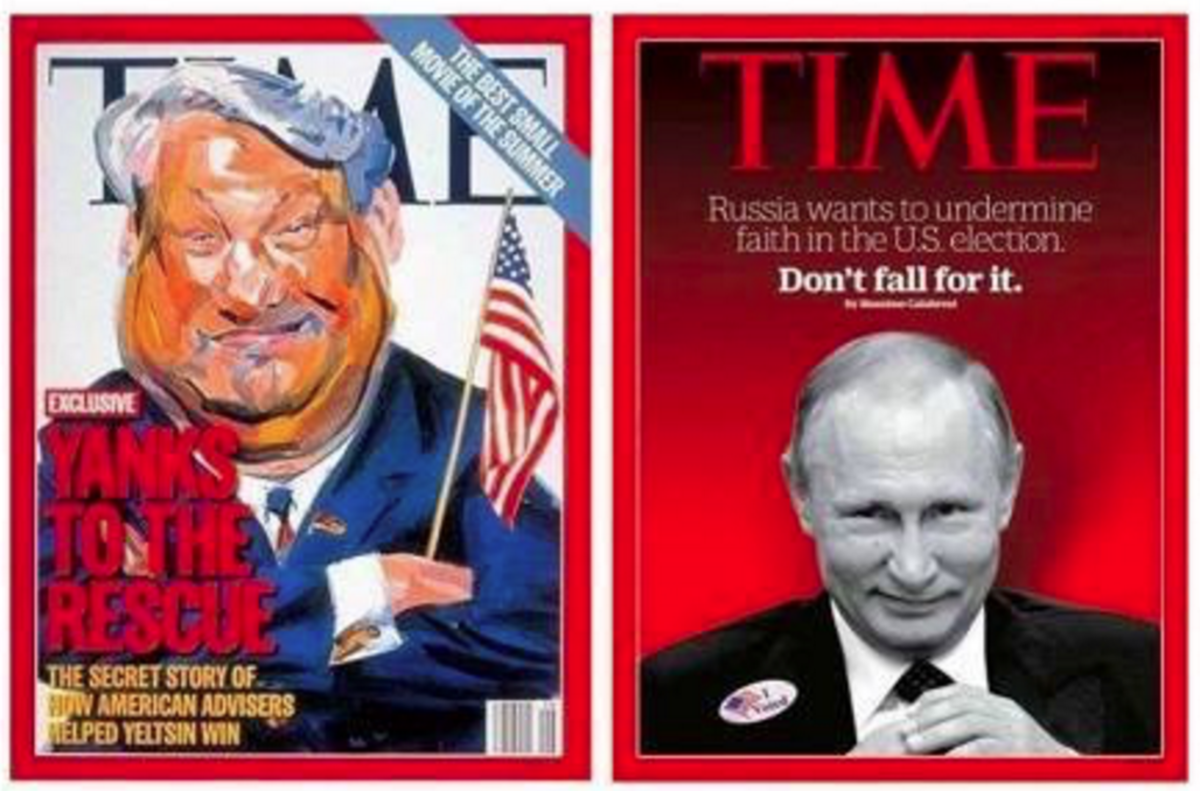
Twenty years ago, TIME Magazine exclusively reported on the feats of American political consultants who’d managed — much to the joy of the United States government — to ensure Boris Yeltsin won re-election to the Russian presidency.


election20 years ago, TIME praised America’s propaganda campaign to elect Yeltsin. Today, they have appeared to change their tone.


Titled Rescuing Boris, TIME’s article bore a subtitle eerily similar to accusations flooding headlines two decades later — for altogether different but parallel reasons — “THE SECRET STORY OF HOW FOUR U.S. ADVISERS USED POLLS, FOCUS GROUPS, NEGATIVE ADS AND ALL THE OTHER TECHNIQUES OF AMERICAN CAMPAIGNING TO HELP BORIS YELTSIN WIN.”


While the U.S. decries “fake news” and dismisses the successes of alternative media’s reporting on corruption in the Democrat Party by collectively deeming it “Russian propaganda,” it would seem the entire country has forgotten American exploits in Russia in 1996.


In fact, these American advisors literally meddled in the Russian election that year — and as TIME, itself, points out, changed the course of the country’s politics forever.


“The outcome was by no means inevitable,” TIME’s Michael Kramer penned on July 15, 1996. “Last winter Yeltsin’s approval ratings were in the single digits. There are many reasons for his change in fortune, but a crucial one has remained a secret. For four months, a group of American political consultants clandestinely participated in guiding Yeltsin’s campaign. Here is the inside story of how these advisers helped Yeltsin achieve the victory that will keep reform in Russia alive.”


Because of increasing authoritarianism and corrupt economic policies, the Russian populace had grown weary of Yeltsin and looked to vote in a more traditional communist leader. But the U.S. sought to maintain the course of reform in Russia, because, as Kramer noted in TIME, Yeltsin “is arguably the best hope Russia has for moving toward pluralism and an open economy.”


Thus, Felix Braynin, a close friend to one of Yeltsin’s aides, helped hatch a plan to sway the election in the president’s favor — one that involved specialized polling, negative ad campaigns, propaganda, and other tools typical of an American election.


But the plan had to remain covert — for obvious reasons.


“Secrecy was paramount,” Braynin told TIME, saying he had been told to “find some Americans” to put the plan into action. “Everyone realized that if the Communists knew about this before the election, they would attack Yeltsin as an American tool. We badly needed the team, but having them was a big risk.”


The TIME article continues:


“To ‘find some Americans,’ Braynin worked through Fred Lowell, a San Francisco lawyer with close ties to California’s Republican Party. On Feb. 14, Lowell called Joe Shumate, a G.O.P. expert in political data analysis who had served as deputy chief of staff to California Governor Pete Wilson. Since Wilson’s drive for the 1996 Republican presidential nomination had ended almost before it began, Lowell thought Shumate and George Gorton, Wilson’s longtime top strategist, might be available to help Yeltsin. They were — and they immediately enlisted Richard Dresner, a New York-based consultant who had worked with them on many of Wilson’s campaigns.”


Dresner, it’s imperative and timely to note, had strong ties to the Clintons — a detail of critical import given the Democrats current hysteria over alleged Russian meddling in the U.S. election. TIME reported:


“Dresner had another connection that would prove useful later on. In the late 1970s and early ’80s, he had joined with Dick Morris to help Bill Clinton get elected Governor of Arkansas. As Clinton’s current political guru, Morris became the middleman on those few occasions when the Americans sought the Administration’s help in Yeltsin’s re-election drive. So while Clinton was uninvolved with Yeltsin’s recruitment of the American advisers, the Administration knew of their existence — and although Dresner denies dealing with Morris, three other sources have told Time that on at least two occasions the team’s contacts with Morris were ‘helpful.’”


It would be difficult to find a more appalling example of ‘it’s only wrong when it doesn’t benefit us’ hypocrisy.


In fact, these American advisors — although watched closely by the Russian intelligence community — carried out their clandestine mission to ensure Yeltsin’s re-election without much discretion.


“The Americans carried multiple-entry visas identifying them as working for the ‘Administration of the President of the Russian Federation,’ a bit of obviousness that constantly threatened to undermine all the supposed secrecy surrounding their real work,” Kramer wrote.


Shumate, Braynin, Dresner, and the others understood the breadth of manipulation necessary to sway Russian voters who were dead set against another term under Yeltsin — just before the team got to work, just 6 percent of Russians saw the president in a favorable light, and even fewer trusted his competency as a leader.


“Stalin had higher positives and lower negatives than Yeltsin,” Dresner told TIME. “We actually tested the two in polls and focus groups. More than 60% of the electorate believed Yeltsin was corrupt; more than 65% believed he had wrecked the economy. We were in a deep, deep hole.”


Ultimately, the team of secretive American political insiders waged a successful information and propaganda war on the otherwise oblivious Russian population, whom they convinced Yeltsin wasn’t so bad, after all.


“We were brought in to help win,” Gorton told TIME, “and that’s what we did. The Russians are prideful and say that people like us won’t be necessary in the future because they’ve learned what to do. You hear that everywhere after the hired guns have done their work — and it may be true. All I know is that for every guy who thinks he can go it alone, there will always be another guy who knows he can’t.”


Make no mistake about it — without U.S. interference and meddling, Yeltsin would not have been victorious in Russia’s 1996 election.


Whether or not Russia interfered in the U.S. election twenty years later — about which no unassailable evidence has yet been presented — shouldn’t really be a matter of consternation for the same political establishment so unconcerned with election ‘rigging’ when the manipulation works in its favor.