Showing posts with label South America. Show all posts

Friday, March 23, 2018

IMF Wants Massive Illegal Immigration to Save Pension Funds

IMF Wants Massive Illegal Immigration to Save Pension Funds | immigration | Economy & Business International Monetary Fund Special Interests US News

[image: AP/Gregory Bull, file]

(The Real Agenda News) In Europe alone, the IMF promotes the arrival of over 5 million illegals to sustain the decaying pension funds.

The governments of Latin America, North America, and Europe have mishandled, not to say stolen, the money saved by workers for decades.


Most of the public and private savings accounts and pension funds were looted by governments to pay for political promises and an insurmountable public debt.


Government handled pension funds are some of the biggest scams ever perpetrated on the working classes in the history of humanity. Consider this: The average person begins working at 18 years of age and contributes to a public fund for over 40 years.


Once it is time to retire, the worker files the paperwork to receive proportionally the average salary he or she earned 40 years earlier. What happened to the earnings that his pension contributions earned over 4 decades?


Did they help pay for other people’s pensions? The answer is a decisive No. The profits made by governments on the monies provided by the working class over decades of hard work was stolen to pay for never-ending entitlement programs, skyrocketing interests from debt accumulated by governments over dozens of years.


Many of these payments are made to international banking institutions like the IMF itself, the World Bank and so-called partner states that lend money at a large profit.


What will happen to the pensioners of the future? In a recent analysis, the International Monetary Fund outlines a way to reform the system.


To do this, it draws up projections with all the variables that condition the Social Security accounts: the number of retirees that is expected, the number of workers, immigration, contributions or generosity with pensioners.


The IMF concludes that it is possible to articulate a financially sustainable system that is socially acceptable at the same time.


But yes: you have to touch many elements, make reforms in depth and, in any case, pensions will be reduced compared to the average salary.


“A public pension is not intended to cover the full income that the retiree would need to retire”, explains the IMF.


If there is such an expectation, it must be made clear that it cannot be fulfilled,“the report stresses. Hence, it asks governments to establish complementary plans.


On the one hand, the Fund collects the projection of retirements that will be in the coming years.


Given that the contributors of today are the pensioners of the future, the only certainty is that the number of benefits will grow.


On the contrary, the rest of factors can vary much more: the number of people working, immigration, contributions made by contributions or other sources of income and the generosity of the system with pensioners.


Adding all these variables and with the intention of giving an idea of the challenge, the IMF outlines various scenarios by 2050.


One is based on the premise that the current generosity is maintained: now the average pension represents almost 50% of the average salary.


To preserve this status, according to the estimates of the Fund, contributors would go from contributing 21% of the salary to 47.8% in 2050. And spending on pensions would be at 22% of GDP, twice the current rate.


In another scenario, the IMF freezes contributions at the levels they are now. Then the expenditure on GDP remain the same.


But in this case the funding of the system collapses during the next 30 years, and the relationship between pension and the average salary is cut by more than half to 22.6%.


In the Fund’s opinion, neither scenario is acceptable. Neither workers can bear a pressure for contributions as in the first case. Neither can a pensioner live with dignity with only 22% of the average salary as in the second.


So the Fund draws an intermediate horizon. In this third hypothesis, spending on GDP would be at 12.9% and the contribution for contributions would rise to 27.3% of their salary, a very high level.


Income would have to increase by raising the ceiling of maximum contributions while leaving the ceiling of the maximum pension the same.


That is, those who earn more would contribute more but would not receive more, penalizing contributivity, the Fund admits.


In addition, some 5.5 million immigrants would need to arrive in countries like SpainThat represents 12% of the current population and a similar proportion to the number of people that entered the country between 2000 and 2007.


And the rate of people working would have to climb from 59.7% to 79%, a very demanding milestone and more difficult to achieve if prices rise.


“This could be achieved through parametric reforms of pensions that lead to greater participation in the labor force, longer working lives and structural reforms that lower the natural rate of unemployment,” it says.


Even so, the pension would end at 35% of the salary. And that, in the opinion of the IMF, does not seem acceptable either. Therefore, consider that you need to save around 5% of the annual salary.


So the IMF recommends that governments adopt the alternative of “automatically enlisting workers in a second private fund backed by the State”.


It also suggests, as another option, private business plans that fatten the savings by taking a part of the future salary increases, in the style of the British system inspired by the Nobel laureate Richard H. Thaler.


Finally, given that there is a lot of savings in housing, the IMF urges that mechanisms be encouraged to sign reverse mortgages.


In the opinion of the men in black, this scenario would be “plausible, financially viable and possibly socially acceptable”.


As you can see, the size of the figures means that you cannot face the challenge with a solution taken from the hat.


You have to touch many things and none by itself fixes it. And, above all, “there is no room to reverse the reforms”, says the Fund.


The post IMF Wants Massive Illegal Immigration to Save Pension Funds appeared first on The Sleuth Journal.

Saturday, September 9, 2017

Declassified CIA Docs Reveal Hitler Survived WW2, With Picture to Prove it

Hitler

Washington, DC – Newly declassified CIA files seem to confirm certain FBI documents related to Adolf Hilter, which claimed the Nazi Fuehrer escaped Germany and took up residence in South America after World War II.


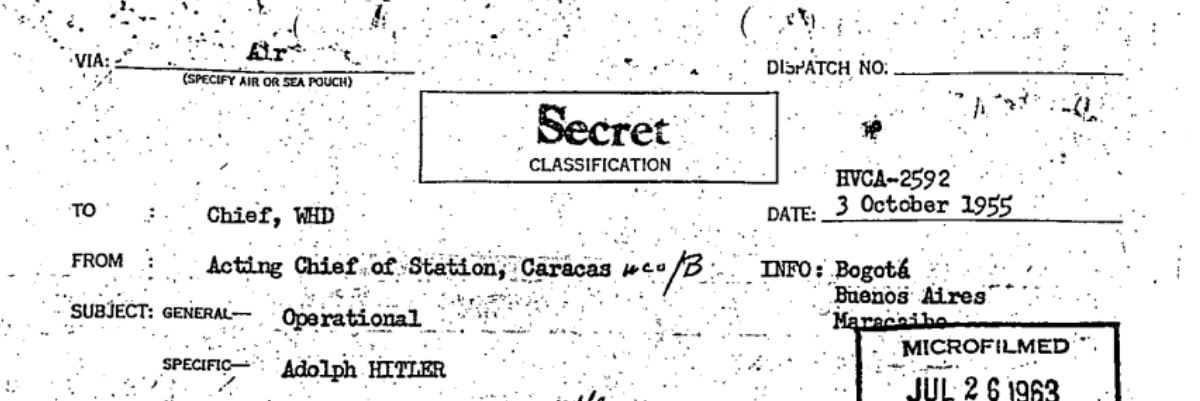
The files indicate that in 1955, the chief of the CIA’s Western Hemisphere Division (WHD) received a secret memo with the subject line “Operational: Adolf Hitler,” from the acting CIA station chief in Venezuela, which indicated that one of his sources had received a tip that the Nazi Fuhrer was indeed alive and living in Argentina.


Interestingly, these revelations seem to confirm declassified FBI documents that also claimed sources had indicated that Hitler was indeed living in Argentina.
While the official story sold to the global public is that Hitler died of suicide in the Fuhrerbunker, the actual truth may be vastly different from the popularized version of events.


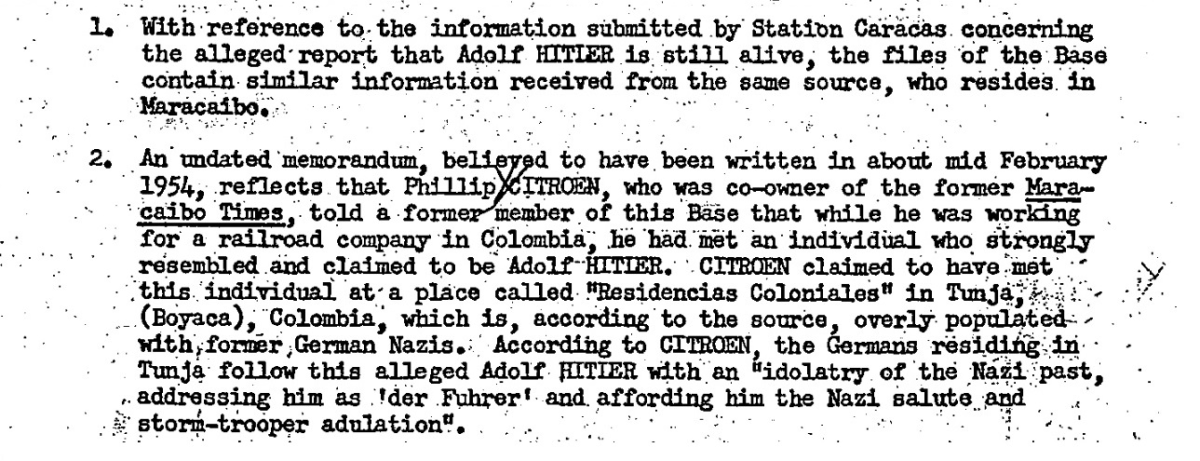
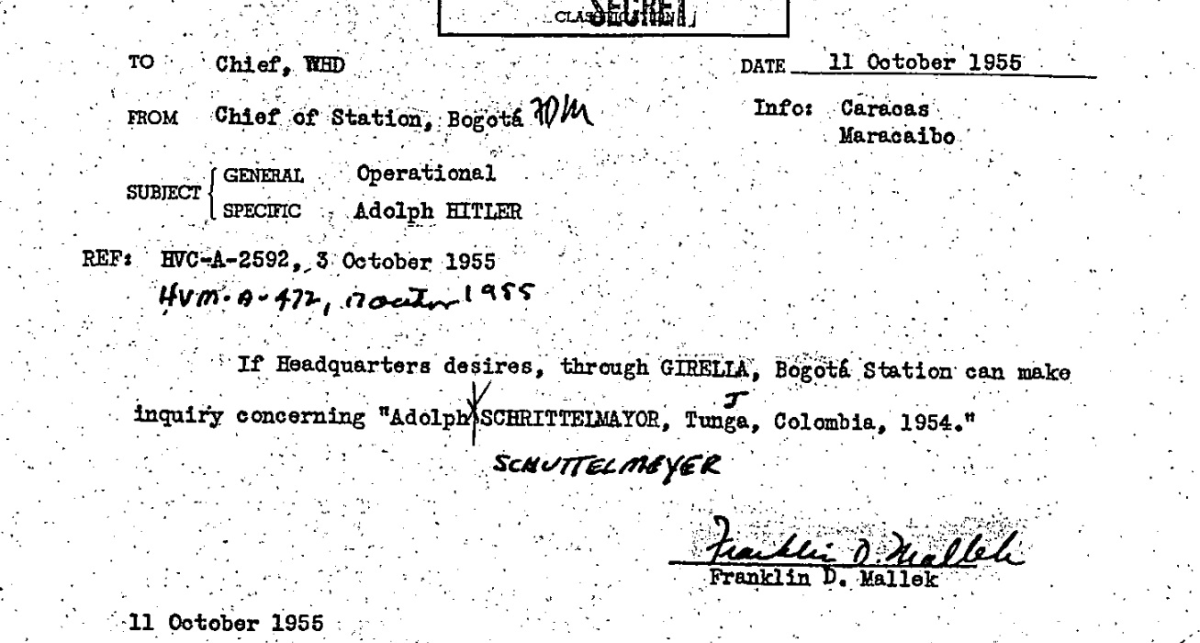
The acting CIA station chief’s informants, CIMELODY, was contacted by a former SS trooper Phillip Citroen, who claimed to have been in contact with Hitler—who was living under the pseudonym Adolph Schuttlemayer—about once a month in Colombia, while there on a trip from Maracaibo as an employee of the Royal Dutch Shipping Company.


Advertisment


Citroen said that Hitler had left Colombia for Argentina around January 1955, and erroneously suggested that the statute of limitations for war crimes had passed—as it had been 10 years since the end of World War II—and that the Allies could no longer prosecute Hitler as a war criminal.


The CIA documents reveal that Citroen told CIMELODY that he had even taken a photo with Hitler, and provided a grainy picture that was included in the CIA memo—with Hitler purported to be the man on the right.


READ MORE:  Declassified "Skull and Bones" Records from George W. Bush White House Set for Public Release


After reviewing the CIA’s files, the WHD chief reported that Citroen had only the year before reported that a colony of Nazis was present in Colombia that engaged in “idolatry of the Nazi past addressing him as ‘der Fuhrer’ and affording him the Nazi salute and storm trooper adulation,” in reference to Hitler himself.


The station chief wrote the WHP chief again only days later to engage in further investigation of whether or not it really was Adolf Hitler.


The HPD chief then incredibly made the decision to drop further inquiry, as he felt “enormous efforts could be expended on this matter with remote possibilities of establishing anything concrete.”


A seemingly strange response considering the magnitude of the report and veracity of the sources credibility in that Citroen was a former Nazi himself.


As The Free Thought Project previously reported:


“South America did indeed play host to many fleeing Nazis—including sadistic doctor Josef Mengele, whose torturous experimentation of Nazi concentration camp prisoners eventually branched into the study of twins. Later, in a small town in Brazil, one in five pregnancies resulted in births of twins—something Argentine historian Jorge Camarasa claimed in 2009 evidenced Mengele’s handiwork following his escape from Germany.”


Perhaps there is more to the story than a war weary public was led to believe in the wake of the devastation of WWII, and the truth lies somewhere other than what has became the official narrative of Hitler’s death in the Fuhrerbunker with his bride—with reality being much closer to an escape with may other Nazi war criminals to South America.

Thursday, May 25, 2017

Travel To US Has Tumbled 16% Since Trump Took Office, Foursquare Says

Social-media company Foursquare has crunched the data generated by its 50 million active monthly users and determined that America’s share of the international tourism market has fallen sharply since October.


According to data published on the company’s blog, visits by foreigners to the U.S.  started to decline in October, when they fell by 6% year-over-year. The decline has continued through March 2017, the latest month for which Foursquare has data, when visits declined by an astounding 16%.


One quick point of clarification: These data don’t measure the absolute number of visitors to the U.S., but rather America’s “market share” – its popularity as a destination for travelers relative to the rest of the world.


Official data published by the National Travel and Tourism Office also suggest that the number of foreign visitors to the U.S. declined last year from the record highs reached in 2015, but the NTTO has only supplied data through August.


Foursquare categorized each traveler as either “business” or “leisure” depending on the types of locations they visited. By breaking down the totals for each subgroup, Foursquare found that leisure travel has experienced the largest decline, having fallen nearly 20% in March on a year-over-year basis, while business travel during the same period was essentially flat.


The data also suggest that travelers from the Middle East and South America are avoiding the U.S. in larger numbers than are travelers from Europe and Asia, which brings us to the obvious implications of this study: Is the dip in tourism Trump’s fault?


In the post, Foursquare contends that the dollar’s rise against the euro over the past two quarters was probably too small to have such an outsize impact on the tourism figures. Therefore, it’s more likely that Trump’s “heated campaign rhetoric” is the primary reason for the decline in tourism.


But it’s worth remembering that foreign visitors – especially leisure travelers - typically plan their trips several quarters – if not several years – in advance. Therefore, measuring the dollar’s performance over the past two quarters probably isn’t sufficient.


Looking back to the second half of 2014, the ICE Dollar index, which measures the dollar’s strength against a basket of rivals like the euro, increased by nearly 25% after the Federal Reserve revealed that it would soon begin raising interest rates.


In the years that followed the financial crisis, the dollar was relatively cheap compared with its main rivals (i.e. the euro). Now it’s not. So, it should come as no surprise that international visits to the U.S. are falling.

Sunday, April 23, 2017

Venezuela on the Verge of Revolution: A Quick Overview

(ANTIMEDIA) Caracas — Venezuela, a country with only $10 billion left in reserves to run on, is in trouble. The people are starving. The government has gone full-on authoritarian, and now desperate human beings are dying in the streets.


From an Associated Press report on Friday:


“Authorities in Venezuela say 12 people were killed overnight following looting and violence in the South American nation’s capital amid a spiraling political crisis.”


Continuing, the report further highlighted the gravity of the situation:


“Most of the deaths took place in El Valle, where opposition leaders say 13 people were hit with an electrical current while trying to loot a bakery protected by an electric fence.”


These are people without options, forced to turn to thievery to stay alive. And they died because of it.


On April 6, The Economist reported that over the past year, 74 percent of Venezuelans lost an average of 20 pounds. Venezuela, incidentally, has topped Bloomberg’s Economic Misery Index for the past three years.


The country began its slide downward into chaos with the election of President Nicolas Maduro, who immediately began implementing socialist programs and has since taken extreme measures to secure his position.


At the end of March, for instance, Maduro effectively shut down Venezuela’s congress — his primary political opposition — and gave those legislative duties to his puppet Supreme Court.


The latest news coming out of the South American nation — aside from the deaths of people trying to steal bread to live — is that General Motors, whose Venezuelan production facility was overtaken by local authorities, has now ceased all operations in the country.


To put that in perspective, consider that in 2016, only 3,000 vehicles were sold in Venezuela, a country of 30 million people.


The U.S. Southern Command has floated the idea of using the United States’ military to contain unrest in Venezuela, though historically American intervention in South America is both widely unpopular in the region and wildly unsuccessful.


As we look on at the continuing horrors in the Middle East and what seems, at the moment, to be the makings of World War III in Asia, let’s not lose sight of the fact that right now, the people of Venezuela are in pain.


Creative Commons / Anti-Media / Report a typo


Saturday, April 22, 2017

Venezuela on the Verge of Revolution: A Quick Overview

(ANTIMEDIA) Caracas — Venezuela, a country with only $10 billion left in reserves to run on, is in trouble. The people are starving. The government has gone full-on authoritarian, and now desperate human beings are dying in the streets.


From an Associated Press report on Friday:


“Authorities in Venezuela say 12 people were killed overnight following looting and violence in the South American nation’s capital amid a spiraling political crisis.”


Continuing, the report further highlighted the gravity of the situation:


“Most of the deaths took place in El Valle, where opposition leaders say 13 people were hit with an electrical current while trying to loot a bakery protected by an electric fence.”


These are people without options, forced to turn to thievery to stay alive. And they died because of it.


On April 6, The Economist reported that over the past year, 74 percent of Venezuelans lost an average of 20 pounds. Venezuela, incidentally, has topped Bloomberg’s Economic Misery Index for the past three years.


The country began its slide downward into chaos with the election of President Nicolas Maduro, who immediately began implementing socialist programs and has since taken extreme measures to secure his position.


At the end of March, for instance, Maduro effectively shut down Venezuela’s congress — his primary political opposition — and gave those legislative duties to his puppet Supreme Court.


The latest news coming out of the South American nation — aside from the deaths of people trying to steal bread to live — is that General Motors, whose Venezuelan production facility was overtaken by local authorities, has now ceased all operations in the country.


To put that in perspective, consider that in 2016, only 3,000 vehicles were sold in Venezuela, a country of 30 million people.


The U.S. Southern Command has floated the idea of using the United States’ military to contain unrest in Venezuela, though historically American intervention in South America is both widely unpopular in the region and wildly unsuccessful.


As we look on at the continuing horrors in the Middle East and what seems, at the moment, to be the makings of World War III in Asia, let’s not lose sight of the fact that right now, the people of Venezuela are in pain.


Creative Commons / Anti-Media / Report a typo