Showing posts with label LED. Show all posts

Saturday, August 26, 2017

LED Street Lights Could Be Harmful to Your Health

LED street lights are so hazardous to people’s health that the American Medical Association (AMA) has adopted an official policy about them.


Adopted unanimously at the AMA’s annual meeting in Chicago on June 14, 2016, the policy comes in response to the growing number of LED street lights in the country. An association committee issued guidelines on how communities can choose LED streetlights “to minimize potential harmful human health and environmental effects.”


Long-lasting LED lights are quickly replacing existing streetlights because they save municipalities money on energy and maintenance. But the AMA’s stance reflects the importance of properly designing new technologies and the tight link between light and human health.


In the statement, the AMA recommends that outdoor lighting at night, especially street lights, should have a color temperature (CT) no greater than 3,000 Kelvin (K). A light’s CT is a measure of the spectral content of light from a source – how much blue, green, yellow, and red there is in it. A higher CT rating usually means a light contains more blue content, which makes the light appear whiter. [1]


Bright LED street lights have been shown to make people feel safer. They also make it easier for police to distinguish the colors of the cars they are chasing. [2]


This Lights Comes with Risk


But blue light has a dark side. Research suggests that blue light can prevent people from sleeping, or make them sleep poorly, because it throws off the body’s circadian rhythm. This is one of the problems the AMA sites in its statement.


In addition to street lights, blue light also emanates from cell phones, computers, tablets, and other electronic devices. This is why so many doctors and health experts recommend never using these gadgets at bedtime.


According to researchers at Harvard, blue light is useful during the day because it boosts attention, reaction times, and mood. But blue light also suppresses the secretion of melatonin, a hormone secreted by the brain that makes people feel sleepy at night.


Melatonin boosts the immune system, and is known to have anti-aging properties, as well.


Green light also suppresses the secretion of melatonin, but blue light suppresses it for about twice as long and was shown in studies to shift circadian rhythms by twice as much (3 hours versus 1.5 hours).


A white LED light at CT 4,000 K or 5,000 K contains a high level of short-wavelength light blue. Many cities, including Seattle and New York City, have chosen these CT-count lights to retrofit their street lighting.


The CT count of 4,000K or 5,000K in LED lights is significantly higher than the CT count of incandescent bulbs, which may have a CT of 2,400K.


But many people have started complaining about the harshness of these lights, and this is the other problem the AMA refers to in the statement. In Davis, California, for example, residents have demanded a complete replacement of the high color temperature LED street lights.


The new “white” LED lights come with bothersome glare that can cause discomfort in the eyes. The light concentration and blue light in white LED’s cause pupillary constriction in the eyes. Blue light scatters more in the eye than the longer wavelengths of yellow and red, and sufficient levels can damage the retina. 


The AMA says in the statement:


“The detrimental effects of high-intensity LED lighting are not limited to humans. Excessive outdoor lighting disrupts many species that need a dark environment. For instance, poorly designed LED lighting disorients some bird, insect, turtle and fish species, and U.S. national parks have adopted optimal lighting designs and practices that minimize the effects of light pollution on the environment….


“The AMA recommends an intensity threshold for optimal LED lighting that minimizes blue-rich light. The AMA also recommends all LED lighting should be properly shielded to minimize glare and detrimental human health and environmental effects, and consideration should be given to utilize the ability of LED lighting to be dimmed for off-peak time periods.”


Dr. Maya Babu, an AMA board member, also says in the statement:


“Despite the energy efficiency benefits, some LED lights are harmful when used as street lighting.”


Sources:


[1] The Conversation


[2] Treehugger


Storable Food


About Julie Fidler:
Author Image
Julie Fidler is a freelance writer, legal blogger, and the author of Adventures in Holy Matrimony: For Better or the Absolute Worst. She lives in Pennsylvania with her husband and two ridiculously spoiled cats. She occasionally pontificates on her blog.

Sunday, July 9, 2017

How Turmeric Will Light Up The Future – Literally!

How Turmeric Will Light Up The Future - Literally! | turmeric_led_alt | Environment Science & Technology Sleuth Journal


Can you imagine a computer or handheld device backlight or display of the future being lit up by a turmeric or pomegranate mixture? Imagine if an entirely edible source of white light could be generated with minimal environmental and human health impacts? The good news is that we no longer have to rely on our imagination. We now have the science to show it is indeed possible! 


What could be more unnatural and yet indispensable in the modern world than a light bulb? Made from metal, glass, and a variety of petrochemicals, who would even consider looking for a “green” alternative? And if so, what would that be?


Now, a groundbreaking study published in Scientific Reports seems to have found exactly such a green solution. Amazingly, Indian researchers discovered that a mixture of two commonly consumed edible plants, red pomegranate and turmeric, when exposed to light wavelengths just below the visible threshold (380 nm), produced almost pure white light emission (WLE).


This finding represents a simple, cheap and environmentally safe alternative to current LED technology, which presently rely on toxic materials, including heavy metals such as arsenic, copper, nickel, and lead,  in their production.


In the new study titled “White Light Emission from Vegetable Extracts,” Indian researchers described how they were able to conveniently tune the color temperature of the WLE by adjusting the concentrations of the “the primary emitting pigments,” namely, anthocyanins from red pomegranate seed juice and curcumin extract from turmeric.

(click image to enlarge)


How Turmeric Will Light Up The Future - Literally! | screen-shot-2 | Environment Science & Technology Sleuth Journal


One of the crucial mechanisms behind their ability to produce an almost pure white light emission was identified as “Foster resonance energy transfer” (FREF). FREF is a mechanism that describes energy transfer between two light-sensitive molecules (known as chromophores). The researchers identified A FRET-like, light-induced energy transfer cascade: polyphenolics > curcumin > anthocyanins, resulting in WLE.


The researchers were also able to create an entirely edible gelatin-based mixture of the plant extracts that was capable of emitting almost pure white light when exposed to UV light, depicted below.


How Turmeric Will Light Up The Future - Literally! | screen-shot2 | Environment Science & Technology Sleuth Journal


The researchers summarized their findings:


In summary, we have generated white light emission from natural dyes extracted in our laboratory using a green and simple procedure. The optimized mixture of two suitably chosen plant extracts using acidic  ethanol, aided by a FRET cascade from polyphenolics to curcumin to anthocyanins, generates almost  pure white light, with CIE values of (0.35, 0.33) in solution, (0.26, 0.33) in gelatin gel and (0.33, 0.25) in PVA film. White light emission from such cheap and nature friendly resources could be important in the context of lighting and sensing application. It would be interesting to see if such system can be used as dyes for tunable dye laser applications. To the best of our knowledge this is the first time low cost, biocompatible (edible) natural dyes have been a part of white light emitting system. Given the vast  number of excellent natural fluorescent dyes obtainable from renewable biosources, approaches similar to the present could lead to a more extensive range of low-cost and efficient WLE biomaterials with ease of adjusting colour temperature, which will obviate more expensive alternatives currently being pursued.” [emphasis added]


The researchers also described the context within which their finding may have revolutionary implications for future technology:


“White light emitting materials have attracted significant attention in recent years as key components in display and lighting devices based on LEDs. LEDs accounts for almost 20% of the total worldwide energy consumption and have wide applications in backlights, displays, lasers and indicators. White light emission has also been used for sensing. There has been a high level of interest in recent years in looking for white light emitting organic and inorganic molecules and materials, when photoexcited at near UV wavelengths.”


Clearly this study holds great promise for a sustainable future. We’ve already identified numerous properties within plants like turmeric and pomegranate which indicate they are far superior to conventional drug-based interventions for disease prevention and treatment. We are only now learning about the technological applications of these remarkable substances and it is likely we are still only scratching the surface.


Create your own review


Average rating:  

 0 reviews


Saturday, January 14, 2017

Grow Lights Explained: Here’s What You’re Doing That’s Wrong

Grow Lights Explained: Here

Image source: gehl-led.com


One of the most important considerations for indoor gardening is light. While some vegetables will chug along with a bare minimum of six hours of light daily, they will flourish with 12-16 hours daily. Clearly, grow lights are a must, especially during winter. However, one of the most common mistakes among indoors gardeners is using the wrong type of light.


Red, Blue, And Full-Spectrum Light


Let’s start by talking about the color in light. We perceive sunshine, for instance, as white light, but it’s actually made up of all the colors of the rainbow — it’s full-spectrum. Light bulbs don’t generate light the same way that the sun does, and the color of light they produce often appears as off-white. Traditional incandescent bulbs, for instance, give off a yellow-red glow, whereas basic fluorescent tubes often have a blue glow.


Looking For Non-GMO Vegetable Seeds? Get Them From A Company You Can Trust!


Plants have different reactions to the different colors within light. Blue light encourages the growth of strong leafy plants, while red light helps plants flower and fruit. It helps to understand how plants react to red and blue light in order to choose the best grow lights for your indoor garden.


Fluorescent Grow Lights


Not that long ago, basic fluorescent tubes were the only real option for grow lights, and many gardeners still swear by them. They are inexpensive, easy to install, and energy efficient. And, with the advent of compact fluorescent light (CFL) bulbs, installation is easier than ever, since you can simply screw a bulb into any existing light fixture.


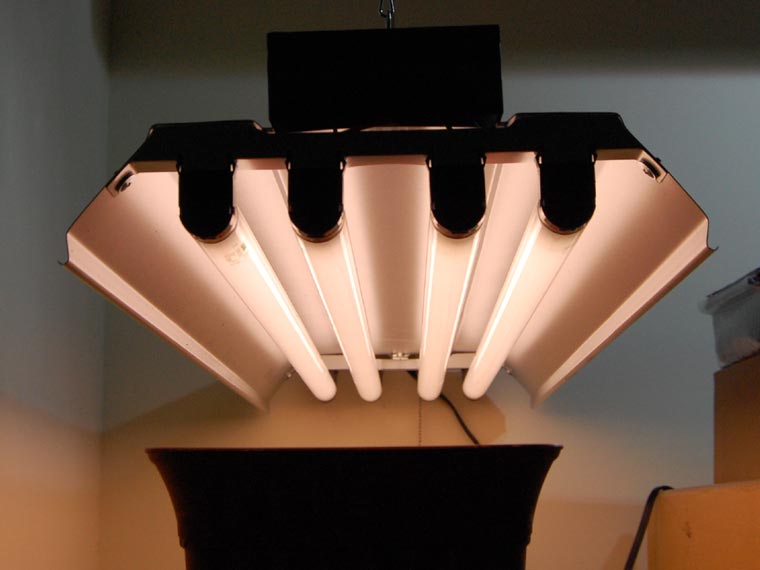
Grow Lights Explained: Here

Image source: Wikimedia


Fluorescent bulbs come in warm (red), cool (blue), and full-spectrum ranges. The light that fluorescents produce is relatively weak, but there are also high-intensity fluorescent bulbs if needed. Full-spectrum and high-intensity fluorescent bulbs are more expensive than basic ones, but they may end up being more cost-effective.


LED Grow Lights


Light emitting diodes (LED) bulbs have a lot of potential for grow lights, but they are not yet widely used. Like many technologies in their infancies, they are relatively expensive, although their cost is coming down. Keep your eye on LED grow lights because they have a lot of benefits, including having a long life and being energy efficient, and emitting little heat. Also, they can be programmed to produce specific wavelengths of light.


HID Grow Lights


There are two types of high-intensity discharge (HID) bulbs, both of which produce bright and intense light. Metal halide (MH) bulbs emit light that is quite similar to natural sunlight, without generating a lot of heat. However, they do tend to the blue end of the spectrum, and depending on the type of bulb used, you may need to supplement with high-pressure sodium (HPS) lighting, which emits red light. HPS bulbs are excellent to promote flowering and fruiting. However, both types of HID bulbs can only be used in special fixtures, with ballasts, and the complete set-up can be expensive.


Your Grow Light Set-Up


Indoor gardening requires light, but that light must be cool. The heat created by incandescent and halogen bulbs is too intense and will fry your seedlings. Stick with fluorescent, LED or HID lighting.


Consider where the grow lights will be placed in your house. If your plants are already getting a great deal of light from a south-facing window, then weaker bulbs (like basic fluorescents) will work fine as supplementary lighting. If your plants are in a darker area of your home, you will need more powerful grow lights, like high-intensity fluorescent or HID bulbs.


The distance between your plants and your light source depends on what kind of bulbs you use. Since fluorescents are weaker, they can be placed only 2-3 inches from your plants; but LEDs should be 12-18 inches away. Either way, you will need to adjust the height of your grow lights as your plants get taller. Don’t count on keeping the position of your lights static. Seedlings will grow tall and spindly, without putting out leaves, if they need to stretch toward a far-away light source; and, of course, you don’t want them to touch the bulb.


The most complicated part of creating a grow light system is figuring out how big — in terms of wattage — it needs to be. It’s not just about the square footage of your growing space, but also about the type of light you’re using and what you’re growing. You will need a higher wattage if you’re using weaker bulbs, or are growing light-loving plants. Lettuce, for instance, needs less light than tomatoes do. While it’s tempting to just go with a higher wattage to cover all contingencies, that can have a negative effect on your energy consumption. There are all kinds of online guides that can help you figure out how to tailor your wattage to your plants.


Grow lights aren’t rocket science, but they aren’t a trip to the candy store, either. To effectively use grow lights, it helps greatly to have some understanding of how plants react to light, and of the available bulb options. Once you have that knowledge, you can optimize your own grow light set-up so that it best suits your needs.


What advice would you add on using grow lights? Share your tips in the section below:


Bust Inflation With A Low-Cost, High-Production Garden. Read More Here.