Showing posts with label English. Show all posts

Tuesday, June 20, 2017

WATCH: Cop Fines Woman $250 for “Not Communicating in the English Language”

English


Miami, FL — In the Land of the Free, failure to speak English will result in a citation. Uber driver, Carmen Echevarria found out the hard way that not speaking English in today’s America — is a punishable offense.


Echevarria’s fine was the result of a discriminatory Miami-Dade County memorandum that demands any driver of a transportation vehicle be able to communicate in English. Up until this week, Echevarria, who doesn’t speak the best English, has not had any problems.


However, all that changed when a see-something-say-something citizen got into Echevarria’s Uber car and demanded she speak English. Instead of simply getting in the car and letting her drive her to the destination, the Uber customer became enraged that Echevarria would ask a passenger in her vehicle to translate. So, the customer called the police.


“I felt discriminated against,” Echevarria told the station in Spanish. “I asked the (passenger sitting in her car) ‘Can you please help translate what she is saying?’ Then she asked why, if I was an Uber driver, I didn’t speak English.”


As Telemundo reports, in May 2016, Miami-Dade County issued a memorandum with rules for drivers of the transportation network, and one of the prerequisites is “the ability to communicate in English.”


“I told her ‘so sorry, a little English’ then she called the inspector who also confronted me and told me in order to be an Uber driver I need it to speak English,” Echevarria explained.


In a sad attempt at justifying the ridiculous code, Miami-Dade Department of Transportation Public Relations Officer Karla Damian issued a statement attempting to clarify the rule.


READ MORE:  Cop Who Planned to Kidnap, Rape & Eat Women, Walks Free After Judge Overturns Conviction


“The Code doesn’t require the driver to be ‘proficient’ in the English language, but the driver should have some knowledge of the English language in order to communicate with a passenger in case of an emergency or to receive and understand basic directions from the passenger(s),” Damian wrote.


As mentioned above, Echevarria has never had a problem with getting her passengers where they needed to go. And, had the passenger this week, who turned her in for lack of English skills, simply got in the car and let Echevarria do her job, there would still not be an issue.


As anyone who’s ever taken an Uber knows, the route, destination, and payment are already entered into the driver’s system before they even show up to drive you. There is absolutely no need whatsoever to engage in conversation with the driver.


In another sad attempt at justifying the citation, Miami-Dade Mayor Carlos Gimenez said usually warnings are given instead of citations, according to NBC. And, in their statement, the mayor’s office even noted that the woman could speak some English.


“It does seem like she could communicate in the English language and take directions so it’s unfortunate that a fine was issued,” said Mike Hernandez, the mayor’s communications director. “The county can work with this driver and with Uber to address this situation.”


As NBC Miami reports, Uber spokesman Javi Correoso sent a statement to NBC 6 saying the company is “proud of the diversity of driver partners in the South Florida market.” Correoso went on to say that until statewide regulations go into effect on July 1, Uber asks all driver partners in the state to follow all applicable local laws and regulations.


READ MORE:  How Thousands of Mass Shootings are Ignored Because their Deaths Don"t Serve a Political Agenda


The statewide regulation to which Correoso is referring is CS/HB 221. This bill was signed into law in May and overrides these ridiculous requirements for speaking English.


The good news is Uber stated that in the case of a driver receiving a ticket for not speaking English, they would cover their expenses. Also, since this story began gaining traction and resulted in subsequent backlash for the county, there are reports that the ticket may be excused.


However, until that time, officials would do well to realize the grave nature of such a law. For being different, in the Land of the Free, you can and will face steep consequences through police enforced extortion — or worse. Make no mistake, if you refuse to pay this extortion fee, you will be kidnapped and thrown in a cage.

Tuesday, February 14, 2017

Selected Articles: Helen Caldicott on Fukushima, Oliver Stone’s “Ukraine on Fire”, Trump Impeachment Campaign: What Is End Game?

Fukushima-Japan-Nuclear-Radiation-Disaster

Helen Caldicott: The Fukushima Nuclear Meltdown Continues Unabated


By Helen Caldicott, February 14 2017


Dr Helen Caldicott, explains recent robot photos taken of Fukushima’s Daiichi nuclear reactors: radiation levels have not peaked, but have continued to spill toxic waste into the Pacific Ocean — but it’s only now the damage has been photographed.


trump-executive-orders-rhk-2045p_f33eca7913aef085ffb9481827ea97dc.nbcnews-ux-2880-1000-400x266

Campaign to Impeach Donald Trump Continues. What’s the End Game?


By Stephen Lendman, February 14 2017


Trump hasn’t been in office long enough to charge him with any offense, let alone an impeachable one – other than for continuing US imperial wars in multiple theaters. No president was ever charged with crimes of war or against humanity. Several instead won Nobel Peace Prizes, Obama the latest, despite months of high crimes before getting the award. Trump may or may not warrant impeachment. A few weeks in office is way too early to judge him this harshly despite justifiable criticism of what he’s done so far.


0

A Documentary You’ll Likely Never See: “Ukraine on Fire” by Oliver Stone


By James DiEugenio, February 14 2017


It is not very often that a documentary film can set a new paradigm about a recent event, let alone, one that is still in progress. But the new film Ukraine on Fire has the potential to do so – assuming that many people get to see it.


club-of-rome-global-warming-300x200

The Globalization of Environmental Degradation


By George Abert and Dr. Paul Craig Roberts, February 14 2017


Figuratively speaking, a ginormous asteroid is hurtling to a cataclysmic rendezvous with earth, but we are not supposed to notice. The asteroid is the rising threat from environmental degradation. Evidence is accumulating that environmental degradation is becoming global.We can either act responsibly by accepting the challenge or take refuge in denial and risk the consequences.


Smartmeter-radiation-2

Smart Utility Meter “Opt Out Bills” Opt to Protect Consumer Rights?


By Patricia Burke, February 14 2017


In many states, AMR meters have already been rolled out and are transmitting 24/7 without the knowledge and consent of residents who are not aware of their increased RF exposures, and the bills only address the future installation of smart meters. States rolling out new AMR meters are claiming that the meters are not smart, misleading citizens. An analog meter with no radio transmitter would be required to address both the privacy and health complaints.


Fukushima Out of Control: Radiation Levels Significantly Higher than “Unimaginable”

Attempting to control the nuclear disaster at Fukushima

After a week of limited coverage of “unimaginable levels” of radiation inside the remains of collapsed Unit 2 at Fukushima (see below), Nuclear-News.net reported February 11 that radiation levels are actually significantly higher than “unimaginable.”


Continuous, intense radiation, at 530 sieverts an hour (4 sieverts is a lethal level), was widely reported in early February 2017 – as if this were a new phenomenon. It’s not. Three reactors at Fukushima melted down during the earthquake-tsunami disaster on March 3, 2011, and the meltdowns never stopped. Radiation levels have been out of control ever since. As Fairewinds Energy Education noted in an email February 10:


Although this robotic measurement just occurred, this high radiation reading was anticipated and has existed inside the damaged Unit 2 atomic reactor since the disaster began nearly 6 years ago…. As Fairewinds has said for 6 years, there are no easy solutions because groundwater is in direct contact with the nuclear corium (melted fuel) at Fukushima Daiichi.


What’s new (and not very new, at that) is the official acknowledgement of the highest radiation levels yet measured there, by a factor of seven (the previously measured high was 73 sieverts an hour in 2012). The highest radiation level measured at Chernobyl was 300 sieverts an hour. What this all means, as anyone paying attention well knows, is that the triple-meltdown Fukushima disaster is still out of control.


“Sievert” is one of the many terms of mystification used to prevent most people from fully understanding radiation. A “sievert” is roughly equivalent to a “gray,” as each represents a “joule” per kilogram (not to be confused, for example, with “Curie” or Bequerel,” or with “rem,” “rad,” or “roentgen”). In the International System of Units (SI), a “joule” is the “unit of work or energy, equal to the work done by a force of one newton when its point of application moves one meter in the direction of action of the force, equivalent to one 3600th of a watt-hour.” Got that? The jargon doesn’t much matter as far as public safety is concerned. All ionizing radiation is life-threatening. The more you’re exposed, the more you’re threatened. As Physics Stack Exchange illustrates the issue:


The dose [of radiation] that kills a tumor is deliberately aimed at that tumor. If, instead of using a collimated beam, you put a person in a wide beam for radio “therapy”, you would be treating their entire body as a tumor and kill them.


Radiation levels at Fukushima are comparable to a nuclear explosion that doesn’t end. That’s one reason that TEPCO, the Tokyo Electric Power Co. that owns Fukushima, keeps trying to reassure the world that little or no radiation escapes from Fukushima. This is not true, radiation in large, mostly unmeasured or undocumented amounts pours into the Pacific Ocean all the time, without pause. One reason this release is out of control is because no one apparently knows just where the three melted reactor cores have gone. TEPCO says it thinks the melted cores have burned through the reactors’ inner containment vessels, but are still within the outer containment walls. They keep looking as best they can.


On February 3, 2017, the Guardian reported the high radiation levels discovered by a remote camera sent into the reactor on a telescopic arm. Reader Supported News carried the story from EcoWatch on February 5. Essentially the same story was reported on February 6 by Smithsonian.com, on February 7 by ZeroHedge.com, and on February 8, Fox News reported that “radiation levels at Japan’s crippled Fukushima nuclear power plant are now at ‘unimaginable’ levels.” There have apparently been no such reports on CBS, NBC, CNN, or MSNBC. On February 9, ABC ran an AP story about pulling a robot out of Unit 2 because of “high radiation,” without specifying a level and adding: “TEPCO officials reassured that despite the dangerously high figures, radiation is not leaking outside of the reactor.” (PJMedia.comcalls the Fox story “fake news,” relies on ad hominem argument, trusts TEPCO on keeping track of the irradiated ocean flow, and accepts US EPA standards for “safe” drinking water – without actually discrediting the story.)


On February 12, Pakistan Defence ran the AP story of February 9, but included the new level of radiation at 650 sieverts that fried a robot’s camera, adding:


The high levels of radiation may seem alarming, but there’s good news: it’s contained, and there are no reports of new leaks from the plant. That means that the radiation shouldn’t affect nearby townships. Higher levels of radiation could also mean the robot is getting closer to the precise source of radioactivity to properly remove the melted fuel.


All this coverage relates only to Unit 2’s melted reactor core. There is no reliable news of the condition of the melted reactor cores in two other units. Last November, in a half-hour talk reviewing the Fukushima crisis, Arnie Gunderson of Fairewinds Energy Education discussed the three missing reactor cores and what he suspected was the likelihood that they had not been contained within the reactor.


The ground water flowing into, through, and out of the reactor is contaminated by its passage and is having some impact on the Pacific Ocean. The US, like other governments, is ignoring whatever is happening, allowing it to happen as if it doesn’t matter and never will. In Carmel, California, local residents are finding that tide pools, once vibrant with life, are now dead. They blame Fukushima.


Whatever is actually going on at Fukushima is not good, and has horrifying possibilities. It is little comfort to have the perpetrator of the catastrophe, TEPCO, in charge of fixing it, especially when the Japanese government is more an enabler of cover-up and denial than any kind of seeker of truth or protector of its people. It took private researchers five years to figure out that Fukushima’s fallout of Cesium-137 on Tokyo took a more dangerous, glassy form that wasn’t cleaned up effectively.


The US and most of the rest of the world have chosen not to take Fukushima more seriously than a multi-car Interstate pile-up. The policy is one more roll of the dice, saving money now and gambling the future. But now we have Rick Perry heading up the US Department of Energy and Scott Pruitt slated to take over the Environmental Protection Agency – so we can expect big changes, right?


Actually there has been one big change already at the Energy Dept., which uses more contractorsthan any other US agency. The Government Accountability Office (GAO) found that the Energy Dept. failed to protect whistleblowers who raised legitimate nuclear safety and other concerns. In response, the Energy Dept. prepared a new rule protecting whistleblowers from contractor retaliation. That rule was blocked from going into effect by President Trump’s regulatory freeze on January 20.


In a sense, Fukushima is perhaps a metaphor for the current American moment. The electoral earthquake and tsunami of 11/9 has produced a political meltdown of unknown and expanding proportions, that continue unchecked, causing still unmeasured destruction and human suffering far into a dark and dangerous future.


William M. Boardman has over 40 years experience in theatre, radio, TV, print journalism, and non-fiction, including 20 years in the Vermont judiciary. He has received honors from Writers Guild of America, Corporation for Public Broadcasting, Vermont Life magazine, and an Emmy Award nomination from the Academy of Television Arts and Sciences.

Organized Anti-Russian Campaigns Hit At Trump’s Foreign Policy Plans

Donald Trump

At the end of his administration Obama implemented a series of anti-Russian moves. The most obvious was the expulsion of 35 Russian diplomats over unfounded allegation of Russian interference in the U.S. elections. Other moves included the launching of an Ukrainian offense against the Russian supported resistance in the east Ukraine.


These moves were designed to impede the incoming Trump administration in its announced plans towards more friendly relations with Russia. The incoming Trump administration countered Obama’s sanction move. Its designated National Security Advisor Flynn phoned up the Russian ambassador in Washington. He did not promise to immediately lift the sanctions but indirectly asked him to refrain from any harsh response:


The transcripts of the conversations don’t show Mr. Flynn made any sort of promise to lift the sanctions once Mr. Trump took office, the officials said. Rather, they show Mr.Flynn making more general comments about relations between the two countries improving under Mr. Trump, people familiar with them said.


This was arguably a sensible move in line with a smooth transition of government.


In the end the Russian government refrained from any in kind reaction to the Obama sanctions.


This was blow to the promoters of hostilities with Russia. It did not stop their meddling. The effort moved towards kicking Flynn out of his new position as NSC. A concerted media campaign was launched to insinuate an early Flynn failure and to press for his dismissal.


Bradd Jaffy @BraddJaffy
Within the last 30 mins — NYT, WashPost, WSJ and Politico each dropped pieces that have to be alarming for your future if you’re Mike Flynn
5:51 PM – 12 Feb 2017


Keep in mind that some 95% of the U.S. media was hostile to Trump during the election campaign. They all peddled the nonsense of “Russian hacks” when an insider leaked emails from the Democratic National Council. They are all willing to support any move that might hinder the Trump administration.


Thus this morning news was filled with these headlines:


All these stories are based on “inside views” from multiple “former and current officials”. All are build around the baseless allegations against Flynn of somehow colluding with the Russian government. All are likely more wishful thinking than fact.


It would be astonishing if Trump falls for this obviously well organized campaign against his administration. Should he fire Flynn or give in to such  pressure his enemies will smell blood, find a new target within his administration and intensify their fire.


Indeed a second well coordinated assault on an announced Trump policy, a change of course in Syria, is already in the making. This one aims at further maligning the Syrian government in an effort to make it impossible to argue for cooperation in the fight against the Islamic State.


  • A few days ago Amnesty International published an unfounded report about alleged executions in Syrian prisons.

  • Today Human Rights Watch claims that the Syrian government systematically used Chlorine in the fight over Aleppo. The sources are solely opposition supporters.

  • Based on similar vague “facts” the Atlantic Council, a NATO lobby with financial ties to Gulf governments, launches a huge propaganda report (large pdf) about the “war crime” of liberating Aleppo from Jihadis.

None of these “humanitarian” organization is concerned about the current devastating situation in Aleppo. For 40 days the water has been cut off by the Islamic State at the Euphrates pumping stations. There is no electricity. Fuel is sparse. Medications are difficult to find.


Their hypocrisy stinks to high heaven. These organizations all assert that the Syrian government, for example, attacked hospitals in east-Aleppo solely to hit civilians. At the same time they all applaud a much bigger assault on the Islamic State held Mosul by U.S. and Iraqi troops. There, the head of Human Rights Watch asserts, the hospitals are used by the Jihadis and thus attacks on them are justified:


Kenneth Roth @KenRoth
As battle for Mosul proceeds, ISIS is regularly occupying hospitals & medical facilities, endangering patients/staff bit.ly/2kqXuUR


The anti-Flynn campaign as well as the bad-Assad campaign are aimed at Trump policy changes. These changes move away from the course the borg implemented throughout the Obama reign.


Meanwhile the Trump administration implements regressive economic and social policies without any noticeable resistance in the media, in Congress or from so called Non-Government-Organizations:


President Trump has embarked on the most aggressive campaign against government regulation in a generation, joining with Republican lawmakers to roll back rules already on the books and limit the ability of federal regulators to impose new ones.


The borg or deep state is way more concerned with keeping up its plans of uncontested global dominance than with the welfare of the citizens within the empire.


Trump promised to put “America first”, to prioritize the inner well being of the States over the quest for global hegemony. His voters elected him for that purpose. Should he fall for the organized campaigns against his plans predictable foreign policy disasters will dominate his presidency. He will then lose any chance for reelection.

American Media Hacking “Fake News” About North Korea

north-korea-usa-flag


US Media continues its campaign against “fake news,” urging people to only listen to mainstream, pro-western capitalist news sources, despite their documented record of factual inaccuracies.


US media coverage around anything related to the Democratic People’s Republic of Korea is a great example of media bias and deception in practice. Sometimes US media is caught blatantly reporting false things about the DPRK, such as the outrageous claim that Kim Jong-Un executed someone by feeding them to a pack of wild dogs. This was proven to be fake, or untrue news.


However, most of the manner in which the US public is deceived about the DPRK is more subtle.


The Forgotten “Economic Miracles”


For example, most Americans believe that the economic system that is in place in the northern half of the Korean peninsula has been an absolute, total failure, and caused nothing but mass starvation. This is demonstrably false.


A new video from the Council on Foreign Relations, a top American foreign policy think tank features Scott Snyder passingly mentioning:


“It is a socialist system, it was established on the  Soviet model. The economy is centrally controlled, it worked well in the early 60s, but it ran into roadblocks.”


A BBC article from 2008 says the same thing:


“At one time, North Korea’s centrally planned economy seemed to work well – indeed, in the initial years after the creation of North Korea following World War II, with spectacular results. The mass mobilization of the population, along with Soviet and Chinese technical assistance and financial aid, resulted in annual economic growth rates estimated to have reached 20%, even 30%, in the years following the devastating 1950-53 Korean war. As late as the 1970s, South Korea languished in the shadow of the “economic miracle” north of the border.”


The Country Study of the DPRK published by the US Library of Congress goes into detail describing the economic achievements of the country, including housing, literacy, self-sufficiency and access to medical care.


Mass food shortages and famine took place in the DPRK during the 1990s. In the aftermath of the Soviet Union’s collapse, the DPRK was unable to import oil, on which the country’s food system was very dependent. Within the DPRK, this period is known as the “arduous march.” The government blames sanctions from the United States for the food crisis.


However, when reporting on North Korea, American media emphasizes the “arduous march” period, and omits the “economic miracles” of the 1960s. Furthermore, the causes of the food crisis of the 1990s are never explained. A single episode of mass starvation during the 1990s does not accurately represent the entire experience of socialist construction in northern Korea.


Furthermore, the audience is led to believe that the only factor is the failure of socialist economics and mis-leadership by the Korean Workers Party. Usually no other factors, such as sanctions, lack of arable land, drought, flooding, etc. are discussed.


Nukes: The Whole Story


The other example of lying through omission and emphasis relates to nuclear proliferation. North Korea withdrew from the Nuclear Non-Proliferation Treaty on January 10th, 2003. It understood now that the country possesses nuclear weapons. But why?American media ignores, omits, or de-emphasizes the entire context of the DPRK developing nuclear weapons. The audience is led to believe that the DPRK randomly developed nukes out of a desire to attack the United States or threaten its neighbors.

Let’s go over the omitted background of the story of nuclear proliferation on the Korean Peninsula. During the Korean War, millions of Koreans died. Some estimate that roughly 30% of the population of the DPRK was lost. Every building above one story high was destroyed. During the war, the United States was openly considering the use of Nuclear Weapons against both Korean and Chinese forces. Douglas MacArthur even made these threats publicly.


North Korea first ratified the Nuclear Non-Proliferation Treaty in 1985. In 1993, they threatened to withdraw. At the time, the country was facing an episode of mass starvation, amid US threats, sanctions, and the loss of their Soviet allies. Negotiations between the US Government and the DPRK took place, and DPRK did not withdraw. In 1994 the “Agreed Framework” was established between the United States and North Korea. It was understood that North Korea would be given agricultural aid, heating oil, and the US would move toward having diplomatic relations with North Korea, all in exchange for nuclear non-proliferation.


However, the United States never fulfilled its end of the bargain. US Congress blocked the implementation of the deal which the Clinton administration had negotiated.


In this context, the DPRK dropped its obligations under the agreed framework as well, and ultimately developed nuclear weapons.


US media of course leaves out this entire chain of events. Korea’s leadership agreed not to develop nuclear weapons in exchange for food for their starving population, as well as other humanitarian support, in a time of mass starvation. US leaders did not fulfill their promises. Very little food and heating gas was ever delivered. In this context, is it a surprise, or a moral outrage that North Korea would also drop its end of the bargain, and go ahead and pursue nukes? Does such an action really fit the narrative of a “rogue state” lead by “insane” leaders bent on destroying the planet?


When a few basic facts are mentioned, the entire narrative and perception of North Korea falls apart. The DPRK hasn’t always had mass starvation, and according to even rather hostile sources like BBC and the Council on Foreign Relations, its economic system was quite successful at one time. Furthermore, the DPRK developed Nuclear Weapons only in response to the failure US leaders to fulfill their obligations under a negotiated agreement. They were promised certain things in exchange for not developing nuclear weapons. They did not get those things, so they went ahead did it.


These facts are conveniently forgotten in any discussion of the DPRK, but they are highly relevant to understanding the country and its relationship with the world. While ignoring important aspects of reality, these news sources talk of “fake news” and urge us to listen exclusively to them? That’s probably not a good idea, especially for those who want peace.


Caleb Maupin is a political analyst and activist based in New York. He studied political science at Baldwin-Wallace College and was inspired and involved in the Occupy Wall Street movement, especially for the online magazine “New Eastern Outlook”.


Between Message and Martyrdom: The World Press Photo of the Year

photo of the year

“Photographs really are experience captured, and the camera is the ideal arm of consciousness in its acquisitive mood.”— Susan Sontag, On Photography (1977)


The photograph is a still image of messages, trapped fleetingly. For that reason, it has been seen as mimicking death, a mask forever preserved. It suspends, a captured meaning hovering in time. That such images become weapons is undeniable. Not all are poetic notices to the great and the good. They are often reminders of the bountifully nasty, an inspiration for what is to come.


The photograph taught us, effectively, a new visual code, a Susan Sontag reminds us. In instructing us on that code, “photographs alter and enlarge our notions of what is worth looking at and what we have a right to observe.”


The right as to what to observe, and what is worth looking at. The award of the “World Press Photo of the Year” Burhan Özbilici’s dramatic shot featuring the slaying of Russian ambassador Andrei Karlov in an Ankara art gallery is one such example, a fistful of tensions and discomforting points. It has divided and abhorred judges; it has drawn out parallels and debates.


The image, featuring a snappily dressed, committed man, is now generally known: The triumphant Mevlut Mert Altintas raises an arm, eyes ablaze, gun discharged, verging on hyped caricature. He extols the virtue of his act; for him, undeniably clear in its vicious beauty, its ideological clarity. The shots have been made, and his bloody work lies on the museum floor. The ambassador, Andrei Karlov, is dead.


The photo captures an insistence, the unqualified nature of this action (true fundamentalists are characterised by their lack of contradiction, their inability to see it). The ambassador needed to die to make a statement, and his rumpled figure, dead or dying, has become part of the gallery.


It has also become part of the register of geopolitics: Turkey’s confused relationship with Russia, sometimes intensely hot, occasional lovers with purpose; other times glacially vindictive, demanding loud resolution. In the background of the killer’s cries: the sea-deep blood bath of Syria, the haunting corpses of Aleppo.


Some have claimed that endorsing the photo as a winner of a contest would give it an unintended, propagandistic boost. Stuart Franklin, the chair of the committee whose decision he ultimately went against, admits to being tormented by his decision not to endorse the photo as the image of the year.


He admires the photographer’s sense of chance, his “composure, bravery and skill”. “It’s the third time that coverage of an assassination has won this prize, the most famous being the killing of a Vietcong suspect , photographed by Eddie Adams in 1968.”[1]


Then, he elaborates on his reasons, the lukewarm, unconvincing grounds of a chairman confused and in need of self-respect. “I voted against. Sorry, Burhan. It’s a photograph of a murder, the killer and the slain, both seen in the same picture, and morally as problematic to publish as a terrorist beheading.”


Franklin, numbed by the current infatuation with staged dramas of beheadings, killings and terrorist indulgences, can only fear what a prize would do for such an image. “Placing the photograph on this high pedestal is an invitation to those contemplating such staged spectaculars: it reaffirms the compact between martyrdom and publicity.”


This is essentially a silly, if not meaningless argument and Franklin reveals the very reasons why such an image deserves circulation, discussion, and tears. A person about to lose his life to the swift application of sword, the bone and vessels severed, the life transported, shifted, removed, would be powerful, terrifying and no less poignant.


That it has a political message is beside the point: all such pictures do. There will always be a higher form of meaning to ground the reaction: the photo merely teases the surface, opens windows without ever showing us the whole room of feeling.


Franklin’s reasoning collapses as he garnishes his argument with nonsensical piffle. “Unlike the assassination of Archduke Ferdinand in Sarajevo in 1914, the crime had limited political consequences.” The statement is that remarkable as to beggar belief.


The “crime” (others prefer the traditional reference of assassination) propelled Europe into a war that destroyed a continent, eliminated the monarchical structure, a generation and much else besides. Ridiculous as it is to blame the confused yet determined Gavrilo Princip for all that, the enormity of the act to historical destiny remains unquestioned. Pictures remain, for all the fuss, records, ideas that capture a moment in time for posterity. There are no foolish pictures, only foolish people.


Broader objections to pictures as propaganda tend to confuse the criteria of best photo with the endorsement of political content. These matters are not necessarily linked, and should not be confused. To appreciate the terrifying moment of a historical fact is not the same thing as agreeing with it. They can only be appreciation, pity, and awareness. The stunning cloud that arises from the atomic bomb that levelled Hiroshima enchants even if it is murderous and piteous.


A reminder to Franklin: The Vietnam conflict is forever caught by that moment where a young girl, naked, retreats in the face of napalm, her skin itself peeling, torn, sizzling before the effects of a US airstrike. The pro-war advocates about opposing the communist juggernaut, blind to nationalist specifics, detested the image as being unduly propagandistic. Each action, each image, that militated against a cause was also one that was seen to embrace it.


Photography remains the terrain where we fight our pre-existing impressions, and perhaps hope for something better. A murder, viciously executed in the presence of art (life being short, art being long), is as suitably outrageous as any. This is not propaganda, but life and death, in all its captivating cruelty, snapped for posterity.


Dr. Binoy Kampmark was a Commonwealth Scholar at Selwyn College, Cambridge. He lectures at RMIT University, Melbourne. Email: [email protected]


Notes


[1] https://www.theguardian.com/commentisfree/2017/feb/13/world-press-photo-year-turkey-russian-assassination


A Documentary You’ll Likely Never See: “Ukraine on Fire” by Oliver Stone

0

It is not very often that a documentary film can set a new paradigm about a recent event, let alone, one that is still in progress. But the new film Ukraine on Fire has the potential to do so – assuming that many people get to see it.


Usually, documentaries — even good ones — repackage familiar information in a different aesthetic form. If that form is skillfully done, then the information can move us in a different way than just reading about it.


A good example of this would be Peter Davis’s powerful documentary about U.S. involvement in Vietnam, Hearts and Minds. By 1974, most Americans understood just how bad the Vietnam War was, but through the combination of sounds and images, which could only have been done through film, that documentary created a sensation, which removed the last obstacles to America leaving Indochina.


Ukraine on Fire has the same potential and could make a contribution that even goes beyond what the Davis film did because there was very little new information in Hearts and Minds. Especially for American and Western European audiences, Ukraine on Fire could be revelatory in that it offers a historical explanation for the deep divisions within Ukraine and presents information about the current crisis that challenges the mainstream media’s paradigm, which blames the conflict almost exclusively on Russia.


Key people in the film’s production are director Igor Lopatonok, editor Alex Chavez, and writer Vanessa Dean, whose screenplay contains a large amount of historical as well as current material exploring how Ukraine became such a cauldron of violence and hate. Oliver Stone served as executive producer and conducted some high-profile interviews with Russian President Vladimir Putin and ousted Ukrainian President Viktor Yanukovych.


The film begins with gripping images of the violence that ripped through the capital city of Kiev during both the 2004 Orange Revolution and the 2014 removal of Yanukovich. It then travels back in time to provide a perspective that has been missing from mainstream versions of these events and even in many alternative media renditions.


A Longtime Pawn


Historically, Ukraine has been treated as a pawn since the late Seventeenth Century. In 1918, Ukraine was made a German protectorate by the Treaty of Brest Litovsk. Ukraine was also a part of the Molotov-Ribbentrop Pact of 1939 signed between Germany and Russia, but violated by Adolf Hitler when the Nazis invaded the Soviet Union in the summer of 1941.


German dictator Adolf Hitler


The reaction of many in Ukraine to Hitler’s aggression was not the same as it was in the rest of the Soviet Union. Some Ukrainians welcomed the Nazis. The most significant Ukrainian nationalist group, Organization of Ukrainian Nationalists (OUN), had been established in 1929. Many of its members cooperated with the Nazis, some even enlisted in the Waffen SS and Ukrainian nationalists participated in the massacre of more than 33,000 Jews at Babi Yar ravine in Kiev in September 1941. According to scholar Pers Anders Rudling, the number of Ukrainian nationalists involved in the slaughter outnumbered the Germans by a factor of 4 to 1.


But it wasn’t just the Jews that the Ukrainian nationalists slaughtered. They also participated in massacres of Poles in the western Ukrainian region of Galicia from March 1943 until the end of 1944. Again, the main perpetrators were not Germans, but Ukrainians.


According to author Ryazard Szawlowksi, the Ukrainian nationalists first lulled the Poles into thinking they were their friends, then turned on them with a barbarity and ferocity that not even the Nazis could match, torturing their victims with saws and axes. The documentary places the number of dead at 36,750, but Szawlowski estimates it may be two or three times higher.


OUN members participated in these slaughters for the purpose of ethnic cleansing, wanting Ukraine to be preserved for what OUN regarded as native Ukrainians. They also expected Ukraine to be independent by the end of the war, free from both German and Russian domination. The two main leaders in OUN who participated in the Nazi collaboration were Stepan Bandera and Mykola Lebed. Bandera was a virulent anti-Semite, and Lebed was rabidly against the Poles, participating in their slaughter.


After the war, both Bandera and Lebed were protected by American intelligence, which spared them from the Nuremburg tribunals. The immediate antecedent of the CIA, Central Intelligence Group, wanted to use both men for information gathering and operations against the Soviet Union. England’s MI6 used Bandera even more than the CIA did, but the KGB eventually hunted down Bandera and assassinated him in Munich in 1959. Lebed was brought to America and addressed anti-communist Ukrainian organizations in the U.S. and Canada. The CIA protected him from immigration authorities who might otherwise have deported him as a war criminal.


The history of the Cold War was never too far in the background of Ukrainian politics, including within the diaspora that fled to the West after the Red Army defeated the Nazis and many of their Ukrainian collaborators emigrated to the United States and Canada. In the West, they formed a fierce anti-communist lobby that gained greater influence after Ronald Reagan was elected in 1980.


Important History


This history is an important part of Dean’s prologue to the main body of Ukraine on Fire and is essential for anyone trying to understand what has happened there since the collapse of the Soviet Union in 1991. For instance, the U.S.-backed candidate for president of Ukraine in 2004 — Viktor Yushchenko — decreed both Bandera and Lebed to be Ukrainian national heroes.


Stepan Bandera, a Ukrainian ultra-nationalist and Nazi collaborator.


Bandera, in particular, has become an icon for post-World War II Ukrainian nationalists. One of his followers was Dmytro Dontsov, who called for the birth of a “new man” who would mercilessly destroy Ukraine’s ethnic enemies.


Bandera’s movement was also kept alive by Yaroslav Stetsko, Bandera’s premier in exile. Stetsko fully endorsed Bandera’s anti-Semitism and also the Nazi attempt to exterminate the Jews of Europe. Stetsko, too, was used by the CIA during the Cold War and was honored by Yushchenko, who placed a plaque in his honor at the home where he died in Munich in 1986. Stetsko’s wife, Slava, returned to Ukraine in 1991 and ran for parliament in 2002 on the slate of Yushchenko’s Our Ukraine party.


Stetsko’s book, entitled Two Revolutions, has become the ideological cornerstone for the modern Ukrainian political party Svoboda, founded by Oleh Tyahnybok, who is pictured in the film calling Jews “kikes” in public, which is one reason the Simon Wiesenthal Center has ranked him as one of the most dangerous anti-Semites in the world.


Another follower of Bandera is Dymytro Yarosh, who reputedly leads the paramilitary arm of an even more powerful political organization in Ukraine called Right Sektor. Yarosh once said he controls a paramilitary force of about 7,000 men who were reportedly used in both the overthrow of Yanukovych in Kiev in February 2014 and the suppression of the rebellion in Odessa a few months later, which are both fully depicted in the film.


This historical prelude and its merging with the current civil war is eye-opening background that has been largely hidden by the mainstream Western media, which has downplayed or ignored the troubling links between these racist Ukrainian nationalists and the U.S.-backed political forces that vied for power after Ukraine became independent in 1991.


The Rise of a Violent Right


That same year, Tyahnybok formed Svoboda. Three years later, Yarosh founded Trident, an offshoot of Svoboda that eventually evolved into Right Sektor. In other words, the followers of Bandera and Lebed began organizing themselves immediately after the Soviet collapse.


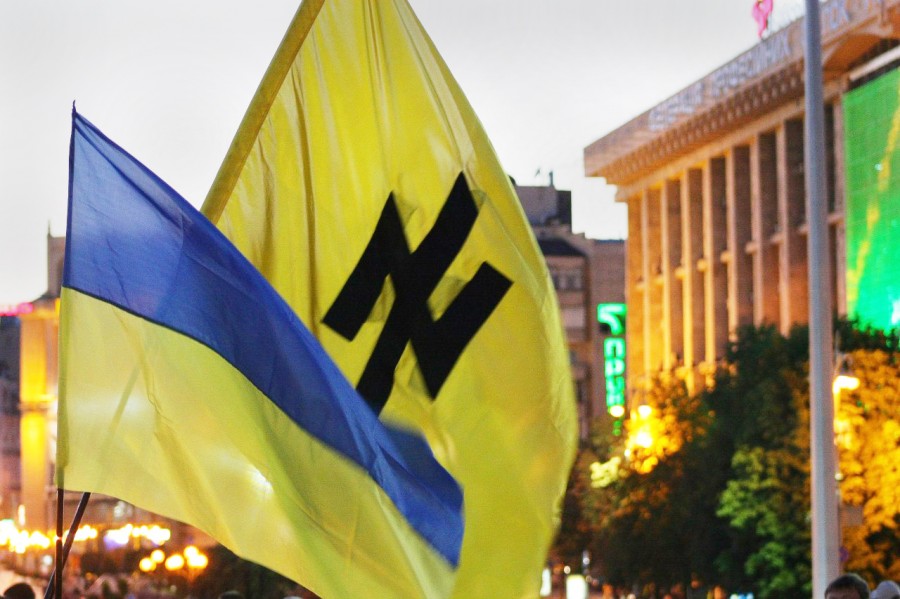
The neo-Nazi Wolfsangel symbol on a banner in Ukraine.


In this time period, Ukraine had two Russian-oriented leaders who were elected in 1991 and 1994, Leonid Kravchuk, and Leonid Kuchma. But the hasty transition to a “free-market” economy didn’t go well for most Ukrainians or Russians as well-connected oligarchs seized much of the wealth and came to dominate the political process through massive corruption and purchase of news media outlets. However, for average citizens, living standards went down drastically, opening the door for the far-right parties and for foreign meddling.


In 2004, Viktor Yanukovych, whose political base was strongest among ethnic Russians in the east and south, won the presidential election by three percentage points over the U.S.-favored Viktor Yushchenko, whose base was mostly in the country’s west where the Ukrainian nationalists are strongest.


Immediately, Yushchenko’s backers claimed fraud citing exit polls that had been organized by a group of eight Western nations and four non-governmental organizations or NGOs, including the Renaissance Foundation founded by billionaire financial speculator George Soros. Dick Morris, former President Bill Clinton’s political adviser, clandestinely met with Yushchenko’s team and advised them that the exit polls would not just help in accusations of fraud, but would bring protesters out into the streets. (Cambridge Review of International Affairs, Vol. 19, Number 1, p. 26)


Freedom House, another prominent NGO that receives substantial financing from the U.S.-government-funded National Endowment for Democracy (NED), provided training to young activists who then rallied protesters in what became known as the Orange Revolution, one of the so-called “color revolutions” that the West’s mainstream media fell in love with. It forced an election rerun that Yushchenko won.


But Yushchenko’s presidency failed to do much to improve the lot of the Ukrainian people and he grew increasingly unpopular. In 2010, Yushchenko failed to make it out of the first round of balloting and his rival Yanukovych was elected president in balloting that outside observers judged free and fair.


Big-Power Games


If this all had occurred due to indigenous factors within Ukraine, it could have been glossed over as a young nation going through some painful growing pains. But as the film points out, this was not the case. Ukraine continued to be a pawn in big-power games with many Western officials hoping to draw the country away from Russian influence and into the orbit of NATO and the European Union.


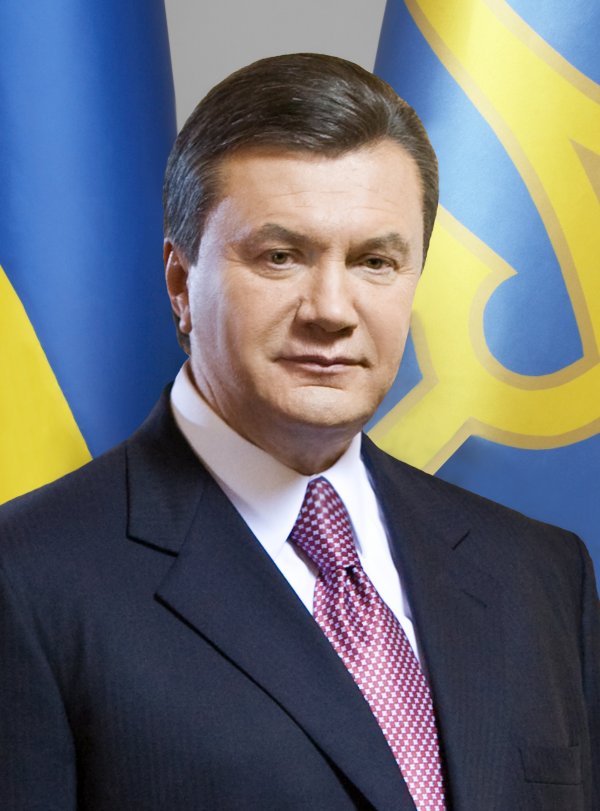
Ousted Ukrainian President Viktor Yanukovych.


In one of the interviews in Ukraine on Fire, journalist and author Robert Parry explains how the National Endowment for Democracy and many subsidized political NGOs emerged in the 1980s to replace or supplement what the CIA had traditionally done in terms of influencing the direction of targeted countries.


During the investigations of the Church Committee in the 1970s, the CIA’s “political action” apparatus for removing foreign leaders was exposed. So, to disguise these efforts, CIA Director William Casey, Reagan’s White House and allies in Congress created the NED to finance an array of political and media NGOs.


As Parry noted in the documentary, many traditional NGOs do valuable work in helping impoverished and developing countries, but this activist/propaganda breed of NGOs promoted U.S. geopolitical objectives abroad – and NED funded scores of such projects inside Ukraine in the run-up to the 2014 crisis.


Ukraine on Fire goes into high gear when it chronicles the events that occurred in 2014, resulting in the violent overthrow of President Yanukovych and sparking the civil war that still rages. In the 2010 election, when Yushchenko couldn’t even tally in the double-digits, Yanukovych faced off against and defeated Yulia Tymoshenko, a wealthy oligarch who had served as Yushchenko’s prime minister.


After his election, Yanukovych repealed Bandera’s title as a national hero. However, because of festering economic problems, the new president began to search for an economic partner who could provide a large loan. He first negotiated with the European Union, but these negotiations bogged down due to the usual draconian demands made by the International Monetary Fund.


So, in November 2013, Yanukovych began to negotiate with Russian President Putin who offered more generous terms. But Yanukovych’s decision to delay the association agreement with the E.U. provoked street protests in Kiev especially from the people of western Ukraine.


As Ukraine on Fire points out, other unusual occurrences also occurred, including the emergence of three new TV channels – Spilno TV, Espreso TV, and Hromadske TV – going on the air between Nov. 21 and 24, with partial funding from the U.S. Embassy and George Soros.


Nazi symbols on helmets worn by members of Ukraine’s Azov battalion. (As filmed by a Norwegian film crew and shown on German TV)


Pro-E.U. protests in the Maidan square in central Kiev also grew more violent as ultra-nationalist street fighters from Lviv and other western areas began to pour in and engage in provocations, many of which were sponsored by Yarosh’s Right Sektor. The attacks escalated from torch marches similar to Nazi days to hurling Molotov cocktails at police to driving large tractors into police lines – all visually depicted in the film. As Yanukovich tells Stone, when this escalation happened, it made it impossible for him to negotiate with the Maidan crowd.


One of the film’s most interesting interviews is with Vitaliy Zakharchenko, who was Minister of the Interior at the time responsible for law enforcement and the conduct of the police. He traces the escalation of the attacks from Nov. 24 to 30, culminating with a clash between police and protesters over the transport of a giant Christmas tree into the Maidan. Zakharchenko said he now believes this confrontation was secretly approved by Serhiy Lyovochkin, a close friend of U.S. Ambassador Geoffrey Pyatt, as a pretext to escalate the violence.


At this point, the film addresses the direct involvement of U.S. politicians and diplomats. Throughout the crisis, American politicians visited Maidan, as both Republicans and Democrats, such as Senators John McCain, R-Arizona, and Chris Murphy, D-Connecticut. stirred up the crowds. Yanukovych also said he was in phone contact with Vice President Joe Biden, who he claims was misleading him about how to handle the crisis.


The film points out that the real center of American influence in the Kiev demonstrations was with Ambassador Pyatt and Assistant Secretary of State for European Affairs Victoria Nuland. As Parry points out, although Nuland was serving under President Obama, her allegiances were really with the neoconservative movement, most associated with the Republican Party.


Her husband is Robert Kagan, who worked as a State Department propagandist on the Central American wars in the 1980s and was the co-founder of the Project for the New American Century in the 1990s, the group that organized political and media pressure for the U.S. invasion of Iraq in 2003. Kagan also was McCain’s foreign policy adviser in the 2008 presidential election (although he threw his support behind Hillary Clinton in the 2016 race).


Adept Manipulators


As Parry explained, the neoconservatives have become quite adept at disguising their true aims and have powerful allies in the mainstream press. This combination has allowed them to push the foreign policy debate to such extremes that, when anyone objects, they can be branded a Putin or Yanukovych “apologist.”


Assistant Secretary of State for European and Eurasian Affairs Victoria Nuland during a press conference at the U.S. Embassy in Kiev, Ukraine, on Feb. 7, 2014. (U.S. State Department photo)


Thus, Pyatt’s frequent meetings with the demonstrators in the embassy and Nuland’s handing out cookies to protesters in the Maidan were not criticized as American interference in a sovereign state, but were praised as “promoting democracy” abroad. However, as the Maidan crisis escalated, Ukrainian ultra-nationalists moved to the front, intensifying their attacks on police. Many of these extremists were disciples of Bandera and Lebed. By February 2014, they were armed with shotguns and rapid-fire handguns.


On Feb. 20, 2014, a mysterious sniper, apparently firing from a building controlled by the Right Sektor, shot both police and protesters, touching off a day of violence that left about 14 police and some 70 protesters dead.


With Kiev slipping out of control, Yanukovich was forced to negotiate with representatives from France, Poland and Germany. On Feb. 21, he agreed to schedule early elections and to accept reduced powers. At the urging of Vice President Biden, Yanukovych also pulled back the police.


But the agreement – though guaranteed by the European nations – was quickly negated by renewed attacks from the Right Sektor and its street fighters who seized government buildings. Russian intelligence services got word that an assassination plot was in the works against Yanukovych, who fled for his life.


On Feb. 24, Yanukovych asked permission to enter Russia for his safety and the Ukrainian parliament (or Rada), effectively under the control of the armed extremists, voted to remove Yanukovych from office in an unconstitutional manner because the courts were not involved and the vote to impeach him did not reach the mandatory threshold. Despite these irregularities, the U.S. and its European allies quickly recognized the new government as “legitimate.”


Calling a Coup a Coup


But the ouster of Yanukovych had all the earmarks of a coup. An intercepted phone call, apparently in early February, between Nuland and Pyatt revealed that they were directly involved in displacing Yanukovych and choosing his successor. The pair reviewed the field of candidates with Nuland favoring Arseniy Yatsenyuk, declaring “Yats is the guy” and discussing with Pyatt how to “glue this thing.” Pyatt wondered about how to “midwife this thing.” They sounded like Gilded Age millionaires in New York deciding who should become the next U.S. president. On Feb. 27, Yatsenyuk became Prime Minister of Ukraine.


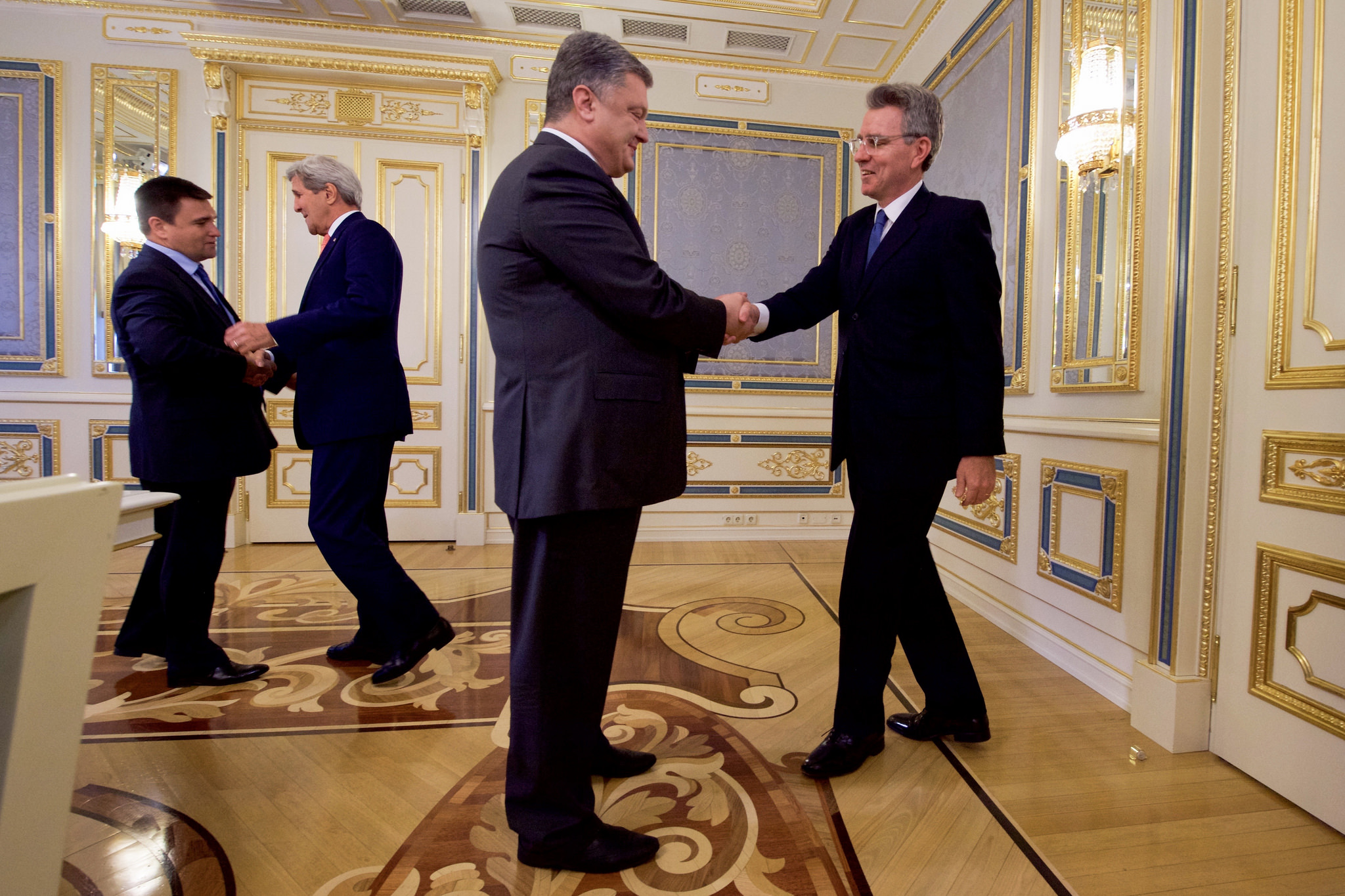
Ukrainian President Petro Poroshenko shakes hands with U.S. Ambassador to Ukraine Geoffrey Pyatt as U.S. Secretary of State John Kerry shakes hands with Ukrainian Foreign Minister Pavlo Klimkin in Kyiv, Ukraine, on July 7, 2016. [State Department Photo]


Not everyone in Ukraine agreed with the new regime, however. Crimea, which had voted heavily for Yanukovych, decided to hold a referendum on whether to split from Ukraine and become a part of Russia. The results of the referendum were overwhelming. Some 96 percent of Crimeans voted to unite with Russia. Russian troops – previously stationed in Crimea under the Sevastopol naval base agreement – provided security against Right Sektor and other Ukrainian forces moving against the Crimean secession, but there was no evidence of Russian troops intimidating voters or controlling the elections. The Russian government then accepted the reunification with Crimea, which had historically been part of Russia dating back hundreds of years.

Two eastern provinces, Donetsk and Lugansk, also wanted to split off from Ukraine and also conducted a referendum in support of that move. But Putin would not agree to the request from the two provinces, which instead declared their own independence, a move that the new government in Kiev denounced as illegal. The Kiev regime also deemed the insurgents “terrorists” and launched an “anti-terrorism operation” to crush the resistance. Ultra-nationalist and even neo-Nazi militias, such as the Azov Battalion, took the lead in the bloody fighting.


Anti-coup demonstrations also broke out in the city of Odessa to the south. Ukrainian nationalist leader Andrei Parubiy went to Odessa, and two days later, on May 2, 2014, his street fighters attacked the demonstrators, driving them into the Trade Union building, which was then set on fire. Forty-two people were killed, some of whom jumped to their deaths.


‘Other Side of the Story’


If the film just got across this “other side of the story,” it would provide a valuable contribution since most of this information has been ignored or distorted by the West’s mainstream media, which simply blames the Ukraine crisis on Vladimir Putin. But in addition to the fine work by scenarist Vanessa Dean, the direction by Igor Lopatonok and the editing by Alexis Chavez are extraordinarily skillful and supple.


Screen shot of the fatal fire in Odessa, Ukraine, on May 2, 2014. (From RT video)


The 15-minute prologue, where the information about the Nazi collaboration by Bandera and Lebed is introduced, is an exceptional piece of filmmaking. It moves at a quick pace, utilizing rapid cutting and also split screens to depict photographs and statistics simultaneously. Lopatonok also uses interactive graphics throughout to transmit information in a visual and demonstrative manner.


Stone’s interviews with Putin and Yanukovych are also quite newsworthy, presenting a side of these demonized foreign leaders that has been absent in the propagandistic Western media.


Though about two hours long, the picture has a headlong tempo to it. If anything, it needed to slow down at points since such a large amount of information is being communicated. On the other hand, it’s a pleasure to watch a documentary that is so intelligently written, and yet so remarkably well made.


When the film ends, the enduring message is similar to those posed by the American interventions in Vietnam and Iraq. How could the State Department know so little about what it was about to unleash, given Ukraine’s deep historical divisions and the risk of an escalating conflict with nuclear-armed Russia?


In Vietnam, Americans knew little about the country’s decades-long struggle of the peasantry to be free from French and Japanese colonialism. Somehow, America was going to win their hearts and minds and create a Western-style “democracy” when many Vietnamese simply saw the extension of foreign imperialism.


In Iraq, President George W. Bush and his coterie of neocons was going to oust Saddam Hussein and create a Western-style democracy in the Middle East, except that Bush didn’t know the difference between Sunni and Shiite Moslems and how Iraq was likely to split over sectarian rivalries and screw up his expectations.


Similarly, the message of Ukraine on Fire is that short-sighted, ambitious and ideological officials – unchecked by their superiors – created something even worse than what existed. While high-level corruption persists today in Ukraine and may be even worse than before, the conditions of average Ukrainians have deteriorated.


And, the Ukraine conflict has reignited the Cold War by moving Western geopolitical forces onto Russia’s most sensitive frontier, which, as scholar Joshua Shifrinson has noted, violates a pledge made by Secretary of State James Baker in February 1990 as the Soviet Union peacefully accepted the collapse of its military influence in East Germany and eastern Europe. (Los Angeles Times, 5/30/ 2016)


This film also reminds us that what happened in Ukraine was a bipartisan effort. It was begun under George W. Bush and completed under Barack Obama. As Oliver Stone noted in the discussion that followed the film’s premiere in Los Angeles, the U.S. painfully needs some new leadership reminiscent of Franklin Roosevelt and John Kennedy, people who understand how America’s geopolitical ambitions must be tempered by on-the-ground realities and the broader needs of humanity to be freed from the dangers of all-out war.


James DiEugenio is a researcher and writer on the assassination of President John F. Kennedy and other mysteries of that era. His most recent book is Reclaiming Parkland.

Declassified: How America Planned to Invade Italy, To Save It from Russia

US jet

As accusations fly that Russia manipulated the 2016 American election to put Donald Trump in the White House, some Americans are remembering that the United States also fiddled with elections in numerous nations during the Cold War, including Chile, Iran and Central America.


One of the most notorious examples is Italy, where the CIA mounted an aggressive—and successful—campaign to limit Communist success in the 1948 election, including handing bags of money to conservative Italian political parties (a tradition hardly unknown in American politics). From 1948 to 1968, the CIA gave more than $65 million to Italian parties and labor unions.


But instead of cash, the United States could have sent in the Marines to give Italy the government that America thought it deserved. As late as 1960, America was still contemplating using military force if the Communists took power. Of course, the United States would always have responded militarily if the Soviet Army invaded Italy during the Cold War. But note the difference: American intervention would have been prompted not by Soviet tanks, but rather if the Communists took power through a coup—or by winning an election.


The details have emerged in a newly declassified Pentagon study released by the private watchdog organization, the National Security Archive.


In 1954, the Joint Chiefs of Staff urged that if a Communist government took power in Italy, “the United States, preferably in concert with its principal Allies, should be prepared to take the strongest possible action to prevent such an eventuality, such action possibly extending to the use of military power.”


That position didn’t suit President Dwight Eisenhower, whose World War II experiences as Supreme Allied Commander in Europe made him smarter than most about how to keep an alliance like NATO together. Eisenhower warned that he “could not imagine anything worse than the unilateral use by the United States of its forces to overthrow a Communist regime. This simply could not be done except in concert with our allies.”


Nonetheless, the National Security Council approved a paper that stated: “In the event the Communists achieve control of the Italian government by apparently legal means, the United States, in concert with its principal NATO allies, should take appropriate action, possibly extending to the use of military power, to assist Italian elements seeking to overthrow the Communist regime in Italy.”


Note the words “apparently legal means.” Perhaps the attitude among American leaders during the Cold War was that “Communist government” and “legal” were oxymorons, and that no Communist government could have genuine legitimacy (which had certainly been the case of the Eastern European regimes that rode into office on the backs of Soviet tanks in 1945). Nonetheless, the U.S. Sixth Fleet would have performed the ultimate act of electoral nullification, by using force against a Communist Party that—as did happen in the 1940s and 1950s—enjoyed strong popular support.


Even as late as August 1960, just months before John F. Kennedy took office, an NSC paper proposed that regardless of whether the Communists took power in Italy by illegal or legal means, the United States should be prepared to use military force—unilaterally if need be—to “assist whatever Italian elements are seeking to prevent or overthrow Communist domination.” This was fifteen years after the chaos and devastation of World War II. While Italy has never been known for stable governments, in 1960 it was not still the political and economic basket case under the rule of Allied military government.


In the end, “Eisenhower and Dulles were willing to intervene militarily only if the Communists forcibly seized power and then only in concert with other European nations,” concludes the study’s author, Ronald Landa. And that was wise: as Eisenhower himself realized, U.S. tanks rolling into Rome—or supporting right-wing Italians overthrowing their own government—would have been a propaganda godsend for the godless Communists in Moscow.


All of which has nothing to do with the question of whether Russia influenced the U.S. election. Except as a reminder that political manipulation has been performed by many nations.


Michael Peck is a contributing writer for the National Interest. He can be found on Twitter and Facebook.

Crumbling California Dam Forces 188,000 to Evacuate as Threat of Major Flood Looms

california-dam oroville

Approximately 188,000 people in several impoverished towns underneath the Oroville Dam in northern California were suddenly forced to evacuate their homes Sunday afternoon amid fears that high water levels would overwhelm the structure and flood populated areas north of Sacramento. The water level appears to have subsided for the moment, but more rain is expected Wednesday that could once again put the dam at risk.


The dam was at 151 percent capacity on Saturday, triggering the use of an emergency spillway for the first time in the dam’s 48-year history on Sunday. That same day, officials gave evacuation orders for the city of Oroville and towns in surrounding Yuba, Sutter and Butte counties, which remained in effect on Monday. If the deteriorating dam breaks, a 30-foot wall of water will descend upon the towns below.


The dam is not functioning properly due to a massive hole 250 feet long and 45 feet deep in the dam’s main spillway. The risks of structural failure and of a breach at the Oroville dam have been well known for over a decade, with the government ignoring the issue and refusing to spend the relatively small amount that would be required to protect the lives of the hundreds of thousands at risk. In large part this is because the at-risk cities, including Marysville, Yuba City, Oroville, Live Oak and Wheatland, are home to mostly impoverished and working-class residents.


While weather cannot be perfectly predicted or altered, the current threat to lives and homes is entirely man-made. The condition of the dam is representative of the deteriorating infrastructure in the United States. Little to no preparations were made to protect against this well-predicted threat of catastrophe. In 1997, residents living under the Oroville dam were also forced to evacuate when water levels came within a foot of overflowing the structure.


Both the state and federal governments had been warned more than ten years ago that just such a situation involving the structural collapse of the emergency spillway could occur.


On October 17, 2005, three environmental groups—the Friends of the River, the South Yuba Citizens League, and the Sierra Club—filed a motion with the Federal Energy Regulatory Commission (FERC) to have the emergency spillway covered in concrete. These organizations warned that the dam failed to meet modern safety standards and that large amounts of rain would overwhelm the primary spillway and that the emergency structure would erode. This is precisely what happened.


Furthermore, the report stated: “A loss of crest control could not only cause additional damage to project lands and facilities but also cause damages and threaten lives in the protected floodplain downstream.” State and federal agencies ignored these concerns. FERC claimed that the emergency spillway could handle 350,000 cubic feet of water per second and that concerns were unfounded. However, on Sunday, water flowing at less than 5 percent that figure came close to realizing the environmental groups’ fears.


“We said ‘Are you really sure that running all this water over the emergency spillway won’t cause the spillway to fail?’” said Ron Stork, policy director with Friends of the River told the press on Sunday. “They tried to be as evasive as possible. It would have cost money to build a proper concrete spillway.” He added, “I’m feeling bad that we were unable to persuade DWR [the state’s Department of Water Resources] and FERC and the Army Corps to have a safer dam.”


Despite these warnings, nothing had been done during either Republican or Democratic administrations or by the Democratic-dominated legislature. The Oroville Dam was completed in 1968 and is the tallest in the United States. It sits on the Feather River, supplying water for much of the state. The state claims that the dam is still sound with the spillway inspected annually, last being repaired in 2013.


The state ordered a last-minute evacuation that would have left hundreds dead if the dam had burst this weekend.


The California Emergency Operations Center began issuing evacuation notices just four hours after giving a press conference in which the center said they expected no problems. Suddenly, the DWR warned that the spillway could fail within an hour. California governor Jerry Brown subsequently issued a state emergency order. Residents began receiving alerts via robocalls or social media and had little time to prepare. The order to leave the area was given so suddenly that traffic along evacuation routes became congested, forcing some people to abandon their cars and walk to shelter.


Rocque Merlo, an almond grower from Durham, California, described the situation many faced to the Sacramento Bee: “I have friends in Gridley (one of the affected towns). They have animals, and they have one hour to get out.” He added, “The state wasn’t being forthcoming with anybody. I don’t know why Sacramento [the state capital] didn’t start advising people earlier they might want to think about getting ready. It’s a pretty serious deal.”


The lack of communication was echoed by others affected. “I’m just shocked, pretty mad,” local resident Greg Levias told Fox News. His wife Kaysi added that she was angry that officials had “not given us more warning.”


Many of the evacuees took shelter in Chico, a city located just north of Oroville, where cots were set up at the local Silver Dollar Fairgrounds. Isaac Loseth, 18, told the Los Angeles Times that the atmosphere there was “hectic” and “uptight,” with fears persisting that the coming rain this week would exacerbate the situation with the dam. Doris O’Kelley, 84, fled with her husband, William, who complained, “I’d like to see them be a little more plain about what’s going on.”


The potential for a catastrophe in northern California calls to mind the horrific events of Hurricane Katrina in 2005. Like then, the government has ignored well-founded warnings of danger caused by a lack of infrastructure spending and sprung a last-minute plan to evacuate the 188,000 people, many of whom would have drowned stuck in traffic had the dam actually burst.


According to the American Society of Civil Engineers, 15,500 of the country’s 84,000 dams are “high-hazard” and death could result from dam failure. Remarkably, one third of high-hazard dams lack an emergency action plan to help protect residents from flood-related disaster. The average age of dams in the US is 52 years old, with 3 percent of dams built before 1900. Two thirds of dams are privately owned. The government placed security checks in place after September 11, 2001, which make it much more difficult for organizations to research dam safety and nearly impossible for residents living under dams to even find out the dam’s stability.


There is no answer to be found within capitalism and the profit system to address the deteriorating social conditions and infrastructure that are too often highlighted by natural disasters. While the area around the Oroville Dam was spared destruction on Sunday, nothing will be done to prevent a similar situation from developing in the immediate or long-distance future.

Wall Street Journal Goes With “Alternative Facts” in AIG Hank Greenberg Saga

AIG

In 2005 and 2006, Wall Street Journal reporters distinguished themselves in covering the charges of fraud being hurled at the giant insurer AIG and its CEO, Maurice (Hank) Greenberg. At that point, the Bancroft family had owned the Wall Street Journal for more than a century. But in 2007, Rupert Murdoch and his corporate entity, News Corp, bought the newspaper. The paper’s editorial page has subsequently taken bizarre positions on Wall Street’s crimes, refusing to allow the facts to get in their way.


Last evening, hitting a new low in the arena of “alternative facts,” the Wall Street Journal opined that Maurice (Hank) Greenberg, the former Chairman and CEO of the giant bailed-out insurer, AIG, had received a “vindication” by last Friday’s settlement with New York State Attorney General, Eric Schneiderman. The editorial characterized the case against Greenberg as a “revenge campaign” started by former Attorney General Eliot Spitzer for Greenberg having dared to “criticize his prosecutions against business.”


Maurice (Hank) Greenberg

Maurice (Hank) Greenberg


Reading the actual documents that New York State Attorney General Schneiderman released, the Wall Street Journal appeared to have stepped into a serious case of brain fog. Schneiderman’s statement included the following headlines:


Greenberg And [Howard] Smith [former AIG CFO] Agree To Return Multi-Million Dollar Bonuses They Received While The Frauds Were On AIG’s Books;


When Combined With Previous SEC Settlement, Greenberg Will Have Disgorged Nearly Every Dollar In Bonuses He Received During The Period Of The Fraud.


Read complete article

Smart Utility Meter “Opt Out Bills” Opt to Protect Consumer Rights?

Smartmeter-radiation-2

Note: The compilation of state smart meter opt out bills listed below does not constitute endorsement of the bills. In some cases, the bills do not provide protection from surcharges for opting out; in some cases, they allow for the installation of a different kind of transmitting meter that is linked with adverse health effects.


In many states, AMR meters have already been rolled out and are transmitting 24/7 without the knowledge and consent of residents who are not aware of their increased RF exposures, and the bills only address the future installation of smart meters. States rolling out new AMR meters are claiming that the meters are not smart, misleading citizens. An analog meter with no radio transmitter would be required to address both the privacy and health complaints.


Legislators in several states have filed bills giving customers the right to opt out of wireless smart utility meters, emphasizing privacy and customer choice.


Maine’s Senator Dave Miramant  (D) introduced LD 229, “An Act To Prohibit an Electric Utility from Charging a Customer for Using an Electromechanical Meter” with 8 co-sponsors. The bill goes before the legislature’s Energy, Utilities, & Technology Committee in February.


Missouri Rep. Tim Remole (R- Excello) prefiled House Bill 196 (HB196), which would require utilities regulated by the Public Service Commission to allow customers to choose between smart meters and traditional meters, and would prohibit utilities from disincentivizing traditional meter usage.


New York Asm. Michael DenDekker (D – East Elmhurst) introduced Assembly Bill 3066 (A3066) to allow New Yorkers to opt out of any utility company smart meter program with no penalty.


Oklahoma Rep. Scott McEachin (R) prefiled House Bill 1435 (HB1435) for the 2017 legislative session to give residential and business utility customers the right to refuse installation of smart meters.


In Michigan, according to WILX news, “Michigan lawmaker Representative Gary Glenn (R-Midland) filed a bill to waive opt out fees. The legislation would also allow home owners to self-read their meter by just taking a picture of it and sending it in. The utility could check the meter quarterly to confirm they’re not being misled.” Rep. Glenn told News10 WILX the choice should be up to the home owner. “As long as those utilities are a state privilege monopoly given the right exclusively to deliver electricity, then we are going to protect homeowners from that kind of monopoly policy,” said Rep. Glenn. “Trying to force certain technology on homeowners against their will or if they refuse to have it installed, charge them.”  “Last year Michigan Attorney General Bill Schuette issued a legal opinion that utilities don’t have the authority to charge ‘opt-out’ fees. It was dismissed by the state Public Service Commission which oversees utilities.”


In Pennsylvania, a Commonwealth Court panel has sided with ratepayer Antonio Romeo who refused to allow PECO workers onto his property to install a smart meter. The court ruled that he has the right to provide evidence that the meters are dangerous because they can catch fire.


Utility companies have leveraged support for wireless smart utility meters claiming that they are necessary to integrate renewables into the grid, that they will reduce costs, and that they will “give customers more control over their energy usage. ”


Many lawmakers and constituents have become increasingly concerned about privacy juxtaposed with the emerging surveillance capabilities of the smart grid. Opposition to AMR and smart meters has also centered around green-washing, cost, hack-ability, fires, lack of informed consent and customer choice, environmental impacts, and documented adverse health effects.


The smart meter narrative has lacked transparency regarding:


  • punitive pricing structures

  • the consumption of energy required to power the wireless networks themselves

  • the consumption of energy used for data storage

  • the raw materials required for the electronics

  • the planned obsolescence of the meters

  • lack of disclosure of installation of chips in appliances to enable communication with the grid

  • safety issues including fires

  • health damage to a portion of the population

After installing smart meters, some states have limited solar installations, reduced the compensation formula for solar producers, and attempted to surcharge solar producers for their use of the grid, casting a pall on the green energy story. Policy has favored industrial-scale solar and wind and the need for transmission lines to transmit power over long distances, rather than smaller-scale local strategies. Federal research has emphasized costly large-scale storage rather than small-scale local and less infrastructure-intensive alternatives.


FCC guidelines for RF exposure have been characterized as being 30 years out of date by the Dept. of the Interior. No premarket safety testing for chronic or cumulative exposure to the pulse modulated frequencies was conducted, and no independent health or environmental monitoring has been done.


http://ehtrust.org/memorandum-bird-wildlife-impacts-non-ionizing-radiation-albert-m-manville-ph-d-former-u-s-fish-wildlife-service-senior-biologist/


https://www.nap.edu/catalog/12036/identification-of-research-needs-relating-to-potential-biological-or-adverse-health-effects-of-wireless-communication-devices


Massachusetts Senator Michael O. Moore introduced Bill SD344: An Act relative to utilities, smart meters, and ratepayers’ rights, with 8 co-sponsors. The bill would allow ratepayers the choice of a non-transmitting analogue meter at no charge. SD344 prohibits utilities from discriminating against medically vulnerable residents whose condition may be exacerbated by exposure to pulsed microwave radio frequencies.  In addition to reported aggravation of pre-existing health conditions, the acute onset of electromagnetic hypersensitivity has been associated with smart meter installation.


https://skyvisionsolutions.files.wordpress.com/2013/11/aaem-wireless-smart-meter-case-studies.pdf


https://skyvisionsolutions.files.wordpress.com/2015/07/aaem-july-2012-recommendations.pdf


Senator Moore’s Worcester district is the site of the controversial National Grid smart meter pilot program, which is behind schedule and over budget and has been widely criticized as an example of “decision based evidence making” and a manipulation of the process of community consent.


http://170.63.40.34/DPU/FileRoomAPI/api/Attachments/Get/?path=16-28%2fBurke_testimony_62316.pdf


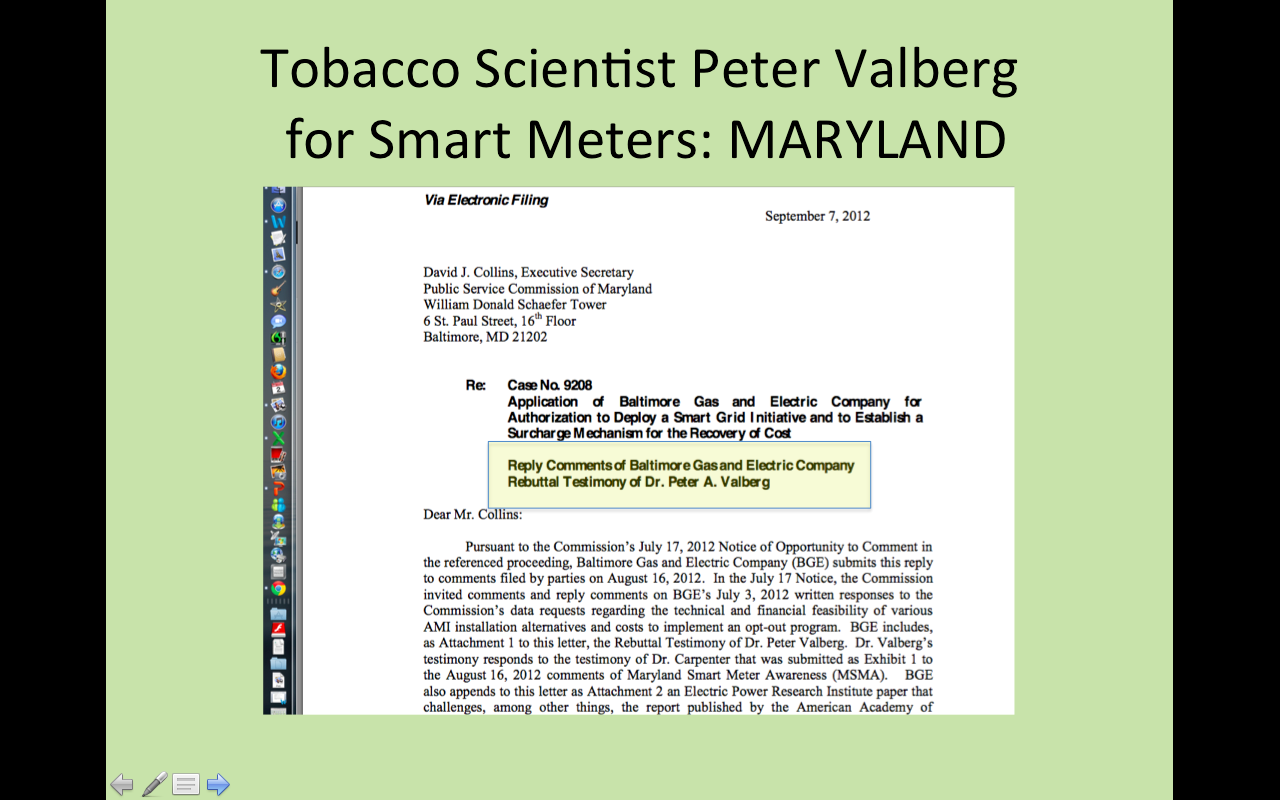
Scientists from the product defense firms Exponent and Gradient, which have their roots in the tobacco industry, provided expert health and safety testimony for smart meters to many U.S. state utility regulators.


Peter Valberg of Gradient, who testified in Massachusetts, Maryland, and Michigan, also testified for Phillips Lights cigarettes the same week he spoke before the Massachusetts Dept. of Public Utilities to override citizen health complaints.


http://business.cch.com/plsd/PhillipsvPhilipMorris.pdf


The Center for Public Integrity published a series entitled “Science for Sale” in Feb. 2016. The Center reported that Gradient, where Peter Valberg works, publishes high volume tainted science defending harmful products. The series reported how Peter Valberg discounted the significance of 22 brain tumor deaths at a chemical plant. It was the largest occupational brain cancer cluster ever reported.  The Center for Public Integrity also reported that Valberg blamed illness caused by asbestos exposure on cigarettes. The lawyer he was working with was fired from his law firm due to the outrageous plan.


Regarding the science that underlies claims of smart meter safety, MA grassroots opposition group Halt MA Smart Meters notes,


Massachusetts possesses a wealth of resources in the areas of science, health care, technology, and green energy.


It seems incomprehensible that the Dept. of Public Utilities and the legislature could even consider allowing National Grid to charge its 1.3M ratepayers $800M to $1B for a grid modernization program whose safety claims are based solely on the testimony of a mercenary liar.


In 2012, the Telecom Utilities Council quoted inaccurate safety claims by career tobacco science firms to the National Council of State Legislators. These unsubstantiated claims should be confronted and discounted entirely.


http://www.ncsl.org/documents/energy/Oldak_PPT.pdf


At some point, citizens have to question why so many decision makers continue to ignore mounting evidence of corruption, juxtaposed with mounting evidence of harm. Radio frequencies are causing damage, and human physiology and nature do not lie. We are not against technology; we are against the reckless deployment of untested and unsafe surveillance technology justified under the guise of sustainability that has already resulted in harm to a portion of the population.


We are up against the manipulation of the core values of environmentalists who are inadvertently supporting unsustainable economic growth, and the unchecked consumption of resources for a dual use technology representative of a nation that has turned on its own citizens. The wireless explosion is not green, it is unsustainable, ecologically damaging, sourced in the warfare industry, and unethical.


Massachusetts grid modernization hearings are underway through May, with Attorney General Maura Healy’s office representing ratepayers.


Patricia Burke works with activists across the country and internationally calling for new biologically-based microwave radio frequency exposure limits. She is based in Massachusetts and can be reached at [email protected].