Showing posts with label Critical theory. Show all posts

Thursday, July 6, 2017

Professor Teaches Students About "The Problem That Is Whiteness"

Authored by Nathan Rubbelke via TheCollegeFix.com,


Serious explorations into race should focus on the problem of whiteness and be grounded in the claim that it’s a hegemonic “power apparatus,” a Fairfield University professor suggested at a recent conference aimed at pushing “radical social change” in higher education.


The remarks from associate professor of philosophy Dr. Kris Sealey, who spoke about her strategies for discussing race in the classroom, were presented at a diversity conference for employees of Jesuit colleges.


“So more and more, the courses that I teach on race have become courses in which I expect my students to engage in the hegemonic power of whiteness,” said Sealey, who’s taught courses such as “Black Lives Matter” and “Critical Race Theory.”


Sealey, a scholar of color, said her approach toward teaching race has much to do with teaching at Fairfield University, a predominately white institution, and requires difficult conversations that force students to reevaluate how they understand themselves.


“Hence, part of what makes pedagogies of racial justice particularly difficult are the stakes that they invariably include for all parties involved,” she said.


Sealey’s comments were based in the book “Black Bodies, White Gazes: The Continuing Significance of Race” by Emory University philosopher George Yancy.


Discussing Yancy’s work, the professor said she’s moved by his premise that “any inquiry into the experience of blackness must include some genealogy or some history of the white gaze.”


Taking the thesis seriously, Sealey said, means “to acknowledge that any critical investigation of race should devote some time to the problem that is whiteness.”


While saying there’s no single strategy on discussing race that works best for all students, Sealey touted what she called the “proven advantages” of her approach. Those advantages, she said, establish “objectively grounded claims” that she listed as the following:


Whiteness means a specific power apparatus that exists at the expense of the disempowerment of black people.


To be white in the U.S. is to be a perpetuator of the power apparatus unless one actively and consistently resists.


It is possible, perhaps necessary, to acknowledge one’s personal implications in the white power apparatus.


Sealey said it’s helpful for her students to see that their time in the classroom isn’t about existential conversion or evaluation of one’s character, but rather “the goal is to understand the role of the white gaze in the confiscation of the black body.”


In a 2013 op-ed published by The New York Times, Yancy described the white gaze as “hegemonic” and wrote that it includes “poisonous assumptions and bodily perceptual practices.” Recalling an experience he had with a white police officer in the late 1970s, he said the white gaze includes seeing “the black male body as different, deviant, ersatz.”


Drawing on Yancy’s work and speaking in philosophical terms, Sealey said she frames her class toward the concept of “un-suturing” — an idea she described as opening one’s self to what is other.


Expanding on the concept, Sealey said that “if to suture is to keep closed,” then to un-suture means being able to be influenced by sensibilities or attitudes that run counter to one’s worldview.


Sealey said Yancy applied this approach to suggest when white people engage in un-suturing, there’s an “undoing of a white-centric universe.”

Wednesday, June 28, 2017

Proximity Is Destiny In America's Pay-To-Play Democracy

Authored by Charles Hugh Smith via OfTwoMinds blog,


Privilege is unearned proximity to power in all its manifestations.


My friend G.F.B. recently coined an insightful maxim: Proximity Is Destiny. The power of this concept lies in its unification of physical proximity and abstract proximity.


We all understand physical proximity can be consequential. As the Titanic settled lower in the ice-cold Atlantic, those close enough to the lifeboats to secure a seat (mostly the first and second class passengers) lived and those who were not died.


College graduates seek internships at the most successful companies because they know the connections they make by working within the headquarters might lead to a job offer: physical proximity to movers and shakers (and those with the power to hire) is destiny.


But proximity to abstract manifestations of power is even more consequential in an economy/society in which wealth and power are predominantly abstract. For example, getting an internship in the Federal Reserve doesn"t mean you can obtain proximity to the Fed"s money/credit spigot as a result of your physical proximity to the building or staff: the really powerful proximity--being close to the Fed"s money/credit spigot--is entirely abstract.


Abstract proximity is structural, and often invisible. We can"t discern an individual"s proximity to money/ credit/ privileged-information spigots by their physical locale or appearance, though we may infer their income/wealth from various status signifiers.


But signifiers don"t tell us much about abstract proximity. Two individuals may own the same status signifiers, but one earned them the hard way, and the other had the advantage of proximity to insider information.


Privilege is much in the news recently, and I wrote a short book exploring the nature of privilege: Inequality and the Collapse of Privilege. The point of the book is this: privilege requires a centralized power hierarchy, as only a centralized power hierarchy can impose or nurture privilege, often through informal power structures.


Privilege is unearned proximity to power in all its manifestations: in our world of abstract structures of power, privilege often appears informal, masking its structural nature.


This informality enables a useful (to the privileged) confusion of privilege and merit. Two individuals may appear to enjoy similar status--both own homes in upscale neighborhoods, drive luxury vehicles, vacation in exotic locales, own second homes, belong to churches, temples, clubs, charitable organizations, etc. well-stocked with wealthy, influential people, etc., but the sources of their status are very different.


One was handed all this by family connections and inherited wealth, while the other worked his/her way up from humble beginnings. The individual who managed to work his/her way up the social-mobility ladder needed proximity to opportunity, and might have been helped by mentors and plain old luck, but privilege played a relatively modest role in the journey, as millions of other people with similar social status had roughly similar proximity to opportunity.


This inherent difficulty in differentiating privilege from merit allows the privileged Elites to claim their advantageous position is all due to merit: I worked harder than the other guy, etc., when in fact it was proximity to abstract privilege and power that lofted them to the top of the pyramid.


The Power Elites always have need for hard-working, smart, honest strivers to serve their enterprises and institutions, and so they recruit non-privileged strivers to their inner circles: prep schools, elite universities, prestigious organizations, the "right" church, temple, etc., internships in higher management, scholarships, foreign postings that serve to quickly advance careers, and so on.


This proximity is very close to what they offer their own offspring. But there"s a difference, of course; their offspring can be dull-witted and lazy, and they will still get access to all these advantages.


And there is another unstated difference: the merely merit-based striver will not be invited to private gatherings, nor encouraged to find a mate in the Elite class.


Proximity is destiny, and it"s proximity to abstract but very real structures of privilege, power and capital that count.


As I detailed yesterday, proximity to the flow of cheap credit creates fortunes, fortunes that aren"t earned via merit, innovation, genius or the creation of new goods and services; proximity to cheap credit is the core dynamic of rentier skims based on the acquisition of income-producing assets.


With sufficient income and capital, you also gain proximity to the machinery of governance--our pay-to-play "democracy" in which influence can be bought to benefit the few at the expense of the many.


Proximity is destiny. To understand this, we must first illuminate the abstract structures that enable proximity to the abstract but oh-so-real levers of privilege, power, wealth and influence.

Wednesday, June 7, 2017

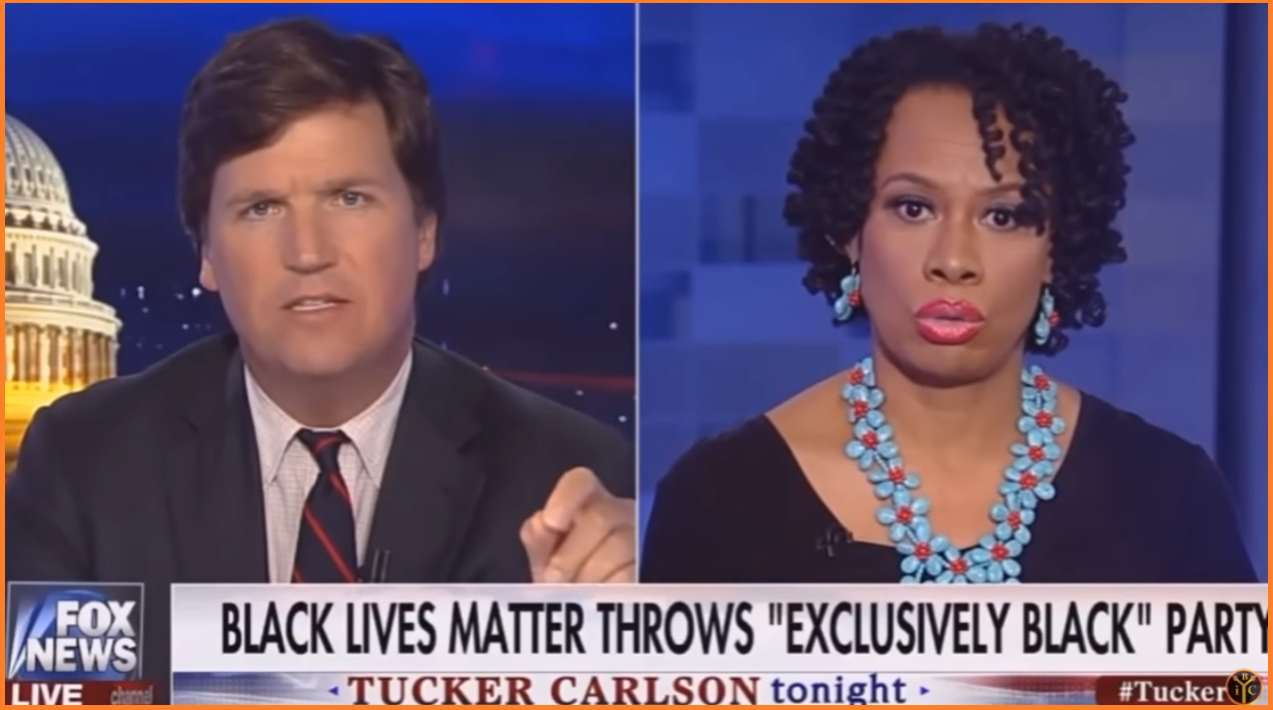
Tucker Carlson Debates BLM Supporter Over Segregated Blacks-Only Event

Tucker Carlson debated a horribly racist Black Lives Matter supporter last night - compelling his guest to distance herself from the group by the end of the interview...


Last weekend, a New York City BLM group decided to throw an "Exclusively Black" Memorial Day party creating what they called an "Exclusively Black Space."


Being intentional about being around Black People is an act of resistance. This is an exclusively Black Space... -NY BLM Group


Sorry guys...


In response to the event, Fox"s Tucker Carlson hosted an ardent BLM supporter, who defended the segregated event with a series of regressive analogies and outdated race-based identity politics (scroll down for the video).


Tucker: I was confused by this because I thought the whole point of BLM - one of the points would be to speak out against singling people out on the basis of their race and punishing them for that. Because you can"t control what your race is, and yet they seem to be doing that. Explain that to me?


#1 - White Privilege


Lisa: What I say to that is BOO HOO HOO... You white people are angry because you couldn"t use your White Privilege card to get invited to the Black Lives Matters all black memorial day celebration!


Tucker: Well, hold on... [she does not]


#2 - Memorial Day was created by former slaves


Lisa: Memorial day was created by black former slaves in 1865 to honor those individuals who were union soldiers who fought and died for our  freedoms. So Black Lives Matter in that same vein decided to get together with Black folks to make sure that Black folks are celebrated for being murdered by racist terrorists. If you"re mad at that, you just.... [mic cut]


Tucker: I"m not mad at that - I just have a really simple question for you. If you don"t like people excluding others on the basis of their race. And as a society, we agree that"s bad - why are you defending that?


#3 - Every day is "White Day"


Lisa: White folks crack me up... all of the sudden when "we" want one day for black folks to focus on ourselves - but you"ve been having White Day forever!


#4 - Hollywood is racist


Lisa: You"ve had an all white Oscars, all these movies with all white actors - movie after movie after movie, all white TV shows with white casts over and over and over again.


Tucker: I hope you"re not speaking for anyone else. What you"re saying is SO hostile and separatist and crazy. It"s such a basic violation of what I thought we all agree on - which is that you don"t attack people for things you don"t control - namely their race.


#5 - White people are like unruly children at a wedding


Lisa: People give weddings where they exclude children. It doesn"t mean they don"t like children - they don"t know if your kids are gonna be monsters... So in that same vein, black lives matter decided to have one day where they didn"t want white folks that were gonna be off the rails. They don"t know if you"re gonna be behaved.


"Stay your asses out! We wanna celebrate today. We don"t want anybody going against us today."


Tucker: And you can"t celebrate if someone that doesn"t look like you is around? You"re demented, actually. You"re sick. And what you"re saying is disgusting. And if you were a NAZI [Lisa: Ooooh!] I would say the same thing to you. Because what you"re saying is indistinguishable. "I don"t care your opinions, I don"t care your views - your life experience - your intentions... All I care about is the way you look," something that you can"t control. And on that basis alone I"m judging you...


I can"t believe I have to say that out loud!


#6 - America is an inherently racist society


Lisa:  Well unfortunately, when you have a racist society like America, you force individuals to come together collectively to make sure that they have a voice. And that"s unfortunate that the racism has caused people to come together collectively.


Tucker then asks Durden if there"s a single White person in America that she"d let into the event. Perhaps realizing what a total racist she"d been for the last 7 minutes, she distances herself from the BLM decision.


Lisa: Now I"m not Black Lives Matter. Black Lives Matter is a movement. However, however, however - I can respect the decision. It doesn"t mean it"s the decision I would have made. Maybe I would have. Just like a wedding where I might say your kids can"t bring their bad asses at my wedding!


Tucker: Children are not an ethnic group.


See below:


Sunday, May 14, 2017

UofA Hires "Social Justice Advocates" To Police Fellow Students For "Bias Incidents"

Submitted by Ian Miles Cheong via HeatSt.com,


Administrators at the University of Arizona are now accepting applications for “social justice advocates,” whose job it is to snitch on other students accused of bias. They’re also expected to hold educational programs about “the mosaic of diversity, multiculturalism and inclusivity” and maintain “social justice bulletin boards” in student residence halls.


The job, which officially calls (archived link) for the advocates to “report any bias incidents or claims to appropriate Residence Life staff,” pays the student workers $10 an hour. They’re expected to work 15 hours a week, which means they could be making as much as $600 a month to police their fellow students.


Part of the job description reads:


“The position also aims to increase understanding of one’s own self through critical reflection of power and privilege, identity and intersectionality, systems of socialization, cultural competency and allyship as they pertain to the acknowledgement, understanding and acceptance of differences. Finally, this position intends to increase a student staff member’s ability to openly lead conversations, discuss differences and confront diversely insensitive behavior.”


The core responsibility, however, is to report bias claims. Bias incidents, which in recent years are increasingly being policed on college campuses, can range from outright acts of racism to far more subtle “microaggressions” such as referring to someone as a “guy” or wearing dreadlocks while white.


The social justice advocate’s job will also be, according to the job posting, to foster dialogue “related to diversity, multiculturalism and social justice”. Furthermore, the advocates will be tasked with “increasing awareness of diverse identities” and are expected to “promote inclusive communities.”


Lastly, these wildcats are expected to “be punctual in all position-related functions and tasks”.


The University of Arizona is a public school, and so these positions are funded with taxpayer dollars. At least until the state legislature reads about it.

Wednesday, February 15, 2017

Democrats At Pennsylvania College Invite Students To Wear White Pins As Reminder Of Their "White Privilege"

Students at Elizabethtown College in Pennsylvania are being encouraged by the campus Democrat club to wear a white pin for a year to help them reflect on their "white privilege and the impact white privilege has on people of color."  The campaign was launched over the weekend by the Elizabethtown College Democrats, who say it aims to make students at the small and private liberal arts college in Pennsylvania more introspective about issues of race, especially in their predominantly white region of Lancaster County.


Reached by College Fix via email, the President of the Elizabethtown College Democrats said that no matter how accepting white people are it "doesn’t stop them from being part of a system based on centuries of inequality."


“Discussions about race are often perceived as being only open to people of color, but I think it is just as important for white people to partake in conversations about race,” Aileen Ida, president of the College Democrats, told The College Fix via email.


Ida said white people are continually allowing for a societal system of oppression to occur unless they work against it. The white puzzle piece pin represents racial struggles of all sorts.


“No matter how accepting someone is, that doesn’t stop them from being part of a system based on centuries of inequality,” she said, adding the campaign transcends politics.


Asked if all white students are "privileged", Ida quickly dropped some of the knowledge she"s managed to accumulate in here vast 18ish years of worldly experiences by responding with a simple, “yes”...what more is there to say really?  While conceding that she doesn’t think all whites are socioeconomically privileged, Ida, to our complete shock, declined to cite specific examples of white privilege...way to act on your convictions supported by carefully considered facts and figures, Ida.


She also clarified that it’s not just white students who can wear the pins, that students of all races should take part to start a campuswide discussion that crosses racial divides.


Yet, she notes most people of color already have to live with racism while white people don’t.


“I believe that this [inherent white privilege] can be seen in the day-to-day life of people of color versus the day-to-day life of white people,” Ida said. “Most people of color don’t have a choice but to consider how their race affects their life on a daily basis, this is not true for most white people.”


Meanwhile, a Facebook post by the "Etown College Dems" helped to shed some additional light on the effort.


The Elizabethtown College Democrats are proud to announce a campaign being launched this weekend! This project, which is slightly modified for our use, was started by a ELCA Lutheran Pastor from Wisconsin named Barb Girod. Barb made a commitment to wear a white puzzle piece pin every day for a year to force herself to think about her white privilege and the impact white privilege has on people of color. This project, along with ours, forces everybody to think about racial issues people face daily.


The project sponsored by the Elizabethtown College Democrats will follow Barb’s inspiring initiative to create the conversation greatly needed in Central Pennsylvania. Students on campus and in the community are encouraged to join our campaign to think about one thing – how race affects their life, whether directly or indirectly. Following the launch of our pin campaign, a sister campaign will be launched where students have the opportunity to anonymously tell personal stories about how race affects their everyday lives.


There will be a kick-off at the Mosaic House (346 E. Orange Street, Elizabethtown, PA) Sat., Feb. 11 at 7 p.m. where the project will be explained in full and guest speakers will present on the topic of racial privilege and the importance of such a conversation. There will be food and drinks! This event is free and open to the public.


And, our parting thoughts...


Full Retard

Sunday, February 5, 2017

American Contractor in Iraq Weighs in on Banned Countries Order, Sharing Perspective of Local Iraqis

Whether you supported the Middle East wars or not, the aftermath of more than a decade of war in that region has taken their anti-Americanism to a new level of hatred. An American contractor on the ground in Iraq, Steve Gern, offered his point of view -- gently trying to redpill those who believe importing Iraqis into America is a great idea.


More to that end, who in their right mind thinks it"s a great idea to accept immigration from the following countries?


Syria
Iran
Iraq
Yemen
Libya
Algeria
Bangladesh
Brunei


This isn"t a ban against Muslims. This is a ban against stupidity, by disallowing the migration of people from war-stricken areas of the world and/or countries that are rife with criminal elements into the country -- who may be plotting to commit acts of terror on American soil.


Content originally generated at iBankCoin.com

Saturday, January 28, 2017

Ohio State Offers Class On How To Detect Microaggressions And Be "Self-Aware Of White Privilege"

This spring, Ohio State University will launch a new course entitled "Crossing Identity Boundaries" which will empower America"s precious snowflakes with all of the tools they need to detect microaggressions and become "self-aware" of their inherent "white privilege."  Unfortunately, this isn"t a joke.


According to the class homepage, at the end of the course, students should be able to "identify micro-aggressions within their daily lives and within society as a whole" and "identify ways in which they can challenge or address systems of power and privilege."


Moreover, although it seems a little off topic for this particular course, students will also apparently be taught whether or not it"s appropriate for guys to always pay on a date.  And even though it"s not explicitly addressed on the course syllabus, we presume it"s a given that such a question would only be asked after determining one"s preferred pronoun because otherwise we"re just not sure how young people would go about confirming they"re actually on a date with a "guy."  It"s also very unclear whether the mere discussion of stereotypical gender roles, like who should pay for a date, might be a "micro-aggression" in and of itself...dicey territory for sure.


OSU


For those of you who may want to do some personal, private study, here is a list of a couple of books/articles from the course"s required reading list:


  • Waking up White: What it means to accept your legacy, for better and worse

  • White privilege: unpacking the invisible knapsack

  • Here’s the perfect explanation for why White people need to stop saying #AllLivesMatter

  • 3 examples of everyday cissexism

  • The science behind why people fear refugees

  • Creating identity-safe spaces on college campuses for Muslim students

  • Christian privilege: Breaking a sacred taboo


Meanwhile, per College Fix, homework assignments include, among other things, taking two "implicit bias tests" and finding at least 12 example of micro-aggressions on social media.


Taking the course, offered through the Department of Educational Studies, is one way students can fulfill the university’s mandatory diversity requirement, and many sections are offered throughout the school year.


Part of the homework includes taking two “implicit bias tests,” and writing journals on prompts such as “power/privilege in your life” or calling on Christians to write about what it might feel like to be Muslim, or males on what it’s like to be female, and “reflecting on how this new identity would have impacted your day.”


One big part of the class is a microaggressions group presentation and reflective paper.


The assignment, according to a syllabus, calls on students to “find at least 12 examples of microaggressions using at least 3 different types of social media (e.g., Yik Yak, Twitter, Facebook, Tumblr, Pinterest). Explain who the target of the microaggression is and why your group believes it is an example of a negative remark. Provide an example of how you might respond to such a comment.”


The assignment’s goal is for students to “evaluate the impact that power and privilege have within social media,” a syllabus states. Students are graded on the “quality of microaggresion chosen (do they clearly articulate why they are microaggressions and which group is targeted” and “quality of response (did they address the microaggression in an appropriate and meaningful way?)”


Amazingly, American parents can get all of this for the bargain basement price of just $44,784 per year.  Just an amazing value.

Tuesday, January 10, 2017

Georgetown Professor Calls For Whites To Have An I.R.A. – "Individual Reparations Account"

Submitted by Joseph Jankowski via PlanetFreeWill.com,


Georgetown Professor Michael Eric Dyson is proposing the idea that white people should have an ‘Individual Reparations Account’ to make donations to black institutions and individuals.


The idea is part of his forthcoming book, “Tears We Cannot Stop: A Sermon to White America.”


Dyson made the argument during an interview with Ana Marie Cox in the January 8 edition of the New York Times Magazine.


From the interview:


At the end of your sermon, you do a “benediction” section, in which you talk about making reparations on the local and individual level: donating to groups like the United Negro College Fund or a scholarship program, but also, to cite your example from the book, paying “the black person who cuts your grass double what you might ordinarily pay.” That gave me pause!


Good! I used to say in church, “If the sermon ain’t making you a little bit uncomfortable, it ain’t effective.” Look, if it doesn’t cost you anything, you’re not really engaging in change; you’re engaging in convenience. You’re engaged in the overflow. I’m asking you to do stuff you wouldn’t ordinarily do. I’m asking you to think more seriously and strategically about why you possess what you possess.


I agree with reparations, but maybe this is my white privilege speaking: I can’t imagine actually doing that.


That is what I meant by an I.R.A.: an individual reparations account. You ain’t got to ask the government, you don’t have to ask your local politician — this is what you, an individual, conscientious, “woke” citizen can do.


But charity can’t be the end of it, right? The Koch brothers gave the United Negro College Fund $25 million, but I doubt you would consider them “woke.”


No. Martin Luther King Jr. believed that charity is a poor substitute for justice. But I ain’t turning $25 million down.


Dyson believes his book will reach out to “the ocean of white folk” who are “deeply empathetic to the struggles of minorities.”


The professor and former MSNBC contributor told the NYT that his book opens with “horror stories” about his engagement with police. He says that those types of experiences with law enforcement are even shared by prominent black politicians like Barrack Obama and former Attorney General Eric Holder.


“The reality is that this is part and parcel of what it means to be black in America, and I wanted to spend time talking and thinking about it from a number of different perspectives to show white brothers and sisters that we aren’t making this up,” Dyson said.


According to the official George Town University website, from 2008 to 2014, Dyson taught Social Science classes titled “Barack Obama and Race,” “Hip Hop Culture: Orig/Mean/Conseq,” and “Hip Hop: URB THEODICY JAY-Z.”


Carlos Lozada, a non-fiction book critic for The Washington Post, effectively summarizes the inflammatory nature of Dyson’s book:


Dyson makes clear that he regards much of white America as a pernicious force. “We can do nothing to make our tormentors stop their evil,” Dyson laments to the Almighty. “How can we possibly combat the blindness of white men and women who are so deeply invested in their own privilege that they cannot afford to see how much we suffer?”


He likens law enforcement officers to terrorists (“We think of the police who kill us for no good reason as ISIS”) and slave drivers (“The police car is a mobile plantation”). He admits that he’d like to pay violence back in kind. “Lord, Dear Lord, I don’t want to feel this way, but I swear to you I want to kill dead any Godforsaken soul who thinks that killing black people is an acceptable price to pay for keeping this nation safe. But then, am I any better than that soul?” And, in shades of Rev. Jeremiah Wright, Dyson calls on God to “convict” America. “May this land know your displeasure, taste your holy wrath, for killing us like pigs without conscience,” he writes.


In December, Dyson wrote a racially charged piece for the New York Times titled, “What Donald Trump Doesn’t Know About Black People,” in which he accused the President-Elected of having a “vast ignorance of black life” and claimed that the “greatest purveyors of identity politics today, and for the bulk of our country’s history, have been white citizens.”


A similar call for reparations was advocated by Duke University Public Policy Professor and reparations advocate Dr. William “Sandy” Darity in 2014.


Darity advocated that anyone who could prove that one of their ancestors was a slave and that they self-identified as African-American would be eligible to receive publicly funded reparations.