I happen to be fortunate that I live in a somewhat undeveloped bedroom community. I call it somewhat undeveloped because we don’t have all the things that you would normally expect a community to have. I have to drive six miles each way to the grocery store, about the same to the hardware store, and a mile if I need a gallon of milk. One other thing about this community: While we have running water, we have no sewage system.
Many of my neighbors are actually upset about this — complaining to our city government, because they haven’t invested however many millions of dollars it will cost to put in a sewage treatment plant and then another so many million dollars to tear up all of our streets and put in sewage lines. But to me, it’s a blessing in disguise.
Remember the Carnival Cruise Line ship that was adrift in the Gulf of Mexico for five days, after an engine room fire, in 2013? Passengers testified that not only did the running water give out, but that human waste was running down and seeping under the walls, due to the lack of running water.
During a disaster when the electricity is out and there is no running water, can you imagine how wonderful your neighborhood will smell when everyone’s sewage is backed up, due to a lack of running water? If there isn’t enough electrical power to run the pumps for our water, I can guarantee you that there won’t be enough power for the sewage pumps, either.
Without running water and in some cases pumps to pump the sewage, there is literally nowhere for it to go … at least, not for most people.
But for those of us who are still on old-fashioned septic systems, well, that’s another story. While my septic system still requires water, it doesn’t require anywhere near as much water as the city sewer system does. As long as I have enough water to flush my toilets, I won’t have to dig an outhouse or bag up human waste for disposal.
How a Septic System Works
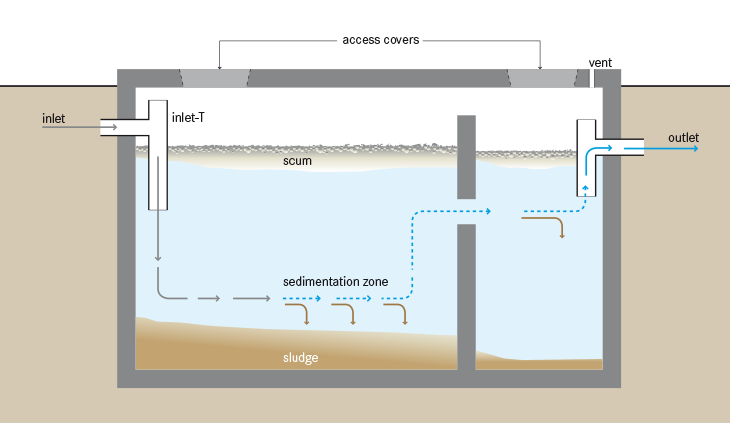
But first, let me explain how a septic system works. Most home systems consist of two 500 gallon tanks, connected together and buried in the backyard. All the drain water from the house enters the first tank, where the solids settle out of it. The effluent (the liquid part, after the solids settle) flows through a short pipe mounted near the top of the tank and enters the second tank. When that tank reaches full, the water flows out of it to the leach field.
The leach field is the secret of any septic system. The two tanks are there to collect solids and allow them to break down. Bacteria in the water attack the solids, doing their work in the recycling process. With two tanks, all the solids manage to settle, even the paper.
Image source: Wikimedia
Four-inch pipes carry water from the tanks to the leach field. These pipes are perforated along the sides, allowing the water to flow out and into a gravel bed, where it can dissipate. Unfortunately, those holes also allow tree roots to find their way in.
The water entering the leach field is actually fairly clean, if you ignore the discoloration and the slight odor. Since the gravel bed is only a couple of feet below the surface of your yard, it can water the grass, trees and rose bushes. But most of it evaporates into the air, turning it into perfectly clean, pure water vapor, that falls to the ground once again as rain.
What Can Go Wrong?
The thing that most people don’t like about septic systems is that they have to be pumped out every two to three years. That’s to remove the solids which gather in the system. While the two tanks have a combined capacity of 1,000 gallons, you really don’t want more than about 300 gallons of solids, before the tanks are pumped out. That way, the water going into the leach field will be fairly clean.
Failure to pump out the system regularly could lead to solids going into the leach field and plugging up the pipes. My system actually had that happen. The builders had connected all the pipes from the house to the second tank, rather than the first, so the solids had a much easier time of finding their way to the leach field pipes than they should. Nevertheless, the system still lasted 32 years before the leach field had to be rebuilt.
It’s recommended to not use bleach with a septic tank system, because the same bleach that whitens your clothes and kills bacteria on surfaces, also will kill the bacteria in your septic tank, if you let it get in there.
The other big thing that can go wrong with a septic tank system is for tree roots to get into the leach field, the pipes and even the tanks themselves. I also had this happen to mine. Most contractors don’t use PVC cement when connecting drainage pipes together. This offers an opportunity for tree roots to find their way into the pipes. But that’s not the worst. If the drain pipes aren’t connected to the tank properly, then roots can get in there.
Roots in the pipes or in the entrance to the tanks will plug up your drains, eventually causing them to back up. The solution is to kill off the roots and clean out the lines with a power snake and a root cutter.
But tree roots are even more likely to get into the leach field than they are into the sewage pipes and septic tanks. While a few roots aren’t a problem, eventually they will reach a point where they can plug up the leach field pipes and prevent the water from actually reaching the gravel bed. When that happens, it’s time to replace the leach field.
Using Your Septic System as Part of Your Survival Plan
If your survival plan is to bug in, sheltering in place, you’ll want to make sure your septic system is ready for it. That means being sure to have the septic tank cleaned out on a regular schedule, perhaps even more often that necessary. That way, it will have capacity when you need it most.
The other thing you need to do is ensure that your leach field is in good shape. If your system is draining slowly, with the water not soaking into the ground as fast as it should, then it’s possible that you need to replace your leach field. The newer technology for leach fields is actually better, replacing the four-inch pipe with a two-foot wide leaching chamber. This has much more capacity, is cheaper to install, doesn’t require gravel and is more or less impervious to the problems caused by roots.
What advice would you add? Share it in the section below:
The documentary, “Crapshoot: The Gamble with Our Wastes,” produced by the National Film Board of Canada in 2003, investigates an important aspect of human life you likely give little consideration: sewage. Do you know what happens to the water and other items after you flush the toilet or run water down the drain?
If you’ve never stopped to consider what happens after you turn off the faucet or put down the lid, this one-hourlong film will edify you. It may surprise you to learn the many negative consequences resulting from our so-called “modern system” of waste management.
The True Face of Sewage
Sewers are used all over the world. Through its miles and miles of underground pipe, sewers collect everything you send down the drain or flush down your sink. While waste management may seem simple from your vantage point as a single user, it is much more complicated and complex than you may imagine.
If you’ve ever toured your local waste treatment plant, you have likely seen the mechanical filter called a bar screen that is used to remove large items such as baby wipes, condoms, diapers, feminine-hygiene items, hairballs, paper towels, plastic wrappers and the like.
Although it is somewhat inconvenient, at least these items can easily be seen, gathered up and disposed of as landfill waste. Of greater concern are the items contained in sewage that cannot be seen with the naked eye, as well as the mixing of all kinds of items. As narrator, the late Ruth DeGraves reminds us of the variety of the wastes that conspire to make sewage a kind of “toxic soup:”
“Down into the sewer they go: factory run-off, thousands of new synthetic chemicals, organic chemicals, pharmaceuticals, storm overflow, food wastes, human excrement, vomit, detergents, industrial solvents, petroleum products, paints, oils, abattoir wastes, cleansers, asbestos, radioactive materials, heavy metals and dental and hospital wastes, to name a few.”
In case you are not familiar with the term “abattoir,” it is the technical term used for slaughterhouse. As such, abattoir wastes include byproducts from livestock operations such as animal blood, fat, feces, stomach contents, trimmings and urine. Not only is sewage an ugly, stinking mess, it also is dangerous due to the intermixing of all those types of waste.
But, most of us seldom think about it. Boston-based Laura Orlando, civil engineer and waste-reform advocate, estimates that up to 75 percent of the U.S. is connected to sewers. As such, she believes Americans have become desensitized to the potential risks involved. In reality, most people both appreciate the sewer system and take it for granted.
As noted by Orlando, “When we think about a drain that carries whatever we dump into the pipe and takes it somewhere else, it helps us forget about all of the dangerous things that can be in that pipe.”
Sewers: An Ancient Development of the Romans
According to DeGraves, the modern sewer system was a brainchild of the ancient Romans. She states: “The sewer was in its glory in ancient Rome. It was about a vision of being civilized, and to have sanitation meant to be civilized, dignified and ennobled. It was in classical Rome that the sewers were first built on a grand scale over 2,500 years ago.”
So enthralled were they with their invention, the Romans paid homage to a sewer goddess named Cloacina. She was so loved that Roman ruler Titus Tatius, a contemporary of Romulus, erected a statue of Cloacina near the famed sewer Cloaca Maxima (“Greatest Drain”).
This masterfully constructed sewer was established in the 6th century and remains today. Like all sewers, notes DeGraves, the goal of the Cloaca Maxima centered around: “The collection and transport of wastes by the use of water. Quite simply, the idea has always been to use water to move our wastes downstream to where we are not.”
Historian and writer Carlo Pavia suggests the ancient Cloaca Maxima will always reign supreme in both historic and modern-day Rome. This is, in part, due to a famous Latin phrase attached to it, which when translated means: “The Cloaca is the vessel, the bowel of the city, which purges everything.” But, does the modern-day sewer really purge everything? Common sense, and the filmmakers, suggest otherwise.
Spewing Raw Sewage: Trouble in Our Global Waterways
It may surprise you to learn that not all sewage is treated. In cities around the globe, even in these modern times, raw sewage is still dumped into lakes, rivers and other waterways at sickening rates.
In India, raw sewage has been dumped continuously into the famed Ganges River since 1917. Once pristine waters now churn with chunks of animal and human excrement at inconceivable levels of toxicity. Here, pollution levels are estimated to be 340,000 times what is considered safe! Veer Bhadra Mishra, an engineer and Hindu priest who lives in Varanasi, India’s holiest city, notes the river, while not globally polluted, has local stretches that are highly toxic. Says Mishra:
“When we move from Tulsi Ghat towards the end of [Varanasi], more and more sewers join the river and more and more sewage flows into the river. The cumulative effect of all the city’s sewage flowing into the river is felt at the downstream point where the Yemuna meets the Ganges, [in the city of Allahabad]. At that confluence point, the river water is septic — practically no dissolved oxygen, brown-black water and methane bubbles you can see surfacing from the bottom.”
About the Ganges, The Sydney Morning Herald, states:1
“Experts estimate that more than 3,000 million litres of untreated sewage from towns along the Ganges are pumped into the river every day. By the time it reaches Varanasi… it becomes a sewer, and the sixth most polluted river in the world. Scientists … have found the river has a fecal coliform count of more than 1.5 million per 100 milliliters (ml) of water. Water regarded as safe for bathing should not contain more than 500 fecal coliform per 100 ml.”
Similar to the Ganges, the harbor in St. John’s, Newfoundland, Canada, was recipient of some 120 million liters (31.7-million gallons) of raw, untreated waste that was being pumped into it every day. The waste was so prominent, tourists frequently observed large flocks of seagulls scavenging for bits of floating human waste.
With such a large volume of input, local experts estimate at least 16 feet of excrement solids rest on the bottom of the harbor, effectively making it a gigantic toilet bowl. DeGraves estimates 80 percent of Canadian coastal communities dump their sewage raw. Said Bill Stoyles of the Atlantic Coastal Action Program, which focuses on environmental and sustainability issues related to watersheds and adjacent coastal areas:
“There’s a huge mound 20 feet high — a mound of crap just below the outfall that just keeps coming out. The solids, of course, drop to the bottom and pile up there, and the other stuff drifts away … We‘ve come so far, become so civilized, so how can we be … living in our own filth?”
Untold Types and Quantities of Toxic Chemicals Lurk in Sewage
Given the public’s general lack of education about sewage and sewage treatment, you may not realize how many toxic chemicals are lurking therein. Since the 1950s, which marked the introduction of chemicals into mainstream America, “countless new and unpredictable ingredients are being added to the sewage recipe,” DeGraves says. “The sewer has become a super highway for toxic wastes.”
Indeed, the average city generates millions of gallons of wastewater daily, containing many unknown types and untold quantities of hazardous components. The goal of sewage treatment is to attempt to clean the wastewater and then release it back into lakes, rivers and oceans.
While it is called “reclaimed water,” it’s anybody’s guess as to the effectiveness and safety of this practice. In the documentary, waste-reform advocate Abby Rockefeller expresses concern about what she calls “our radical disconnection between us and our waste.” In her opinion, most of us minimize the consequences of mixing our wastes together in the sewer. She notes:
“The fact that the consequences of our actions are not immediately connectable and we don’t see the trouble immediately, makes it extremely easy for people to go on with their behavior and not think about the effects. In fact, our entire culture — the educational system, the industrial system, the government system — all encourage people not to think about waste disposal.”
Sludge Anyone?
As part of the sewage treatment process, liquid waste and solid waste are separated. Liquids go on to become “reclaimed water,” while solids become known as “sludge.” According to the film, sewage treatment plants produce millions of tons of sludge every year, which in North America, depending on its intended application, may be known as:
Biosolids
Black gold
Compost
Nutricake
Sewage compost
Solid waste
As noted by DeGraves, Canada has embraced the notion of repackaging its sludge as fertilizer for application to farm and garden soil:
“We have embraced the idea of co-composting, wherein two big-city waste dilemmas are seemingly solved by mixing municipal garbage and sewage sludge. These waste materials undergo a ‘digestive process,’ and are packaged as ‘Nutriplus,’ a compost promoted for home gardens and agricultural use. Nutrient ingredients are listed on this mixed-waste product, but not the toxins or heavy metals.”
Orlando notes sludge was long considered to be a hazardous waste until “Part 503 rules recast it as a beneficial, nonhazardous substance.” (Part 503 refers to the U.S. Environmental Protection Agency’s laws and regulations pertaining to biosolids.) The reality is sewage treatment was never meant to clean or purify anything. Moreover, it should never have been suggested sewer treatment could or would result in by-products that are chemical-free, beneficial and safe for use by human beings. She emphasizes:
“It never started out that way, nor is it possible to make it that way. We end up in a treatment process with a very dangerous material that, most unfortunately, we are now putting into life cycles and on our land.”
While it is well-known that sludge contains an unknown and extensive array of chemical wastes, there is also intense pressure being felt by all kinds of entities to dispose of it. Within the industrialized world, it seems, the need to dispose of sludge and sewage waste is almost always prioritized above public health and safety.
Sludge Contaminates Soil and Threatens Human Health
According to Mother Jones,2 recycling sewage has become a big business, with trillions of gallons of the wastes Americans flush annually being processed into products that are spread on farms, gardens and lawns. They note:
“In theory, recycling ‘poop’ is the perfect solution to the one truly unavoidable byproduct of human civilization. Turning sewage into a potent, inexpensive fertilizer means cleaner rivers and oceans. But as sludge has spread across the country, so have concerns that it may cause as many environmental problems as it solves. In communities where sludge has been used, residents have reported ailments ranging from migraines to pneumonia, to mysterious deaths.”
Sweden has been called out as one nation that has made a direct link between sewage sludge and public health. One of the big concerns highlighted by Gunnar Lindgren, a chemical engineer from Goteborg, Sweden, centers on the presence of metals, such as copper, found in sludge. According to Lindgren:
“[T]he levels of metals is increasing very rapidly. Authorities know they have to accept the presence of metals because they desperately want to get rid of the sludge … Copper is one metal that is now presenting us with severe problems. It has risen to a level where it is a poison for the soils, as well as the organisms in the soils.”
What Mother’s Milk Reveals About the Negative Effects of Sludge
The turning point for Sweden’s handling of sludge reportedly stemmed from the discovery of flame retardants in it that were linked to Non-Hodgkin lymphoma. Of particular concern was the dramatic increase of flame retardants found in mother’s milk. Says Swedish oncologist Lennart Hardell of Orebro Regional Hospital:
“The concentration of brominated flame retardants in mother’s milk has been increasing. We have historical batches [of mother’s milk] in Sweden from the early 1970s, and at that time there were really low concentrations. Now the curve is going straight up, and the concentration of these flame retardants in mother’s milk is doubling every sixth year.”
Lindgren underscores a common-sense reality that whatever we put into our bodies, our water supplies and our sewer systems eventually comes out in the sludge. He states, “If you have a poison somewhere in an industry, you will have the poison in the sludge. … Sludge is a collection basket of all bad things.” Adds Swedish civil engineer Carl Lindstrom:
“If you say that broccoli is a healthy vegetable, the next question is: What is it grown [in]? Broccoli grown [in] one soil can be very good for you, but if the broccoli contains heavy metals, it can be very bad for you. To focus attention on what you eat, you have to go deeper into the question of what is actually in the food, and especially look at what is in the soil it was grown in.”
Is Your Food Grown in Sludge?
Sadly, nearly half of all sludge is applied to farmland, even though no one knows exactly what may be in the thick, wet mud. To sweeten the interest, sludge is often touted as a soil conditioner and it is routinely offered to farmers at no charge. Various forms of wastes find their way onto productive farmland under the guise of sludge-based fertilizers, including paper and pulp sludges, raw-septic waste and sewage sludge. About this sickening practice, Orlando comments:
“It says a lot about our culture to think we would even take the gamble to ruin our productive agricultural soil by applying a material that we know causes great harm. If we have any doubts at all, why risk putting it on our soil?”
In the U.S., sewage sludge used for fertilizer may contain a cocktail of pharmaceutical drugs due to the fact that many Americans take medications. These drugs are excreted in your waste and find their way into sewage-treatment plants, which typically don’t adequately remove such drugs. When the sludge is applied to farm or garden soil as fertilizer, the plants get exposed to the pharmaceuticals, sending them indiscriminately into the food supply.
After news about the potential dangers of sludge became public in Sweden and other countries in Europe, including Belgium and the Netherlands, authorities banned the spreading of sewage sludge on agricultural land. In the short term, Sweden turned to burying its sludge in the ground, focusing first on areas such as motorways that were perceived to be less-intrusive to human health.
Solar Aquatics: A Unique Approach to Waste Treatment
In Bear River, Nova Scotia, residents resorted to a totally different tactic. They addressed their sludge waste by installing a solar aquatics treatment system. In a bold move, they placed the end of the city’s sewer pipe in the center of town. By doing so, it was hoped sewer waste would remain top of mind for the community.
While this setup has not necessarily resolved all of their sewer and sludge-related issues, it certainly has made residents think more consciously about what is happening to their water and waste. Said Mark Van Zeumeren, former senior engineer with Environmental Design and Management, the company responsible for designing and installing the Bear River system in 1995:
“In the past, it was never in people’s mindset as to what happened to the water, what they were doing with it … Here, everyone’s keen to come down and walk through the system … They identify with their sewage now … This is their sewage and they have to deal with it.”
Solar aquatics is radically unique in that it employs plants and microbes to purify waste. Inside the greenhouse in the city of Weston, Massachusetts, 16 gravity-fed tanks brew sewage with the help of floating flora. Celery, cherry tomatoes, mint, primroses and water lilies, as well as a few fish and snails absorb contaminants. Phil Henderson, chief executive officer of Ecological Engineering Associates, which owns and operates the Weston greenhouse, shares a few of the advantages of solar aquatics:3
It produces half or less as much sludge as most industrial plants
Local residents much prefer living next to a greenhouse than a traditional waste treatment plant, which is generally thought to be an eyesore
It is a great learning tool for students and the community
Change Is Needed: Steps You Can Take to More Responsibly Handle Waste
No matter what kind of sewage treatment methods we may use to clean up after ourselves, certain problems will undoubtedly remain unless we determine to change our ways. Unless we change, most assuredly the habitual, daily use of all sorts of chemicals, medications and other toxic substances in our homes, industries and institutions will continue to burden our sewers.
While the film ended without a clear “call to action,” I would like to draw your attention to a few potential areas that may fuel your thinking about how you can become more engaged with, and responsible toward, waste and waste treatment. If each of us made just one small change, it would go a long way toward helping us to collectively “clean up our act.” Some areas to consider include:
Place baby wipes, condoms, diapers, feminine hygiene items, paper towels, plastic wrappers, so-called flushable wipes and the like in your garbage can; do not put them down your drain or toilet
Be sure to dispose of hazardous wastes such as motor oil, paints, pesticides, stains and varnishes, which can contaminate soil and water supplies, according to the directives issued by your local regulatory bodies; never flush them down drains or toilets
Take caution with respect to the amount of water, as well as the cleaning supplies, detergents and personal-care products, you use for car washing, laundry, lawn care and personal hygiene, because they introduce additional areas where contamination may occur
Keep leaves, trash and other debris out of storm sewers because those items are often deposited, untreated, directly into natural waterways, which may be a source of your drinking water