Showing posts with label pilgrims. Show all posts

Thursday, November 23, 2017

Unforgettable Survival Lessons … Straight From The Pilgrims


Each and every year, we celebrate a story of survival. But few people, other than schoolchildren, bother to think about it.


The story of Thanksgiving is one of survival. The Pilgrims who landed at Plymouth Rock in 1620 established one of the first permanent settlements in the New World. Yet, they almost didn’t make it.


The biggest problem the Pilgrims had was a severe lack of preparedness. They arrived far into the Northeast, from a grueling sea journey, in November, with winter just around the corner. Originally, they were to travel in two ships, with the Mayflower being their cargo ship. But when the Speedwell was found to be unseaworthy, they had to quickly retrofit the Mayflower for passengers and leave a lot of their cargo behind.


Due to a late start and a longer voyage than expected, the Pilgrims landed in the New World much later in the year than expected. They also made landfall much farther north, which make the encroaching winter a much more serious issue. There was little time to build shelters and prepare for winter before it was on them.


Put God Back Into History And Teach Your Kids What They Won’t Learn Anywhere Else!


Fortunately for them, the Mayflower stayed through the winter, providing them with shelter and food. Even so, about half of their population died off that first winter, through a combination of disease and starvation. It wasn’t until the next year that they established a firm footing on modern U.S. soil, doing what was necessary to ensure their survival.


The Pilgrims who made that journey were not well-suited for wilderness survival. They were city folk who were used to living in established society. While many knew useful skills, they did not know the skills needed for establishing a colony in a new land. Those they were going to have to learn.


So, with all that was stacked against them, how did the Pilgrims manage to survive?


In truth, the things the Pilgrims did to survive don’t look like “survival skills” to us today. That’s because many of the things we call survival skills were things that they took for granted as part of their day-to-day life. Starting a fire wasn’t a specific survival skill, but rather something learned by 10-year-old boys, when they would take over responsibility for keeping the fires going in their homes.


Much of the “skill” that allowed them to survive was more about their attitude, rather than anything we would recognize as a skill. They developed the right mental attitude, then everything else followed. This really is not much different than a modern prepper, except in the fact that they were forced into it by the necessity of their situation.


Nevertheless, there are several key elements to their survival that it would do us good to emulate. That is, unless we want to learn everything the hard way, too.


Learned From the Experts


Much has been said about the Native-American, Squanto, who became their teacher and interpreter. Squanto had recently escaped from captivity in England. Returning to his native land with an explorer, he soon discovered that his tribe had been decimated by plague.


When the Pilgrims landed at Plymouth Rock and began to establish their settlement, Squanto became their friend. Having grown up an American Indian, he knew the forests and the animals that inhabited them. He had extensive knowledge of the ways of the Indians and what they did to survive. This he passed on to the Pilgrims, teaching them the knowledge of his people and giving them the skills they needed to survive.


Squanto was also the Pilgrims ambassador, arranging meetings and alliances with friendly Indian tribes. This strengthened the Pilgrim colony, as well as opening doors for trade, by which they could receive the bounty which the Indians harvested from nature.


Used What They Had Available


While the Pilgrims didn’t come to the New World properly outfitted for survival, they did come with tools, goods and other supplies. These were put to use in helping them to survive and establishing their colony. Their inventiveness in using what they had was demonstrated by the use of a printing press to undergird a beam in the Mayflower, when rough seas caused it to crack.


They also made good use of the Mayflower itself, living aboard as they prepared shelters on shore. Some lived through the winter in the ship, as there were not enough homes available for every family.


The homes themselves were built from whatever was on hand. Fortunately for the Pilgrims, they had landed in an area with abundant forests. So they were able to use the trees they felled in clearing land to farm, in order to build their homes and barns.


Each Man for Himself


Although we typically learn that the Pilgrims struggled through that first winter, with many dying, we don’t learn that they struggled through the next two, as well. In fact, it wasn’t until 1624 that they had an abundant harvest and were able to make it through the winter comfortably.


What made that difference? When the colony was established, it was done so under contract with the Virginia Company of London and the Virginia Company of Plymouth, both “adventurer” companies. As part of their contract, they were to work as a commune. Each would work according to their ability and each would receive according to their need.


While that sounds like a wonderful system, it isn’t. As with all socialist systems, it eliminates reward. Many received more than they worked for and many others earned much more than they received. That bred discontent, which manifested itself in laziness and a general unwillingness to work. Those who worked, didn’t give it their best effort.


This led to two more difficult winters, until the governor, William Bradford, eliminated the socialist system, giving each family a plot of ground and allowing them to keep the fruit of their labor. This was not done in all things, but first done only in the growing of corn.


The result was that triple the amount of corn was planted, as what had been planted the years before. When the crop was threatened by drought, the governor declared a fast, and God answered, giving them rain. Their crop that year was so abundant that they were able to export an entire ship full of corn that same year.


Trusted in God


Finally, the Pilgrims depended on a deep, abiding trust in God. Some may not see that as a survival skill, but history has proven over and over again, not just in Plymouth, but in other places, that God is in control. When we trust in Him, our chances of survival are greatly increased.


Faith is as necessary to human existence as oxygen is. While some might claim that they can survive without faith, what they are really saying is that their faith is in something other than God. They might be trusting in science or knowledge of even their own strength. But they are trusting in something. How much better to follow the example of the Pilgrims and trust in God.


What do you think? Share your thoughts in the section below:

Monday, November 20, 2017

The Pilgrims’ Story: Separating Fact From Fiction

sue allan pilgrimsSchoolchildren all across America are learning about the Pilgrims this month, but for many of them it’s the politically correct version – sanitized of anything that might offend.


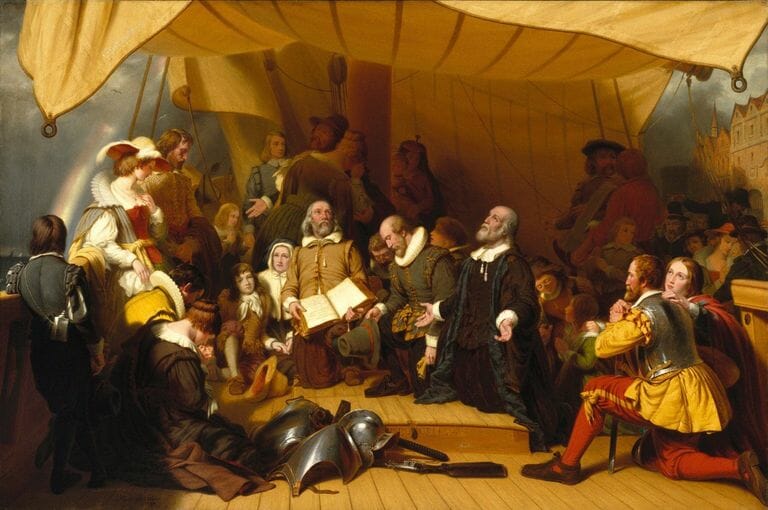
On this week’s edition of Off The Grid Radio, you’ll hear the non-PC story of the Pilgrims from one of the world’s foremost experts, Sue Allan, who separates myths from facts and provides details about the Pilgrims you’ve never heard.


Allan is an author and speaker who gives tours of Pilgrim sites in the United Kingdom, and her knack for making you “feel like you were there” is unmatched.


The Pilgrims, she says, were some of the nation’s first survivalists, and their stories of persistence and endurance rival anything out of Hollywood.


Allan also tells us:


  • Why the depictions of Pilgrims you see in paintings are almost always wrong.

  • What the Pilgrims did to stay out of jail in England – a story so incredible it is sure to inspire.

  • How the Pilgrims survived their journey across the Atlantic, despite not having enough food to eat.

  • Why she believes the Pilgrims’ story must include their faith – or else not be told at all.

  • How the Pilgrims could have avoided that first harsh winter, if only they had done this one thing.

Perhaps most incredible of all, Allan tells us how the “first Thanksgiving” we’ve been taught for decades perhaps wasn’t the first Thanksgiving at all. Allan has been featured in a series of documentaries, including the BBC’s Coast and Kirk Cameron’s Monumental. Listen as this expert tells the Pilgrims’ story as only she can.

Sunday, July 2, 2017

The Pilgrims And Liberty

Off The Grid Theology

The Pilgrims And Liberty


In times of cultural failure and upheaval, there are usually two kinds of extremists.  Those who abandon any established order as a thing beyond redemption, and those who remain within the system, hoping they can reform it.  New England was settled by both sorts in turn — by Separatists and by Puritans.  Let’s talk about the Separatists first, those intrepid settlers we Americans call the Pilgrims.  Next time we will look at the Puritans.


The Separatists were English Calvinists who had separated themselves from the Anglican Church and eventually from England itself as they sought a place where they could worship God according to His word.  At first they met privately, even secretly in homes.  But when Church and State combined to “harry them out of the land,” they fled to the Netherlands.  What they found there, however, was hard labor and a local culture with plenty of temptations and distractions.  When they’d finally had enough, they fled.  William Bradford chronicled the motives for the move:


Lastly, and which was not least, a great hope and inward zeal they had of laying some good foundation, or at least to make some way thereunto, for the propagating and advancing the gospel of the kingdom of Christ in those remote parts of the world; yea, though they should be but even as stepping-stones unto others for the performing of so great a work.


And so, through many difficulties and complications, they set sail for North America.  When they neared this continent’s Eastern shores, a tempest blew their lone ship, the Mayflower, off course and set them outside the lands designated by their charter.  And, in the face of potential mutiny from the “strangers” aboard, the Pilgrims drew up a compact as a foundation for political self-government.


This Mayflower Compact was done “in the name of God” and with loyal acknowledgement of the political sovereignty of their king, James I.  The Compact listed the Separatists’ broad goals as the glory of God, the advancement of the Christian faith, and the honor of king and country.  Specifically, the Compact combined the signers and their families into “a civil Body Politick” so that they could, in the future, “enact, constitute, and frame, such just and equal Laws, Ordinances, Acts, Constitutions and Offices, from time to time, as shall be thought most meet and convenient for the General good of the Colony.”  Those who signed were most of the adult males aboard the Mayflower, as well as two apprentices.


The Pilgrims vs. Democracy


Clearly, the Pilgrims were strangers both to our modern brand of individualism and what we usually think of as the democratic spirit.  First, they acknowledged themselves the “loyal subjects” of King James.  They also bound themselves in terms of divine principles and under the authority of God Himself … and the Christian God specifically.  They also foresaw the need for new laws and civil offices in the future, and they committed themselves to ordering this civil government in terms of English and biblical law.


The Pilgrims And LibertyThe signers expected that they would, in due time, have proper elected or appointed officers who would make and enforce civil law.  There was no commitment in the Mayflower Compact to any type of ongoing direct democracy.  There would be governors and officers and it would be the duty of every man to humbly submit to their rule.


Turn Drive Time Into Fun-Filled, History Time With Your Kids!


Foreseeing this, their first pastor, John Robinson, had admonished them with these words before they left for the New World:


Lastly, whereas you are to become a body politic, administering among yourselves civil government, and furnished with persons of no special eminence above the rest, from whom you will elect some to the office of government, let your wisdom and godliness appear, not only in choosing such persons as will entirely love and promote the common good, but also in yielding them all due honour and obedience in their lawful administrations; not beholding in them the ordinariness of their persons, but God’s ordinance for your good. . .  And this duty you can the more willingly perform, because you are at present to have only those for you governors as you yourselves choose.


Champions of Religious Liberty?


Modern opinion treats the Pilgrims as champions of religious liberty and freedom of conscience.  But this is not how the Pilgrims themselves would have spoken of their mission and goals.  The Pilgrims covenanted together, first as a church congregation and later as civil body, to promote the Christian faith as they understood it.  Their common faith defined and dictated the nature of their ecclesiastical and political community.  To put it bluntly, those who wished to worship God on terms foreign to the Separatists’ theology …  should go elsewhere.  The original Separatists had no desire to compel others to worship biblically because they believed that coerced worship was no worship at all.


They refer to the impossibility of forcing the conscience incidentally, not for the purpose of advocating freedom of opinion.  Sometimes the people who are in error are sternly dismissed, in the spirit of the old prophet — “Ephraim is joined to his idols, let him alone.” Sometimes they are alluded to with pitifulness; but for the most part the impossibility of forcing the conscience is brought in to condemn the action of those clergy who are striving to get a legal sanction for their scheme of Church Reformation, in order that it may be imposed on the whole nation.  (MacKennal, 24).


The Pilgrims, being Congregationalist Calvinists, were unimpressed with the imaginations of men.  Like Luther, their minds were captive to the Word of God.  They believed in absolute truth, revealed infallibly and authoritatively in Holy Scripture.  They took it for granted that a truly Christian people would want to obey God in all of life, including politics.  They assumed that a Christian people, given the opportunity, would construct a Christian commonwealth, but they didn’t believe that any laws, even God’s Mosaic Law, could regenerate men and make them disciples of Christ.


Conclusion


The Pilgrims And LibertyThe Separatists practiced congregational government within their churches.  The “heads of households”  … usually an adult male … called or elected the pastor and the elders.  These elected officers led the congregation by teaching, admonition, and by example.  In some matters however, the whole congregation voted.  This form of church government laid a strong foundation for the way the Pilgrims’ would enact their civil government, as well.  The strong traditions of English civil government also would play a large role in  how they would stay in covenant with each other.  Throughout both influences ran the Christian understanding of law, grace, and representation.


The Pilgrims, like their Puritan cousins, thought in terms of covenant.  They believed in biblical absolutes and in the need for humble submission to God’s ordinances.  What they didn’t accept was Greek or classical democracy and the modern idea that every man’s opinion is as good as ever other man’s.  They were strangers to individualism and knew no law higher than God’s.


For Further Reading:


Alexander MacKennal, The Story of the English Separatists (London:  Congregational Union of England and Wales, 1893).


Terrill Irwin Elniff, The Guise of Every Graceless Heart:  Human Autonomy in Puritan Thought and Experience (Vallecito, CA:  Ross House Books, 1981).


Rousas J. Rushdoony, This Independent Republic, Studies in the Nature and Meaning of American History (Nutley, NJ:  The Craig Press, 1964).


Clarence B. Carson, The Rebirth of Liberty, The Founding of the American Republic 1760-1800 (Irvington-on-Hudson, NY: The Foundation for Economic Education, Inc., 1976).