Showing posts with label Mick Mulvaney. Show all posts

Saturday, July 15, 2017

White House Reveals Budget Deficit Will Be $250 Billion Greater Due To "Mistake"

On Thursday, we first discussed that in its latest monthly budget report for the month of June, the US Treasury reported a massive outlier that has largely been ignored by the general press: in June total US government spending hit $429 billion, the biggest one-month outlay on record, and 33% higher than the $323 billion spent a year ago.


As explained,  the main reason for the outlier print was that outlays increased by roughly $60 billion in "other" items relative to baseline because the Treasury revised up its estimates of the subsidy cost of student loans, and to a lesser extent housing, it guarantees. And, as we further noted, based on the CBO revisions, "it appears that the deficit for the fiscal year, which has three months left, will be in the $650 billion to $700 billion range, if not even higher, mostly due to the surge in "subsidy costs of housing and student loans" guaranteed by the Treasury."


This was troubling: as we stated "what the unexpected surge in government spending means is that quietly and mostly behind the scenes, the student debt bubble has begun to burst, and the Treasury is "provisioning" for it in real time, with all US taxpayers once again on the hook."


There was more: while outlays surged, revenue growth failed to keep up...


...which taken together led to our conclusion that "while many analysts had a deficit base case for fiscal 2017 at roughly $575BN (the year ends on Sept 30), the CBO recently revised its projection for the fiscal 2017 up by $134 billion to $693 billion. Most of the CBO revision reflects weaker than expected revenues, which means it will be even more surprised when it finds out what is going on with outlays."


As it turns out we were right, because just one day later, the Director of the Office of Management and Budget, Mick Mulvaney, warned that the budget deficit for Trump"s first two years in office will be nearly $250 billion higher than initially estimated "due to a shortfall in tax collections and a mistake in projecting military healthcare costs," according to Reuters.


The problem first emerged in late May, when Mulvaney submitted the OMB"s first spending plan to Congress. It now appears that, as Thursday"s data confirmed, the projections were overly optimistic and on Friday Mulvaney said the deficit projected for the current fiscal year has increased by $99 billion, or 16.4 percent, to $702 billion, a miss which was virtually in line with what we calculated two days ago. It doesn"t stop there, however, and Mulvaney said that for 2018, the deficit will be $149 billion more than first expected, increasing by 33 percent to $589 billion.


In other words, a budgeting "mistake" just shy of $250 billion.


In an amusing twist, AP added that the White House kept its budget report to a bare-bones minimum and cast blame on "the failed policies of the previous administration" although whether this gambit of "blaming Obama" for budget errors, even as the president is all too happy to take credit for the market"s all time highs, will work remains to be seen. 


As Reuters further adds, the figures come as the administration is facing "widespread doubts among economists and analysts that it can erase government deficits largely by boosting economic growth and changing laws like the Affordable Care Act. ACA reform is facing a difficult path in Congress, and the Congressional Budget Office on Thursday said the administration"s growth and deficit reduction plans were optimistic."


Worse, it means that far from balancing the budget, as the Trump administration had hoped to do over the next decade, the budget will drift well wide of even the latest "optimistic" CBO projections, which saw Trump"s proposed budget cutting on the baseline number by a cumulative 33% over the next ten years.


And while spending took a back seat in Mulvaney"s letter, he blamed the bulk of the budget shortfall this year and next on lower-than-expected tax collections. Specifically, individual and corporate income taxes and other collections for this year are expected to be $116 billion less than the administration anticipated in May. Tax receipts in 2018 are expected to be $140 billion less than initially estimated.


We also touched on this two days ago when we said that "one theory explaining the shortfall in revenues reflects taxpayers delaying the recognition of income in 2016, anticipating tax cuts this year. That revenue should eventually be recovered" however as we cautioned, this may be an overly optimistic scenario, and the underlying reality may be that tax receipts are set for a structural decline as US workers and corporations earn less, and as a result, remit less in the form of taxes. According to the Mulvaney letter, it was this more adverse case, that is emerging as the likely explanation.


The OMG chief did touch on spending, which he said in 2017 would be $17 billion less than expected, and would have been even lower if not for the use of "erroneous outlay rates" used in estimating costs of health programs for the U.S. military, i.e., another mistake, and one which did not take into account the surge in subsidy costs for student loans, i.e., the marking-to-market of student loan writeoffs and discharges which the government will be forced to do over the coming years as the student loan bubble bursts.  Furthermore, costs for the defense health program will be $19 billion higher in 2017 and $9 billion higher in 2018 than initially expected. As a result, overall spending in 2018 will rise by $10 billion; our calculations suggest the final number will be substantially greater.


There is still a chance that the latest budget "mistake" will be rectified: the latest estimates are "based on existing law and do not include any proposed changes to health, welfare or other programs" however with virtually all policies proposed by Trump halted by the gridlock in Congress, it is unlikely that many, if any, proposed changes will be implemented.

Wednesday, June 28, 2017

Trump Budget Cuts Hit As State Department Imposes New Hiring Freeze

In an effort to support President Trump’s plans to cut the State Department budget by about one-third in fiscal year 2018, Secretary of State Rex Tillerson has imposed a new freeze on hiring.


As a reminder, President Trump instigated an across-the-board hiring freeze in his first days as President, then lifted it in April in favor a more "surgical freeze."


Mick Mulvaney, the director of the Office of Management and Budget, described the new stay on hiring as a more "surgical" freeze than the first.


"This is a big part of draining the swamp," he said. "Really what you"re talking about doing is restructuring Washington, D.C., and that is how you drain the swamp, so this is a centerpiece of his campaign and a centerpiece of his administration."


But now, as Bloomberg reports, it appears the planned budget cuts are being prepared for as an emailed memo sent to State Department staff calls for immediate freeze to “all position upgrades, reorganizations, and lateral reassignments,” according to a copy of the document seen by Bloomberg.


Memo sent June 27 bars creation of any new positions including "senior advisors, envoys, chiefs of staff"


“These restrictions are necessary and prudent to insure we do not permit additional position and grade level growth at a time when the Department is undergoing reform and restructuring."


Notably, the memo added that exceptions may be considered for a “national security, life safety” or “public health situation."

Tuesday, June 6, 2017

Democrats Plot Debt Ceiling Fight And Government Shut Down To Thwart Trump Tax Cuts

After 8 years of bashing Republicans for using debt ceiling votes as leverage to try to force spending cuts, Democrats now seem intent upon doing pretty much the same thing, well, at least the "using the debt ceiling as leverage" part.  In fact, after repeatedly calling for a "clean" debt ceiling vote (i.e. one without attached conditions) House minority leader Nancy Pelosi recently hinted, in her typical incoherent manner no less, that Democrats may now be looking into using the debt ceiling vote as leverage to thwart Trump"s forthcoming tax proposals.


"I don"t have any intention of lifting the debt ceiling to enable the Republicans to give another tax break to the wealthy in our country.  To further exacerbate the challenge that is created when they have their trickle down economics."


"The president keeps saying "the tax bill is moving through Congress," it doesn"t exist.  It doesn"t exist.  So you understand the frustration.  It doesn"t exist.  There is no tax bill moving through Congress."


As Bloomberg points out, Democrats have been the key to passing "clean" debt ceiling increases in the past but hypocrisy is not a concept that is well understood in Washington D.C.


It’s unclear how this would work in practice, but Democratic aides in both chambers said they are discussing possible strategies to tie the debt ceiling to blocking tax cuts.


Such an approach would be a significant change for Democrats, who have spent the past eight years arguing that debt ceiling increases should be free from conditions, and could further complicate efforts to raise the government’s borrowing authority when the current limit is reached later this year.


Democrats have been willing in the past to provide Republicans enough support on “clean” debt-ceiling measures to help make up for the loss of votes among conservatives, mostly in the House, who refuse to support them without deep cuts to domestic programs. Democrats were key to helping resolve the 2011 fight over the debt limit, a protracted standoff that contributed to S&P Global Ratings’ decision to downgrade the U.S. to AA+ to AAA.


Ironically, efforts to use the debt ceiling as leverage could, presumably for the first time ever, partially align the interests of Democrats with the most conservative voices in Congress, many of whom would have no problem shutting down the federal government for a while.  After being singled out and blamed for the last government shutdown in 2013, the House Freedom Caucus undoubtedly welcomes Pelosi"s sudden support.


Already, members of the House Freedom Caucus have said they will push for spending cuts in this year’s debt-ceiling debate in exchange for their support. On Friday, President Donald Trump’s chief economic adviser, Gary Cohn, said the White House would consider spending cuts or policy changes favored by Republicans in order to avert an unprecedented default. That appears to align him with White House budget director Mick Mulvaney, but against Treasury Secretary Steve Mnuchin, who has called on Congress to pass a “clean” debt-ceiling hike.


“Treasury secretary would love to do a clean debt ceiling -- I get that. But if we need to get things attached to get it through, we’ll attach things,” Cohn said on CNBC.


Several conservative groups met at the White House last week to discuss a strategy. Ideas they discussed included caps on mandatory programs such as Social Security and Medicare, extending automatic across-the-board spending cuts and matching any debt-limit increase with spending cuts, according to two participants in the meeting.


Republicans in both chambers are seeking to draft and approve a tax-cut package this year that would lower individual and corporate tax rates, although no proposal has been circulated yet. Several leaders, including Senate Majority Leader Mitch McConnell, have said they want any tax overhaul to be revenue-neutral. But Trump has repeatedly promised large cuts.


So, by all means, fight on Nancy...for one time in your multi-decade political career you may actually slip up and save taxpayers some money.

Sunday, April 23, 2017

Trump Warns Democrats "Obamacare Will Die Soon Without 'Big Money'"

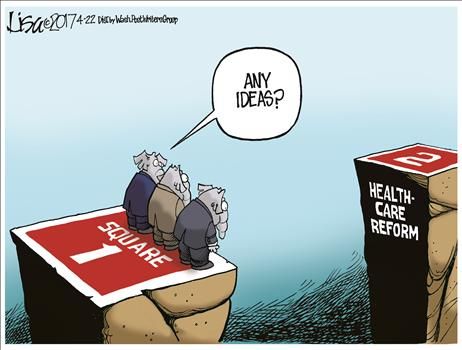
Amid tensions over debt ceiling discussions and government shutdown concerns, Republicans continue to face the fact that passing an Obamacare "alternative" remains highly unlikely.


Source: Townhall.com


But it appears the GOP has a cunning plan to cross that chasm. President Trump said early Sunday that ObamaCare will die "far sooner than anyone" thought if it doesn"t receive federal funds to keep it going.


As The Hill reports, the president"s message comes just days before the Democrats and Republicans must agree on a federal budget or face a government shutdown. Both parties are pushing for funding of their own priorities. The White House is pushing for funds to build a wall along the Mexican border and enhance border security, while Democrats hope to make more inroads in healthcare coverage.


White House officials have been publicly talking about the negotiations Sunday morning. Office of Management and Budget Director Mick Mulvaney said Sunday that a government shutdown is not a "desired end." He dodged questions about what would be acceptable to the administration in negotiations.


"The negotiations are ongoing and there"s no reason we can"t have an agreement there as early as today," Mulvaney said in an interview on Fox News Sunday.


Republicans and Democrats have until Friday to agree on a funding package to keep the federal government open until Sept. 30, when the 2017 federal fiscal year ends. Legislation will require support from Democrats to clear the Senate.


Secretary of Homeland Security John Kelly said the president will be "insistent" on border wall funding. Congress must pass a spending bill by Friday to avoid a government shutdown.


Judging by the Philly Fed"s Partisan Conflict Index, it will be an uphill battle...


The GOP wants to push for a second healthcare bill before the 100th day of the new administration (Saturday, April 29), something that Barclays sees as unlikely to succeed as spending agreement talks take central stage. Congress needs to send a spending bill to the president’s desk before Friday midnight in order to avoid a government shutdown. Political gridlock continues to be a risk for the those trades that performed well after November’s elections, as political capital is spent before getting into the discussion of the tax reform.

Saturday, April 22, 2017

What Trump Tax Plan? Key Senate Panel Has Not Even Seen It

RIP BAT - the Border Adjustment Tax, which was floated in November under a proposal from Paul Ryan and which met with fierce resistance, is effectively dead. According to Bloomberg, Trump’s "tremendous" tax plan to be revealed next week likely won’t include the controversial border-adjusted tax.


To be sure, White House Budget Director Mick Mulvaney said that Trump’s position on the border-adjusted tax is still under discussion, however he added that administration officials are grappling on how well that portion of Ryan’s plan would contribute to economic growth. The border-tax concept is estimated to raise more than $1 trillion in revenue over 10 years; without that the plan would be unable to achieve revenue-neutrality, which in turn makes the entire budget reconciliation process seem untenable absent substantial revenue increases elsewhere.


In any case, absent more deferrals, Trump is expected to release a tax plan for individuals and businesses next week that may not include every component that will go into final legislation, Bloomberg notes. The plan, which Trump said will be released Wednesday, will contain the administration’s priorities, although it was not clear what those are since every day the Trump administration appears to be flipflopping on every major issue depending on what feedback it gets from various Goldman economists.


Adding to the confusion, Mulvaney, in an interview with Bloomberg Television, provided few details of Trump’s plan, saying it’s aimed at providing 3% annual growth. “We’re trying to backfill from there,” he said -- by incorporating tax policy that would provide for that ambitious growth target. Again, it was not clear how such a pace of growth could be achieved. The Consensus outlook for 2017 GDP is 2.2%.


Mulvaney also raised the possibility that the plan might not be revenue-neutral, meaning that it might provide for only temporary tax cuts that would have to expire after 10 years. “Deficits are not driving the discussion,” he said. An odd statement coming from a man who was notorious for making deficits the only part of the discussion.


Earlier on Friday, the AP reported Friday said his plan would result in “massive” tax cuts for both individuals and businesses. The cuts will be “bigger I believe than any tax cut ever.”  Later, while signing an executive order related to a broad review of tax regulations from 2016 and 2017, Trump said he wants Treasury Secretary Steven Mnuchin “to begin the process of tax simplification.”


In a stark departure from previous occasions when stocks soared on Trump promises of "imminent" tax cuts, today the S&P completely ignored the latest guidance. There is precedent for that: Trump said on Feb. 9 that he would be releasing a “phenomenal” tax plan to overhaul the tax code within two to three weeks. It is now almost three months later. The word that he’ll release a plan next week comes as he approaches the end of his first 100 days in office on April 29.


The most surprising reaction to Trump"s announcement, ironically, came out of Congress, where the reaction was muted. Senate Majority Leader Mitch McConnell’s office referred questions to the White House.


As Bloomberg adds, the Senate Finance Committee has not even seen final details of the Goldman White House plan - said to be unveiled in 5 days - a congressional aide said Thursday.


That"s not all: tax-related challenges presented by the 2010 Affordable Care Act remain in place amid Republicans’ disagreement on how to dismantle the health-care law they’ve criticized for years. Mulvaney repeated Friday that Trump would like to see health-care legislation tackled first - because it could help pave the way for larger tax cuts overall.


In the House, where any tax legislation would have to begin, “our intention has always been and continues to be to coalesce around a unified GOP plan and those conversations continue,” said AshLee Strong, a spokeswoman for House Speaker Paul Ryan.


So no Obamacare repeal still, but vocal promises of "massive" tax cuts contained in a plan that nobody has seen and which may eliminate local and state tax deductions, resulting in even higher tax burdens for many taxpayers? Our forecast of the most likely outcome: a government shutdown.

Monday, January 30, 2017

Trump Executive Order: For Every New Regulation, Two Must Be Revoked

January 30, 2017   |   admintam


(ZHEPresident Trump has signed an executive action to revoke two regulations for every one enacted, or as officials told AP, that they are naming the new directive a “one in, two out” plan. Federal agencies will need to revoke two regulations for every new regulation they request, and the White House will review the proposal, according to administration officials.


The order sets a budget of $0 for new regulations in 2017 and the administration will set a regulation budget each year, the official said on customary condition of anonymity. Military and national security regulations are exempt.


“This will be the biggest such act that our country has ever seen. There will be regulation, there will be control, but it will be normalized control,” Trump said as he signed the order in the Oval Office, surrounded by a group of small business owners.


Trump’s latest executive action will prepare a process for the White House to set an annual cap on the cost of new regulations, a senior official told reporters ahead of the signing. For the rest of fiscal 2017, that cap on new regulations would be $0, the official said on customary condition of anonymity.


Here are the key highlights in the order compiled by Axios, as per the text released by the White House:


  • Whenever an agency proposes a new regulation, it has to identify “at least two” previous regulations to be repealed.

  • For all new regulations, “the total incremental cost … shall be no greater than zero.”

  • If there are new costs, they have to be offset by eliminating costs in “at least two prior regulations.”

  • The process will be directed by Mick Mulvaney, who’s set to become the next director of the Office of Management and Budget.

  • If a new regulation wasn’t already listed on the “Unified Regulatory Agenda” — a list of rules in the works — it can’t be issued, “unless otherwise required by law” or unless Mulvaney says it’s OK.

  • The limit applies to fiscal year 2017, which is already underway.

As Reuters adds, major regulations are typically reviewed by the White House’s Office of Management and Budget (OMB) before they are issued. That review will continue under this new measure, but agencies will also have to identify what two regulations will be repealed to offset the costs of any new rule. The new order does not require that the repeal of the two regulations be done simultaneously with the release of additional rules, the official said.


“This vests tremendous power and responsibility in the OMB director to ensure the president’s direction in how we manage this across the government,” the official said.


This means that Trump’s pick to lead the OMB, budget hawk Mick Mulvaney of South Carolina, will have critical say on any US regulatory spending and “pork” going forward.


This article (Trump Executive Order: For Every New Regulation, Two Must Be Revoked) by Tyler Durden originally appeared on ZeroHedge.com and was used with permission. Tune in! Anti-Media Radio airs Monday through Friday @ 11pm Eastern/8pm Pacific. Help us fix our typos: edits@theantimedia.org.

Wednesday, January 25, 2017

President Trump Continues to Troll the Left Over Inaugural Crowd Size

For reasons beyond the scope of rational thinking, during confirmation hearings today for The Office of Management and Budget, Senator Jeff Merkley, shill from Oregon, produced a photograph from Obama"s 2008 inauguration and compared it to a sparsely populated Trump one -- which was taken in the morning before the crowd had filled in, and asked Mick Mulvaney which crowd size was larger.


Much to the delight of the chimped out media on the left, Mulvaney said Obama"s crowd appeared to look larger.


Ben Wehl from Politico was practically masturbating to the thought of Obama"s crowd size in an article published today about the ordeal.


Politico


Alas, Trump, the consummate troller in Chief that he is, had to fuck with them -- twisting the knife inside of their soulless bodies -- ever so slowly, divinely, taking to Twitter to thank a photographer for sending him a picture of the inauguration -- which clearly showed a much larger crowd than the one being shilled around by the media-fags.


Crowd


The media"s response to being checkmated in such a glorious fashion was to nitpick over a small oversight by the photographer.
Media


Shills have to shill. They haven"t a choice.


Can we simply get this behind us, for the sake of unity, and admit that Trump did, indeed, have a much larger crowd than Obama?


Content originally generated at iBankCoin.com