Showing posts with label jesus. Show all posts

Sunday, March 25, 2018

The King Rides In

The King Rides In


Now shrugging off his rags the wiliest fighter of the island leapt


and stood on the broad door sill, his own bow in his hand.


—Homer, The Odyssey (c. 8th century BC)


The king has returned!


—Rafiki, The Lion King (1994)


The Return of the True King


The exiled king story is one of the oldest narratives ever recorded. From Odysseus to Arthur, from Richard to Aragorn and Simba, these remarkable stories all ring with the hope of a returning king.  There’s a reason for this, and it stands at the very center of Earth’s history and hope of redemption.  It’s about an archetype. It’s about the story of Jesus the Messiah.


It was the 10th of Nisan (our March-April).  Jesus had spent the previous day in the little village of Bethany, just outside Jerusalem, with His close friends, Mary, Martha, and Lazarus.  There had been a lot of buzz. People coming and going busily with a big banquet to make the day complete.  The word was out and spreading like wildfire.  Jesus had raised Lazarus to life after he had been dead four days.  People rushed to see Lazarus who was raised by Jesus.  Everyone was talking.  But, believe it or not, there was more going on than a man being raised from the dead.  It was Passover week.  Religious fervor and Messianic expectations were high. But also, a kind of desperation was in the air. And today, the 10th, a Sunday, was the day that Israel picked out her Passover lambs for slaughter.


Sometime in the morning Jesus set out on foot with His 12 disciples.  But first, he sent two ahead around the Mount of Olives to another little village close by called Bethpage.  Jesus gave His men some rather unusual and unexpected instructions.  They were to look for a young donkey … one unbroken and never ridden.  They were to bring it back to Jesus.  If anyone objected, the disciples were only to say, “The Lord has need of him.”  And so it happened as Jesus said.  The two disciples found the colt and its mother and began to untie them.  The owners, who were standing nearby, objected until the disciples spoke about Jesus needing the animals.  The disciples went their way with the donkey.  The owners had a “brush with celebrity” story to tell, and they told it.


Get Heirloom Audio’s Popular 2-CD Set, “Captain Bailey’s Heir,” For FREE! Use Coupon Code LTA2


When the disciples caught up with Jesus, they threw their cloaks over the donkey to make a saddle. Jesus then climbed onto the lowly creature’s back.  And so, they set off.  But in the rush and excitement of the moment … no one remembered the prophecies of Zechariah:


Rejoice greatly, O daughter of Zion; shout, O daughter of Jerusalem: behold, thy King cometh unto thee: he is just, and having salvation; lowly, and riding upon an ass, and upon a colt the foal of an ass (Zech. 9:9).


Not a warhorse.  An ass.  A donkey.  The Messiah would come in justice and humility.  He would come to save His people.  But in the chaos … amid all the shouting and hubbub … no one remembered.  Meanwhile, word continued to spread quickly and the frenzied crowds multiplied.  Jesus was coming to Jerusalem.


The Triumphal Procession


With Passover only a few days away, throngs of Galilean pilgrims crowded the road that wound around the Mount of Olives and led on to the East Gate of Jerusalem.  As the pilgrims came in, they sang the Hallel (Psalms 113-118).  Traditionally, the people of Jerusalem would come out to greet the pilgrims, and together the two groups would sing the final lines of Psalm 118 antiphonally:


Save now, I beseech thee, O LORD: O LORD, I beseech thee, send now prosperity.


Blessed be he that cometh in the name of the LORD: we have blessed you out of the house of the LORD.


God is the LORD, which hath shewed us light: bind the sacrifice with cords, even unto the horns of the altar.


Thou art my God, and I will praise thee: thou art my God, I will exalt thee.


O give thanks unto the LORD; for he is good: for his mercy endureth for ever.


The Hebrew word Hosanna can be rendered “save now.”  It’s a plea for divine intervention and redemption, which was an especially appropriate prayer at Passover.


Jesus and the crowds that followed Him mixed in with the excited Galilean pilgrims and were soon greeted by the expectant crowds flowing out of Jerusalem.  Men and women began to lay their cloaks before the slow-moving donkey.  Others cut down palm branches and waved them like flags or laid them in Jesus’ path.  This was a greeting for royalty.  The clothes represented the prostrate bodies of their owners.  The carpet of palm leaves symbolically exalted Jesus into the heavens.


As Jesus reached the high point in the road where it began its descent around Olivet, the cries of the multitudes began to deviate from the standard psalms.  Disciples, pilgrims, and citizens began to improvise on the inspired words and chant some new refrains:


Hosanna to the Son of David:  Blessed is he that cometh in the name of the Lord:  


Hosanna in the highest.


Blessed be the kingdom of our father David that cometh in the name of the Lord:


Peace in heaven, and glory in the highest.


With these chants, the crowds greeted Jesus as the royal Son of David and the rightful King of Israel.  This hinted at the cosmic effects of His coming reign.  Some Pharisees in the crowd called out to Jesus to silence His followers, but Jesus told them, “If these should hold their peace, the stones would immediately cry out.”


But then, as Jesus looked out over the City, He halted his forward progress.  He stopped, and He cried.  With divine foresight He spoke to a City that couldn’t hear Him:  He wept over His people’s blindness and their horrible destiny.  He foresaw the Roman siege, now only 40 years away.  He saw the horror, the destruction and the total desolation that Roman general Titus and his legions would bring.


And then He moved on.  He passed over the Kidron Valley and through the East Gate of the City.  The whole City was buzzed, and people cried out, “Who is this?”


The pilgrims answered, “This is Jesus the prophet of Nazareth of Galilee.”  No mention of David or his kingdom.  No more hosannas.  Only an earthly Galilean prophet.  Now, anticlimactic air seemed to rush out like someone took a pin to a balloon.  The excitement slowed to a halt.  The crowds dispersed.  Those who stayed with Jesus saw Him enter the Temple precincts, look around, and do nothing of consequence.  Puzzled, perhaps, the crowds went about their business, and Jesus and His disciples quietly left Jerusalem and returned to Bethany and to the home of their friends.  But the countdown to the cross had begun.


Great Expectations?


Throughout His three and half years of ministry, Jesus avoided any public broadcasting of His miracles and exploits.  He had refused the clamor of the crowds.  In fact, He had performed His most amazing miracles privately and usually told their recipients to “tell no man.”  But not just that, He normally referred to Himself as the Son of man, not the Son of David or the Son of God.  He spoke the word of His Father with power and let those who could hear draw their own conclusions.


But now Jesus officially and formally “came unto His own.”  He presented Himself as their Messiah and King.  Even more, He seemed to have deliberately provoked the loud and enthusiastic response from the crowds.  He played off of His greatest miracle.  He intentionally set the rumor mill in motion by commandeering the colt.  He went where the crowds were.  He deliberately chose Passover season, a time of religious fervor and a kind of frenetic energy.  He presented Himself “enthroned” on a donkey, like rulers of an earlier age.  And when the crowds did hail Him as the Son of David … He blatantly refused to silence them.  In fact, He promised another miracle if the crowds became silent saying, “The stones would immediately cry out.”


His enemies threw up their hands: “Behold, the world is gone after Him!”  With each careful and deliberate choice, Jesus pushed them back into a corner.  He kept upping the stakes and eventually forced their hand.  He forced them onto His timetable.  He marched with determination toward the cross for the sake and love of His people.


Another Christ?


Like the teachers of the law who hated Jesus so much, many scholars and theologians today have invented their own idea of what a savior might look like.  Their Jesus is an Eastern sage, a great moralist, a spiritual superstar, or even a prophet, but in all cases this false Jesus is always just a man with limited and very earthly powers.  He spoke words of great wisdom, so they say, but it was wisdom with no authority.  It demands nothing of those who hear it and asserts nothing that might disturb someone’s conscience or alter a lifestyle.


To keep this Christ of theirs safely intact, these scholars, theologians and pastors must misunderstand the Triumphal entry.  Jesus never claimed to be a king, they say.  He never claimed to be Messiah.  And He certainly never claimed to be the incarnate Son of God.  And so the whole thing with the donkey bordered on a mistaken identity.  To these secular theologians … Jesus’ resolve simply weakened, and He gave into the crowds.  He made a last desperate bid for acceptance.  He deviated from His chosen mission and fell prey to the conspiracy of throne and altar.  All very sad, they say, but there it is.  Too bad He didn’t cope better. And think what He could have accomplished if He had lived longer.


But Scripture will have none of this.  The Jesus of Scripture set His mission toward Jerusalem and the cross.  He presented Himself as the saving King.  He provoked an excited response from the crowds and thereby a deadly response from His enemies.  He came to claim His kingdom, a claim that also meant death and resurrection.  He came humbly, but with purpose. Jesus came to save His people and rightfully claim the throne of the universe.  This is the Christ we celebrate and worship on Palm Sunday.

Tuesday, December 26, 2017

Jesus Was Born In A Police State

Authored by John Whitehead via The Rutherford Institute,


The Christmas narrative of a baby born in a manger is a familiar one.


The Roman Empire, a police state in its own right, had ordered that a census be conducted. Joseph and his pregnant wife Mary traveled to the little town of Bethlehem so that they could be counted. There being no room for the couple at any of the inns, they stayed in a stable, where Mary gave birth to a baby boy, Jesus.


Unfortunately, Jesus was born into a police state not unlike the growing menace of the American police state. And when he grew up, Jesus did not shy away from speaking truth to power. Indeed, his teachings undermined the political and religious establishment of his day. He was eventually crucified as a warning to others not to challenge the powers-that-be.


Yet what if, instead of being born into the Roman police state, Jesus had been born and raised in the American police state?


Rather than traveling to Bethlehem for a census, Jesus’ parents would have been mailed a 28-page American Community Survey, a mandatory government questionnaire documenting their habits, household inhabitants, work schedule, etc.


Instead of being born in a manger, Jesus might have been born at home. Rather than wise men and shepherds bringing gifts, however, the baby’s parents might have been forced to ward off visits from state social workers intent on prosecuting them for the home birth. One couple in Washington had all three of their children removed after social services objected to the two youngest being birthed in an unassisted home delivery.


Had Jesus’ parents been undocumented immigrants, they and the newborn baby might have been shuffled to a profit-driven, private prison for illegals where they would have been turned into cheap, forced laborers for corporations such as Starbucks, Microsoft, Walmart, and Victoria’s Secret.


From the time he was old enough to attend school, Jesus would have been drilled in lessons of compliance and obedience to government authorities, while learning little about his own rights. Had he dared to step out of line while in school, he might have found himself tasered or beaten by a school resource officer, or at the very least suspended under a school zero tolerance policy that punishes minor infractions as harshly as more serious offenses.


Had Jesus disappeared for a few hours let alone days as a 12-year-old, his parents would have been handcuffed, arrested and jailed for parental negligence.


From the moment Jesus made contact with an “extremist” such as John the Baptist, he would have been flagged for surveillance because of his association with a prominent activist, peaceful or otherwise. Since 9/11, the FBI has actively carried out surveillance and intelligence-gathering operations on a broad range of activist groups.


Jesus’ anti-government views would certainly have resulted in him being labeled a domestic extremist. Law enforcement agencies are being trained to recognize signs of anti-government extremism during interactions with potential extremists who share a “belief in the approaching collapse of government and the economy.”


While traveling from community to community, Jesus might have been reported to government officials as “suspicious” under the Department of Homeland Security’s “See Something, Say Something” programs.


Rather than being permitted to live as an itinerant preacher, Jesus might have found himself threatened with arrest for daring to live off the grid or sleeping outside. In fact, the number of cities that have resorted to criminalizing homelessness by enacting bans on camping, sleeping in vehicles, loitering and begging in public has doubled.


Viewed by the government as a dissident and potential threat to its power, Jesus might have had government spies planted among his followers to monitor his activities, report on his movements, and entrap him into breaking the law. Such Judases today—called informants—often receive hefty paychecks from the government for their treachery.


Had Jesus used the internet to spread his radical message of peace and love, he might have found his blog posts infiltrated by government spies attempting to undermine his integrity, discredit him or plant incriminating information online about him. At the very least, he would have had his website hacked and his email monitored.


Had Jesus attempted to feed large crowds of people, he would have been threatened with arrest for violating various ordinances prohibiting the distribution of food without a permit. Florida officials arrested a 90-year-old man for feeding the homeless on a public beach.


Had Jesus spoken publicly about his 40 days in the desert and his conversations with the devil, he might have been labeled mentally ill and detained in a psych ward with no access to family or friends.


Without a doubt, had Jesus attempted to overturn tables in a Jewish temple and rage against the materialism of religious institutions, he would have been charged with a hate crime. Currently, 45 states and the federal government have hate crime laws on the books.


Rather than having armed guards capture Jesus in a public place, government officials would have ordered that a SWAT team carry out a raid on Jesus and his followers, complete with flash-bang grenades and military equipment. There are upwards of 80,000 such SWAT team raids carried out every year.


Had anyone reported Jesus to the police as being potentially dangerous, he might have found himself confronted—and killed—by police officers for whom any perceived act of non-compliance (a twitch, a question, a frown) can result in them shooting first and asking questions later.


Charged with treason and labeled a domestic terrorist, Jesus might have been sentenced to a life-term in a private prison where he would have been forced to provide slave labor for corporations or put to death by way of the electric chair or a lethal mixture of drugs.


Either way, as I show in my book Battlefield America: The War on the American People, whether Jesus had been born in our modern age or his own, he still would have died at the hands of a police state.


Remember, what happened on that starry night in Bethlehem is only part of the story. That baby in the manger grew up to be a man who did not turn away from evil but instead spoke out against it, and we must do no less.


Sunday, June 18, 2017

What Is The Church?

What Is The Church?

Image source: Pixabay.com


When you hear the word “church,” do you first think of a building or a people?


Famous revivalist Leonard Ravenhill said: “In the church in Acts, the Scripture says they were all amazed, but today, everyone just wants to be amused.”


As we look out over the landscape of the church as we know it today in modern-day America, this statement could not be truer. Many are drawn to the church because their flesh is fed in a religious fashion, but their souls remain dead to God and the love of Christ. To attract the world in an age of folly and sensuality, pastors have dressed the church in the garb of a clown or the gown of a vagabond.


But what is the church? Ephesians 2:19-22 states:


So then you are no longer strangers and aliens, but you are fellow citizens with the saints and members of the household of God, built on the foundation of the apostles and prophets, Christ Jesus himself being the cornerstone, in whom the whole structure, being joined together, grows into a holy temple in the Lord. In him you also are being built together into a dwelling place for God by the Spirit.


The analogy the Apostle Paul uses is that of a building project—the household of God. Every true Christian—that is, the person who has turned from his sin (repented) and believed that Jesus Christ is the risen Lord—is part of the church universal (sometimes called the invisible church).


The true church is made up of those who are regenerate, repenting, believing and being conformed to Christ. We are weak sheep of a mighty Shepherd! The true church is marked by devotion, obedience and perseverance (even under trial) to the Word of God rightly preached, the ordinances faithfully administered, and church discipline employed (when necessary), not because of its own goodness, but because of its Shepherd, Jesus Christ.


Christian Heroes For Christian Kids: These Amazing Stories Are Putting God Back Into History!


Because the whole theological scope is deeper and wider than this short column, here are 10 biblical and practical faith lessons to consider about the church:


1. The church is a divine project—God’s undertaking to eternally display His glorious grace


Christianity is a church experiencing the glory of Jesus, with the senses of the heart, through the Gospel, by God’s power (2 Cor. 3:18). That’s why a church that is weak in missions is weak in worship. If your focus is on God’s glory, your life will be about His mission.


2. We need to be constantly reminded that the church He leads is not our church; it’s Christ’s church (1 Tim. 3:15-16).


For the most part, evangelicals have not done a good job of articulating a theology of the church. At the cross, Jesus bought His chosen bride, the church, at the cost of His own life. Not a drop of His blood was shed in vain. So, God’s church isn’t a venue for us to perform at, but, rather, a garden for us to grow in. What His Word says is sufficient for all of our needs in the church.


3. The church is not a property, but a people. We can only go to church when God’s people are there.


Some people are members of the church. Others are members of the building where the church meets (3 John). The church of Jesus Christ is an organism, not an organization. That should radically shape our practice.


4. The problem in the church isn’t too much theology; it’s not enough of the right theology.


I’ve noticed that church division is rarely theological in nature. Instead it’s generally related to people being jerks and blaming theology. Yet, there’s no peace in the church without doctrinal purity in the church. True peace comes not through compromise but biblical truth (Jude 3).


What Is The Church?

Image source: Pixabay.com


5. When we try to perform the ministry of the church in the world’s way, we not only make God laugh but the world, as well.


We’re not called to ruminate about reinventing the church. We’re called to faithfully minister ordinary means of grace (2 Tim. 4:1-6). There is change in the church — but what kind, to what end, and through what means? For that, Scripture, not culture, must provide the answer.


6. The church should not be a community of self-righteous people, but a community of broken people who know they need grace.


The church isn’t an organization of spiritual giants. It’s broken men and women who can lead others to the cross. Maybe the biggest sin in the church is this: staunchly holding to biblical doctrine, while easily accepting broken relationships (Rom. 12; Eph. 5). We should be able to say, “We’re the perfect church for imperfect people, and we do it imperfectly.”


7. The church should strive to be at peace with all men but we ought to be concerned if we’re not upsetting anybody.


A church must stand for the truth or it will fall for anything. Leading in the church is not about casting or selling our vision. Rather, it’s about knowing, following and preaching God’s vision from His Word (2 Tim. 3:16).


8. Be among those in your congregation keeping the Gospel central, guarding the church’s unity, loving as Jesus loves you & welcoming outsiders.


Unity in the church is not something we can ever take for granted (Eph. 4:1-6). Ask the Lord to show us how to guard the peace and unity of your church today, by our attitudes, words and actions.


9. Satan’s first appearance in the book of Acts is not out in the world but in the church, spreading hypocrisy (Acts 5:3).


Imagine if we all acted right, did good deeds, recycled, helped each other, went to church … but didn’t treasure Jesus. Satan would love it!


If your church is not facing spiritual opposition, it could be that you need to rethink your ministry. Satan opposes that which glorifies God.


10. Make prayer your first instinct when you see weakness in the church (John 17).


After all my years, I am still amazed at how weak I am apart from prayer. Our weakness, like all other inconveniences, leads us to Christ. Let us be more upset by our own gossip about others than we are by others’ gossip about us—and pray for all involved.


What is the church? The purpose of the church is not to attract. It is to “go.” But a missional church is attractive. Are you on mission?

Sunday, May 21, 2017

Are Christians Narrow-Minded Bigots For Believing Jesus Is The Only Way?

Are Christians Narrow-Minded Bigots For Believing Jesus Is The Only Way?

Image source: Pixabay.com


“Will those who are saved be few?” (Luke 13:23). Or, said another way, “Is this Jesus really the only way to heaven?”


That was a big question in Jesus’ day, and it’s a big question in our day, too. Jewish rabbis were kicking this question around a lot in the first century, and it was widely believed that every Israelite would somehow have a share in eternal salvation—except the really bad ones, of course.


But Jesus upsets the apple cart, because up to this point in Luke, His teaching has ruled out the very people everyone thought had it made easy—moral people, rich people and religious people.


And in our day, the question is just as relevant, but for different reasons. The reason many people ask this question, both Christians and non-Christians, is that we think God should be an equal-opportunity redeemer. We judge God by our standard of fairness, and we assume humanity’s moral innocence. So, when we’re confronted with the reality of hell, or the idea that Jesus is the only way (John 14:6; Acts 4:12), or the cost of following Jesus (Luke 9:23-27), or the fact that our morality isn’t good enough for God (Rom. 3:10-18), then we come out asking, “Will those who are saved be few?”


And we ask it with a chip on our shoulder. We’re dubious about it.


Are Christians Narrow-Minded Bigots For Believing Jesus Is The Only Way?

Image source: Pixabay.com


We say, “If the God of the Bible is worth His salt, then surely those who are saved will not be few, because the God I believe in wouldn’t do X, Y or Z; or He wouldn’t require this or that of people.”


It’s a challenging question, but how does Jesus respond?


Christian Heroes For Christian Kids: These Amazing Stories Are Putting God Back Into History!


Jesus doesn’t answer the question as it was asked. He actually poses and then answers a different question. He says, in effect, “You’re asking the wrong question.” He answers a question about the few in 13:23 with a statement about the many in 13:24:


“Strive to enter through the narrow door. For many, I tell you, will seek to enter and will not be able.”


Jesus answers a question about the passive idea of being saved, with a command about the active idea of striving. And he answers an impersonal question about others with a personal question of His own.


It’s not about the few, but the many. It’s not about passively being saved, but actively striving to enter. And it’s not about them; it’s about you.


Someone asks, “Will it be few?” Jesus asks, “Will it be you?”


Asking “will those who are saved be few?” or, “how can there be only one way?” is a smokescreen. It makes us appear humanitarian, but it only serves to hold Jesus at arm’s length.


The right question is, “Am I entering, am I striving to enter, through the narrow door?” Jesus is saying we should be, in some sense, be narrow-minded. We should agonize to enter God’s kingdom through repentant faith in Jesus Christ alone.


How we answer the question, “Aren’t Christians just narrow-minded, bigots? Wasn’t Jesus?” is telling. Here are a few key answers that will help us understand the answer.


1. It’s no narrower to claim that one religion is right than to claim that your way to think about all religions is right.


Logic cuts both ways. Every faith is “narrow.” Even the faith that says all faiths are equal excludes those who disagree.


Yet, at His birth, Jesus was unlike any baby ever born—eternal Deity joined to sinless humanity, the Infinite Infant. The God revealed in the Bible is no local deity, one of many. He speaks as the King of the whole earth (Jeremiah 46-51). One would have to read their Bible upside down, in a dark room, with their eyes closed not to see the deity of Jesus Christ and His superiority over all and the only way.


2. No Christian struts through the narrow gate of Jesus—we’re sheep, not peacocks.


True Christians realize that the irony of Jesus’ Gospel is that the only way to be worthy of the Gospel is to confess you’re utterly unworthy of it. Neither does anyone who truly understands the biblical truth strut through the narrow gate, but all enter with lowly humility. No one snickers through the narrow gate, but all who enter come mourning over their sin. The narrow path is difficult, demanding and less traveled, but is paved with blessing, and it only leads to life. Better to travel on the narrow path with the few than on the broad path with the many.


This is why all Christians are called to be “fishers of men.” We understand that before the thrice-holy God of the Bible that we are simply one beggar telling another beggar where to find bread. We are to tell of the Gospel of Jesus Christ—who He is and what He can do—not just in deeds, but we are to speak of the Gospel in words.


Want To Know About The REAL Constitution And What The Founders Truly Intended?


Are we willing to risk being misunderstood and maligned in order that the truth of the Gospel might be told and men might be saved? Yes, as Christians, we are to share this eternal message.


3. Christianity is radical inclusion, yes, but through the narrow gate.


Are Christians Narrow-Minded Bigots For Believing Jesus Is The Only Way?

Image source: Pixabay.com


Our culture’s madness rests on the assumption that the gate is wide and the way is easy. Jesus said otherwise in John 14:6:


“I am the way, and the truth, and the life. No one comes to the Father except through me.”


Unabashed critics of Christianity demand a false inclusion; they want not the word that their sins are forgiven but that their sins aren’t sins. The Bible doesn’t say that as we know God more, we are more comfortable with God. As we draw near, we are more mindful of our own sins and God’s grace through Jesus Christ.


Jesus gives inclusion to the disqualified. He never sells it, especially to those who think they deserve it (Romans 9:30-33). The command to believe in Jesus Christ can only be obeyed to the exclusion of all other objects of faith.


Those of us who have passed through the “small gate” must walk in the narrow way — the way marked out by Scripture. Which one are you on?

Sunday, April 2, 2017

Why Did Jesus Say He Would Bring ‘Division?’

Why Did Jesus Say He Would Bring ‘Division?’

Image source: Flickr / Creative Commons


How do you view Jesus? Is He a Yoda-like guru that is serene and levelheaded? Would you compare Him to a Peace Corps volunteer with 70s-era grooviness?


Notice what Jesus in Luke 12:51 said about Himself:


“Do you think that I have come to give peace on earth? No, I tell you, but rather division.”


The actual, biblical Jesus was very polarizing. You either hated Him or loved Him. For some, He grew more and more lovely. For others, He became despicable. Some flocked to Him while others sought ways to kill Him.


Many today view Jesus as a doting grandfather—boring but wise. Yet, no one in Scripture ever found Him to be uninteresting.


But did Jesus really come to Earth to bring division? Wasn’t He the “prince of peace”?


Heirloom Audio: Christian Heroes For Christian Kids


The next two verses of Luke 12:52-53 are telling:


“For from now on in one house there will be five divided, three against two and two against three. They will be divided, father against son and son against father, mother against daughter and daughter against mother, mother-in-law against her daughter-in-law and daughter-in-law against mother-in-law.”


Jesus will be the lightning rod of division in some families. Why is this so? Because Jesus’ truth claims are so exclusive that you can’t be indifferent.


It is popular in our culture to call Christians divisive. “They are always stirring people up,” people say. It is just as common to view other religions and viewpoints as inclusive and tolerant, and Christianity as just the opposite.


But all truth claims are exclusive. We all think we are right and everyone is wrong.


The problem is that most people don’t want anybody – Jesus included — telling them they are wrong. They don’t want authority in their lives.


What makes Jesus’ claim in Luke 12:51-52 so “over-the-top” in today’s society is that He’s insisting to be the center of our lives in all areas.


Don’t misunderstand Jesus’ teaching, though. He isn’t promoting a cavalier attitude toward the family. Instead, those who come to this biblical Jesus become better wives, husbands, mothers, fathers, children, employees – everything. That’s because Jesus teaches what it really means to lay down your life for Him and others.


Some may say, “That’s a huge sacrifice to follow Jesus! I might lose everything. This is too burdensome.” But they’re not understanding the richness of the blessings of following Christ. Is anything greater than having a personal relationship with God and your sins forgiven? We were lost … but He offered free salvation to us.


Let’s close with two questions to ponder:


1. Do you put conditions on what it means to follow this Jesus?


Some give up following Him because things didn’t work out like they thought it should. They are in the “I-tried-Jesus-but-it-didn’t-work-for-me” crowd. They put their own conditions on following Him, instead of making Him first in their lives.


2. Are you causing unnecessary division?


Sometimes we can be divisive rebel-rousers where Jesus was not.


The gospel frees us to follow Jesus out of love rather than out of fear. What Jesus are your following today?

Sunday, March 19, 2017

Water Into Wine

Off The Grid Theology

Water Into WineI left the empty life behind. He turned the water into wine.


—Dave Stearman, “He Turned the Water into Wine” (1973)


He comes to make His blessings flow  Far as the curse is found.


— Isaac Watts, “Joy to the World” (1719)


A Jewish Wedding


They were getting married.  A young couple.  A simple celebration.  Their families weren’t rich.  Even scraping together enough money to pay for the food and wine had been difficult, but family and friends chipped in.


Organization was a headache, too, but the young couple had found a family friend to serve as coordinator.  Her name was Mary.  She was a widow from nearby Nazareth.  She was known for her godliness and good sense.  She had raised a large family and had lots of practical experience.  Perfect for a planner. There was more, though, something unusual.  Rumors had it that strange things happened when her first Son was born.  Angels.  Stars.  Prophecies. She and her family had spent time in Egypt, too, in Alexandria perhaps.  No doubt she had stories to tell, if only she would.


There was one more thing about the wedding.  Mary’s Son Jesus had recently taken up the calling of Rabbi, a teacher of the Law.  The desert prophet John had introduced Him to Israel, and thus He had already begun to attract a small following.  The families had invited Jesus to join the celebration and to bring His disciples.  More mouths to feed.  But rabbis were always well-received at Jewish weddings.


Awaken Your Child’s Love Of Learning And Put God Back Into History! Read More Here.


The bridal procession itself had begun at dusk.  Covered with a veil and surrounded by her childhood friends, the young bride had left her father’s house and set out for her new home.  Before her went pipers.  Then came those who passed out oil and wine to the grownups, and nuts to the children.  Some carried torches or lamps on poles.  Those nearest the bride had myrtle branches or wore garlands of flowers.  Everyone rose to greet the procession and to pronounce blessings and praise.


Once the bride reached her new home, she was taken to her espoused husband.  Then came the official pronouncement:  “Take her according to the Law of Moses and of Israel.”  The groom signed the contract, the written vows in which he promised to care, keep, and provide for his wife.  Next came the ceremonial washings and their accompanying benediction.  Finally, there was the bridal cup and one more blessing.


Then came feasting.  There were many guests.  Perhaps more than the young groom had thought would come.  The wine began to run low.  In Jewish life and for a Jewish festival, this meant disaster.  Mary, always watchful, saw the problem.  There was no backup plan for wine.  But Mary had something else in mind.


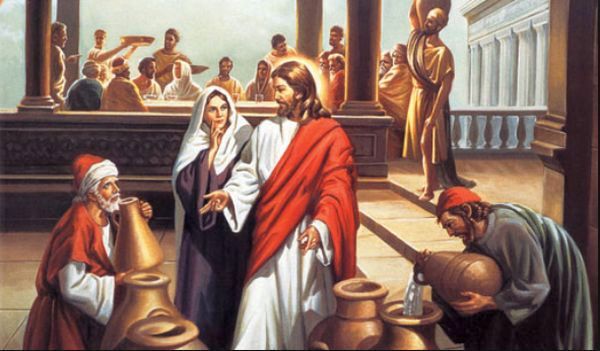
Mary went to Jesus and said simply, “They have no wine.”


Mary and the Wine


We aren’t told exactly what Mary was thinking. We’re not sure if Mary completely understand who her Son really was.  Certainly, He had always been responsible and reliable as a young man.  And with Joseph gone, she had learned to trust Jesus with the ordinary affairs of money and family.  But given Jesus’ response, she may have actually been looking for a miracle.


John had baptized Jesus and hailed Him as the Lamb of God and as the One who would pour out the Holy Spirit.  And, in fact, the Spirit had descended upon Jesus, and a heavenly voice had pronounced Him the Son of God.  Surely Mary had heard of all this.  And just as surely it would have resonated with the old memories and meditations she had locked up in her heart.  What was in Mary’s heart?


Well, what had the angel said?  “He shall be called the Son of the Highest, and the Lord God shall give unto Him the throne of His father David. … He shall be called the Son of God” (Luke 1:32, 35).  “Messiah the Lord.”  That’s what the angels had called Him to the shepherds.  “Born, King of the Jews,” the wise men had said.


Water Into WineHad the time finally come?  Was everything about to come together?  Did she need to give one little nudge?  Or maybe she simply needed help, and her observation veiled a motherly hint for action.


“They have no wine,” she said.


Jesus said, “Woman, what have I to do with thee?  My hour is not yet come.”


Whatever Mary may have had in mind, Jesus was now on His Father’s timetable.  His final revelation as Messiah lay three and half years in the future.  In the meantime, it wasn’t for Mary to dictate, however gently, how He should pursue His course to the cross and the throne.


In confidence, humility and meekness, Mary simply turned the matter over to Jesus and trusted Him for whatever resolution pleased God.  She told the servants, “Whatever He tells you to do, do it.”


Water Into Wine


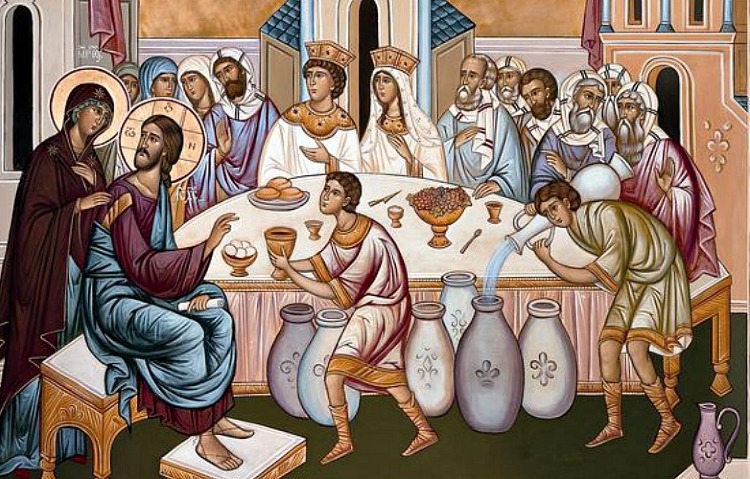
Jesus directed the servants to six large stone water pots.  These contained the water that the faithful used for ritual purifications.  Each could hold 20 to 25 gallons.  But the crowd had already used up a lot of the water.  So Jesus told the servants to fill the water pots.  They did… up to the brim.  Jesus told them to carry some of what was in the jars to the table master, the one who oversaw the banquet.  They obeyed.


When the table master tasted what the servants brought him, he immediately called for the groom.  He said, “Every man sets out his good wine at the beginning of the feast; then, when everyone’s had plenty to drink, he puts out the worse.  But you’ve kept the best until now!”  The groom, unaware of the miracle, didn’t know what to say.


This was the beginning of Jesus’ miracles, His first manifestation of His power and glory (John 2:11).  Scripture simply says, “and His disciples believed on Him.”


A Feast of Wines


The prophets had described the coming of Messiah through a great many figures and metaphors:  water, wind, and fire were among their favorites.  But another prominent, recurring image was that of festival, of banqueting, and every good feast involved lots of good wine.  Here are a few of the prophecies that connect Messiah with the free gift of celebratory wine:


And in this mountain, shall the LORD of hosts make unto all people a feast of fat things, a feast of wines on the lees, of fat things full of marrow, of wines on the lees well refined (Isa. 25:6).


Ho, everyone that thirsteth, come ye to the waters, and he that hath no money; come ye, buy, and eat; yea, come, buy wine and milk without money and without price (Isa. 55:1).


Behold, the days come, saith the LORD, that the plowman shall overtake the reaper, and the treader of grapes him that soweth seed; and the mountains shall drop sweet wine, and all the hills shall melt (Amos 9:13; cf. Joel 3:18).


It was no accident that Jesus began His ministry by providing an abundance of wine for a wedding.  The miracle was an open declaration that He was the Messiah and the divine Bridegroom. But not just that … also that the kingdom of God had come in power and that God was about to make all things new.  The sacrament He established just before His death said the same thing …  new and eternal life through the blood of the new covenant (Matt. 26:27-29).  But Jesus ordained wine for the sacrament (instead of blood) — wine for the celebration of victory.


As our Priest, Jesus has completed and perfected our atonement.  As our warrior King, He has defeated sin and death.  His work is done.  He has taken His throne (Heb. 10:11-14).  It is time to celebrate and rejoice.  He summons us to eat and drink with Him at His table in His kingdom (Luke 22:28-30; cf. Matt. 8:11).


The Lessons of the Miracle


Jesus’ first miracle displayed His power as Creator.  We aren’t told whether He called new carbon molecules into existence or merely restructured the protons of the existing hydrogen and oxygen molecules to make the water into wine.  It doesn’t matter.  This was a creative miracle.  Jesus is God.  Period.


Entertain Your Kids For HOURS On The Road — Without A DVD Player! Read More Here.


Jesus performed the miracle at a simple wedding, as the traditional wedding ceremonies remind us, saying of human marriage: “which holy estate Christ adorned and beautified with his presence, and first miracle that he wrought, in Cana of Galilee.”  At the beginning of the world He ordained marriage and gave away the bride (Gen. 2:18-25).  Now as the Divine Bridegroom, He blessed marriage anew and revealed Himself in and through it.


Water Into WineIn the wine miracle, Jesus displayed the stark contrast between His own ministry and that of John the Baptist.  “For John the Baptist came neither eating bread nor drinking wine” (Luke 7:33).  John majored in austerity and abstinence, traits appropriate for a nation that stood on the verge of destruction (Matt. 3).  But Jesus came to establish a kingdom whose marks are “righteousness, peace, and joy in the Holy Spirit” (Rom. 14:17).


To perform the miracle, Jesus used waters set aside for ritual purifications.  These were not washings that God had ordained, but ritual cleansings established by tradition (Mark 7:3-4).  Apparently unimpressed with Jewish tradition, Jesus swept it aside to rescue an ordinary wedding and ensure the happiness of two young lovers and their guests.


In this miracle, Jesus turned the ordinary into the extraordinary.  He could have left the wedding guests with water.  Certainly, water is life-sustaining.  He could have given them grape juice.  But He gave them wine.  He replaced the mundane with the extraordinary, the bland with celebration.  The good news is, He still does it with human lives today.


In the miracle, Jesus showed Himself the fulfillment of Old Testament prophecy and announced the advent of His kingdom.  He chose to work with images of joy, celebration, prosperity, and renewal.  This is not a Neo-Platonic kingdom locked up in our hearts, but a kingdom with real consequences in the real world.  “He comes to make His blessings flow far as the curse is found.”


Conclusion


It has been nearly 2,000 years since Jesus turned the water into wine.  Very few of the wedding guests knew or understood what He had done.  Jesus wasn’t trying to prove His identity or start an advertising campaign.  Jesus Christ is the living God who does wonders.  He is Life:  He makes all things new.  Those with faith and “eyes to see” will take comfort in the water into wine miracle.  Those without faith will see nothing but myth and superstition.  But then againv… such will not believe “though one rose from the dead.”


Dedicated To Jared Brewer, Who Makes Great Wine


For Further Reading:


Alfred Edersheim, “The Life and Times of Jesus the Messiah” (New York:  Longmans, Green, and Co., 1904).

Sunday, March 12, 2017

Is Christianity Essentially A Jail?

Is Christianity Essentially A Jail?

Image source: Pixabay.com


For many, living under the auspice of the Bible is not only seemingly impossible, but, perhaps, a ridiculous idea.


You know the story, don’t you? A young Christian at college gets invited to a party and says, “I just can’t go.” The organizer says, “Why not?” The Christian responds, “It’s not what I believe or follow.” It’s enough to make some believe that Christianity is too restrictive, rules-minded, and life-altering.


They may say, “Why should I follow something that will limit me?” Of course, the catch for our culture is that freedom is defined as having no restrictions — to shed all authority and discover what works best for you.


Ironically, that is exactly what biblical Christianity is all about – allowing you to discover what’s best for you. Following the risen Christ allows you to really thrive in the purpose God created you for (to glorify His name).


Awaken Your Child’s Love Of Learning And Put God Back Into History! Read More Here.


In John 8:31-38, Jesus unpacks two truths that help answer the question, “Is Christianity a jail?”


First, Jesus—God in the flesh—teaches that true, authentic freedom is found only in serving the living God. Serving” seemingly reeks with the chains of non-freedom. But freedom isn’t just throwing off any man-made restraints. It also comes from within:


“Jesus answered them, ‘Truly, truly, I say to you, everyone who practices sin is a slave to sin.’” (John 8:34)


In other words, we all work hard for something – success, romance, acceptance, achievement, materialism — that we think will fulfill us. And, instead, of us controlling whatever that is, that thing ends up controlling us.


But notice what Jesus says in John 8:35-36:


“The slave does not remain in the house forever; the son remains forever. So if the Son sets you free, you will be free indeed.”


Is Christianity Essentially A Jail?

Image source: Pixabay.com


The son has real freedom. But why is that? Because the son knows he is in union with the Father. No matter what we may chase in this life, nothing can replace the fact that we are created for God and His purposes. Moreover, the son also knows that the Father best recognizes the way he should live. The world claims that true freedom is experienced by whatever we want. Yet, Jesus Christ says that His freedom is doing what you were created to do—following Him.


Real freedom is found only in serving the living God. Freedom isn’t just living independently. We all long and cling to something—known or unspoken. That thing becomes our master and lord. The world says freedom isn’t having a boss or master. Jesus says that true freedom comes with acknowledging and having the right Master.


Secondly, the biblical Gospel alone sets you free. Let’s be honest—when you don’t live in the Father’s house mentioned above, then yes, the Father’s house is going to be like and feel like slavery. We become resentful of being in such a home and look for “greener pastures” and a chance to get away.


Notice Jesus’ words in John 8:37-38:


“I know that you are offspring of Abraham; yet you seek to kill me because my word finds no place in you. I speak of what I have seen with my Father, and you do what you have heard from your father.”


Jesus wants to give us back the heart of the son in this passage. A son who trusts, loves and follows his Father. One that is like the Father in all respects and loves what his Father loves. You need the Holy Spirit of God to change your heart, not more resolutions or plans to “do better.” You need to be absolutely overcome by Jesus’ love for you and what He did for you in the Gospel.


For many who are reading this, going to church and trying to live the Christian life does feel like drag. They reason many believe that Christianity is restrictive is because they’ve never accepted Jesus’ free offer of forgiveness by repenting and believing the Gospel.


Remember Jesus’ words in Matthew 11:28:


“Come to me, all who labor and are heavy laden, and I will give you rest.”


Life isn’t a “cake walk” with Jesus. But He will sustain you and satisfy you under any burden.


So, make a choice today: Would you rather have a burden or the right master? I don’t know about you, but the biblical Jesus is my desire, not a burden. Only is Him can true, non-restrictive freedom found.


What is your choice today?


Entertain Your Kids For HOURS On The Road — Without A DVD Player! Read More Here.

Sunday, March 5, 2017

Why Did Jesus Say He Didn’t When He Would Return?

Why Did Jesus Say He Didn

Image source: Pixabay.com


In Mark 13:32, Jesus says, “But concerning that day or that hour, no one knows, not even the angels in heaven, nor the Son, but only the Father.


But wait, isn’t this Jesus, the God-man? How does the very Son of God not know when He will return? Doesn’t this show He isn’t God?


Each of these, at first, are very valid questions. It’s also worth noting that his isn’t the first time Jesus is described with restrictions. Luke 2:52, for instance, says Jesus “increased in wisdom and stature.” The book of Hebrews says that “though he were a Son, yet learned he obedience by the things which he suffered.”


Let’s be clear: Scripture teaches that Christ had to be fully God to represent God to men, and be fully man to represent man to God (Col. 2:9; John 1, etc.). He’s 100 percent God and 100 percent man!


To save us from the Father’s due wrath upon us, He had to be both. If He wasn’t a man, he couldn’t have died in our place as a substitute. If He was not God, He would have been just like you and me—that is, unable to defeat the power of sin and death and satisfy the Father’s wrath as a perfect sacrifice.


Awaken Your Child’s Love Of Learning And Put God Back Into History! Read More Here.


Throughout His life, we see glimpses of both natures.  For instance:


  • Because He was human, He got thirsty (John 19:28). But because He was God’s Son, He could turn water into wine (John 2:1-13).

  • Because He was human, He got hungry (Mark 11:12). But because He was God’s Son, He could feed 5,000 hungry people (Mark 6:30-44).

  • Because He was human, He became weary (John 4:6). But because He was God’s Son, he was raised from the dead (Matthew 28:1-15).

Why Did Jesus Say He DidnAnd, to answer the question posed at the beginning, because He was human, He didn’t know the day or the hour of His return. But because He is God’s Son and fully divine, He promised He would return with great power and great glory.


In other words, while on this earth, Jesus willingly emptied Himself of many of His divine powers (Philippians 2:5-11). The Greek word is kenosis, which literally renders as “emptying.” In His human nature, Jesus has limitations like you and me.


In short, the reason Jesus doesn’t know is because, in His humanity, He “emptied himself” of all that knowledge and access to it.


Entertain Your Kids For HOURS On The Road — Without A DVD Player! Read More Here.


But here’s the bigger question: Are you ready for Jesus’ return?


Here are four questions to ask yourself.


  1. Are you spiritually alert? How would your life be different if you knew Jesus was coming back today? Wouldn’t it make you question, “Am I ready? Am I living to please him?” For many reading this, the ultimate question is, “Is your soul ready for Jesus to return? Have you repented and believed the Gospel (Mark 1:14-15)?”

  2. Are you urgently on a mission? If you knew the world would end, how would your priorities be rearranged? We are consumed by work, possessions, hobbies and bucket lists. And there’s nothing wrong with these things. We need rest and recovery and we have to work! But in the midst of these things, are we investing our life, time and resources to eternal matters?

  3. Do you find hope in your most intense suffering? Suffering is a reminder that this world is not the way it is supposed to be. The world is full of unfathomable evil and suffering. The Lord is full of unending love and comfort. If someone you loved died of cancer, if your closest relationship is severed, or if your body is full of pain, you can lift your eyes! Jesus is coming back. His return promises us that the things of this life are only temporary.

  4. Do you have an intense power to forgive? If you believe Jesus will return as He said He would, then you can forgive as He commanded. At the return of Christ, He’s going to set all things right, and we can endure until then because of that fact.

May we long daily for heaven, pray daily for Christ’s return, and live daily content and joyful as we rest daily in the sovereignty of God.

Sunday, February 19, 2017

The First Temptation of Christ

Off The Grid Theology

The First Temptation of Christ


Want. Take. Have.


Buffy the Vampire Slayer, “Bad Girls” (1999)


. . . Miracle, mystery, and authority.  Thou hast rejected all three and hast set the example for doing so.


—Fyodor Dostoevsky, The Brothers Karamazov (1879)


In the Wilderness


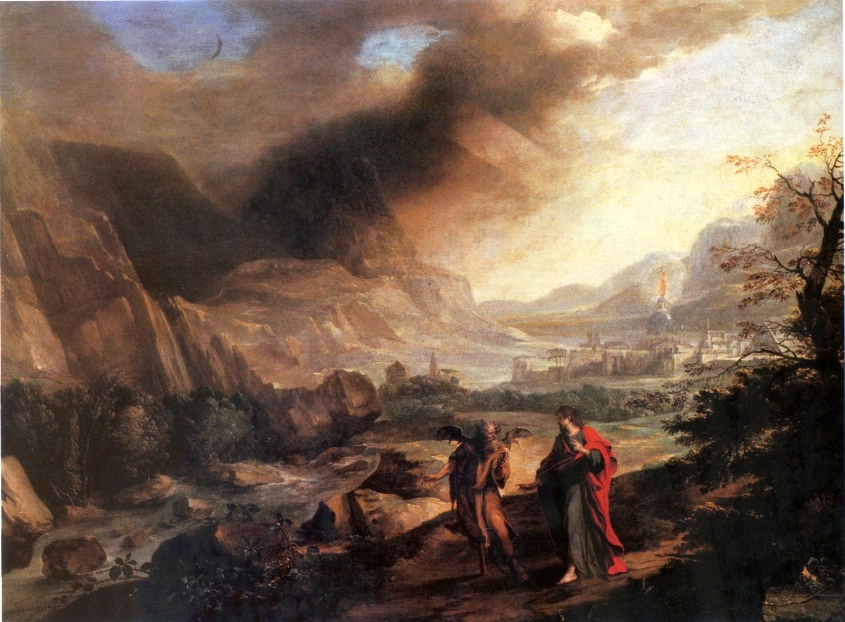
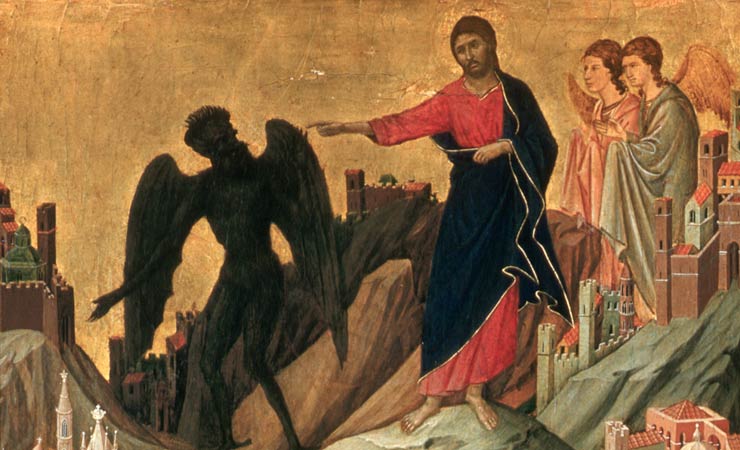
After the Spirit descended upon Him, Jesus went immediately into the wilderness.  He was there, fasting, for 40 days and 40 nights.  All the while, Satan tempted Him to abandon His mission (Luke 4:2).  He tempted Him to trade obedience to His Father for the glories of self-will and self-affirmation.  As the days wore on and the trial drew to an end, Jesus’ health and strength began to fail.  Satan then appeared to Him in visible form and made three last assaults on His ultimate trust in His Father.


Scripture insists that these temptations were real and that there was, in each of them, something that would appeal to Jesus’ human nature (Heb. 4:15).  It’s important to understand that Jesus was truly human.  Huge deal.  In addition, He is also eternal deity.  Huge deal, too.  The truth is, the psychology of all this is tough for mortals to process.  As the Son of God, Jesus was both omniscient and omnipotent.  He upheld creation and decreed its end from its beginning.  As a true man, He grew, learned, and suffered.  So, as days of temptation turned into weeks, He could feel the full effects of hunger, exposure, and exhaustion.  And so, in His humanity, Jesus felt the full force of Satan’s arguments.  He really was tempted in all points like we are, and yet He never yielded to the temptation.  He did what His mission required, never turning away from His Father’s will.


Satan’s Attacks


Satan struck first at Jesus’ very real need to survive.  “If you are the Son of God, command that these stones become bread.”  The force of this temptation was simple enough …  if you die here and now, it’s all for nothing and your whole mission goes south.  Fail in your mission and you fail your Father and your people.  That said, survival becomes job No. 1, right? If you are who you claim to be, accomplish phase one of your mission by living to fight another day.  Make bread out of these stones.  Use your miraculous powers to save your life and the lives of those who will follow after you. Focus on the ends, not the means.


Satan struck next at the path to the cross.  In a moment of time he showed Jesus all the kingdoms of the world and their glory.  All these, he said, I’ll turn over to you if you fall down and worship me (Rev. 13:4).  In other words, Satan was offering to withdraw all opposition to Jesus’ mission.  Fascinating.  There would be no resistance, no sufferings, no cross.  But not just that, there would be no persecution for His followers, either.  No lions, no stakes, no martyrdom.  Satan would support Jesus’ claims to sovereignty, and no Christian would ever have to suffer for his faith.  Jesus could have it all simply by admitting that Satan’s perspective made pragmatic and existential sense.


Awaken Your Child’s Love Of Learning And Put God Back Into History! Read More Here.


Finally, Satan struck at the actual definition of the mission.  People, he implied, are a tough sell.  They’re not going to buy in to your mission on your word alone.  They need real reasons to believe.  They need evidence.  Give them some.  Jump from the pinnacle of the Temple.  The God you call your Father won’t let you die.  He’ll send angels to catch you, land you and get you safely among “credible” witnesses … the Pharisees and Sadducees.  With those kinds of witnesses and that kind of buzz, everyone in the Temple precincts will know beyond a doubt that you are the Messiah!  And to punctuate this third argument, the devil quoted Scripture: “For he shall give his angels charge over thee, to keep thee in all thy ways.  They shall bear thee up in their hands, lest thou dash thy foot against a stone” (Ps. 91:11-12).  In this version of Satan’s plan, the Temple and the scriptural promise of the supernatural “safety net” were to launch the ministry in a big new way. It would be the “P.T. Barnum” way.


What Would Jesus Say?


The First Temptation of ChristJesus had walked His prescribed path all His life.  He knew His Father’s word.  It was indelibly stamped on His heart (Ps. 40:8).  When He responded to each of Satan’s attacks with Scripture, He didn’t speak like a child who, from a memory that has been crammed with Bible verses simply spits out the necessary, parent-pleasing responses.  He spoke from a firm, heart-felt commitment to the power of God’s Spirit.  And He spoke as the eternal Son of God.  There was no word-magic here, only a firm and full commitment to God the Father.


Satan’s first temptation was addressed to the desires and needs of the physical body.  Satan had tried to place these bodily needs above the very word of God.  But in words borrowed from Deuteronomy (8:3), Jesus said, “It is written, Man shall not live by bread alone, but by every word that proceeds from the mouth of God” (Matt. 4:4).  Jesus didn’t deny that man needs bread and food to live, but He insisted that obedience to the words of God was a far greater need.  Man doesn’t need to merely live … man needs … first and foremost … to obey God.


Satan’s second temptation appealed to man’s desire for possessing the big, the shiny and the beautiful.  Man sees, wants, and takes often without any regard to God’s law.  Jesus could have all the kingdoms of the world immediately, Satan said.  No delayed gratification necessary.  No killing the will to self. All He had to do was admit Satan’s underlying and most fundamental premise …


The right to challenge divine authority. Simply stated… men can be as gods.  But Jesus responded with: “It is written, you shall worship the Lord your God, and Him only shall you serve” (Matt. 4:10).  The universe functions in terms of God’s law and His decree.  There are no other gods, no other sovereigns.  Man must acknowledge God as the only true source of legitimate authority.  His Word alone is the only legitimate explanation of reality.  And with respect to man’s place in all of this … true authority comes from submission to God and His law.


Satan’s third temptation aimed at human pride.  Man wants celebrity status.  He wants attention, acclaim, admiration … and he wants it now.  Just like Veruca Salt in the original Willy Wonka movie, who wanted to be the first to find the golden ticket and wanted an Oompa Loompa pretty quick, too. But that was mild compared to vanity and pride offered in the place of worshiping God.  Again, Jesus answered Satan with Scripture: “You shall not tempt the Lord your God” (Matt. 4:7).  God’s promises are not to be a launching pad for our own private plans and pleasures, our own pursuits of glory.  Man’s chief end is the glory of God.  And we are created for precisely that.


Three Deceptive Hooks


The lust of the flesh, the lust of the eyes, and the pride of life.  This is how John sums up the lifestyle of the world apart from God (1 Jn. 2:16).  These were the three hooks with which Satan tried to deceive Jesus and if “sold separately and without responsibility” are the ones he throws at us.  These were also the big three hooks that Satan used in the Garden against Eve:


“And when the woman saw that the tree was good for food, and that it was pleasant to the eyes, and a tree to be desired to make one wise, she took of the fruit thereof, and did eat, and gave also unto her husband with her; and he did eat.” (Gen. 3:6).


Here’s what’s important:


This threefold hook is directed at man’s threefold office, that of prophet, king, and priest.  Satan would have man put his bodily needs and desires over the (prophetic) Word of God.  He would have him seize (kingly) power and dominion without regard to the law of God.  He also would have mankind seduce and abuse others in an anti-priestly bid for prominence and pride.


Entertain Your Kids Hours On The Road — Without A DVD Player! Read More Here.


The First Temptation of ChristBut since man is always prophet, king, and priest … every temptation appeals in a greater or lesser degree to all of these at once.  In other words, every temptation appeals in some measure to the lust of the flesh, the lust of the eyes, and the pride of life.  And every sin is a surrender of our hearts and souls … to the power of Satan and self.


Victory Over Satan


All of Satan’s temptations implied a kind of soft-and-easy-to-digest “marketing message” for Jesus and those who would follow Him.  He encouraged Jesus to use miracles to save life, power to establish His kingdom, and mystery to gather a following.  Miracle, authority, and mystery.   These are exactly the words Fyodor Dostoevsky uses in “The Grand Inquisitor” section of The Brothers Karamazov (1879).  In this parable, the Grand Inquisitor, like Satan before him, berates Jesus for failing His people, for not loving them enough.  Of course, Satan and his messengers regularly pose as angels of light.


But Satan’s worldview assumes that man’s biggest problem lies in his current situation or condition. This could be found either in the outside world around him or even in his own current physical or psychological status.  But how can we turn the misuse of miracle, authority, and mystery into something we can use?


Here’s the thing that should immediately grab us and is the very bottom line:


Our true problems are NOT environmental or psychological.  Our real problems are ethical and judicial.  Our natural, unbridled impulses push us to be ethical rebels against God’s law and we then find ourselves under His temporal curse.  The truth is, no miracles, no heavy-handed tyrannical power, no slick and seductive mysticism carry any real meaning and authority.  They’re only the devil’s lies.  Jesus knew this, and He rejected every and all options except a very painful but obedient walk toward Calvary.  He set His face toward the cross.  He trusted His Heavenly Father.  He obeyed the Word of God, and Satan fled. That’s the only formula that makes Satan flee.


Then God intervened.  Angels came and ministered to Jesus.  He was in the wilderness with the wild beasts, and for a moment Paradise was restored (Mark 1:13).  It was Jesus’ ethical obedience that won this battle.  But the war had only begun.  There would be fierce, future engagements.

Sunday, January 15, 2017

Crazy Voices Crying In The Wilderness

Off The Grid Theology

Crazy Voices Crying In The Wilderness


For the herald’s voice is crying / in the desert far and near,


calling all to true repentance / since the kingdom now is here.


—Johann Olearius, “Comfort, Comfort Ye My People” (1671)


Alone of all the prophets, John hailed the Lamb who takes away the sin of the world.


—The Church of England, Common Worship (2008)


The Voice


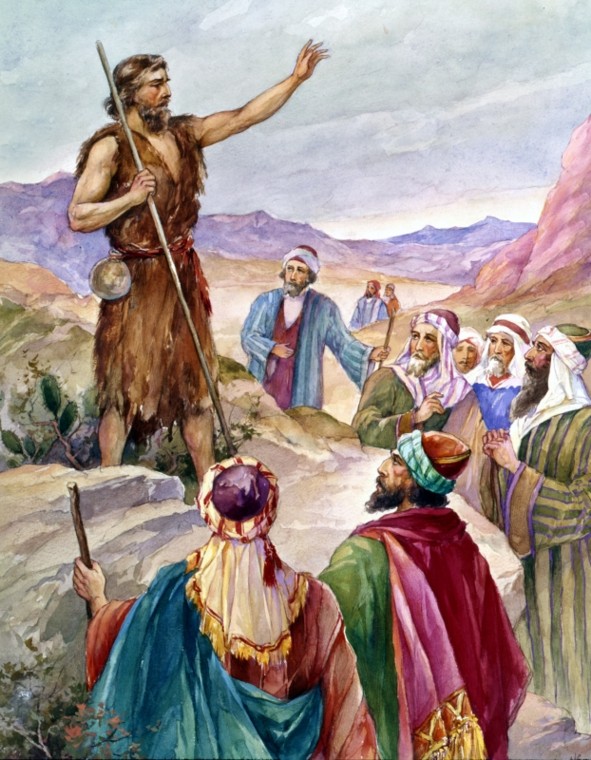
He came out of the wilderness.  His hair was long and caught up in seven braids.  He wore camel’s hair clothes, rough and not so fashionable.  He tied it together with a leather belt.  Locust was his superfood and he preferred wild honey to Stevia.  His name was John.


He cried with a loud voice.  Anywhere he could.  From a bluff.  From big rocks.  From a rise along the riverbank.  Wherever there was a makeshift camp, a passing caravan, a crowd gathering at a waterhole … suddenly he would appear, and he would lift up his voice and cry:


“Repent!  For the kingdom of God is at hand.”


Kingdom of God?  The people knew those words.  Daniel the prophet had spoken of a kingdom the God of heaven would set up in the latter days (Dan. 2:44).  Kingdom of God.  Kingdom of heaven.  The kingdom of the coming Messiah.


The Messiah.  Could the Messiah be John himself?  Was he the promised King?  Or was he perhaps some other figure out of a distant prophecy?  Elijah was supposed to come as the Messiah’s herald (Mal. 4:5).  And, if anyone could pull off the look and feel of Elijah, it was John.


Then again, Moses had spoken of a great Prophet, the greatest Prophet, who would speak all of God’s words, do great signs and wonders, and know God face to face (Deut. 18:15-19 and 34:10).  Maybe this man was He.


Christian Heroes For Christian Kids: These Stories Are Putting God Back Into History!


Whoever he was, his message bit the soul with great force.  He called the religious leaders “a generation of vipers” — “the seed of the Serpent.”  He called all of God’s people to turn from their sins, not in word only, but most especially in deed.  “Bring forth fruits appropriate for repentance,” he demanded.  And he did something else.  He summoned men and women alike to baptism, a cleansing rite that the prophets had associated with Messiah.


More and more people flocked to the wilderness to hear this man preach and — before long — he established himself on Jordan’s banks where Israel’s religious leaders could easily find him.  It was only a matter of time before they showed up.  Church police.  He was an outside voice in religious matters and a potential rival to their authority.  They came to examine his credentials, to see what he would have to say for himself.


“Who are you?” they demanded.  “The Messiah?”  Not that they would have believed him if he had said yes.  “Or are you Elijah?”


“Nope,” he answered to all three.


“Who are you, then?  We need to give an answer to those who sent us.”


And John said: “I am the voice of one crying in the wilderness, ‘Make straight the way of the LORD,’ as the prophet Isaiah said.”


“Then why are you baptizing if you’re not the Messiah or Elijah?”


Keep in mind … baptism was an Old Covenant concept and ordinance (Heb. 9:10; Num. 19).  That’s why the theological experts didn’t ask, “What are you doing?” but rather, “Why are you doing it?”  The baptisms they knew mostly pertained to certain Jewish sects in the area. But they knew there was another baptism, one that was both Messianic as well as eschatological (Isa. 52:12; Ezek. 36:25).  But who was John that he should offer it?


“I indeed baptize you with water unto repentance,” John said, “but He who comes after me is mightier than I whose sandals I am not worthy to bear.  He will baptize you with the Holy Spirit . . . and with fire.”


John’s Baptism


We’ve all heard it in Handel’s Messiah:


The voice of him that crieth in the wilderness, Prepare ye the way of the Lord, make straight in the desert a highway for our God.


Ev’ry valley shall be exalted, and ev’ry mountain and hill made low; the crooked straight and the rough places plain.


And the glory of the Lord shall be revealed, and all flesh shall see it together: for the mouth of the Lord hath spoken it.


The words come from Isaiah 40:1-5.  The voice is that of John the Baptist.  God was about to manifest His glory before all flesh, and He chose this particular man to serve as His voice.


John was the son of a priest and a Nazarite from birth, a birth that had been foretold in the Temple (Luke 1:5-22).  He came “in the spirit and power of Elijah” to prepare Israel for the Messiah’s coming (Luke 1:17).  His message was one of glory and judgment.  The kingdom of heaven, the redemptive rule of God through His Messiah, was about to explode into history with news of the King.  John’s message regarding the new King posed a challenge to all men, beginning with Israel:  Will you submit obey and be faithful or will you be a rebel?


Crazy Voices Crying In The WildernessJohn hit a nerve.  Submission requires repentance.  Men must acknowledge their transgressions of God’s law and turn away from them.  The King required action, visible fruit.  Mere “bloodline” descent from Abraham meant nothing: “God is able of these stones to raise up children to Abraham,” John said.  He pictured the King, the Messiah, standing at the threshing floor that was Israel with a winnowing fan already in His hand.  This Messiah would separate the chaff from the wheat:  He would gather the wheat into His barn and burn up the chaff with unquenchable fire.  The Judge was knocking at the door.  Israel … each Israelite … must make a choice.  The consequences would be eternal.


Those who professed repentance, John marked with baptism.  Baptism pointed to cleansing, to new birth and resurrection (Ps. 51:7; Ezek. 36:26-27; Titus 3:6).  It was a sign and seal of the work of God’s Holy Spirit.  The Messiah was coming to baptize Israel with God’s Spirit or with the fires of God’s wrath.  There could be no neutral ground.  Those who would repent and receive their King would have the gift of the Holy Spirit (Acts 2:38).  Those who rejected repentance, who continued in their self-righteousness, would face temporal and eternal wrath.  (The destruction of Jerusalem, with all its horrors, was little more than 40 years away.)


Behold, The Lamb Of God!


John’s first work was to call Israel to epistemological self-awareness.  Each Israelite needed to know his own sin.  And each needed to repent.  John’s second work was to introduce the Messiah Himself.  And so one day, John saw his cousin Jesus coming to Jordan for baptism.  John knew Him for who He was, and he tried to put Him off, “hey wait a minute … I need to be baptized by You, and are You coming to me?”


But Jesus insisted.  For though He had no sins, He needed to be identified with His people, and He needed to be set apart to His priesthood by one already a priest (Matt. 21:23-27).  And so John baptized Jesus in the Jordan.  As Jesus came up from the river, the heavens opened, the Spirit of God, dove-like, descended upon Him, and the Father in heaven said, “This is my beloved Son, in whom I am well pleased” (Matt. 3:16-17).  And so, baptized and anointed, Jesus of Nazareth, the Son of God, became the Christ, the Anointed One, the Prophet, King, and Priest of divine redemption.


It was about this same time that John pointed to Jesus and called out, “Behold the Lamb of God, who takes away the sins of the world!”  And here is the last puzzle piece.  How can a sovereign and holy God forgive sinners?  Good works have no merit.  Repentance has no merit.   Man has broken God’s law, and God is rightly offended.  His wrath is just and inevitable.  Unless …


“The Lamb of God.”  A sacrifice.  A substitute.  One whose life is of infinite value.  One who in His own body and soul bears the wrath of God against sin in the place of His people.  To repent, then, means to embrace the Lamb, to trust His shed blood, to find in Him new life and the power for obedience.  Entry into God’s kingdom lies through the blood of the Lamb.


A Dying Voice


John died a martyr’s death for condemning King Herod’s marital sins (Matt. 14:3-12).  Jesus said he was the greatest of the Old Testament saints, the greatest of the prophets.  But John got to see Jesus, his Messiah.  He had the amazing privilege and responsibility of introducing Him to Israel.  And yet, Jesus said, “the least in the kingdom of heaven is greater than he” (Matt. 11:11).  John still operated in the shadows of the Old Covenant.  He didn’t live to see the cross or the empty tomb.  He didn’t live to Pentecost.  The blessings of New Covenant life far surpass even the glories of John’s ministry … because the King has come.  The kingdom of heaven, then and now, is a reality.

Sunday, January 8, 2017

Wise Men From The East

Off The Grid Theology

Wise Men From The East


And lo, to their great surprise, the star which they saw in the east then appeared . . ..


—John Gill, Exposition of the New Testament (1746-8)


Nothing will awaken those that are resolved to be regardless.


—Matthew Henry, Commentary on the Whole Bible (1712)


Where Is He . . .?


When Jesus was born in Bethlehem of Judea in the days of Herod the king, there came Magi, stargazers, from the East to Jerusalem.  These wise men weren’t from the Orient.  They most likely came from Persia.  They weren’t kings, and Scripture doesn’t say how many of them there actually were.  But certainly, their arrival was enough to get Jerusalem all wound up and draw the attention of the whole city to their one question:  “Where is He that is born King of the Jews?”


There was no ambiguity in the question.  The wise men weren’t asking after recently born “princelings” in general.  They weren’t asking about a child who would one day become a king.  They were looking for the One whose very birth made Him the King of Israel by divine right.  They were looking for the Messiah.


Everyone who heard their question understood its significance.  These wise men claimed that the Messiah had already been born.  They further claimed to have astral evidence:  “We have seen His star in the East and are come to worship Him.”  We don’t know exactly what they saw, but the few details given in Scripture are only beginning to match up with the conjunctions, comets, and super novae that we’re familiar with.  Whatever the nature of the star, these wise men were sure that it was a sign from the God of heaven.


The Magi came to the court of Herod the Great.  It was the obvious place to begin.  Herod, after all, was king of Judea.  If the newborn Child wasn’t his, he would certainly know where to find it.


But Herod didn’t know.  Aside from some itinerant shepherds, no one with first-hand knowledge had made any announcements.  The Magi’s star had gone unnoticed or at least unappreciated.  Still, Herod believed the Magi.  For political reasons, Herod had converted to Judaism and learned its rhythms.  He knew its structure and basic theology.  He knew the prophecies and understood the hope of Israel.  And one thing was certain beyond doubt … he wasn’t about to let it interfere with his reign.  While politely putting the wise men on hold, he summoned the chief priests and scribes (the authorities on Jewish Scripture) and demanded of them where the Messiah would be born.


Christian Heroes For Christian Kids: These Amazing Stories Put God Back Into History!


They knew, of course.  All Jews knew.  The prophet Micah had given the location 700 years earlier.  “In Bethlehem of Judea,” the priests said, and they paraphrased his prophecy:


And thou Bethlehem, in the land of Judah, art not the least among the princes of Judah: for out of thee shall come a Governor, that shall rule my people Israel (Matt. 2:6; cf. Mic. 5:2).


Herod went back to the wise men and enquired about elapsed time.  When had they first seen the star?  Then he pointed the wise men toward Bethlehem, a small village about six miles south of Jerusalem.


“Go and search diligently for the child,” Herod said, “and when you have found Him, bring me word again that I may come and worship Him also.”


The wise men were completely taken in.  But at this moment Herod’s much-vaunted political acumen wholly failed him.  He offered the Magi no guide, sent no escort, ordered no spies or surveillance teams.  He sent the wise men off on their own and trusted these strangers to be his eyes and ears.  No doubt, he commended himself for his cunning and craftiness.  The wise men set out.


And no one followed them.  No one at all.


Wise Men From The East

Image source: Pixabay.com


As the wise men journeyed south, the star they had seen in the East suddenly reappeared and led them through the dark night to Bethlehem.  There, it stopped and shed its light on one very specific house.  A house, not a stable.  Remember, months had passed since Jesus’ birth.  Joseph had found his family a real house and had probably picked up work of some kind.  He was away when the Magi first arrived, so when the wise men entered the small home, they found only the Child with Mary his mother.  Immediately, they fell to their knees and worshipped the infant King.  Then they unpacked their gifts and presented them:  gold, frankincense and myrrh.  Princely gifts, indeed.


The hour must have been very late because the wise men didn’t attempt the fairly short return journey to Jerusalem.  Instead, they found a place to unburden their camels and set up their tents for a quick night’s sleep.  But hardly had sleep fallen upon them before God’s word burst through into their dreams with a solemn warning …  they must not return to Herod.  Treachery and danger were the heavy implications.  The wise men rose, packed up their things, and fled from Bethlehem and Judea.


Then the angel of the Lord entered Joseph’s dreams with a more specific warning and admonition.  “Rise, take the child and his mother, and flee to Egypt, and remain there until I tell you, for Herod is about to search for the child, to destroy him” (Matthew 2:13).


And so, Joseph gathered his small family and immediately headed for Egypt.  The gifts of the Magi would fund the flight and their time away.


It didn’t take Herod too long to realize what was happening.  The wise men had betrayed him and he would entertain no more indirect approaches.  In a rage, he sent his soldiers with orders to kill all the children under two near Bethlehem.  The soldiers obeyed zealously.  And Bethlehem wept as the prophets had foretold.  Another night, not so silent, not so calm.


Only The Wise Men Went


Herod was a cagey political realist.  He understood the political implications of Jewish theology as well as anyone in the kingdom.  Before a divine King, all earthly kings would have to bow.  To a divine King, all temporal rulers must pay homage.  If the infant Messiah lived, Herod would be obligated, sooner or later, to conform to his policies, laws and prescribed way of life.  Herod would rather murder a bunch of babies than accept such terms.


Be Prepared: Get The Ultimate In Portable Backup Power!


The priests and scribes, on the other hand, lived in a dichotomy of practical occupation. That, versus a vague fairytale religion of “Bible people, Bible stories, Bible times.”  Oh yes, they knew the prophecies.  They knew the promises.  They knew the theology, all too well.  But it never occurred to them that the implications of this theology would radically uproot their own world in the blink of an eye and set them on a collision course with some pretty big players. And that it would begin with their own personal agendas and turf battles.


You see, the priests were in bed with Rome.  In fact, they worked hard to maintain their position, power and wealth all while balancing a necessary allegiance to Rome.  The scribes, mostly Pharisees, majored in secular moralism and religious manipulation.  They strained at theological gnats while swallowing moral camels, all the while basking in the admiration of God’s poor.


Here’s what’s so often overlooked:


Despite their knowledge of Scripture, neither the priests nor the scribes made the obvious connection from “Messiah is born” to “Let us go and worship Him also.”  When the wise men set out for Bethlehem, not a single Jewish theologian went with them. Interesting.


Then there was the city itself.  When the Magi’s question was made public, the populace fell into confusion, fear and tumult.  What did it all mean?  What would Herod do?  What would this mean for relations with Roman?  For religious coexistence?  For market prices?  No doubt, this created a great deal of buzz on the streets. But not one of God’s covenant people came to the wise men and said, “Look, I’m in, wherever you guys go, I’m going.”


The wise men, of course, had come a long way.  They brought expensive gifts.  They crossed a desert.  They advanced into a strange culture, into a political situation full of intrigue and treachery.  All to ask one, very important question.  They risked everything to see the culmination of 4,000 years of prophecy and hope.  They risked everything for a few brief, if expensive, moments of worship.  And then they went home.  Fascinating.


One More Thing


We’ve all sung the carol called “The Twelve Days of Christmas.”  But few people realize that the Twelve Days of Christmas doesn’t end with December 25.  That’s where it begins.  It ends on January 5 Twelfth Night. The next day is Epiphany, a feast that celebrates the revelation of God in human flesh and, more particularly … the revelation of Christ to the Gentiles.  The focus of which, at least for Western churches, is the visit of the wise men to the baby Jesus.   The Book of Common Prayer gives us this prayer for the day:


O God, who by the leading of a star didst manifest thy only-begotten Son to the Gentiles:  Mercifully grant, that we, which know thee now by faith, may after this life have the fruition of thy glorious Godhead; through Jesus Christ our Lord.  Amen.


Think about this: How much will we give up, how far will we journey, how much will we risk, what crazy culturally driven thoughts and misconceptions will we abandon in order to see God made flesh in Jesus Christ? And then if we find Him, will we worship Him?  After that …. how, then shall we live?