Showing posts with label Christianity. Show all posts

Tuesday, April 24, 2018

The Testimony of Heroes

“It is our job to tell the stories. Tell your students what a difference people of courage and nobility and genius have made to the world. Just tell the stories!”


—Scott LaBarge, “Why Heroes Are Important” (2000)


A Cloud of Witnesses


Most Christians are familiar with the sports analogy that begins in Hebrews 12. The writer challenges us to lay aside the weights that might slow us down and run our race with patience and with our eyes fixed on Jesus Christ. The race here is the Christian life. As an encouragement to us all, the writer reminds us that we are surrounded by a great cloud of witnesses. The witnesses are all the great heroes of faith described in chapter 11.


It would be easy to fill out the sports analogy and think of these great men and women as spectators who are watching us and cheering us on. But that’s not what the word “witness” actually means. A witness (martyr) is someone who can give legal testimony to something he has seen or heard. Those who make up the great cloud of witnesses aren’t bearing witness about us. They, by their faith and actions, have borne and continue to bear witness to the faithfulness of God. They are His witnesses.


This idea of giving and receiving testimony runs throughout Hebrews 11. The “elders”—all the saints of old—“received a good report,” honorable testimony, through their faith. By faith, Abel offered the right kind of offering to God and so “received a witness that he was righteous, God testifying of his gifts” (v. 4). Enoch walked with God, and God took him straight to heaven, but before that translation “he had this testimony, that he pleased God” (v. 5). The writer goes on to mention Noah, Abraham, Sarah, Isaac, Jacob, Joseph, Moses, and others. He says they all “obtained a good report through faith” (v. 39). That is, God bore witness to their faith, the faith that He Himself had given them.


Notice the shift, though. In Hebrews 11 it is God who gives the good report to His servants. In chapter 12 these same servants are witnesses to us of how God keeps His promises, of how He rewards those who believe.


The Heroes of Faith


Abel bore testimony to the gospel by bringing God a slaughtered lamb. Noah testified to God’s promise of coming judgment by building a huge boat on dry land. Abraham testified to the reality of the New Jerusalem by forsaking his own city and setting out for a land he knew nothing of. Moses parents testified to God’s promises by hiding their infant son from the civil authorities. Moses testified to the reality of Christ by choosing persecution and exile over the throne of Egypt. Rahab testified to the grace of God by committing treason against her city and her gods. In each case, the testimony sprang from faith in the promises of God.


The testimony of the saints is always to the grace and promise of God, never to their efforts or accomplishments. But the faith and actions that constitute that testimony brings forth God’s own testimony to the world: These are My servants, He says; these are My friends: they are righteous … righteous through Jesus Christ.


Why We Need Witnesses


Scripture tells us that we are to believe the testimony of two or three credible witnesses (Deut. 19:15; Matt. 18:16). God gives us many, many witnesses to His faithfulness. He gives us such witnesses because we need them. We need them for inspiration and encouragement. We need them as examples. We need to see how others ran the same race and how God sustained them during difficult and dangerous times. We need to see what faith looks like as others lived it out—both in circumstances like our own and in circumstances different from our own.


Some might object to the word “need.” We have Christ presented to us in the preaching of the gospel and the sacraments. How can we rightly say that we need anything more? There are at least three ways to answer this.


First, while it is true that Scripture emphasizes the preaching of the gospel and the sacraments as the primary means of grace, God also provides other things to help us grow in grace: Bible reading, prayer, meditation, fellowship, and, yes, the example of others. All of these point us back to Christ, who purposes to save men by “the foolishness of preaching” (1 Cor. 1:21) or “the hearing of faith” (Gal. 3:2). But each is more than a mere repetition of last Sunday’s sermon. Each has a depth and texture that goes beyond the exact words of the pastor’s previous message.


Second, when we speak of others as examples, we ought to be speaking evangelically. That is, the men and women whom God holds up to us as examples were themselves living out the gospel. They had Christ as the goal of their earthly race, just as we do. They believed the promise of God concerning the Messiah, and they moved, however imperfectly, in terms of that faith. When we look to these saints, we ought to see Jesus. When we reduce their lives to mere moralisms, then we have mistaken their lives altogether.


Third, Scripture repeatedly holds up other believers as examples for the rest of us. In Philippians Paul writes, “Brothers, join in imitating me, and keep your eyes on those who walk according to the example you have in us” (Phil. 3:17, ESV). He also exhorts Timothy, a young pastor, to “be an example to believers” in word, manner of life, love, spirit, faith, and purity (1 Tim. 4:12). Peter says that all elders ought to be examples to their flocks (1 Pet. 5:3). James includes all the Old Testament prophets as examples of suffering and patience: he specifically mentions Job (Jas. 5:10-11). But in all these commands there is an implied qualification. Paul makes it explicit when he tells the Corinthians, “Be ye followers of me, even as I also am of Christ” (1 Cor. 11:1). We are to follow others as we see Christ in them, as we see them living out the gospel.


Witnesses as Heroes


Why did the writer of Hebrews choose the men and women he did? Why do we call these saints “heroes”? There are no doubt many reasons, but here are two. First, these saints all fit the argument of the book. Hebrews was addressed to Jewish believers who needed to abandon the Old Covenant for the New. They needed to give up the religion they thought they knew to follow Christ. They had to give up Jerusalem for the New Jerusalem. But their allegiance to the gospel was proving difficult: persecution had begun. Each saint the writer picks as an example speaks in some manner to the Hebrew situation. Each of these saints gave up something extraordinary—a city, a world, a way of life … to follow Jesus.


Second, the stories of these faithful men and women appeal to the reader’s imagination and emotions. We are drawn into their faith-adventure. We are intrigued and moved by their lives. We find that in many ways they are just like us, and yet God used them to accomplish things that mattered. Not everything they did was great as the world measures greatness, of course. Some of these heroes did subdue kingdoms and put foreign armies to flight. But others simply suffered, worshipped, and waited. Their stories can encourage us as well. We see that we can imitate heroes, even be heroes, in the course of very ordinary lives.


Conclusion


God could have filled Scripture with outlines or bullet points of theological truth. Instead, He told us stories about men and women of faith. And all of these stories combine to give us the one great Story, the good news of Jesus Christ. We should conclude that God intends these stories, not merely as a deposit of theological truth, but also as encouragements to our faith, imagination, and vision. Jesus is our Savior. He is also our Example. We are to be like Him. That’s the goal of salvation. To help us toward that goal, Jesus gives us Himself … in the gospel, in the sacraments, and in the stories of imperfect heroes who ran their race with their eyes fixed on Him.

Thursday, April 19, 2018

Russia’s Religious Reason for Being in Syria

Christians in Syria can date the origins of their faith as far back as any group on the planet, and many Christians there still speak Aramaic, just like Jesus did. But since the escalated conflict in 2011, the nation’s Christian population has dropped from 30% to less than 10 percent of the populace. Many Christians are being pushed out of their homes, forced to convert to Islam or even murdered.


                       Is Putin’s Faith A Factor in Syria?


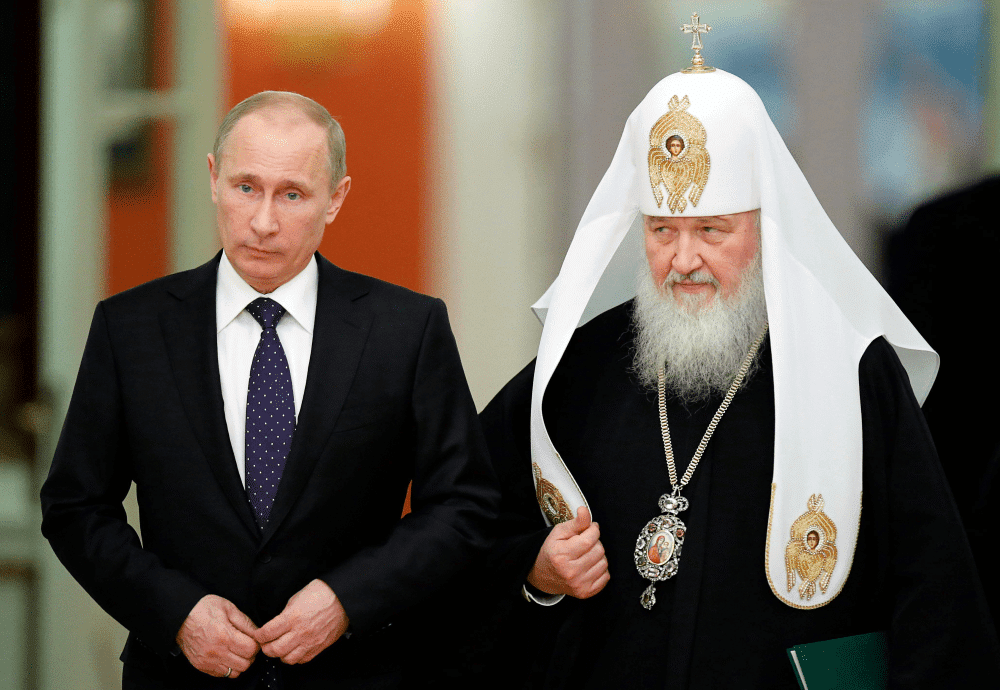
But westerners must understand that religious faith is a serious and significant motivation for Russian involvement in Syria.  Western news agencies consider this a non-issue. Don’t be too sure. President Vladimir Putin seems to be following a course of action that caused a major conflict earlier in the 19thCentury.


An evident and historical reason for Russian involvement in the Middle East has been to protect Orthodox Christian shrines in Israel as well as Orthodox Christians that live in the region. Czar Nicholas I pursued a similar policy that led to a disastrous war between Russia, France, Turkey, and the British Empire – the Crimean War.


Nicholas triggered the Crimean War by asserting Russian authority over Christian shrines in Palestine, then part of the Turkish Ottoman Empire. The Turks objected to the violation of their sovereignty, and so did French Emperor Napoleon III, who wanted France’s Roman Catholic Church to control the shrines.


Eventually, the British intervened because they were afraid the Russians would conquer Turkey and establish bases on the Mediterranean. War broke out,             and troops from all four powers got bogged down in trench warfare in Crimea – the same region seized from Ukraine by Vladimir Putin.


Is History Repeating Itself in Syria?


Two of the powers attacking Syrian President Bashir Assad, a Russian ally, are Britain and France. Both countries had fought Russia in the Crimean War 160 years ago. It seems as if that history might be repeating itself.


Interestingly enough, Putin is modeling himself on Czar Nicholas I, who ruled from 1825 to 1855. Like Putin, Nicholas organized a police state based on Russian nationalism and strict Orthodox Christianity. Nicholas administered a program of “Orthodoxy, Autocracy, and Nationality.” Putin has expanded the police state, restored most of the power and authority of the Orthodox Church, and started flexing Russia’ s military muscle.


A key component in the Czars’ ideology was the belief that Russia was the successor state to the Greek Orthodox Byzantine Empire. Several of the Czars, including Nicholas I, Catherine the Great, and Peter the Great, believed they were ordained by God to recapture the Christian lands of the Middle East from the Moslems. Not surprisingly, the Turks did not agree, and the result was centuries of war between the Russian and Ottoman Empires.


Is Moscow the Third Rome?


A fundamental idea in Czarist Russia was that Moscow was the Third Rome, after Constantinople (Istanbul) the Byzantine capital and the original Rome. It was a city destined to be the seat of a new Orthodox Christian Empire. Putin seems to have inherited that idea and may believe that the modern Russian Federation is the current successor state to the Byzantine Empire.


A good case can be made that Putin believes he is the successor to the Czars and that he has a mandate from God to conquer the Middle East. Putin likes to appear with Czarist symbols such as the Imperial Flag, and with soldiers in Czarist, not Communist uniforms.


Is Putin trying to start a Holy War in the Middle East?


Putin has already waged two wars to reclaim Czarist territory, one in Chechnya and one in Crimea. Now he is conducting another war to make Czarist goals a reality in Syria.


Putin has also proven that he is willing to pit his forces against American troops to achieve those goals. News stories have relayed that U.S. forces killed hundreds of Russian mercenaries in Syria before the April 13 airstrikes.


That should worry everybody because it would lead to all-out war between Russia and Islamic countries like Saudi Arabia (a criticalAmerican ally). Such a war would drag in the United States, Israel, NATO, and possibly the People’s Republic of China. The People’s Liberation Army of China established a naval base in Djibouti across the Red Sea from Saudi Arabia in August 2017.


Czar Nicholas I’s Middle Eastern adventure led to a large-scale war that included naval battles in the Baltic Sea. Hopefully, Putin’s attempt to behave like a Czar will not lead to all-out war in the Middle East.


Tuesday, December 12, 2017

America"s Decline And The Neglect Of Luther"s Principles Of Liberty

Authored by S.T.Karnick via Specator.org, 


Freedom requires a sense of personal responsibility if it is to survive.


With the nation’s news dominated by reports of political corruption (most recently, the Clintons’ apparent use of “pay to play” schemes during Hillary Clinton’s tenure as U.S. secretary of state), sexual harassment scandals pandemic among the nation’s elites, extreme vulgarization of political speech and the common culture, riots against freedom of speech on the nation’s college campuses, paralyzing partisanship in Congress, death threats and open assassination attempts against government leaders and police officers, and the rest of the dismaying parade of moral shortcomings on display among the nation’s leaders in all walks of life, it appears that we are in the midst of a war not just between political and cultural factions, but over the very definition of our civilization.


Friday, November 17, 2017

A Europe We Can Believe In

Via Oriental Review,


In early October a group of European intellectuals published a conservative manifesto with 36 tenets defending "old Europe" and its values, which we are republishing today in full:


1. Europe is our home.


Europe belongs to us, and we belong to Europe. These lands are our home; we have no other. The reasons we hold Europe dear exceed our ability to explain or justify our loyalty. It is a matter of shared histories, hopes and loves. It is a matter of accustomed ways, of moments of pathos and pain. It is a matter of inspiring experiences of reconciliation and the promise of a shared future. Ordinary landscapes and events are charged with special meaning—for us, but not for others. Home is a place where things are familiar, and where we are recognized, however far we have wandered. This is the real Europe, our precious and irreplaceable civilization.


2. A false Europe threatens us.


Europe, in all its richness and greatness, is threatened by a false understanding of itself. This false Europe imagines itself as a fulfilment of our civilization, but in truth it will confiscate our home. It appeals to exaggerations and distortions of Europe’s authentic virtues while remaining blind to its own vices. Complacently trading in one-sided caricatures of our history, this false Europe is invincibly prejudiced against the past. Its proponents are orphans by choice, and they presume that to be an orphan—to be homeless—is a noble achievement. In this way, the false Europe praises itself as the forerunner of a universal community that is neither universal nor a community.


3. The false Europe is utopian and tyrannical.


The patrons of the false Europe are bewitched by superstitions of inevitable progress. They believe that History is on their side, and this faith makes them haughty and disdainful, unable to acknowledge the defects in the post-national, post-cultural world they are constructing. Moreover, they are ignorant of the true sources of the humane decencies they themselves hold dear—as do we. They ignore, even repudiate the Christian roots of Europe. At the same time they take great care not to offend Muslims, who they imagine will cheerfully adopt their secular, multicultural outlook. Sunk in prejudice, superstition and ignorance, and blinded by vain, self-congratulating visions of a utopian future, the false Europe reflexively stifles dissent. This is done, of course, in the name of freedom and tolerance.


4. We must defend the real Europe.


We are reaching a dead-end. The greatest threat to the future of Europe is neither Russian adventurism nor Muslim immigration. The true Europe is at risk because of the suffocating grip that the false Europe has over our imaginations. Our nations and shared culture are being hollowed out by illusions and self-deceptions about what Europe is and should be. We pledge to resist this threat to our future. We will defend, sustain and champion the real Europe, the Europe to which we all in truth belong.


5. Solidarity and civic loyalty encourage active participation.


The true Europe expects and encourages active participation in the common project of political and cultural life. The European ideal is one of solidarity based on assent to a body of law that applies to all, but is limited in its demands. This assent has not always taken the form of representative democracy. But our traditions of civic loyalty reflect a fundamental assent to our political and cultural traditions, whatever their forms. In the past, Europeans fought to make our political systems more open to popular participation, and we are justly proud of this history. Even as they did so, sometimes in open rebellion, they warmly affirmed that, despite their injustices and failures, the traditions of the peoples of this continent are ours. Such dedication to reform makes Europe a place that seeks ever-greater justice. This spirit of progress is born out of our love for and loyalty to our homelands.


6. We are not passive subjects.


A European spirit of unity allows us to trust others in the public square, even when we are strangers. The public parks, central squares and broad boulevards of European towns and cities express the European political spirit: We share our common life and the res publica. We assume that it is our duty to take responsibility for the futures of our societies. We are not passive subjects under the domination of despotic powers, whether sacred or secular. And we are not prostrate before implacable historical forces. To be European is to possess political and historical agency. We are the authors of our shared destiny.


7. The nation-state is a hallmark of Europe.


The true Europe is a community of nations. We have our own languages, traditions and borders. Yet we have always recognized a kinship with one another, even when we have been at odds—or at war. This unity-in-diversity seems natural to us. Yet this is remarkable and precious, for it is neither natural nor inevitable. The most common political form of unity-in-diversity is empire, which European warrior kings tried to recreate in the centuries after the fall of the Roman Empire. The allure of the imperial form endured, but the nation-state prevailed, the political form that joins peoplehood with sovereignty. The nation-state thereby became the hallmark of European civilization.


8. We do not back an imposed, enforced unity.


A national community takes pride in governing itself in its own way, often boasts of its great national achievements in the arts and sciences, and competes with other nations, sometimes on the battlefield. This has wounded Europe, sometimes gravely, but it has never compromised our cultural unity. In fact, the contrary has been the case. As the nation states of Europe became more established and distinct, a shared European identity became stronger. In the aftermath of the terrible bloodshed of the world wars in the first half of the twentieth century, we emerged with an even greater resolve to honor our shared heritage. This testifies to the depth and power of Europe as a civilization that is cosmopolitan in a proper sense. We do not seek the imposed, enforced unity of empire. Instead, European cosmopolitanism recognizes that patriotic love and civic loyalty open out to a wider world.


9. Christianity encouraged cultural unity.


The true Europe has been marked by Christianity. The universal spiritual empire of the Church brought cultural unity to Europe, but did so without political empire. This has allowed for particular civic loyalties to flourish within a shared European culture. The autonomy of what we call civil society became a characteristic feature of European life. Moreover, the Christian Gospel does not deliver a comprehensive divine law, and thus the diversity of the secular laws of the nations may be affirmed and honoured without threat to our European unity. It is no accident that the decline of Christian faith in Europe has been accompanied by renewed efforts to establish political unity—an empire of money and regulations, covered with sentiments of pseudo-religious universalism, that is being constructed by the European Union.


10. Christian roots nourish Europe.


The true Europe affirms the equal dignity of every individual, regardless of sex, rank or race. This also arises from our Christian roots. Our gentle virtues are of an unmistakably Christian heritage: fairness, compassion, mercy, forgiveness, peace-making, charity. Christianity revolutionized the relationship between men and women, valuing love and mutual fidelity in an unprecedented way. The bond of marriage allows both men and women to flourish in communion. Most of the sacrifices we make are for the sake of our spouses and children. This spirit of self-giving is yet another Christian contribution to the Europe we love.


11. Classical roots encourage excellence.


The true Europe also draws inspiration from the Classical tradition. We recognize ourselves in the literature of ancient Greece and Rome. As Europeans, we strive for greatness, the crown of the Classical virtues. At times, this has led to violent competition for supremacy. But at its best, an aspiration toward excellence inspires the men and women of Europe to craft musical and artistic works of unsurpassed beauty and to make extraordinary breakthroughs in science and technology. The grave virtues of the self-possessed Romans and the pride in civic participation and spirit of philosophical inquiry of the Greeks have never been forgotten in the real Europe. These inheritances, too, are ours.


12. Europe is a shared project.


The true Europe has never been perfect. The proponents of the false Europe are not wrong to seek development and reform, and there is much that has been accomplished since 1945 and 1989 that we should cherish and honor. Our shared life is an ongoing project, not an ossified inheritance. But the future of Europe rests in renewed loyalty to our best traditions, not a spurious universalism demanding forgetfulness and self-repudiation. Europe did not begin with the Enlightenment. Our beloved home will not be fulfilled with the European Union. The real Europe is, and always will be, a community of nations at once insular, sometimes fiercely so, and yet united by a spiritual legacy that, together, we debate, develop, share—and love.


13. We are losing our home.


The true Europe is in jeopardy. The achievements of popular sovereignty, resistance to empire, cosmopolitanism capable of civic love, the Christian legacy of humane and dignified life, a living engagement with our Classical inheritance—all this is slipping away. As the patrons of the false Europe construct their faux Christendom of universal human rights, we are losing our home.


14. A false freedom prevails.


The false Europe boasts of an unprecedented commitment to human liberty. This liberty, however, is very one-sided. It sells itself as liberation from all restraints: sexual freedom, freedom of self-expression, freedom to “be oneself.” The Generation of ’68 regards these freedoms as precious victories over a once almighty and oppressive cultural regime. They see themselves as great liberators, and their transgressions are acclaimed as noble moral achievements, for which the whole world should be grateful.


15. Individualism, isolation, and aimlessness are widespread.


For Europe’s younger generations, however, reality is far less gilt with gold. Libertine hedonism often leads to boredom and a profound sense of purposelessness. The bond of marriage has weakened. In the roiling sea of sexual liberty, the deep desires of our young people to marry and form families are often frustrated. A liberty that frustrates our heart’s deepest longings becomes a curse. Our societies seem to be falling into individualism, isolation and aimlessness. Instead of freedom, we are condemned to the empty conformity of consumer- and media-driven culture. It is our duty to speak the truth: The Generation of ’68 destroyed but did not build. They created a vacuum now filled by social media, cheap tourism and pornography.


16. We are regulated and managed.


At the same time that we hear boasts of unprecedented liberty, European life is more and more comprehensively regulated. Rules—often confected by faceless technocrats in league with powerful interests—govern our work relationships, our business decisions, our educational qualifications, our news and entertainment media. And Europe now seeks to tighten existing regulations on freedom of speech, an aboriginal European freedom—freedom of conscience made manifest. The targets of these restrictions are not obscenity or other assaults on decency in public life. Instead, Europe’s governing classes wish to restrict manifestly political speech. Political leaders who give voice to inconvenient truths about Islam and immigration are hauled before judges. Political correctness enforces strong taboos that deem challenges to the status quo beyond the pale. The false Europe does not really encourage a culture of freedom. It promotes a culture of market-driven homogeneity and politically enforced conformity.


17. Multiculturalism is unworkable.


The false Europe also boasts of an unprecedented commitment to equality. It claims to promote non-discrimination and the inclusion of all races, religions and identities. Here, genuine progress has been made, but a utopian detachment from reality has taken hold. Over the past generation, Europe has pursued a grand project of multiculturalism. To demand or even promote the assimilation of Muslim newcomers to our manners and mores, much less to our religion, has been thought a gross injustice. A commitment to equality, we have been told, demands that we abjure any hint that we believe our culture superior. Paradoxically, Europe’s multicultural enterprise, which denies the Christian roots of Europe, trades on the Christian ideal of universal charity in an exaggerated and unsustainable form. It requires from the European peoples a saintly degree of self-abnegation. We are to affirm the very colonization of our homelands and the demise of our culture as Europe’s great twenty-first century glory—a collective act of self-sacrifice for the sake of some new global community of peace and prosperity that is being born.


18. Bad faith grows.


There is a great deal of bad faith in this thinking. Most in our governing classes doubtless presume the superiority of European culture—which must not be affirmed in public in ways that might offend immigrants. Given that superiority, they think that assimilation will happen naturally, and quickly. In an ironic echo of the imperialist thinking of old, Europe’s governing classes presume that, somehow, by the laws of nature or of history, ‘they’ will necessarily become like ‘us’—and it is inconceivable that the reverse might be true. In the meantime, official multiculturalism has been deployed as a therapeutic tool for managing the unfortunate but ‘temporary’ cultural tensions.


19. Technocratic tyranny increases.


There is more bad faith at work, of a darker kind. Over the last generation, a larger and larger segment of our governing class has decided that its own self-interest lies in accelerated globalization. They wish to build supranational institutions that they are able to control without the inconveniences of popular sovereignty. It is increasingly clear that the ‘democratic deficit’ in the European Union is not a mere technical problem to be remedied by technical means. Rather, this deficit is a fundamental commitment, and it is zealously defended. Whether legitimated by supposed economic necessities or autonomously developing international human rights law, the supra-national mandarins of the EU institutions confiscate the political life of Europe, answering all challenges with a technocratic answer: There is no alternative. This is the soft but increasingly real tyranny we face.


20. The false Europe is fragile and impotent.


The hubris of the false Europe is now becoming evident, despite the best efforts of its partisans to shore up comfortable illusions. Above all, the false Europe is revealed to be weaker than anyone imagined. Popular entertainment and material consumption do not sustain civic life. Shorn of higher ideals and discouraged from expressing patriotic pride by multiculturalist ideology, our societies now have difficulty summoning the will to defend themselves. Moreover, civic trust and social cohesion are not renewed by inclusive rhetoric or an impersonal economic system dominated by gigantic international corporations. Again, we must be frank: European societies are fraying badly. If we but open our eyes, we see an ever-greater use of government power, social management and educational indoctrination. It is not just Islamic terror that brings heavily armed soldiers into our streets. Riot police are now necessary to quell violent anti-establishment protests and even to manage drunken crowds of football fans. The fanaticism of our football loyalties is a desperate sign of the deeply human need for solidarity, a need that otherwise goes unfulfilled in the false Europe.


21. A culture of repudiation has taken hold.


Europe’s intellectual classes are, alas, among the chief ideological partisans of the conceits of the false Europe. Without doubt, our universities are one of the glories of European civilization. But where once they sought to transmit to each new generation the wisdom of past ages, today most within the universities equate critical thinking with a simpleminded repudiation of the past. A lodestar of the European spirit has been the rigorous discipline of intellectual honesty and objectivity. But over the past two generations, this noble ideal has been transformed. The asceticism that once sought to free the mind of the tyranny of dominant opinion has become an often complacent and unreflective animus against everything that is our own. This stance of cultural repudiation functions as a cheap and easy way of being ‘critical.’ Over the last generation, it has been rehearsed in the lecture halls, becoming a doctrine, a dogma. And to join in professing this creed is taken to be the mark of ‘enlightenment,’ and of spiritual election. As a consequence, our universities are now active agents of ongoing cultural destruction.


22. Elites arrogantly parade their virtue.


Our governing classes are advancing human rights. They are at work fighting climate change. They are engineering a more globally integrated market economy and harmonizing tax policies. They are monitoring progress toward gender equality. They are doing so much for us! What does it matter by what mechanisms they inhabit their offices? What does it matter if the European peoples grow more sceptical of their ministrations?


23. There is an alternative.


That growing scepticism is fully justified. Today, Europe is dominated by an aimless materialism that seems unable to motivate men and women to have children and form families. A culture of repudiation deprives the next generation of a sense of identity. Some of our countries have regions in which Muslims live with an informal autonomy from local laws, as if they were colonialists rather than fellow members of our nations. Individualism isolates us one from another. Globalization transforms the life prospects of millions. When challenged, our governing classes say that they are merely working to accommodate the inevitable, adjusting to implacable necessities. No other course is possible, and it is irrational to resist. Things cannot be otherwise. Those who object are said to suffer nostalgia—for which they deserve moral condemnation as racists or fascists. As social divisions and civic distrust become more apparent, European public life grows angrier, more rancourous, and no one can say where it will end. We must not continue down this path. We need to throw off the tyranny of the false Europe. There is an alternative.


24. We must turn back ersatz religion.


The work of renewal begins with theological self-knowledge. The universalist and universalizing pretensions of the false Europe reveal it to be an ersatz religious enterprise, complete with strong creedal commitments—and anathemas. This is the potent opiate that paralyzes Europe as a political body. We must insist that religious aspirations are properly the province of religion, not politics, much less bureaucratic administration. In order to recover our political and historical agency, it is imperative that we re-secularize European public life.


25. We must restore a true liberalism.


This will require us to renounce the mendacious language that evades responsibility and fosters ideological manipulation. Talk of diversity, inclusion and multiculturalism is empty. Often, such language is deployed as a way to characterize our failures as accomplishments: The unravelling of social solidarity is ‘actually’ a sign of welcome, tolerance, and inclusion. This is marketing language, a language meant to obscure reality rather than illuminate. We must recover an abiding respect for reality. Language is a delicate instrument, and it is debased when used as a bludgeon. We should be patrons of linguistic decency. Recourse to denunciation is a sign of the decadence of our present moment. We must not tolerate verbal intimidation, much less mortal threats. We need to protect those who speak reasonably, even if we think their views mistaken. The future of Europe must be liberal in the best sense, which means committed to robust public debate free from all threats of violence and coercion.


26. We need responsible statesmen.


Breaking the spell of the false Europe and its utopian, pseudo-religious crusade for a borderless world means fostering a new kind of statesmanship and a new kind of statesman. A good political leader stewards the commonweal of a particular people. A good statesman views our shared European inheritance and our particular national traditions as magnificent and life-giving, but also fragile gifts. He does not reject that inheritance, nor does he chance losing it all for utopian dreams. Such leaders covet the honors bestowed upon them by their people; they do not lust for the approbation of the ‘international community,’ which is in fact the public relations apparatus of an oligarchy.


27. We should renew national unity and solidarity.


Recognizing the particular character of the European nations, and their Christian mark, we need not be perplexed before the spurious claims of the multiculturalists. Immigration without assimilation is colonization, and this must be rejected. We rightly expect that those who migrate to our lands will incorporate themselves into our nations and adopt our ways. This expectation needs to be supported by sound policy. The language of multiculturalism has been imported from America. But America’s great age of immigration came at the turn of the twentieth century, a period of remarkably rapid economic growth, in a country with virtually no welfare state, and with a very strong sense of national identity to which immigrants were expected to assimilate. After admitting large numbers of immigrants, America closed its doors very nearly shut for two generations. Europe needs to learn from this American experience rather than adopt contemporary American ideologies. That experience tells us that the workplace is a powerful engine of assimilation, that a generous welfare system can impede assimilation and that prudent political leadership sometimes dictates reductions in immigration—even drastic reductions. We must not allow a multicultural ideology to deform our political judgments about how best to serve the common good, which requires national communities with sufficient unity and solidarity to see their good as common.


28. Only empires are multicultural.


After World War II, Western Europe cultivated vital democracies. After the collapse of the Soviet Empire, Central European nations restored their civic vitality. These are among Europe’s most precious achievements. But they will be lost if we do not address immigration and demographic change in our nations. Only empires can be multicultural, which is what the European Union will become if we fail to make renewed solidarity and civic unity the criteria by which to assess immigration policies and strategies for assimilation.


29. A proper hierarchy nourishes social well-being.


Many wrongly think Europe is being convulsed only by controversies over immigration. In truth, this is but one dimension of a more general social unraveling that must be reversed. We must recover the dignity of particular roles in society. Parents, teachers and professors have a duty to form those under their care. We must resist the cult of expertise that comes at the expense of wisdom, tact and the quest for a cultured life. There can be no renewal of Europe without a determined rejection of an exaggerated egalitarianism and the reduction of wisdom to technical knowledge. We endorse the political achievements of the modern era. Each man and woman should have an equal vote. Basic rights must be protected. But a healthy democracy requires social and cultural hierarchies that encourage the pursuit of excellence and give honor to those who serve the common good. We need to restore a sense of spiritual greatness and give it due honour so that our civilization can counter the growing power of mere wealth on the one hand and vulgar entertainment on the other.


30. We must restore moral culture.


Human dignity is more than the right to be left alone, and doctrines of international human rights do not exhaust the claims of justice, much less of the good. Europe needs to renew a consensus about moral culture so that the populace can be guided toward a virtuous life. We must not allow a false view of freedom to impede the prudent use of the law to deter vice. We must be forgiving of human weakness, but Europe cannot flourish without a restoration of a communal aspiration toward upright conduct and human excellence. A culture of dignity flows from decency and the discharge of the duties of our stations in life. We need to renew the exchange of respect between social classes that characterizes a society that values the contributions of all.


31. Markets need to be ordered toward social ends.


While we recognize the positive aspects of free-market economics, we must resist ideologies that seek to totalize the logic of the market. We cannot allow everything to be for sale. Well functioning markets require the rule of law, and our rule of law should aim at more than mere economic efficiency. Markets also function best when they are nested within strong social institutions organized on their own, non-market principles. Economic growth, while beneficial, is not the highest good. Markets need to be oriented toward social ends. Today, corporate giganticism threatens even political sovereignty. The nations need to cooperate to master the arrogance and mindlessness of global economic forces. We affirm the prudent use of government power to sustain non-economic social goods.


32. Education needs to be reformed.


We believe Europe has a history and culture worth sustaining. Our universities, however, too often betray our cultural heritage. We need to reform educational curricula to foster the transmission of our common culture rather than indoctrinating young people into a culture of repudiation. Teachers and mentors at every level have a duty of memory. They should take pride in their role as a bridge between generations past and generations to come. We must also renew the high culture of Europe by setting the sublime and the beautiful as our common standard and rejecting the degradation of the arts into a kind of political propaganda. This will require the cultivation of a new generation of patrons. Corporations and bureaucracies have shown themselves to be poor stewards of the arts.


33. Marriage and family are essential.


Marriage is the foundation of civil society and the basis for harmony between men and women. It is the intimate bond organized around sustaining a household and raising children. We affirm that our most fundamental roles in society and as human beings are as fathers and mothers. Marriage and children are integral to any vision of human flourishing. Children require sacrifice from those who bring them into the world. This sacrifice is noble and must be honoured. We endorse prudent social policies to encourage and strengthen marriage, childbearing, and childrearing. A society that fails to welcome children has no future.


34. Populism should be engaged.


There is great anxiety in Europe today because of the rise of what is called ‘populism’—though the meaning of the term seems never to be defined, and it is used mostly as invective. We have our reservations. Europe needs to draw upon the deep wisdom of her traditions rather than relying on simplistic slogans and divisive emotional appeals. Still, we acknowledge that much in this new political phenomenon can represent a healthy rebellion against the tyranny of the false Europe, which labels as ‘anti-democratic’ any threat to its monopoly on moral legitimacy. The so-called “populism” challenges the dictatorship of the status quo, the ‘fanaticism of the centre,’ and rightly so. It is a sign that even in the midst of our degraded and impoverished political culture, the historical agency of the European peoples can be reborn.


35. Our future is the true Europe.


We reject as false the claim that there is no responsible alternative to the artificial, soulless solidarity of a unified market, a transnational bureaucracy, and glib entertainment. Bread and circuses are not enough. The responsible alternative is the true Europe.


36. We must take responsibility.


In this moment, we ask all Europeans to join us in rejecting the utopian fantasy of a multicultural world without borders. We rightly love our homelands, and we seek to hand on to our children every noble thing that we have ourselves received as our patrimony. As Europeans, we also share a common heritage, and this heritage asks us to live together in peace as a Europe of nations. Let us renew national sovereignty, and recover the dignity of a shared political responsibility for Europe’s future.


*  *  *


Signers:

Philippe Bénéton (France)


Rémi Brague (France)


Chantal Delsol (France)


Roman Joch (Czech Republic)


Lánczi András (Hungary)


Ryszard Legutko (Poland)


Pierre Manent (France)


Janne Haaland Matlary (Norway)


Dalmacio Negro Pavón (Spain)


Roger Scruton (United Kingdom)


Robert Spaemann (Germany)


Bart Jan Spruyt (Netherlands)


Matthias Storme (Belgium)


Saturday, November 11, 2017

Roy Moore Story Unraveling? One Accuser Worked For Hillary, Another Claims Several Pastors Made Sexual Advances

Content originally published at iBankCoin.com


From the outset, several aspects of the Washington Post‘s decades-old accusations of Roy Moore having inappropriate relations with four young women seemed off. In addition to odd circumstances surrounding the story’s origins, the accusers themselves – and even the WaPo journalist who wrote the story – have checkered pasts and political views which some could consider ulterior motives.


If the accusations against Moore are true, he needs to immediately step aside and exit politics – as both President Trump and, oddly, Mitch McConnell have stated. Moore has vehemently denied the charges.


How did the story come together?


As Radio host Mark Levin pointed out on his show last week that there are several aspects of the case which don’t really make sense. To recap; a Washington Post reporter overheard a rumor at a Roy Moore event in Alabama about Moore sexually abusing four girls 38 years ago, then found the women, interviewed them, and the rest is history.


Per WaPo:


While reporting a story in Alabama about supporters of Moore’s Senate campaign, a Post reporter heard that Moore allegedly had sought relationships with teenage girls. Over the ensuing three weeks, two Post reporters contacted and interviewed the four women.


Levin posed the following questions:


  • How did the WaPo reporter know there were four women, who they were, and how to contact them?


  • How is it that the reporter"s anonymous source, who they bumped into, knew about the four women who don’t know each other and have never met, and knew each woman"s story and contact information?


  • Why hasn’t any of this been reported in Moore’s 38 years in politics? And why now – a month before an important election to fill Jeff Sessions’ senate seat?


Adding to the list of questionable circumstances - one which the Washington Post oddly omitted from it"s report, is the fact that one of Moore’s accusers, Debbie Gibson, worked as a sign language interpreter for Hillary Clinton and Joe Biden, and is actively campaigning for Moore’s Democrat opponent, Doug Jones.


As New York Times bestselling author, Attorney, Law professor and Newsmax columnis James Hirsen points out:


 Here’s Gibson, hard at work for Hillary:


Another Moore accuser, Leigh Corfman, has claimed “several pastors at various churches made sexual advances at her.” This 3x divorcee who has also filed for bankruptcy three times.


The Star reports:


She says that her teenage life became increasingly reckless with drinking, drugs, boyfriends, and a suicide attempt when she was 16.


As the years went on, Corfman says, she did not share her story about Moore partly because of the trouble in her life. She has had three divorces and financial problems. While living in Arizona, she and her second husband started a screen-printing business that fell into debt. They filed for bankruptcy protection three times, once in 1991 with $139,689 in unpaid claims brought by the Internal Revenue Service and other creditors, according to court records.


In 2005, Corfman paid a fine for driving a boat without lights. In 2010, she was working at a convenience store when she was charged with a misdemeanor for selling beer to a minor. The charge was dismissed, court records show.


The WaPo reporter who penned the article wrote fake check, according to an 2011 Red State report


Ms. McCrummen has a rather interesting criminal history herself, as public criminal records in multiple states stretching across 4 time zones have shown.


Ms. McCrummen’s criminal history began with North Carolina Case # 1992 CR 00654, a violation of the Article 19 – False Pretenses and Cheats section of the North Carolina Criminal Code. Ms. McCrummen was convicted of a crime punishable by up to six months of imprisonment for writing a hot check that was deemed worthless.


Last but not least, former Secret Service agent Doug Lewis (@umpire43) has made an unsubstantiated claim that a WaPo reporter named “Beth” offered a family friend $1000 to accuse Roy Moore, and that a tape of the offer is in the hands of the DA. 


Again – if Roy Moore took advantage of four young women 38 years ago, it is reprehensible and he should face justice if at all possible. That said, several troubling aspects of the Moore accusations have come to light in the days since the report, casting what many feel is reasonable doubt on the entire thing.


Moore has denied the allegations and issued the following statement:


Follow on Twitter @ZeroPointNow § Subscribe to our YouTube channel

Sunday, October 15, 2017

Christianity And The Arts

Off The Grid Theology

Christianity And The Arts

Image source: Pixabay.com


The only artist who is perfect in all forms of creativity . . . is of course God—the God who is Personal.


—Edith Schaeffer, Hidden Art (1971)


Come with me to the Alps and look at the snow-covered mountains.


There can be no question. God is interested in beauty.


 —Francis A. Schaeffer, Art and the Bible (1973)


The God of Creation


The Bible has a lot to say, both directly and indirectly, about God’s love for beauty.  Even a quick reading of Genesis 1 demonstrates the marvelous wisdom and power of God in creation.  We see light spring out of darkness, vast reservoirs of water lifted into the heavens, massive landforms rise out of the sea.  We see trees and grasses spring instantly from the earth to bud, blossom, and bear fruit in a day.  We see the sun rise over the horizon for the first time, and the moon climb through the night sky pacing the sun.


We see stars set into constellations and galaxies.  We see multi-hued fish and fowl swarm to fill the seas and skies.  We see great dragons navigate the deep.  We see beasts, cattle, and creeping things prowl and crawl and cavort through the meadows, fields, and rain forests of the new Earth.  And, of course, we also see the first man and woman, unstained by the Fall, lift their eyes to heaven to hear the voice of God.  The whole thing must have been staggering to behold. And it’s right here at this point that adjectives can’t live up to what they’re describing.  In fact, philosophers of aesthetics could write long volumes simply on this first chapter of Genesis alone.


But behind Genesis 1, hidden in eternity, is the beauty and majesty of the Triune God Himself … Father, Son, and Holy Spirit.  It’s important to know that this God is simple in His essence.  He’s doesn’t have “parts or pieces.”  He isn’t partly this and partly that.  He isn’t mostly this but a little bit of that.  God’s essence is identical with His attributes.  He is both truth and light.  He is also beauty, glory, and joy.


Put God Back Into History And Teach Your Kids What They Won’t Learn Anywhere Else!


But here’s the interesting thing:


This one, simple God exists eternally as three distinct Persons.  From eternity, the Father begets the Son who then speaks the divine Word.  From eternity, the Son is the Father’s only Begotten.  This divine Logos is the brightness of the Father’s glory.


Implications


Christianity And The Arts

Image source: Pixabay.com


From this brief summary of Trinitarian theology, we can make some basic observations about the ontological foundations of the arts.  First, God is coherent and rational.  He is light, “and in him is no darkness at all” (1 Jn. 1:5).  There are no dark corners in His being.  He isn’t evolving or on His way to becoming anything new.  He isn’t in process of being.  In fact, there is no room in His mind for surprises.  His attributes aren’t in competition.  This all-wise and perfectly rational God is … at the same time and to the same degree … Joy, Beauty, and Delight.


Second, it is the nature of this God to reveal Himself.  He expresses Himself both by Word and Spirit (He breathes life).  God delights in this self-revelation and self-communication.  He joys in shared beauty, glory, and truth.


We should then expect that this God would pour out His beauty and glory onto and into anything and anywhere He decides.  We should expect then, that His creation would both reflect and declare His glory.  We also should expect that His spoken and written Word would abound in beauty, wisdom, simplicity, and majesty.


Third, God is Trinity.  He is true diversity in perfect unity.  In God, unity and diversity are equally ultimate.  The universals don’t swallow up the particulars.  The particulars don’t destroy the universals.  God’s nature is harmony, balance, perfect integration, complexity, simplicity, true community, and true individuality.


This is the God who chose to create the earth and more.  The God who made the world, the God who speaks both beautifully and powerfully in His Word.  We should expect God’s Word and God’s created world to be characterized by the same attributes.


It’s A History Must-Have For Homeschool Families


It is no wonder, then, that when we open Scripture, we find that God speaks of Himself as a working Artisan or Artist.  Get this:  He’s a singer (Zeph. 3:17), a potter (Isa. 64:8), a gardener (Isa. 5:1-2), an engraver (Zech. 3:9), a jeweler (Isa. 54:11), an architect and builder (Heb. 11:10), and even a metal worker (Mal. 3:3).


God also speaks of Himself as a work of art:  “In that day shall the LORD of hosts be for a crown of glory, and for a diadem of beauty, unto the residue of his people” (Isa. 28:5).  And, of course, in the first lines of Scripture, we read, “In the beginning God created the heaven and the earth” (Gen. 1:1).  God is the Artist who makes all things from nothing and who made no two things exactly alike.  Literally everything God has made … speaks of His glory and power (Ps. 19).


Conclusion


Before Scripture ever says in so many words that God is Spirit, it shows us in great detail that God is Creator.  From the very first chapter, Scripture is antithetically “at odds” with any Gnostic, Platonic or Neo-Platonic view of creation or of art.  God made the world in all its wonder, beauty, intricacy, mystery, strangeness, and glory.  In all these dimensions, creation declares God as He truly is.  God made man in His very image.  He also made man to know Him, to commune with Him and to live and work in His world.  My guess is that this is the perfect place to begin any discussion of Christianity and the arts.


For Further Reading:


Herman Bavinck, The Doctrine of God (Edinburgh:  The Banner of Truth Trust, 1977).


Edith Schaeffer, Hidden Art (Wheaton, IL:  Tyndale House Publishers, 1971).


Francis Schaeffer, Art and the Bible (Downers Grove, IL:  InterVarsity Press, 2006).


Gene Edward Veith, State of the Arts, From Bezalel to Mapplethorpe (Wheaton, IL:  Crossway Books, 1991).


H.R. Rookmaker, Art Needs No Justification (Downers Grove, IL:  InterVarsity Press, 1979).


Leland Ryken, The Christian Imagination (Grand Rapids:  Baker Book House, 1981).


Leland Ryken, The Liberated Imagination, Thinking Christianly About the Arts (Wheaton, IL:  Harold Shaw Publishers, 1989).

Wednesday, September 13, 2017

Germany: The Rise Of Islam

Authored by Giulio Meotti via The Gatestone Institute,


  • Turkey controls 900 mosques in Germany and feels free to say that a "liberal mosque" in Germany is "incompatible" with Islam.

  • Can you imagine Germany offering Iraq, Syria and Egypt to build "200 new churches" to reconstruct the derelict and dispossessed Christian communities there? No, because in the Middle East, Christians have been eradicated in a forced de-Christianization.

  • Christians in Germany will become a minority in the next 20 years, according to Die Welt.

  • We risk losing not only our churches, but more importantly, our cultural strength and even confidence in the values of our own civilization.

Jan Fleischhauer, a journalist of the weekly magazine Der Spiegel, coined an expression to define the free fall of German Christianity: Selbstsäkularisierung ("self-secularization"). Is the Church being liquidated?


The German Bishops" Conference just released the data on the decline of Catholicism in Germany for 2016. In one year, the German Catholic Church lost 162,093 faithful and closed 537 parishes. From 1996 to today, one quarter of the Catholic communities have been closed. "The faith has evaporated," said Cardinal Friedrich Wetter, the Archbishop of Munich and Freising from 1982 to 2007.


Christians in Germany will become a minority in the next 20 years, according to Die Welt. Around 60% of the country is currently Christian, with 24 million Catholics and 23 million Protestants. But that number is falling by 500,000 a year through deaths alone. "Those statistics are embodied by what visitors observe in German cities on Sunday: largely empty churches", the Catholic theologian George Weigel wrote.


German Protestantism is facing the same crisis. Die Zeit revealed that in 2016, 340,000 Protestants passed away, and there were just 180,000 baptisms. Some 190,000 people left the church and just 25,000 people chose to join it.


In his most famous lecture, Pope Benedict XVI famously said that the West, including those who do not accept transcendence, should act "etsi Deus daretur", as if God does exist. The old-fashioned Christian society will never come back, but it is critical for even a secular West to stay based on -- and profoundly inspired by -- its Judeo-Christian values.


The next stage seems to be a German cultural and religious landscape dominated by atheists and two minority religions: Islam and Christianity. If the secularists do not take Western Christian heritage -- or at least the Judeo-Christian values from which it sprang -- more seriously and start defending it, both atheists and Christians will soon be dominated by the rising political and supremacist religion, Islam. A prominent Muslim fundamentalist organization in Germany, banned by the federal government, calls itself "The True Religion" ("Die Wahre Religion"). They apparently think they are overtaking Judeo-Christian values.


There are dramatic instances of Christian decay in Germany. In the diocese of Trier, for example, site of the oldest Catholic community and the birthplace of Karl Marx, the number of parishes will drop from 903 to 35 by 2020, according to bishop Stephan Ackermann -- a decrease of more than 90%. In the diocese of Essen, more than 200 parishes have been closed; their number has fallen from 259 to 43.


A demographic decline is also involved in this religious crisis. "Christianity is literally dying in Europe," said Conrad Hackett, head of the researchers who drafted a Pew Forum report a few months ago. In Europe, between 2010 and 2015, Christian deaths outnumbered births by nearly 6 million. In Germany alone, there were about 1.4 million more Christian deaths.


This decline also apparent from the recruitment crisis for the priesthood. The official website of the German Catholic Church, noted in May that the dioceses of Osnabrück and Mainz did not receive any new priests this year. The archdiocese of Munich last year drew only one candidate. Throughout the Archdiocese of Munich today, there are only 37 seminarians in the various training stages, for about 1.7 million Catholics. In comparison, the American diocese of Lincoln, Nebraska, currently has 49 seminarians for about 96,000 Catholics. In the U.S., Christianity is strong; in Germany it is literally dying.


A German architect, Joaquim Reinig, told Die Tageszeitung that to integrate Muslim immigrants better, churches should be demolished and replaced with "highly visible mosques". It might sound a bit crazy, but it contains a dramatic truth. In his book The Last Days of Europe, the historian Walter Laqueur wrote that "Germany had some 700 little mosques and prayer rooms in the 1980s, but there are more than 2,500 at the present time". If, in Germany, Christianity is evaporating, Islam is proliferating.


The Turkish-Islamic Union for Religious Affairs (DITIB) just opened a new mega-mosque for worship in the German city of Cologne. The new German mega-mosque has a 1,200-person capacity and the tallest minaret of Europe. According to Deutsche Welle, "Christian leaders bristled at the idea of Cologne"s famed Dom cathedral sharing the skyline with minarets". When the mosque was planned in 2007, a citizens" initiative was launched to say that "we want the cathedral here, not minarets". The Muslim authorities then announced the plan to "double" the number of mosques.


The new mega-mosque in Cologne, Germany has a 1,200-person capacity and the tallest minaret of Europe. (Image source: Raimond Spekking/Wikimedia Commons)


The Turkish authorities not only wanted to build a mega-mosque in the city hosting the largest cathedral of Germany, but these also had the sense of irony to commission architect Paul Böhm to design the mosque. Böhm"s father and grandfather were in fact the two most radical and admired church architects of their generations. In the "new Germany", nobody had asked Böhm to design a new cathedral.


Since he took power in Turkey, Recep Tayyip Erdogan has built 17,000 Islamic prayer sites there. The Turkish president is committed to the construction of mosques in European capitals as well. Turkey controls 900 mosques in Germany and feels free to say that a "liberal mosque" in Germany is "incompatible" with Islam, according to the daily Frankfurter Allgemeine Zeitung. That is why the 57 percent of Germans fear the rise of Islam in their country.


When Chancellor Angela Merkel opened her country to mass migration in 2014, she apparently did not see any cultural problem in accepting more than another million Muslims.


In the words of Erdogan, however, "Our minarets are our bayonets, our domes are our helmets, our mosques are our barracks". Islamic regimes are, in fact, offering to fill the empty spaces in Germany"s religious landscape. Saudi Arabia proposed building 200 new mosques in Germany, "one for every 100 refugees".


Can you imagine Germany offering Iraq, Syria and Egypt to build "200 new churches" to reconstruct the derelict and dispossessed Christian communities there? No, because in the Middle East, Christians have been eradicated in a forced de-Christianization. In Europe, Christians are also becoming extinct by a process of "self-secularization". We risk losing not only our churches, but more importantly, our cultural strength and even confidence in the values of our own civilization.

Friday, September 1, 2017

A Tale of Twisted Fate

A Tale of Twisted Fate | BD-Book-Cover-200x300 | Authors Civil Disobedience Consciousness Faith Insider Exclusive TV Multimedia News And Opinions News Articles Sleuth Journal Society US News


Written by Guest Author


Bob Wilson


“Bob Dylan and the Grateful Dead: A Tale of Twisted Fate” (2017 – by Howard F. Weiner), is a fine addition to the Dylan canon in an often overlooked chapter in Dylan’s lengthly saga.  It is equally a filling out of the long, strange trip undertaken by the merry pranksters in the Grateful Dead.  Dylan had reached icon status that he was trying to escape before 1970 chimed in.  Weiner reports that Dylan mentioned to Levon Helm as far back as 1972, that he had ideas of touring with the Dead.  Even tie-die-hard Dylanolgists must be shocked to digest such a flavorful morsel, as related by Bob Dylan and Jerry Garcia aficionado, Howard F. Weiner.


It is hard to fathom looking back to 1987, that Dylan had already been written off several times by vitriolic critics.  They seemed to follow him like “the men that followed Jesus, when they put a price upon his head.” They went apoplectic when the man went electric. Criticism was sundry when Dylan went to Nashville singing all country.  It is hard to fathom that people would pay good money to come in and then “boo” Dylan.  Before the Dead, Dylan went preaching about the man from Nazareth who is arisen, bringing Gospel live to the befuddled Grammys, as well as Saturday Night Live.  If he threw the bums a dime for every time he irritated his following, we would likely be able to eliminate welfare.  None of us would have been better off though, for missing out on the jousting surrounding the fanfare.


Author Howard F. Weiner also offers up in this book the head scratching nugget that Dylan offered to permanently be playin’ in the band.  Weiner whittles down the naysayer who shot the idea down from under the red sky in a vote that required only one Grateful Dead dissenting member and offers up a bounty of insight, recounting anecdotes of Dylan & Deadheads which you will love tearing through in these pages.


Jerry Garcia and his band members had a profound effect on the Bob Dylan they met, caught between the gears of his own career.  Weiner hashes out how the band’s touring machinery would plant the seed for Dylan’s “Never Ending Tour”.  The reluctant Nobel Prize winner would go on to do more shows in the remainder of his career than the Dead did in toto.  Not bad for a hermit, folk-rock, protest song writing, born again, wandering minstrel!  Did I get that right?


In the video below, Howard F. Weiner joins Bart Sibrel and myself for some lively discussion about Dylan, the Dead, and Weiner’s books on the two.  Turn, turn, turn around, tune in, and squeeze the last drop out of one more cup of coffee.  We look back on the saga that brought these musical icons together.


~Don’t you dare miss it.


~Bob Wilson


Just click HERE or below to enjoy.


Thank you for your kind support.


Donate


–Brother Bart-


Saturday, August 12, 2017

WHAT? Now Hillary Clinton Wants To Be A Pastor?

WHAT? Now Hillary Clinton Wants To Be A Pastor? | hillary-clinton | Faith Politics Sleuth Journal Special Interests


How would you feel if you went to church next Sunday and “Pastor Hillary Clinton” got up to deliver the message? According to Clinton’s longtime pastor, Hillary says that she wants wants to start preaching. Considering the fact that she stands in direct opposition to just about everything that the Bible says, it is hard to imagine her doing this with a straight face. Bill and Hillary Clinton have been fueling anger and hatred toward conservative Christians for decades, but now she is suddenly going to turn over a new leaf? If Clinton announced that she had decided to denounce abortion then she would definitely get my attention, but at this point this just seems like another Clinton political stunt. 


Earlier today when I came across an article published by the Atlantic entitled “Hillary Wants To Preach”, I was tempted to dismiss it as some of that “fake news” that we have been hearing so much about lately. But it turns out that this story is actually true…


Hillary Clinton wants to preach. That’s what she told Bill Shillady, her longtime pastor, at a recent photo shoot for his new book about the daily devotionals he sent her during the 2016 campaign. Scattered bits of reporting suggest that ministry has always been a secret dream of the two-time presidential candidate: Last fall, the former Newsweek editor Kenneth Woodward revealed that Clinton told him in 1994 that she thought “all the time” about becoming an ordained Methodist minister. She asked him not to write about it, though: “It will make me seem much too pious.” The incident perfectly captures Clinton’s long campaign to modulate—and sometimes obscure—expressions of her faith.


For Clinton, this would be yet another very unusual chapter in a very strange religious journey. She has always claimed to be a “Christian”, but it is also important to remember that in college she did her senior thesis on a radical leftist that dedicated his book to Lucifer…


In 1993, the president of Wellesley College approved a new rule that all senior theses written by a president or first lady of the United States would be kept under lock and key, a move aimed at preventing the public from learning about their new First Lady. After the Clintons left the White House, however, Hillary’s senior thesis was released to the public – a 92 page homage to radical leftist Saul Alinsky, who dedicated his book to Lucifer.


And back in 2015, Clinton delivered a speech in which she insisted that “religious beliefs” that do not conform to her progressive agenda “have to be changed”…


“All the laws we’ve passed don’t count for much if they’re not enforced. Rights have to exist in practice, not just on paper. Laws have to be backed up with resources and political will. And deep seated cultural codes, religious beliefs and structural biases have to be changed.”


Hillary Clinton is not interested in the God of the Bible or in living the way that the Bible actually intends for us to live.


Clinton and her husband have been promoting just about every form of evil imaginable for decades, but that won’t matter to many people. If Hillary wants to preach, many on the left will be absolutely thrilled…


“Given her depth of knowledge of the Bible and her experience of caring for people and loving people, she’d make a great pastor,” Shillady told me. No, she probably won’t go to seminary, he said. No, she probably won’t pursue an official lay position in the Methodist church, like deaconess. (I reached out to Clinton’s spokespeople for comment, but didn’t hear back.) “I think it would be more of … her guest preaching at some point,” he said. “We have a long history of lay preachers in the United Methodist Church.”


Since the election, “I think her faith is stronger,” Shillady added. “I haven’t noticed anything different, except that I think she is more relaxed than I’ve ever seen her.” Maybe after all these years of hard-scrabble politics, Clinton is finally becoming a more straightforward version of herself: a woman whose fondest ambition is teaching scripture in church.


I am just glad that she isn’t in the White House. If she had won the 2016 election, things would have gone very badly for extremely outspoken conservatives like me.


As I keep saying, our nation is in the midst of a cultural war. If the left ultimately wins, they plan to do whatever they can to criminalize our way of thinking. And I am not the only one that is warning about this. For example, just consider what Newt Gingrich had to say about this recently…


“Remember: There are a lot of people on the other side, including in the elite news media, who deeply, deeply want President Trump to fail,” he warned, “who deeply want our values to be wiped out by making them, frankly, illegal, and who are deeply committed to changing America in ways that would turn it into a country you and I would have no real knowledge of and no understanding of.”


In an America where the political and cultural divisions seem to be widening, Gingrich pointed out Trump can make a real difference.


“He’s clearly committed to breaking up political correctness,” the former Georgia representative said. “He’s clearly committed to advocating the kind of future that we want for our children and our grandchildren.”


I wrote quite a bit about this cultural war in my brand new book entitled “Living A Life That Really Matters”. It is my most important book yet, and just today I had someone tell me how it had deeply affected them. The truth matters, and many on the left are trying very hard to convince us that right is wrong and that wrong is right.


If Hillary Clinton wants to “preach”, she certainly has the right to do so.


But in the end, her side is not going to win. No matter how hard the left tries to twist and distort the Bible, the plain meaning of the Scriptures is there for everyone to see. The Bible has been changing hearts and minds all over the planet for centuries, and nothing is going to change that.


And Hillary Clinton better be careful, because if she starts reading the Bible too much it might end up changing her heart too…