
A firearm is a critical defensive tool to have in your survival kit, but there are a wide variety of non-firearm alternatives available on the market.
While a gun might be your first and best defensive option, it has some drawbacks, too. One of the biggest is noise – guns are loud, and even suppressed firearms are fairly noisy. Shooting an unsuppressed firearm can cause severe hearing damage, give away your location to an imminent threat, or scare away wild game that you are trying to hunt.
Another downside is that firearms need ammunition to function – without it, your expensive new gun is just a menacing-looking paperweight. Your supply of ammunition is limited by its cost, the amount of space you have to store it, and (in survival situations that require you to leave your home) the weight you can carry. Consequently, you may only have a limited amount of ammunition on hand when your survival plan needs to be put into play. You should consider purchasing one or more non-firearm defensive tools if:
- You want a backup to your firearm in case you run out of ammunition.
- You want a quiet defensive tool.
- You cannot carry a gun in some locations.
- You have moral, philosophical or ideological objections to the use of firearms.
This article will discuss your options for purchasing alternative defensive tools to add to your bug-out bag or emergency stash. Remember: You will need to practice and become proficient with any defensive tool to ensure that you can operate it effectively when a disaster strikes.
Projectile Weapons
1. A crossbow or compound bow.
While crossbows and compound bows are traditionally used for hunting, they also can be used as a defensive tool. While not as effective as a firearm, a good crossbow or compound bow will provide lethal accuracy out to 60 yards without the loud report of a gunshot. A well-constructed entry level crossbow (firing at 300fps or greater) will typically cost around $500, though lower-powered variants can be purchased for much less. Entry level compound bows firing at 300fps or greater will typically start at $200, and go up from there. You will want to purchase a case, spare bolts or arrows, replacement arrowheads, spare bow strings, and bow wax.
2. A survival bow.
As with the crossbow or compound bow, a survival bow is a hunting tool that can double as a defensive weapon. Unlike compound bows, a survival bow can be disassembled easily, and stored in a small pouch or carrying case. Aside from its ability to be disassembled for compact storage, the main benefit of the survival bow is its simple design when compared to a compound bow. However, survival bows are not as easy to shoot as compound bows because they have a much heavier draw. Your bow should have a minimum of a 40-pound draw – if the manufacturer doesn’t provide you with draw information, it is likely under the 40-pound mark. A decent survival bow can be purchased for as little as $90.
3. A slingshot.
They can use virtually any small object as ammunition, are compact enough to store virtually anywhere, and are very quiet. Steel ball bearings are the best ammunition for this type of weapon, but marbles, rocks and even steel nuts from a hardware store will function adequately.
The Self-Defense Weapon That Doesn’t Require A Firearms License!
While a slingshot may not kill an attacker, it can certainly break bones and cause substantial bodily trauma. The best part is the price – a decent slingshot can be purchased for under $100.
Handheld Weapons
4. A machete.
A machete is a great tool to have in your prep kit, regardless of whether or not you are looking for an alternative to firearms for defending yourself. You can find a high-quality machete for less than $50 at any hardware or sporting goods store. Just remember that machetes are designed to slash, not stab.
5. An expandable baton.
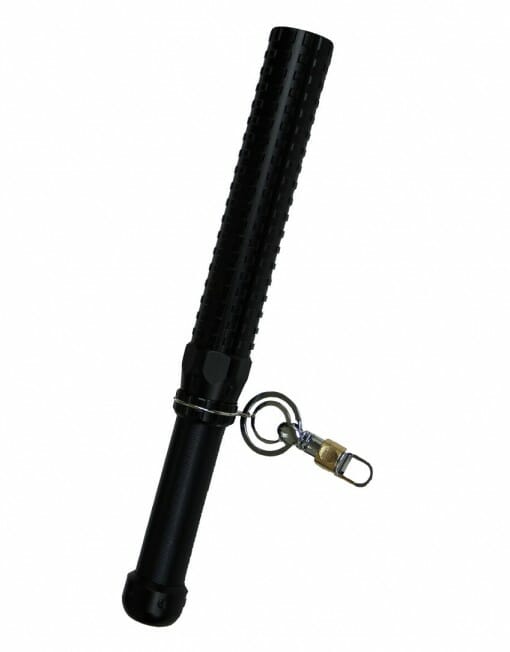
It’s The Low-Cost Way To Defend Yourself Against Criminal Scum!
With the flick of your wrist, the baton expands to its full size, and makes a formidable impact weapon. An entry-level expandable baton can be purchased for around $25, and high-end versions for under $100.
6. A knife.
A fixed-blade knife is an ideal defensive tool because it is designed to withstand a lot of abuse. However, they are harder to store because of their length. Folding knives may not be as durable or reliable as fixed blades, but are good to have because they are easy to store or carry unobtrusively. When looking for a high-quality knife, expect to spend at least $50, maybe more. Some can be purchased for under $20, but their quality and durability may be questionable.
What weapons would you add to our list? Share your thoughts in the section below:


