Showing posts with label Battle of Mosul. Show all posts

Saturday, July 22, 2017

Moscow, Baghdad Sign Huge Arms Deal

Authored by Peter Korzun via The Strategic Culture Foundation,


It was reported on July 20 that Russia and Iraq have struck a deal on supplying a large batch of T-90 tanks. Vladimir Kozhin, the Russian president’s aide for military technical cooperation, confirmed the agreement but declined to provide details, saying only «the number of tanks is substantial». Russian military analyst Ruslan Pukhov told Russian newspaper Izvestia that the deal might cover deliveries of several hundred T-90 tanks, and that the contract may exceed $1 billion.


The T-90 is among the best-selling tanks in the world. Hundreds of vehicles have been sold to India, Algeria, Azerbaijan and other countries. A small number of tanks has been delivered to Syria to reinforce the military’s capabilities of combatting Islamic State (IS). Kuwait, Vietnam and Egypt are considering the option of purchasing T-90s.


Known for its firepower, enhanced protection and mobility, the T-90 features a smoothbore 2A46M 125mm main gun that can fire both armor-piercing shells and anti-tank missiles and the 1A45T fire-control system. Standard protective measures include sophisticated armor, ensuring all-round protection of the crew and critical systems, including Kontakt-5 explosive reactive armor and active infrared jammers to defend the T-90 from inbound rocket-propelled grenades, anti-tank missiles and other projectiles.


During the battle for Aleppo, Syria, a T-90 was hit by US-made BGM-71 TOW missile. The direct impact caused no damage


The agreement to purchase the tanks was also confirmed by the Iraqi Ministry of Defense. The T-90s will reinforce the Iraqi M1A1 Abrams fleet damaged in the fight against the Islamic State (IS) militants. The decision to buy the Russian tanks was prompted by the successful performance of T-90s in Syria. During the battle for Aleppo, Syria, a T-90 was hit by US-made BGM-71 TOW missile. The direct impact caused no damage. For comparison, in October last year, an M1 Abrams was hit by a 9M133 Kornet anti-tank missile at the Qurayyah crossroads south of Mosul. The missile rammed into the turret from behind to make the ammunition compartment explode.


In 2014-2016, Iraq received 15 Mi-28 NE Night Hunter attack helicopters from Russia. The delivery was part of a wider $4.2 billion defense package signed in 2012. The deal included a combination of 43 Mi-35 (28) and Mi-28NE (15) attack helicopters, plus 42-50 Pantsir-S1 combined short to medium range surface-to-air missile and anti-aircraft artillery weapons systems. The contract was fulfilled in October, 2016, as the attack helicopters and anti-aircraft systems had been delivered to the Iraqi military.


In 2014, Russia urgently sent several Su-25 aircraft upon the request of Iraqi government when the country’s military was losing ground during the IS offensive. The Iraqi military also uses Russia-produced TOS-1A Buratino heavy flamethrowers, Grad truck-mounted 122mm multiple rocket launchers, 152mm MSTA howitzers, Su-25 attack planes and armored vehicles.


Russia-made weapons were widely used in the battle for Mosul. One of the systems vastly used in the operation was TOS-1A 220mm 24-barrel multiple rocket launcher and thermobaric weapon mounted on the T-72 tank chassis designed for defeating enemy personnel in fortifications, in open country, and in lightly armored vehicles and transport. It can fire incendiary and thermobaric rockets. The munitions disperse a cloud of flammable liquid into the air around the target, and then ignite it to produce an explosion significantly longer and stronger in comparison to a conventional warhead. This is an effective weapon to strike terrorists hidden in bunkers and caves. Iraqi Russia-made Mi-28 and Mi-35 helicopters also effectively launched attacks against IS positions in Mosul.


A joint Baghdad-based Russia-Iraq-Iran-Syria operational center was established in 2015 to exchange intelligence and coordinate activities against terrorists. Iraq has allowed the Russian Air Space Forces to use its airspace for airstrikes against Islamists in Syria.


Trade turnout between the two countries is roughly $2 billion, mostly made up of Russian exports. In early 2016, a delegation of nearly 100 government and business officials headed by Deputy Prime Minister Dmitry Rogozin, visited Iraq to boost cooperation on all spheres. The officials signed a wide-ranging memorandum of understanding that included measures to more than double bilateral trade and boost Iraq"s electricity production, which only meets around 60 percent of its peak demand during the hot summer months. The head of the delegation said Russia was ready to sell Sukhoi Superjet civil airliners to Iraq and keep providing it with military aid to fight Islamic State. Moscow has invested millions of dollars in Iraq"s energy sector.


Moscow and Baghdad are in talks on opening of a direct air line between Baghdad and Moscow and the abolition of visas for diplomats.


The US still has large influence in Iraq but it does not own it. The impressive performance of Russian weapons in Syria makes them in high demand among the countries facing the terrorist threat. The tank deal between Russia and Iraq reflects the trend. It also serves as an example of Russia’s growing clout in the Middle East and North Africa.

Iraqi VP: US ‘Created ISIS’ and is Now Trying to Claim Victory Over Them

mosul


The vice president of Iraq is calling out the United States for creating a terrorist group, and then claiming victory over it, as U.S. officials brag about gains in Mosul, Iraq, over the Islamic State.


Nouri al-Maliki said in an interview with the RIA Novosti news agency, that he believes the Iraqi people should be the ones receiving credit for defeating ISIS, not the United States.


“Yes, they supported us with aviation, but the main credit goes to the Iraqi soldiers, people’s militia, Iraqi air force,” al-Maliki said, noting that he “regrets and denies [Americans] claiming the victory [in Mosul] is their achievement… In reality, this is the victory of the Iraqi army.”


The U.S. declared victory over ISIS in Mosul on July 10. Army Lt. Gen. Stephen Townsend, commander of the anti-ISIS Operation Inherent Resolve, released a statement calling the achievement a “decisive blow” against the group.


Advertisment


“Make no mistake; this victory alone does not eliminate ISIS and there is still a tough fight ahead,” Townsend said. “But the loss of one of its twin capitals and a jewel of their so-called caliphate is a decisive blow.”


President Trump applauded the achievement in an official statement, calling it a “victory over terrorists who are the enemies of all civilized people.”


“We have made tremendous progress against ISIS—more in the past 6 months than in the years since ISIS became a major threat,” Trump said in the statement. “The victory in Mosul, a city where ISIS once proclaimed its so-called ‘caliphate,’ signals that its days in Iraq and Syria are numbered. We will continue to seek the total destruction of ISIS.”


As the U.S. celebrated its “big win” over ISIS, many on the internet were quick to note that the destruction that has led up to this point is anything but a victory.


READ MORE:  US Army "Lost" $1 BILLION in Weapons and Vehicles in Iraq, No Media Coverage


According to reports, during the 9-month campaign, nearly 1 million civilians were forced to evacuate their homes in Mosul, and with 120 miles of roads destroyed and the majority of the buildings now uninhabitable, the cost to repair the city’s basic infrastructure is over $1 billion.


In addition to advisers and a presence on the ground, the effects of U.S. involvement were mostly felt through the airstrikes it launched. As The Free Thought Project reported in March, local media reports claimed that “up to as many as 230 innocent civilians slaughtered in US coalition airstrikes—in a single night.”


While the U.S.-led coalition insists that around 600 civilians were killed in Mosul, intelligence officials claim the death toll is actually around 66 times higher, with more than 40,000 civilian casualties.


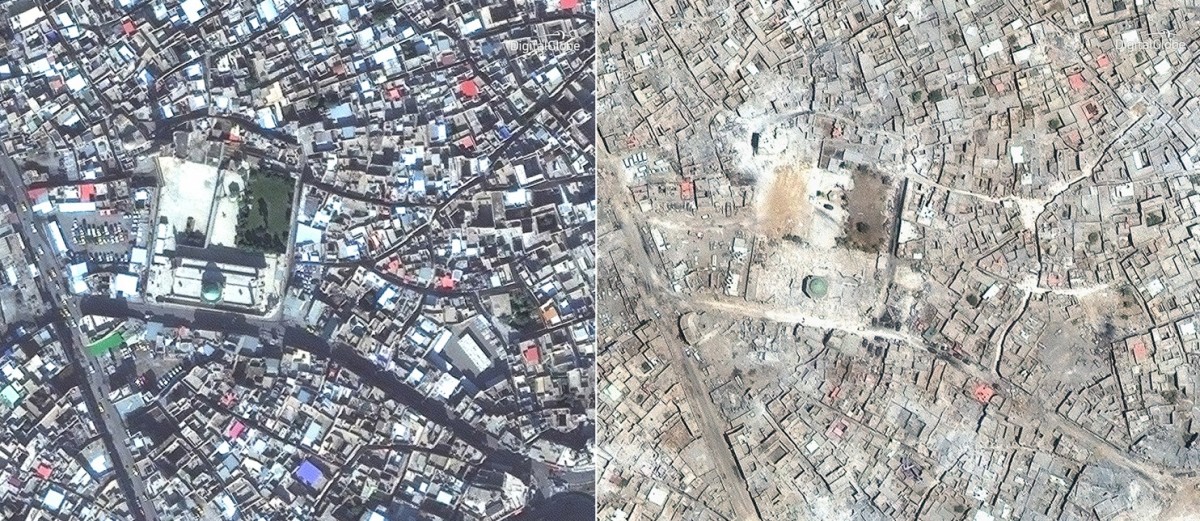
MosulThe Great Mosque of al-Nuri in Mosul, Iraq, seen in satellite photos taken on Nov. 13, 2015, left, and July 8, 2017, right. (Digital Globe)

Al-Maliki told the RIA Novosti news agency that the Iraqi military’s goal was never “to destroy the city more than it was necessary in the circumstances of war,” and that “We could have surrounded the city, but then its residents would have suffered from famine.”


In his statement from the White House, Trump acknowledged the grave death toll, and the price Iraq has paid as a result of the power gained by the Islamic State.


“We mourn the thousands of Iraqis brutally killed by ISIS and the millions of Iraqis who suffered at the hands of ISIS,” Trump said. “We grieve with the Iraqi people for the loss of the heroic soldiers and Peshmerga who gave their lives to restore life to their country, and we honor their sacrifice.”


However, despite comments on the campaign trail holding the U.S. accountable for its roll in creating ISIS, Trump’s statement failed to mention the fact that much of the power ISIS has gained in the last few years has come as a result of the assistance the group has received from the United States and its allies.


READ MORE:  Anonymous Takes Down ISIS Dark Website - Replaces it With Viagra Ad, Message to "Calm Down"


Al-Maliki called out the U.S. for its hypocrisy, and said he believes the creation of the Islamic State has been used by the U.S. as a tool to increase U.S. presence and involvements in Iraq and Syria.


“IS resembles the Taliban which was created by the US administration to counter the USSR in Afghanistan,” Al-Maliki said. “The same way, IS was created to counter the Iraqi stance, which did not agree to blockade Syria, was against no-fly zones in Syria and against American military bases.”

Monday, July 17, 2017

"Shocking" Before And After Satellite Photos From Mosul

It used to be Iraq"s second largest and most vibrant city; now Mosul - which was recently recaptured from the Islamic State - lies under a pile of rubble.


As Foreign Policy magazine writes, "raging for nine months, the street-by-street fight to retake Mosul from the Islamic State outlasted the Battle of Verdun — the longest and largest conflict of World War I. As Iraqi forces won back the city this week, death, destruction, and dust are all that’s left in Iraq’s second-largest metropolis. Satellite images provided to Foreign Policy by DigitalGlobe vividly illustrate this shocking transformation."


Here is the "before and after":


Overview of Mosul"s Old City and east Mosul in November 2015, left, and July 2017, right


The Islamic State"s main hospital in Mosul and the Mosul Hotel in November 2015, left, and July 2017, right.


The Fifth Bridge north of the Old City in November 2015, left, and July 2017, right.


Mosul"s historic Al-Nuri mosque in November 2015, left, and July 2017, right.


The bridge into Mosul"s Old City in November 2015, left, and July 2017, right.


Southeast of the Islamic State"s main hospital in Mosul in November 2015, left, and July 2017, right.


A sports complex in Mosul in November 2015, left, and July 2017, right.


For the full before and after photos, please go to Foreign Policy.

Thursday, July 13, 2017

The Media Says The US Just Liberated Mosul: Here's What Really Happened

Authored by Darius Shahtahmasebi via TheAntiMedia.org,


The mainstream media appears to be celebrating ISIS’ recent defeat in Mosul, albeit with some reservations. The media is largely using the word “liberation,” which indicates the people of Mosul have been freed from a monstrous force by a friendly, benevolent one.


In reality, the “liberation” of Mosul paints a dark, horrifying picture of America’s foreign policy when one realizes how ISIS took hold of Mosul in the first place.


As Anti-Media in summarized in September of last year, the U.S. allowed ISIS to gain control of Mosul quite deliberately:


“In June 2014, ISIS crossed the Syrian border into Iraq, effortlessly taking the strategic oil-rich cities of Mosul and Baiji and almost making it as far as Baghdad. Amid the terror group’s frightening victory, they uploaded images and footage of drive-by-shootings, large-scale death marches, and mass graves (following the mass executions of Iraqi soldiers).


“ISIS militants claimed massive quantities of American military equipment, including entire truckloads of humvees, helicopters, tanks, and artillery as their own. This was no secret to Washington, or even the world, as the militants photographed and recorded themselves and publicly flaunted their activity on social media.”


Was there a good reason the American military sat on its hands despite knowing full well that this was going on? As Anti-Media explained further:


“What did the U.S. do in response? Nothing. In spite of all the American bases in Iraq and the government’s ability to perform all manner of illicit activity — including assassinating Muammar Gaddafi in Libya using a drone that was flown out of Sicily by a pilot who operated the vehicle from a naval base in Nevada‚ the U.S. couldn’t do anything to stop ISIS rapid advancements. Was there a problem preventing the U.S. military from conducting air strikes? Clearly not, as the U.S. had been launching drone strikes in Pakistan at around the same time ISIS advanced.”


The U.S. allowed ISIS to gain this significant portion of territory before moving into Iraq with an air war that was designed to pave the way for a segued operation into Syrian territory. The U.S. couldn’t justify an intervention into Syria without going into Iraq first, and this was quite clearly the underlying intention of this operation the whole time, as evidenced by the U.S.’ obsession with the Syrian conflict throughout both the Obama and Trump administrations.


Since the U.S. moved back into Iraq in 2014, the U.S. has dropped 84,000 bombs in Iraq and Syria up until the end of May 2017. As Counterpunch explains, this is nearly three times the number of bombs and missiles dropped on Iraq during  George W. Bush’s “Shock and Awe” campaign in 2003.


Monitoring group Airwars’ currently estimates that the minimum number of civilians killed by the U.S.-led coalition’s campaign in Iraq and Syria has reached roughly 4,354 since the operation began in 2014. The number is likely higher, but we will never know the exact total because up until a month ago, the U.S. only had two personnel investigating casualties in Iraq and Syria full time.


Under President Trump, the number of bombs being dropped increased rapidly after Trump gave complete control to the military generals on the ground to call in airstrikes with little oversight. One such air raid in Mosul saw close to 300 civilians die, and the fact that the strike had been called in by Iraqi forces on the ground demonstrates the immense amount of scope that Trump has delegated to call in airstrikes with little regard to international law and the principle of proportionality.


The battle for Mosul also drew in Iran-backed Shia militias, who have been known to terrorize Iraq’s Sunni population (including torturing civilians). No one doubts that ISIS is a brutal and abhorrent group, but the people who are supposedly “liberating” the local population — whether it’s the U.S. military, the Iraqi armed forces, or the various militia on the ground — appear to be no better.


Now that these Iran-backed militias have firmly planted themselves in Iraq, the U.S. is left with an ultimate dilemma of how to kick them out and counter Iran’s expanding influence. In all seriousness, the battle for Mosul is only paving the way for further occupation and laying the groundwork for America to pursue its regional ambitions in its never-ending quest to confront Iran.


According to the U.N., more than 742,000 Iraqis have fled the battle in Mosul, with approximately 10,000 new civilians fleeing every day. For a country that hates refugees, the U.S. certainly plays a significant role in creating an endless supply of them.


And for those civilians still trapped in the city, their lives will never be the same.


As Airwars explains:


“According to city officials, as much as 80 per cent of West Mosul has been completely destroyed. Civilians still emerging from the battlefield are often bloodied and starving – traumatised by Iraqi and Coalition bombardments; and by atrocities commited [sic] by ISIS.


“According to reporters accompanying Iraqi forces, the stench of death is everywhere in the Old City – with civil defence officials reporting that as many as 4,000 bodies still remain unrecovered in the rubble. It is likely to be many months before the full death toll is known.”


That is quite the liberation. Even if Mosul really has been “liberated” by the U.S.-backed coalition, no one seems to be talking about the fact that ISIS was only able to conquer strategic areas like Mosul under the safety of the Obama administration’s policies. Leaked audio of former Secretary of State John Kerry when he was a senator confirmed the U.S. was watching ISIS grow, and in turn, the hoped this would bring Syrian President Bashar al-Assad to the negotiating table (you can listen to the full audio here).


You can’t target a group as an enemy in one location and view it as a useful proxy army in another. Indeed, ISIS was always a useful proxy force for the anti-Assad coalition, as Kerry admitted.


Essentially, the U.S. allowed ISIS to gain control of large swaths of Iraq and Syria so they could justify interventions in these war-ravaged nations.


As far as the people of Iraq are concerned, there is only one winner here: the military-industrial complex, which secured massive years-long contracts to make, supply, and drop over 84,000 bombs on a territory that never should have been in the hands of ISIS in the first place.

Sunday, July 9, 2017

Iraqi Prime Minister Declares Mosul "Liberated" From The Islamic State

Iraqi Prime Minister Haider al-Abadi arrived in Mosul on Sunday to announce the city’s “liberation” from the Islamic State, and to congratulate the Iraqi armed forces and people on their “victory” in the city after nearly nine months of urban warfare, and bringing an end to jihadist rule in the city, the WSJ reported. As a reminder, Mosul is where the Islamic State achieved its greatest military victory when it captured the city in just four days on June 29, 2014 and handed the Iraqi military a humiliating defeat, sending shock waves through the region. Subsequent looting of Mosul"s central bank provided the Islamic State with over $400 million in "seed funding" which the terrorist organization promptly put to bad use.


The Iraqi PMI was expected to make an official victory announcement in the northern city later Sunday, after U.S.-backed Iraqi forces waged more than eight months of battle to reclaim it.


Troops have in recent days been fighting to clear the final Islamic State-occupied pockets of Mosul’s dense Old City, on the western bank of the Tigris river.


Loaders and other heavy machinery cleared paths for Iraqi soldiers, who appeared at ease ahead of the recapture, despite bursts of gunfire nearby.


At the same time, the U.S.-led coalition said Sunday it had carried out two strikes near Mosul that destroyed 21 Islamic State fighting positions. Reporting on location, the WSJ adds that Humvees patrolling the area rolled over downed electrical lines "in a stark indication of the toll the siege has taken on Mosul’s infrastructure and the likely high cost of rebuilding the city and resuming basic services there."


The symbolic victory takes place three years after the Islamic State seized Mosul in a 2014 blitz that saw it capture one-third of Iraq’s territory, including the northern city. The battle for Mosul - by far the largest city to fall under the militants" control - left large areas in ruins, killed thousands of civilians and displaced nearly one million people.


"The commander in chief of the armed forces (Prime Minister) Haider al-Abadi arrived in the liberated city of Mosul and congratulated the heroic fighters and Iraqi people for the great victory," his office said in a statement.


As Reuters adds, Abadi met commanders in west Mosul who led the battle, but he has yet to issue a formal declaration that the entire city has been retaken for the group which is also known as ISIS. Still, French President Emmanuel Macron - whose country is part of the coalition that has conducted airstrikes and provided training and assistance to Iraqi forces on the battlefield, welcomed the defeat.


"Mosul liberated from ISIS: France pays homage to all those, who alongside our troops, contributed to this victory," Macron said on Twitter.


The Islamic State lost its administrative grip over Mosul in October, when government forces pushed it from the eastern half of the city, and its ultimate defeat here was all but a foregone conclusion. In its final days, the terrorist group mustered only a couple hundred fighters, cornered on a tiny patch of territory on the western bank of the Tigris River.


Source: ISW


The loss of Mosul, while largely expected, is a major blow for ISIS, which is also losing ground in its operational base in the Syrian city of Raqqa, where it has planned global attacks.  Amusingly, ISIS had group vowed to "fight to the death" in Mosul, but Iraqi military spokesman Brigadier General Yahya Rasool told state TV that 30 militants had been killed attempting to flee by swimming across the River Tigris that bisects the city. Cornered in a shrinking area, the militants have resorted to sending women suicide bombers among the thousands of civilians who are emerging from the battlefield wounded, malnourished and fearful, Iraqi army officers said.


That said, the Islamic State is far from vanquished in Iraq and elsewhere in the region It still controls small swaths of Iraq and large stretches of neighboring Syria. Its members and followers, more dispersed than ever, are likely to pose a terrorist threat in Baghdad, the Middle East and beyond for years to come. As the WSJ adds, "Islamic State’s defeat in Mosul would be a major military, psychological and political blow for the ruthless Sunni Muslim militant group."


A full timeline of the "rise and spread", and now fall, of the Islamic State can be found here.


What happens next?


Aside from Mosul, across the border in Syria a battle is raging to dislodge IS from Raqqa, the second capital of its self-declared caliphate. Fighting will push down the Euphrates valley to Deir al-Zour, the jihadis’ last big urban stronghold.


But the fall of Mosul also exposes ethnic and sectarian fractures that have plagued Iraq for more than a decade.


The victory risks triggering new violence between Arabs and Kurds over disputed territories or between Sunnis and Shi’ites over claims to power, egged on by outside powers that have shaped Iraq’s future since the 2003 U.S.-led invasion toppled Saddam Hussein’s Sunni minority-rule and brought the Iran-backed Shi’ite majority to power.


For Iraq, stunned by the blitz on Mosul by Islamic State in 2014 and the collapse of its army, victory could thus turn out to be as big a problem as defeat. The federal model devised under the Anglo-American occupation and built on a power-sharing agreement between Sunnis, Shi’ites and Kurds collapsed into ethno-sectarian carnage spawned by the al Qaeda precursors of Islamic State.


In the three years since the jihadis swept across the border from Syria where they had regrouped in the chaos of the rebellion against Syrian President Bashar al-Assad’s rule, IS was the rallying point uniting a fractured Iraq.


But now that the group faces military defeat, the unity that held Iraq together is starting to come apart.


Read more on the challenges faced by post-ISIS Iraq here.

Sunday, March 26, 2017

US Confirms Coalition Airstrike In Mosul May Have Killed As Many As 240 Civilians

The US military confirmed on Saturday that a coalition airstrike had hit an Islamic State-held area of Iraq"s Mosul where as many as 240 civilians may have been killed as result of the air raid.


What happened in the incident on March 17 in Mosul al-Jadida district is still unclear according to Reuters. Some residents say a coalition air strike hit an explosive-filled truck, detonating a blast that collapsed buildings packed with families. Mosul municipality chief, Abdul Sattar al-Habbo, who is supervising the rescue, said 240 bodies had been pulled from the rubble of collapsed buildings. Previous estimates from local officials had said around 130 people had died. While US officials say they are investigating, initial reports from residents and Iraqi officials in the past week said dozens of people had been killed after air strikes by U.S.-led coalition forces.


The US said the strike was at the request of the Iraqi forces. The American confirmation followed a decision by Iraqi government forces to pause their drive to recapture west Mosul on Saturday because of the high rate of civilian casualties.


“An initial review of strike data from March 16-23 indicates that, at the request of the Iraqi Security Forces, the Coalition struck ISIS fighters and equipment, March 17, in West Mosul at the location corresponding to allegations of civilian casualties,” US Central Command said in a statement issued on Saturday.


Videos of the deadly aftermath of the airstrike released on Friday show scores of dead bodies being pulled out of a completely destroyed building in western Mosul. There have also been reports by eyewitnesses who say over a hundred civilians were either killed or buried under rubble in the bombing raid.


At least 40 bodies had been recovered from collapsed buildings on Thursday, Reuters reported, citing Iraqi Civil Defense chief Brigadier Mohammed Al-Jawari. Many others were buried in the rubble, he added.


The United Nations on Saturday expressed concern over the high number of civilian casualties in Mosul. “We are stunned by this terrible loss of life,” Lise Grande, the UN’s humanitarian coordinator for Iraq, said in a statement.


Saying that all allegations of civilian casualties are taken “seriously,” the Combined Joint Task Force said “a formal Civilian Casualty Credibility Assessment has been opened to determine the facts surrounding this strike and the validity of the allegation of civilian casualties.”


With fighting intensifying to recapture Mosul, around half a million civilians remain in Islamic State-held areas in the west of the city, complicating use of air strikes and heavy artillery to drive the hardline militants from their last major stronghold in Iraq. Iraqi forces are pushing into Mosul"s Old City, where fleeing residents say militants are hiding among the civilian population, sheltering in family homes and using the narrow alleyways and streets to their advantage.


According to Reuters, an Iraqi Federal Police spokesman said on Saturday that operations to drive Islamic State out of western Mosul were halted because of the “high death toll among civilians inside the Old City.” Later, the Iraqi command denied this in a statement cited by Iraqi Alsumaria TV.


A local resident told RT, whose crew is on the ground in Mosul, that “ISIS made us keep our door open, so they could get onto the roofs at any time. They even broke down the walls between houses so they could move around." Another witness added that "I don’t know why they were climbing onto our rooftops, whether it was to fight or to provoke airstrikes."


Up to 600,000 civilians are still believed to remain in Islamic State-controlled areas of Mosul, according to Reuters. Some 700 civilians had been killed by government and coalition airstrikes in western Mosul since the launch of the offensive in late February, the agency added, citing unconfirmed reports from the Iraqi Observatory for Human Rights.

Monday, February 20, 2017

Mattis "We're Not In Iraq To Seize Anybody's Oil"

In the latest distancing by Trump administration advisors from recent statements by the President, Defense Secretary Jim Mattis arrived in Baghdad on an unannounced visit on Monday to discuss the war effort against ISIS, and said that the US military is not in Iraq "to seize anybody’s oil."


Secretary of Defence, James Mattis, arrives in Baghdad, February 20, 2017


Speaking to a small group of reporters traveling with him, Mattis was quoted by Reuters as saying “I think all of us here in this room, all of us in America, have generally paid for our gas and oil all along and I’m sure that we will continue to do so in the future."


On his first trip to Iraq as Pentagon chief, Mattis is set to assess the war effort against the Islamic State as Iraqi forces launch a new push to evict ISIS militants from their remaining stronghold in the city of Mosul. In Iraq, he is likely to face questions about Trump"s remarks and actions, including a temporary ban on travel to the United States and for saying America should have seized Iraq"s oil after toppling Saddam Hussein in 2003. Trump told CIA staff in January: "We should have kept the oil. But okay. Maybe you"ll have another chance."


Trump later clarified his position in an ABC interview. The president said ISIS would not have become a global threat if it hadn’t taken over Iraq’s oil industry when the country was left weakened by the war.


“We should’ve kept the oil when we got out. And, you know, it’s very interesting, had we taken the oil, you wouldn’t have ISIS, because they fuel themselves with the oil. That’s where they got the money. They got the money… when we left, we left Iraq, which wasn’t a government.


“We created a vacuum and ISIS formed. But had we taken the oil, something else very good would’ve happened. They would not have been able to fuel their rather unbelievable drive to destroy large portions of the world,” Trump noted, while adding that Iraq’s oil could have been beneficial for the United States too, as the country’s budget has been drained by involvement in Middle East wars.


Mattis, however, flatly ruled out any such intent. "We"re not in Iraq to seize anybody"s oil," he told reporters traveling with him, although one wonders if the Bush presidential dynasty would have a strongly differing opinion.


His remarks are the latest example of his policy differences with Trump. Trump has acknowledged that Mattis did not agree with him about the usefulness of torture as an interrogation tactic but, in a sign of Mattis" influence, said he would defer the matter to his defense secretary.


The retired Marine general, who led American troops in Iraq, said he had sought an exemption from Trump"s travel ban for Iraqis who served with U.S. troops, including translators. He said he had not seen a new executive order which the administration is considering. "But I right now am assured that we will take steps to allow those who have fought alongside us, for example, to be allowed into the United States," Mattis said. Mattis has also been more critical than Trump of Russian President Vladimir Putin, and distanced himself from Trump"s labeling of the media as "the enemy of the American people," saying he had no problems with the press.


* * *


Mattis" visit comes one day after Iraqi Prime Minister Haider al-Abadi announced the start of the ground offensive on western Mosul, where Islamic State militants are essentially under siege along with an estimated 650,000 civilians. Last week, Iraqi aircraft dropped millions of leaflets in western Mosul, calling on residents to get ready to welcome the Iraqi troops, as the siege on the militants continues.  The insurgents were forced out of the east of the city last month after 100 days of fighting.


In October, Iraqi forces, backed by the US-led international coalition, launched a campaign to retake Mosul. Last month the US-led coalition admitted to “unintentionally” killing at least 188 civilians in Syria and Iraq since 2014, when the airstrikes against Islamic State began. As of February 14, 2017, the US-led coalition had conducted a total of 18,250 strikes (11,102 Iraq / 7,148 Syria), the US Department of Defense reported.


The U.S. commander in Iraq, Army Lieutenant General Stephen Townsend, has said he believes U.S.-backed forces will recapture both of Islamic State"s major strongholds - Mosul and the city of Raqqa in Syria - within the next six months. The defense secretary"s strategy review could lead to additional deployment of U.S. forces, beyond the less than 6,000 American troops deployed to both Iraq and Syria today.


Experts say the Pentagon may also look at increasing the number of attack helicopters and air strikes and bringing in more artillery, as well as granting greater authority to battlefield commanders fighting Islamic State.


Meanwhile, as Reuters adds, the future for U.S. forces in Iraq, and for Iraq"s fragmented society, is unclear once the hardline Sunni group has been expelled from Mosul. Mattis told the Senate last month that the top U.S. goal in Iraq should be "to ensure that it does not become a rump state of the regime in Tehran", which has close ties with the Shi"ite political elite ruling Iraq.


A power struggle appears to be taking root between Iraq"s Shi"ite leaders. Influential cleric Moqtada al-Sadr, who is openly hostile to Washington"s policies in the Middle East, has begun mobilizing supporters ahead of parliamentary and provincial elections.


Sadr on Monday said the government should demand the withdrawal of U.S. and allied forces after the battle of Mosul. "The Iraqi government has to demand that all occupying and so-called friendly forces leave Iraq in order to preserve the prestige and the sovereignty of the state," he said. Sadr"s main rival is former prime minister Nuri al-Maliki, a pro-Iranian politician re-emerging as a possible kingmaker or even for a return to the premiership itself.


With Mattis" star status in the international arena rapidly rising, and threatening to soon eclipse that of his boss, it is unclear if Trump will be content to hand over the reigns of foreign policy to his defense secretary even as Rex Tillerson seemingly struggles to decide if he is part of the Trump/Bannon or Pence/Mattis axis, or if Trump will seek to pressure the views of retired Marine Corps general into converging with his own.

Saturday, December 31, 2016

Why Politicians Are To Blame For Most Terrorist Attacks

Submitted by Patrick Coburn via Strategic-Culture.org,


European political leaders are making the same mistake in reacting to the massacre at the Christmas fair in Berlin, in which 12 died, as they did during previous terrorist attacks in Paris and Brussels. There is an over-concentration on the failings of the security services in not identifying and neutralising the Tunisian petty criminal, Anis Amri, as the threat he turned out to be. There is too little focus on bringing to an end the wars in Syria and Iraq which make this type of atrocity unstoppable.


In the aftermath of the killings the visibility of Amri, who was shot dead in Milan this morning, as a potential threat looks misleadingly obvious, and the culpability of those who did not see this appears more glaring than it really was. The number of possible suspects – suspected before they have done anything – is too great to police them effectively.


No politician or security official wishing to retain their job can tell a frightened and enraged public that it is impossible to defend them. Those in charge become an easy target for critics who opportunistically exploit terrorism to blame government incompetence or demand communal punishment of asylum seekers, immigrants or Muslims. At such times, the media is at its self-righteous worst, whipping up hysteria and portraying horrifying but small-scale incidents as if they were existential threats. This has always been true, but 24/7 news coverage makes it worse as reporters run out of things to say and lose all sense of proportion. As the old American newspaper nostrum has it: “if it bleeds, it leads.”


But in over-reacting, governments and media play into the hands of the terrorists who want to create fear and demonstrate their strength, but whose greatest gains come when they provoke an exaggerated self-destructive response. 9/11 was the most successful terrorist attack in history, not just because it destroyed the Twin Towers but because it lured the Bush administration into invading Afghanistan and Iraq. Subsequently, Guantanamo, Abu Ghraib, rendition, torture and “targeted killings” (otherwise known as assassination campaigns), all justified by 9/11, have acted as recruiting sergeants for al-Qaeda type organisations.


The war on terror has failed more demonstrably than most wars: al-Qaeda numbered in the hundreds in 2001, but today – along with Isis – it has tens of thousands of fighters and supporters spread across dozens of countries.


Political leaders are not blameless, but they tend to be blamed for the wrong thing. Contrary to talk about “lone wolf” terrorism, most people like Amri turn out to have had sympathetic or supportive connections. In his case, US officials say he had communicated with Isis and was in contact with a Salafi preacher. He would have needed little more than inspiration and encouragement, since driving a truck into a crowd of people celebrating Christmas requires no special expertise.


Isis remains crucial to the present wave of terrorist attacks in Europe because it provides ideological motivation and justification and can, as in Paris and Brussels, control and sustain a terrorist cell. So long as there is a well-organised de facto Isis capable of providing these things, terrorism cannot be defeated; there will always be a “breakdown in security” to be exploited.


The continuing existence of such a state is proof of the failure of US and European leadership. It is they who created the original conditions for the rise of Isis by invading Iraq in 2003. They allowed Syria to be torn apart by civil war after 2011 and believed the consequent anarchy could be confined to Iraq and Syria. It was only in 2014 and 2015 – after the creation of Isis, the flood of migrants fleeing to central Europe and the terrorist attacks in France and Belgium – that politicians and officials really took on board the potential danger.


Yet two-and-a-half years after it was first declared, Isis is still in business. Some 2,885 Iraqis were killed in November alone, most of them as a result of fighting between Isis and the Iraqi security forces. Over the last month international focus has been on the fall of east Aleppo and too little attention is given to the fact that Isis has been holding its own in Mosul and has recaptured Palmyra in Syria.


There is a dangerous disconnect in the minds of governments and news organisations between what happens in the war in Iraq and Syria and the long-term consequences this has on the streets of Europe. When the Iraqi armed forces and their Kurdish allies began on 17 October their advance on Mosul, by far the largest urban centre held by any of the Salafi-jihadi groups, it was widely believed that Isis was about to be defeated in its last lair.


It has not happened. The elite units of the Iraqi armed forces, notably the 10,000 strong “Golden Division”, have suffered as much as 50 per cent casualties. They are being ground down by skilful tactics in east Mosul whereby mobile Isis units rapidly shift their positions in built-up areas using holes cut in the walls of houses and a network of tunnels. They avoid permanent fixed positions where they can be located and targeted by artillery and the US-led air coalition. They ambush the Iraqi military forces in their vehicles as they move through narrow streets. The UN says that almost 2,000 members of the Iraqi security forces, including paramilitary Shia units and Kurdish Peshmerga units, were killed in November alone.


The offensive is largely stalled and still has not reached the main part of Mosul city on the west bank of the Tigris River. Districts in east Mosul captured weeks ago have to be captured again. The main thrust of Iraqi government forces attack on Mosul was meant to come from the south, but this front has not moved for six weeks. Isis is even reported to have sent 500 fighters from Mosul across the desert to retake Palmyra, in the first important territorial gain by Isis for 18 months.


This is not an organisation that is going out of business fast, or even at all. The failure of Jabhat al-Nusra, Ahrar al-Sham and other insurgent groups to defend east Aleppo more resolutely and successfully will probably lead to a haemorrhage of the most experienced and toughest fighters to Isis. It will have the advantage of being less dependent than the other rebel groups on outside support from Turkey, Saudi Arabia and Qatar who are close to accepting defeat in Syria. This may not save Isis in the long term because of the sheer number of its enemies, but it has shown once again that it is more resilient than the Pentagon had supposed.


There are serious consequences here for Europe: Isis can keep going for years with the low-level terrorist attacks like that which just happened in Berlin. It does not have to do much by way of exhortation or material aid to achieve this. When a terrorist incident does take place it is capable of shifting the political agenda in a country as large as Germany. Isis knows this and while it exists the terrorism will not stop.

Tuesday, December 27, 2016

The War On Terrorism Just Keeps Making It Worse

Submitted by Patrick Coburn via Strategic-Culture.org,


European political leaders are making the same mistake in reacting to the massacre at the Christmas fair in Berlin, in which 12 died, as they did during previous terrorist attacks in Paris and Brussels. There is an over-concentration on the failings of the security services in not identifying and neutralising the Tunisian petty criminal, Anis Amri, as the threat he turned out to be. There is too little focus on bringing to an end the wars in Syria and Iraq which make this type of atrocity unstoppable.


In the aftermath of the killings the visibility of Amri, who was shot dead in Milan Friday morning, as a potential threat looks misleadingly obvious, and the culpability of those who did not see this appears more glaring than it really was. The number of possible suspects – suspected before they have done anything – is too great to police them effectively.


No politician or security official wishing to retain their job can tell a frightened and enraged public that it is impossible to defend them. Those in charge become an easy target for critics who opportunistically exploit terrorism to blame government incompetence or demand communal punishment of asylum seekers, immigrants or Muslims. At such times, the media is at its self-righteous worst, whipping up hysteria and portraying horrifying but small-scale incidents as if they were existential threats. This has always been true, but 24/7 news coverage makes it worse as reporters run out of things to say and lose all sense of proportion. As the old American newspaper nostrum has it: “if it bleeds, it leads.”


But in over-reacting, governments and media play into the hands of the terrorists who want to create fear and demonstrate their strength, but whose greatest gains come when they provoke an exaggerated self-destructive response. 9/11 was the most successful terrorist attack in history, not just because it destroyed the Twin Towers but because it lured the Bush administration into invading Afghanistan and Iraq. Subsequently, Guantanamo, Abu Ghraib, rendition, torture and “targeted killings” (otherwise known as assassination campaigns), all justified by 9/11, have acted as recruiting sergeants for al-Qaeda type organisations.


The war on terror has failed more demonstrably than most wars: al-Qaeda numbered in the hundreds in 2001, but today – along with ISIS – it has tens of thousands of fighters and supporters spread across dozens of countries.


Political leaders are not blameless, but they tend to be blamed for the wrong thing. Contrary to talk about “lone wolf” terrorism, most people like Amri turn out to have had sympathetic or supportive connections. In his case, US officials say he had communicated with Isis and was in contact with a Salafi preacher. He would have needed little more than inspiration and encouragement, since driving a truck into a crowd of people celebrating Christmas requires no special expertise.


Isis remains crucial to the present wave of terrorist attacks in Europe because it provides ideological motivation and justification and can, as in Paris and Brussels, control and sustain a terrorist cell. So long as there is a well-organised de facto Isis capable of providing these things, terrorism cannot be defeated; there will always be a “breakdown in security” to be exploited.


The continuing existence of such a state is proof of the failure of US and European leadership. It is they who created the original conditions for the rise of Isis by invading Iraq in 2003. They allowed Syria to be torn apart by civil war after 2011 and believed the consequent anarchy could be confined to Iraq and Syria. It was only in 2014 and 2015 – after the creation of Isis, the flood of migrants fleeing to central Europe and the terrorist attacks in France and Belgium – that politicians and officials really took on board the potential danger.


Yet two-and-a-half years after it was first declared, Isis is still in business. Some 2,885 Iraqis were killed in November alone, most of them as a result of fighting between Isis and the Iraqi security forces. Over the last month international focus has been on the fall of east Aleppo and too little attention is given to the fact that Isis has been holding its own in Mosul and has recaptured Palmyra in Syria.


There is a dangerous disconnect in the minds of governments and news organisations between what happens in the war in Iraq and Syria and the long-term consequences this has on the streets of Europe. When the Iraqi armed forces and their Kurdish allies began on 17 October their advance on Mosul, by far the largest urban centre held by any of the Salafi-jihadi groups, it was widely believed that Isis was about to be defeated in its last lair.


It has not happened. The elite units of the Iraqi armed forces, notably the 10,000 strong “Golden Division”, have suffered as much as 50 per cent casualties. They are being ground down by skilful tactics in east Mosul whereby mobile Isis units rapidly shift their positions in built-up areas using holes cut in the walls of houses and a network of tunnels. They avoid permanent fixed positions where they can be located and targeted by artillery and the US-led air coalition. They ambush the Iraqi military forces in their vehicles as they move through narrow streets. The UN says that almost 2,000 members of the Iraqi security forces, including paramilitary Shia units and Kurdish Peshmerga units, were killed in November alone.


The offensive is largely stalled and still has not reached the main part of Mosul city on the west bank of the Tigris River. Districts in east Mosul captured weeks ago have to be captured again. The main thrust of Iraqi government forces attack on Mosul was meant to come from the south, but this front has not moved for six weeks. Isis is even reported to have sent 500 fighters from Mosul across the desert to retake Palmyra, in the first important territorial gain by Isis for 18 months.


This is not an organisation that is going out of business fast, or even at all. The failure of Jabhat al-Nusra, Ahrar al-Sham and other insurgent groups to defend east Aleppo more resolutely and successfully will probably lead to a haemorrhage of the most experienced and toughest fighters to Isis. It will have the advantage of being less dependent than the other rebel groups on outside support from Turkey, Saudi Arabia and Qatar who are close to accepting defeat in Syria. This may not save Isis in the long term because of the sheer number of its enemies, but it has shown once again that it is more resilient than the Pentagon had supposed.


There are serious consequences here for Europe: Isis can keep going for years with the low-level terrorist attacks like that which just happened in Berlin. It does not have to do much by way of exhortation or material aid to achieve this. When a terrorist incident does take place it is capable of shifting the political agenda in a country as large as Germany. Isis knows this and while it exists the terrorism will not stop.